The Sumerian Tablet That Says the Dome Has Multiple Layers — And Describes What’s Between Each One
The Sumerian Tablet That Says the Dome Has Multiple Layers — And Describes What’s Between Each One
The tablet did not describe empty space. It described a universe built in levels—stone above stone, gods above stars, waters beneath the earth, and hidden realms no human eye was meant to enter.
For thousands of years, people have looked up at the sky and imagined something beyond it. To modern science, the heavens are not a solid roof but a vast universe of atmosphere, planets, stars, galaxies, radiation, gravity, and dark distances almost impossible to comprehend. But the ancient mind did not begin with telescopes. It began with the visible world: the flat horizon, the blue vault overhead, the path of the sun, the wandering moon, the fixed stars, the storms, the rivers, the underworld of graves, and the terrifying question of where the gods lived.
In ancient Mesopotamia, that question was not poetic. It was architectural.
The world was not imagined as a random open void. It was structured. Heaven was above. Earth was in the middle. Beneath the earth lay deep waters and the land of the dead. Above the visible sky were higher divine regions. Each level had beings, materials, rulers, and functions. The universe was not merely space. It was sacred geography.
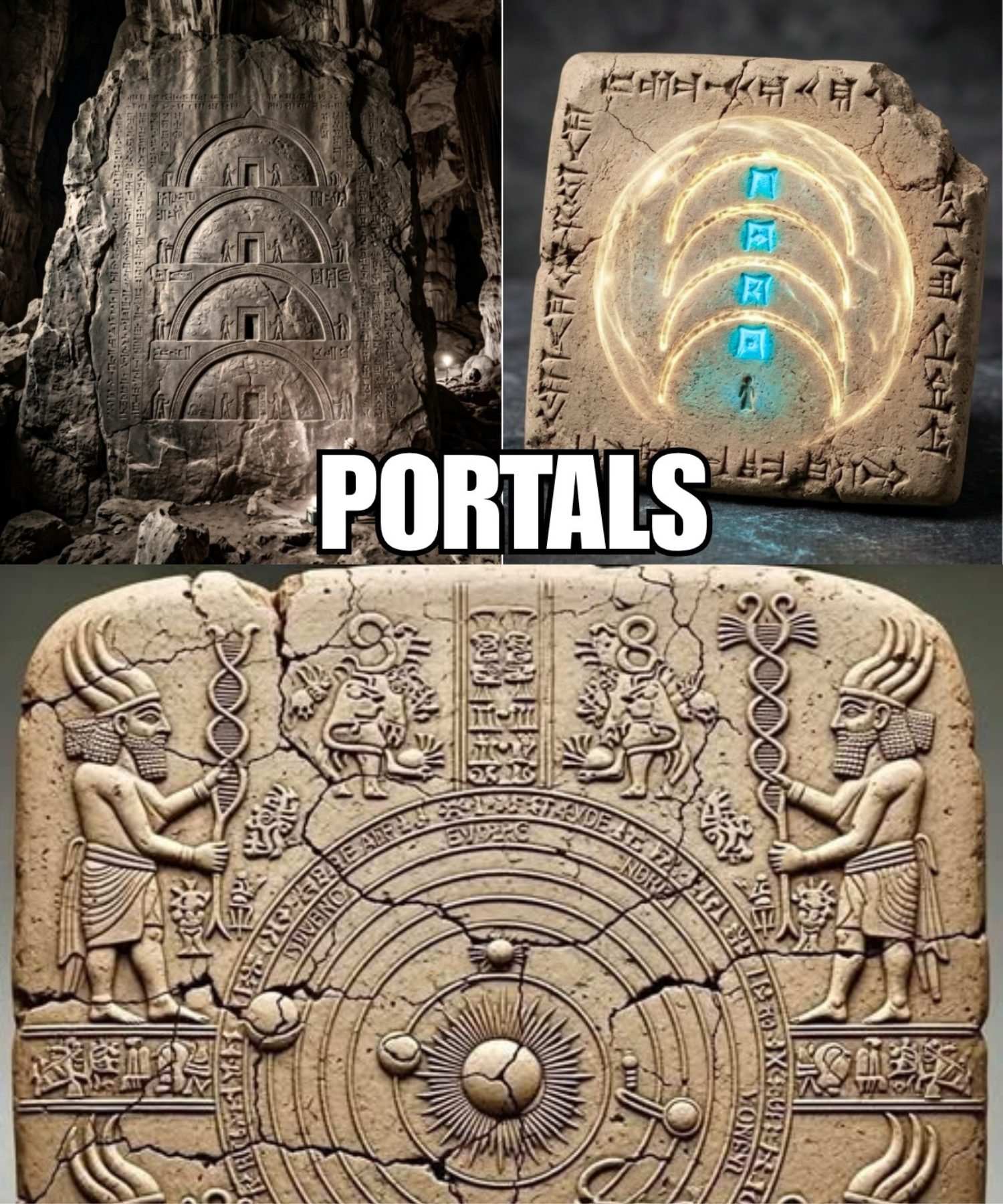
That is why one ancient text has fascinated modern readers so intensely. Often described online as a “Sumerian tablet about the dome,” the real evidence is more complicated. The clearest surviving description comes from a later Mesopotamian scholarly tradition, especially a Neo-Assyrian text known to scholars as KAR 307. It does not use modern scientific language. It does not describe planets orbiting a sun. It does not offer physics. Instead, it gives something stranger: a layered map of reality.
In this ancient model, the heavens are not one single sky.
They are divided.
The upper heaven belongs to Anu, the high god of heaven. It is associated with a reddish stone called luludanitu. There, the great divine powers dwell. Beneath it is the middle heaven, linked with the Igigi gods and described with another sacred stone, saggilmud, compared by scholars with a deep blue, lapis-like material. Below that is the lower heaven, made of jasper, the realm where the stars and constellations are drawn.
This detail is shocking because it shows that ancient Mesopotamian thinkers did not imagine the sky as a simple surface. They imagined a layered celestial structure. The stars were not necessarily in the highest heaven. They belonged to the lower heaven, the visible sky, while higher divine regions existed beyond them.
That reverses the way many modern people think about ancient cosmology. We assume ancient people looked up and saw only stars. But in their imagination, the stars were not the end. They were the first layer of a much greater structure.
The lowest heaven was the visible realm, the place of constellations. This was the heaven humans could observe. It was the sky of omens, calendars, night watches, planetary movements, eclipses, and divine messages. Mesopotamian astronomer-priests studied this realm with astonishing seriousness. They recorded the movements of the moon and planets, watched eclipses, named constellations, and interpreted celestial events as signs from the gods. To them, the sky was not silent. It was a tablet written in light.
Above that lower heaven was the middle heaven. This was not the ordinary sky of birds and clouds. It was a higher divine region, a place associated with gods and sacred authority. In some interpretations, Marduk or Bel sits enthroned there in a shining sanctuary. The language suggests brightness, precious stone, and hidden glory. Humans could see the blue sky from below, but they could not see into the divine chambers above it.
Above that was the highest heaven, the domain of Anu. If the lower heaven was the starry sky and the middle heaven was a divine throne region, the upper heaven was the supreme celestial level, a place beyond normal human approach. It belonged to the god whose very name was connected with heaven itself. Anu represented high authority, remote power, and the uppermost divine order.
This layered structure is what modern videos often turn into the phrase “the dome has multiple layers.” But that phrase can mislead if taken too literally. The ancient text does not describe a modern physical dome in the way internet theories often imagine. It describes a universe with tiered heavens, each made of different mythic materials and assigned to different divine beings or celestial functions. The ancient writers were not doing astrophysics. They were describing cosmic order through sacred architecture.
Still, the image is powerful.
A lower heaven of stars.
A middle heaven of divine throne and sacred brilliance.
An upper heaven of Anu and the highest gods.
And below all of it, the earth.
But the ancient universe did not stop at the ground. Just as heaven had layers, earth also had depths. The human world was only the visible surface. Beneath it lay the Apsu, the deep freshwater realm associated with Enki or Ea, the god of wisdom, water, craft, and hidden knowledge. Beneath that lay the underworld, the dark land of the dead, where the Anunnaki and chthonic powers were imagined to dwell.
The result was a cosmos shaped like a vertical mystery.
Above: the heavens.
Middle: the human world.
Below: the waters and the dead.
This was not merely geography. It was theology. Every level expressed a relationship between humans, gods, stars, water, death, and cosmic authority. To live in Mesopotamia was to exist between powers above and powers below. Humans walked on earth, but their lives were shaped by the stars overhead, the gods beyond the stars, the waters beneath the ground, and the dead below all things.
That is why temples mattered so much. A Mesopotamian temple was not simply a religious building. It was a meeting point between realms. A ziggurat rose upward like a staged mountain, connecting earth to heaven. Its summit was not just a high platform. It symbolized approach, ascent, and divine presence. In a layered universe, vertical movement mattered. To build upward was to reach toward the gods. To dig downward was to approach water, foundation, burial, and the hidden powers beneath.
The dome, then, was not merely a roof.
It was a boundary.
Ancient people were obsessed with boundaries: between heaven and earth, gods and humans, life and death, fresh water and salt chaos, city and wilderness, temple and ordinary space. A boundary could protect. It could divide. It could also be crossed, but only with danger, ritual, or divine permission.
In Sumerian myth, heaven and earth were once joined. The separation of An and Ki—heaven and earth—created the habitable world. Enlil, the wind and atmosphere god, is often associated with the separation that allowed space for life between sky and ground. This mythic separation was not just a story about origin. It explained why humans live in a middle realm. We are not gods above. We are not the dead below. We live between.
That “between” is the most important place in ancient cosmology.
Humans live between the stars and the underworld.
Between divine command and mortal weakness.
Between heavenly order and earthly chaos.
Between life-giving water and destructive flood.
Between prayer rising upward and death pulling downward.
This is what the layered heavens reveal. Ancient Mesopotamians were not simply asking, “What is the sky made of?” They were asking, “Where do we stand in the universe?” The answer was humbling. Humans were small, temporary, dependent, and watched. The gods occupied the higher levels. The dead occupied the lower regions. The stars wrote signs across the lowest heaven. The waters beneath the earth sustained life but also belonged to hidden divine depths.
To modern readers, the materials named in the heaven layers may sound strange. Luludanitu stone. Saggilmud stone. Jasper. These were not laboratory minerals in a modern geological chart. They were symbolic materials, precious and colored, connected with how the sky appeared from below. A blue stone could represent the visible heaven. Jasper could evoke translucence, brightness, or the surface where stars were inscribed. The heavens were imagined not as empty air, but as luminous architecture.
The stars being “drawn” or inscribed on the lower heaven is one of the most fascinating details. It suggests that the visible sky was like a divine surface marked with constellations. The stars were not random points. They were ordered signs, linked to gods, months, omens, and cosmic decisions. The sky was a divine document.
This idea shaped Mesopotamian astronomy and astrology for centuries. The great omen series Enuma Anu Enlil collected celestial observations and their meanings. Eclipses could warn of danger to kings. Planetary movements could signal political change. Strange lights could be read as divine messages. Modern science separates astronomy from astrology, but in the ancient world, observation and interpretation were fused. Watching the sky was a sacred duty because the sky was a realm of communication.
That is why the lower heaven mattered so deeply. It was not inferior in importance because it was the lowest layer. It was the layer humans could read. The higher heavens belonged to gods beyond reach. The lower heaven was the divine page opened over the earth.
But what was between each layer?
The text does not give a travel guide in the modern sense. It does not say, “between layer one and layer two there is this distance.” Instead, it implies separations of material, ownership, and function. Each heaven has its own stone, its own divine association, and its own inhabitants. The space between them may be imagined as open divine realm, but bounded by floors or surfaces made of sacred stone. Some scholars have interpreted these stone heavens like floors or roofs: visible from below, supporting the realm above, and separating one level from another.
In this model, humans could look up and see the lowest heavenly surface. Beyond that lay regions hidden from ordinary sight. The divine world was not absent. It was concealed.
That concealment is crucial. Ancient cosmology often teaches that reality is more layered than human perception. What we see is only the nearest surface. The stars are visible, but the gods behind them are not. The ground is solid beneath our feet, but waters and death lie hidden below. A person who believes only in the visible world is missing most of reality.
This is why the ancient dome concept remains so emotionally powerful today. It speaks to the suspicion that the world has layers we do not see. Modern science describes those hidden layers through atmosphere, magnetosphere, quantum fields, geological strata, gravitational structure, and cosmic background radiation. Ancient people described them through gods, stones, waters, stars, and underworld chambers. The languages differ, but the impulse is the same: the visible world is not the whole world.
The Sumerian and Mesopotamian imagination also placed the Apsu beneath the earth. This was the deep freshwater source, the hidden reservoir from which springs, rivers, wisdom, and life-giving abundance could emerge. Enki, lord of wisdom and waters, was linked to this realm. In myth, he is clever, creative, protective, and mysterious. If the heavens represented divine height, the Apsu represented divine depth.
This made the universe balanced.
Above were stars and high gods.
Below were waters and the dead.
Human life depended on both.
Rain, rivers, irrigation, and underground freshwater sustained agriculture. But floods could also destroy. The same deep waters that nourished life could become instruments of judgment. Mesopotamia, built between the Tigris and Euphrates, knew water as both blessing and threat. No wonder its cosmology placed water in sacred depth.
Beneath the Apsu lay the underworld. This was not the Christian heaven-and-hell system familiar to many modern readers. The Mesopotamian underworld was a shadowy land of the dead, a place of dust, darkness, and separation. The dead continued in a diminished state. They needed offerings and remembrance. The boundary between the living and the dead could be ritually managed but not casually crossed.
So the complete ancient structure becomes terrifyingly beautiful.
At the top: Anu’s high heaven.
Below it: the middle heaven of divine assembly.
Below it: the lower heaven of stars.
Below that: the human earth.
Below earth: the Apsu, deep waters of wisdom and life.
Below that: the underworld, realm of the dead and chthonic powers.
This is not a simple dome.
It is a layered universe of authority, mystery, and fear.
What makes this ancient model so fascinating is how different it is from modern assumptions. Modern people often imagine that ancient cosmology was childish because it lacked scientific instrumentation. But this view is too arrogant. Ancient cosmology was not science in the modern sense, but it was a serious attempt to organize experience: sky, weather, death, dreams, stars, rivers, kingship, temple ritual, and divine power. It gave humans a place within a meaningful structure.
That structure was not random. It told people where power came from. Kings ruled under heaven. Priests read the signs. Temples connected realms. The dead remained beneath. Waters flowed from hidden depths. The stars moved according to divine order. Human society depended on maintaining harmony with the layered cosmos.
If that harmony failed, disaster could follow.
This is why ancient myths often connect cosmic disorder with flood, rebellion, plague, or divine anger. The universe was not imagined as morally neutral machinery. It was a living order. A breach in one level could affect another. Human sin could anger gods. Divine decisions could alter earthly fate. Celestial signs could warn of political upheaval. The layers were separate, but connected.
That connection is what made ritual necessary. Ritual was not empty performance. It was maintenance of cosmic order. Offerings, prayers, purifications, temple service, festivals, and divination all helped align the human world with the divine structure above and below. Without ritual, the middle realm of humans could fall into chaos.
The ancient layered heavens also help explain why later traditions developed ideas of multiple heavens. In Jewish, Christian, Islamic, and other Near Eastern traditions, the idea of layered heavens became important in different ways. Some texts speak of seven heavens. Others of three. Some describe angelic orders, heavenly temples, starry regions, and divine thrones. Mesopotamian cosmology did not simply disappear. It became part of the wider ancient conversation about what lies above the visible sky.
But it is important not to flatten everything into one theory. The Sumerians, Babylonians, Assyrians, Hebrews, Greeks, and later religious traditions did not all imagine the cosmos identically. They borrowed, adapted, argued, and reinterpreted. Ancient cosmology was not one map. It was a family of maps.
The “tablet that says the dome has multiple layers” belongs to that family.
Its shock is not that it proves a hidden modern conspiracy. Its shock is that ancient people imagined the cosmos with extraordinary symbolic depth. The sky was not empty. It had levels. The stars were not the final layer. They were the writing on the nearest heaven. Above them were divine regions. Beneath the earth were waters and the dead.
To read this cosmology today is to enter a world where every direction is sacred.
Look up, and you face the stars and gods.
Look down, and you face waters and death.
Stand still, and you occupy the fragile middle.
That may be why these ancient texts continue to fascinate us. They make the universe feel inhabited again. Modern science gives us an immense universe, but often a silent one. Ancient Mesopotamia gave people a smaller universe in physical scale, but a deeply populated one. Every layer mattered. Every boundary had meaning. Every realm had beings.
The danger, of course, is reading ancient texts too literally or too carelessly. They are not secret technical manuals. They are not modern diagrams hidden in cuneiform. They are religious, mythological, scholarly, and symbolic compositions. To respect them, we must let them speak in their own language.
That language is not weak.
It is powerful.
It tells us that ancient scribes imagined heaven as architecture, stars as divine inscriptions, stone as cosmic material, water as hidden depth, and death as a real lower realm. It tells us that the sky was not just above people; it governed them. It tells us that humans lived in a universe where visible and invisible realities pressed against each other constantly.
The most haunting part of the layered dome idea is not the structure itself.
It is the humility it demands.
Ancient people looked upward and knew they were not at the top. They looked downward and knew they were not beyond death. They lived between powers greater than themselves. That awareness shaped their temples, myths, laws, prayers, fears, and sciences.
Modern people may reject the ancient map, but we still need the humility.
We have satellites, but not final wisdom.
We have telescopes, but not full understanding.
We have equations, but not mastery over death.
We have mapped the stars, but we still ask what it means to be human under them.
That is why the ancient tablet still matters. Not because it gives us a modern astronomy lesson. Not because it proves a literal dome in the way viral theories claim. But because it preserves one of humanity’s oldest attempts to answer the greatest question:
What kind of universe are we living in?
The Mesopotamian answer was layered, sacred, and alive.
A heaven of stars.
A heaven of gods.
A heaven above gods.
An earth of humans.
A deep of waters.
A realm of the dead.
And between all of them, boundaries that could not be crossed casually.
The tablet does not merely describe what ancient people thought was above the sky.
It reveals what they believed was between every visible thing and the hidden powers behind it.
That is why, thousands of years later, it still feels less like a dead myth and more like a warning.
The world has layers.
And humans see only the nearest one.