The Roman Dodecahedron Was Just Re-Analysed By AI — What It Was For Has Finally Been Identified
The Roman Dodecahedron Was Just Re-Analysed By AI — What It Was For Has Finally Been Identified
The object looks too precise to be decorative, too strange to be ordinary, and too carefully made to be useless. For nearly three hundred years, archaeologists have stared at Roman dodecahedra and asked the same question: what were these things actually for?
The Roman dodecahedron is one of those artifacts that seems designed to humiliate certainty. It is usually made of bronze or copper alloy, hollow inside, shaped with twelve pentagonal faces, and pierced by circular holes of different sizes. At each corner sits a small knob, giving the whole object a mechanical, almost futuristic appearance. It looks like a tool, a puzzle, a ritual device, a weapon part, a measuring instrument, a religious symbol, or a mathematical object depending on who is looking at it.
That is exactly the problem.
More than a hundred examples have been found across former Roman provinces, especially in northwestern Europe. Britain, France, Germany, Belgium, the Netherlands, and surrounding regions have produced these mysterious objects. Yet they are strangely absent from Roman texts. No ancient writer explains them. No surviving instruction manual describes them. No obvious mural, mosaic, or relief shows someone using one. For an empire famous for writing, recording, labeling, counting, legislating, and documenting the practical details of life, the silence is almost suspicious.
If the Romans used these objects regularly, why did no one mention them?
If they were tools, why are there no markings?
If they were toys, why were they made so carefully from metal?
If they were weapons, why are they so impractical?
If they were religious, why do they look so engineered?
For generations, theories multiplied. Some claimed they were rangefinders used by soldiers. Others saw them as candleholders, dice, calendar devices, knitting tools, glove-making frames, survey instruments, gaming objects, ritual staffs, fortune-telling devices, astronomical symbols, measuring gauges, or elite puzzle pieces. The more ideas appeared, the less certain the answer became.
Then came the latest twist: digital reconstruction, pattern analysis, and AI-assisted comparison.
The dramatic claim circulating online says artificial intelligence finally solved the mystery. The sober truth is more cautious. No verified archaeological consensus has declared the case closed. But AI-style analysis does offer something valuable. It can compare shape, hole size, wear patterns, find locations, object context, manufacturing complexity, and geometric consistency across known examples. It can ask a question humans have struggled with: do these objects behave like practical tools, or like symbolic objects?
The answer emerging from the most careful recent thinking is chilling because it is not the answer modern people usually want.
The Roman dodecahedron may not have been a tool at all.
It may have been a ritual object.
That explanation frustrates people because it feels vague. “Ritual object” is sometimes treated like archaeology’s polite way of saying, “We do not know.” But in this case, ritual use may actually explain more than many practical theories do. The dodecahedra are not standardized enough for precision measurement. Their holes vary. Their sizes differ. They often lack inscriptions. They do not show clear wear marks consistent with heavy practical use. They are complex and expensive to make, yet no Roman technical text explains them. Many have been found in regions where local Celtic and Roman religious traditions blended together.
That combination matters.
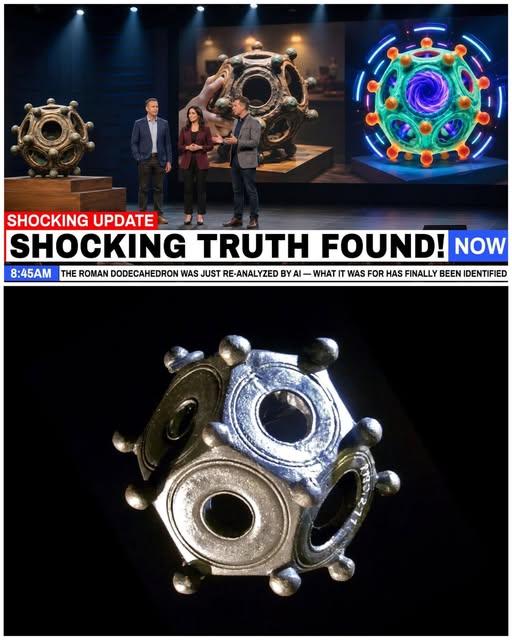
An object can be engineered without being industrial.
It can be precise without being practical.
It can be mathematical because it is sacred.
To the Roman and Gallo-Roman mind, geometry was not merely schoolwork. Shapes carried meaning. The dodecahedron was a powerful form in Greek philosophical thought, associated by Plato with the cosmos. Twelve faces could suggest wholeness, order, time, zodiacal structure, divine harmony, or the universe itself. The knobs, holes, and symmetry may not have served a mechanical purpose in the way modern viewers expect. They may have helped the object function as a symbolic model of cosmic order.
If that sounds too abstract, remember that ancient religion often made invisible forces visible through objects. A small bronze artifact could represent the universe, fate, protection, divination, a deity, the dead, or the hidden architecture of reality. To modern eyes, it looks like a mysterious gadget. To ancient users, it may have been a sacred shape held in the hand.
That is why AI reanalysis, if used responsibly, does not necessarily point toward a battlefield instrument or a forgotten Roman machine. It points toward context. Where are these objects found? What are they found with? Are they associated with military sites, domestic spaces, graves, hoards, temples, villas, or regional cults? Do they cluster in certain provinces? Are they common in Rome itself? Do they appear in places shaped by mixed Roman and local belief?
The pattern is revealing.
Roman dodecahedra appear mostly in northwestern provinces, not uniformly across the empire. That makes a purely universal Roman military or engineering function less likely. If every Roman surveyor, legionary, or builder needed one, we would expect clearer distribution and textual evidence. Instead, the objects seem culturally specific, concentrated in areas where Roman material culture interacted with local traditions.
That is one of the strongest clues.
The dodecahedron may not be “Roman” in the simple sense of an empire-wide official object. It may be Gallo-Roman: a product of Roman-era provincial culture, shaped by local religious ideas, craftsmanship, and status display. The empire provided materials, trade, metalworking styles, and symbolic vocabulary. Local communities may have supplied the deeper ritual meaning.
The Norton Disney discovery in England brought this debate back to life. Found during an amateur archaeological excavation, the object was rare, well preserved, and discovered near a Roman villa landscape. Researchers connected with the find have suggested that ritual or religious interpretation may be more plausible than a practical use. That does not solve every case, but it pushes the mystery in a serious direction.
The dodecahedron’s lack of clear wear is important. Tools usually betray themselves. A measuring device might have markings. A rangefinder might show standardization. A candleholder might show heat marks or wax residue. A knitting device would need evidence that matches known textile practices. A weapon component would show stress, breakage, or battlefield logic. Some individual objects may show damage, but the category as a whole does not behave neatly like a common work tool.
The object looks useful, but refuses to act useful.
That is exactly what makes it feel almost modern. We are trained to assume that complex objects must have practical functions. If something has holes, knobs, symmetry, and metal construction, we expect it to measure, calculate, connect, hold, or produce something. But ancient people did not separate beauty, geometry, religion, power, and function the way modern people often do. A sacred object could be complicated because complexity itself expressed meaning.
The holes may have mattered symbolically.
The twelve faces may have mattered cosmologically.
The knobs may have mattered ritually.
The hollow body may have mattered as a container of space, light, breath, or mystery.
The dodecahedron may have been held, displayed, rotated, suspended, placed on a staff, used in divination, placed in graves, or handled during ceremonies whose words are now lost. If so, the absence of written explanation is not surprising. Many ritual practices lived in local tradition, oral instruction, and restricted knowledge. Not every sacred object came with a manual.
This may be why the dodecahedron feels so haunting.
It is not silent because it was meaningless.
It is silent because the people who understood it are gone.
AI can compare geometry, but it cannot recover a vanished prayer. It can model hole ratios, but it cannot hear the words spoken over bronze in a provincial shrine. It can rank theories, but it cannot fully enter the mind of a Gallo-Roman believer holding an object that may have represented the order of the cosmos.
Still, technology can narrow the field.
A practical rangefinder theory has long appealed to modern viewers because it makes the object feel clever. The idea is that a person could look through two holes and estimate distance or size using geometry. But there are problems. Many dodecahedra are not marked for calculation. Their hole sizes and dimensions vary. Their find locations do not strongly support a military measurement function. If they were essential tools, Roman writers or military manuals should have noticed them.
The knitting theory is also popular online. Some modern experimenters have used replica dodecahedra to knit glove fingers. It is creative and visually persuasive. But it faces major problems too. The earliest known spool-knitting references are much later, bronze seems unnecessarily elaborate for such a purpose, and not all dodecahedron features fit the idea. More importantly, such a common textile tool should appear in everyday contexts more clearly.
The candleholder theory has charm. Some dodecahedra can hold small candles or lamps, and the holes could let light pass through. But again, the evidence is inconsistent. Many examples do not show convincing burn residue. The holes are not arranged like ordinary lantern vents. The knobs complicate stable placement. And if they were lamps, why are ancient depictions absent?
The gaming or dice theory explains the shape but not the holes and knobs. The toy theory explains mystery through play, but not manufacturing cost and distribution. The measuring gauge theory explains different hole sizes, but not the lack of standardization. The apprentice-piece theory explains craftsmanship, but not cultural clustering and repeated form.
One by one, practical theories fail to explain the whole object.
Ritual interpretation survives because it can absorb the object’s strangeness without forcing it into a modern category.
That does not mean “anything goes.” A ritual theory still needs evidence. Regional distribution, absence of textual references, complex geometry, lack of obvious wear, possible grave or shrine contexts, and links with local religious landscapes all strengthen the case. The Norton Disney working interpretation, for example, points toward local religious practice rather than a universal Roman gadget. That does not prove the exact ritual, but it gives the object a plausible cultural home.
If AI were asked to rank the theories based on current evidence, the strongest answer would likely be this: the Roman dodecahedron was probably not a common utilitarian tool. It was more likely a symbolic, ritual, or status object used in specific provincial religious contexts, possibly connected with cosmology, divination, protection, or local cult practice.
That is not as neat as saying “it measured distance” or “it knitted gloves.”
But it may be closer to the truth.
The word “finally identified” should therefore be understood carefully. The exact use has not been proven beyond doubt. Archaeology rarely works like a detective movie where one scan suddenly reveals the whole story. But the direction of evidence is becoming clearer. The old dream of a lost Roman gadget may be giving way to something more mysterious: a sacred object whose meaning belonged to a world of gods, fate, geometry, and local ritual.
That answer may actually be more fascinating.
A tool tells us what people did.
A ritual object tells us what they feared, hoped, believed, and tried to control.
The Roman dodecahedron may have helped people interact with the invisible. It may have been used to ask questions of fate. It may have represented the heavens in miniature. It may have served as a protective object in a household or shrine. It may have been an elite sign of learning, mystery, or initiation. It may have belonged to a religious specialist whose practices never entered official Roman literature.
The fact that it appears mostly in certain provincial regions suggests a cultural story beneath the bronze. These were places where Roman rule did not erase older traditions. Instead, beliefs blended. A local god might receive a Roman name. A Roman symbol might take on local meaning. A geometric object inspired by classical thought might become part of a ritual world Rome itself never fully documented.
That is how empires really work.
They do not simply impose one culture everywhere. They create zones of mixture, adaptation, and hybrid meaning. The Roman dodecahedron may be one of those hybrid objects: Roman in material world, local in ritual life, cosmic in shape, mysterious because the bridge between those worlds has collapsed.
Imagine one in use.
Not on a battlefield, but in a dim room.
A bronze object sits on a table beside oil lamps, offerings, and small figures of gods. The holes catch light. Shadows fall through the faces. A person turns it slowly, aligning openings, touching knobs, perhaps speaking names or numbers. The twelve faces are not engineering parts. They are directions, signs, months, heavens, deities, or paths of fate. The object is both beautiful and serious. Its power lies not in what it does mechanically, but in what it represents.
That scene is speculative.
But it fits the evidence better than many mechanical fantasies.
The reason modern people resist this answer is simple: ritual meaning is hard to reconstruct. We want certainty. We want diagrams. We want ancient labels. We want the object to behave like a device in our world. But the dodecahedron comes from a world where religion, mathematics, craft, and daily life overlapped. It may not have one simple modern equivalent.
That does not make it useless.
It makes it sacredly specific.
A wedding ring is not useful in a mechanical sense, yet it carries enormous meaning. A crown does not make a head function better, but it transforms the person wearing it into a ruler. A rosary is not a machine, yet its beads guide prayer. A ritual object does not need to produce a physical output to be important. It produces meaning, authority, protection, memory, and connection.
The Roman dodecahedron may have worked in that kind of way.
It may have been an object whose value depended on performance, belief, and context now lost.
This would explain why no Roman writer bothered to define it. Official authors may not have cared about provincial ritual objects. Elite Roman literature often ignored local practices unless they became politically important. Many everyday and sacred customs left no written trace. The dodecahedron may have belonged to a kind of knowledge transmitted by use, not by text.
If so, its mystery is not a failure of archaeology.
It is evidence of cultural silence.
The artifact survives, but the ceremony does not.
The bronze remains, but the words are gone.
That is why AI can only take us so far. It can say the object likely was not standardized like a precision instrument. It can compare forms. It can detect clusters. It can support or weaken hypotheses. But the final meaning may always remain partly beyond reach because meaning lived in human practice.
The most responsible conclusion is therefore both exciting and humble.
The Roman dodecahedron was probably not a simple tool, weapon, or toy. The strongest current interpretation points toward ritual, religious, symbolic, or cosmological use within Gallo-Roman provincial culture. AI-assisted analysis may strengthen that conclusion by showing how poorly many practical theories fit the full dataset. But the exact ceremony, belief, or function remains unknown.
And maybe that is why the object still holds us.
Some ancient artifacts become famous because we understand them.
The Roman dodecahedron is famous because we almost do.
It sits in the hand like a locked thought from the Roman world. Too patterned to be accidental. Too widespread to be unique. Too strange to be ordinary. Too silent to surrender.
If its purpose has finally been identified, the answer is not a battlefield rangefinder or a knitting tool.
It is something darker, older, and harder to translate.
A sacred object from a lost ritual world.
A bronze model of order.
A provincial mystery where Roman geometry and local belief met.
A small hollow cosmos with twelve faces and no surviving voice.
The machine did not solve the mystery by making it simple.
It solved it, perhaps, by showing that the mystery was never meant to be mechanical.
The dodecahedron was not a forgotten gadget.
It was a key to a belief system whose door is still mostly closed.