The Nefertiti Bust Has Been Hiding A Second Face For 3,300 Years — A Scanner Just Exposed It
The Nefertiti Bust Has Been Hiding A Second Face For 3,300 Years — A Scanner Just Exposed It
For more than a century, the world believed it knew Nefertiti’s face. Then a scanner looked beneath the gold, paint, and perfection—and found another woman hiding underneath.
The bust of Queen Nefertiti is one of the most recognizable images ever created by ancient Egypt. Her long neck, high cheekbones, elegant crown, calm mouth, and flawless gaze have turned her into an icon of beauty, power, and mystery. Millions have seen her face reproduced in books, museums, documentaries, posters, and digital images. She is not only an archaeological object. She is a symbol.
But the face the world knows may not be the first face the sculptor made.
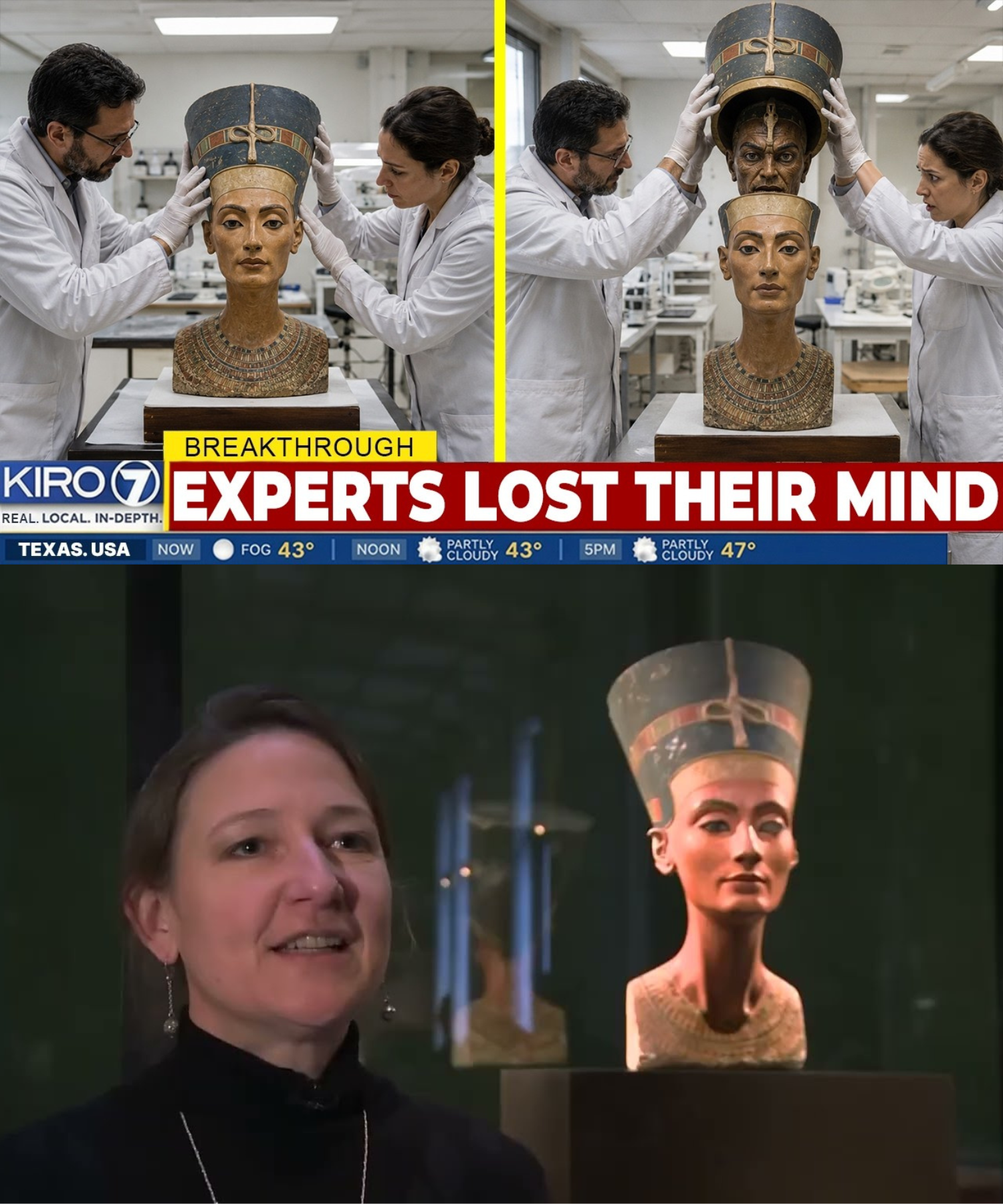
Hidden beneath the smooth painted surface is a limestone core, and inside that core is a second version of Nefertiti: older, more human, less idealized, and far more revealing. It was not exposed by chisels. No one had to break the masterpiece open. Modern scanning technology saw through the layers and revealed what the naked eye could never see.
The result was stunning. The famous bust was not simply a finished portrait. It was a transformation. Beneath the polished outer image, researchers found a carefully carved inner face with subtle differences: faint creases, a slightly altered nose, lines around the mouth, and features that suggest the sculptor first captured a more realistic version of the queen before covering it with a final layer of idealized beauty.
That discovery changes how we look at Nefertiti.
It also changes how we look at ancient Egyptian art.
The bust was discovered in 1912 by a German archaeological team led by Ludwig Borchardt in the ruins of Amarna, the short-lived capital built by Pharaoh Akhenaten. It was found in the workshop of the sculptor Thutmose, a detail that has always made the object especially fascinating. This was not just a royal statue found in a temple. It was found in an artist’s workspace, surrounded by the world of production, study, correction, and craft.
That context matters. If the bust came from a sculptor’s workshop, it may have functioned as a model. It may have been used to teach, copy, study proportions, or establish the official image of the queen. It was not necessarily a tomb object, nor a public monument. It may have been part of the machinery of image-making in one of the most unusual periods of Egyptian history.
Nefertiti lived during the Amarna Period, a revolutionary age shaped by her husband, Akhenaten. He moved Egypt’s religious center away from traditional gods and promoted the worship of the Aten, the sun disk. Art changed dramatically during his reign. Royal figures were shown with elongated bodies, intimate family scenes, unusual facial features, and a softness that differed from earlier Egyptian styles. Nefertiti was not a passive queen in this visual revolution. She appeared prominently in royal imagery, sometimes with power and presence that seemed almost equal to the king.
That is why the bust has always felt larger than beauty.
It represents politics, religion, gender, art, and propaganda all at once.
When most people look at Nefertiti’s bust, they see perfection. The blue crown rises like a symbol of authority. The face is smooth and balanced. The mouth is controlled. The surviving right eye seems alert, almost alive. The missing left eye has generated endless debate, but even incomplete, the bust feels finished in a deeper sense. It gives the impression of a queen made timeless.
But the scanner showed that timelessness was constructed.
The outer face was not the whole truth. It was the final mask.
Under the stucco, the limestone core showed a version of the queen with more natural features. The inner face had details that were softened or corrected by the outer layer. The nose appears different. The cheeks and mouth carry signs of age or realism. The final surface smoothed and refined these features, producing the world-famous image of almost impossible elegance.
This does not mean the bust is fake.
It means the bust is more sophisticated than anyone imagined.
Ancient Egyptian artists were not simply copying faces. They were negotiating between reality and ideal. A royal portrait did not have to look like a modern photograph. It had to express status, divinity, order, youth, power, and eternal presence. The goal was not only to show what a ruler looked like on a certain day. The goal was to show what a ruler meant.
The hidden face suggests that Thutmose, or the artists in his workshop, may have begun with a more natural portrait and then adjusted it to match royal ideals. This is deeply human. It shows the ancient artist making choices: what to preserve, what to soften, what to conceal, what to perfect.
In that sense, the scanner did not merely reveal a second face.
It revealed the ancient editing process.
The discovery also raises a provocative question: which face is more “real”?
Is the real Nefertiti the public face, the queen as Egypt wanted to see her? Or is the real Nefertiti the inner face, the one with subtle signs of age, individuality, and physical truth? The answer may be both. The outer face shows the queen as royal image. The inner face may preserve the queen as human subject. Together, they reveal a woman caught between flesh and symbol.
That is why the discovery feels so powerful. Nefertiti has often been treated as an icon of beauty, almost removed from ordinary humanity. The hidden face brings her closer. It suggests she was not merely the flawless woman on museum postcards. She was a living person whose image was shaped, corrected, and idealized by a court artist working within the demands of power.
The scanner exposed not scandal, but intimacy.
It let the world see the unfinished conversation between artist and queen.
The technique itself is part of the wonder. Computed tomography allowed researchers to look inside the bust without damaging it. This matters because the Nefertiti bust is incredibly fragile and historically priceless. It cannot simply be scraped, cut, or dismantled for curiosity. The scanner acted like a non-invasive eye, revealing layers beneath the surface while preserving the object intact.
What it found was more than a hidden portrait. It found evidence of construction. The bust is made from a limestone core covered with layers of stucco of varying thickness. Those layers were not applied randomly. They were used to refine and complete the face, adjusting contours and creating the perfect final appearance. In some areas, the stucco is thin. In others, it is thicker, acting almost like ancient cosmetic surgery in sculptural form.
That detail has fascinated modern viewers because it sounds surprisingly contemporary. Today, images are edited constantly. Faces are filtered, reshaped, smoothed, corrected, and idealized for public consumption. Ancient Egypt did not have digital filters, but it did have artistic filters. The Nefertiti bust shows that the impulse to shape public beauty is thousands of years old.
The queen’s outer face may be ancient Egypt’s version of the perfect public image.
The inner face may be the truth before the final edit.
This is not only an art story. It is also a power story. Royal images in ancient Egypt were never neutral. They communicated legitimacy. They told subjects how to see the ruler. They placed the king and queen within a sacred order. In Akhenaten and Nefertiti’s world, where religious and political change were tightly connected, image mattered intensely.
If Nefertiti’s official face was perfected, that perfection served a purpose. It presented her not simply as attractive, but as controlled, eternal, and almost divine. Her beauty was political. Her serenity was ideological. Her face was part of the visual language of a regime that tried to remake Egypt’s relationship with the divine.
The hidden face reminds us that power often edits reality before displaying it.
Yet the second face also adds emotional depth. The faint creases and altered features beneath the surface are not flaws. They are traces of life. They suggest that the artist first carved a queen who had lived, aged, ruled, and perhaps carried the strain of a turbulent court. Then that human face was covered by a more official version, one fit for eternity.
This tension between life and ideal is what makes the bust unforgettable.
The more we learn about it, the less simple it becomes.
The scan also helps explain why the bust continues to provoke debates about identity and ownership. Nefertiti’s image is housed in Berlin, but Egypt has long called for its return. To Germany, it is one of the crown jewels of the museum collection. To many Egyptians, it is a masterpiece removed from its homeland and displayed far from the civilization that created it. The hidden face discovery adds another layer to that debate, because it makes the bust feel even more personal. It is not only an object of beauty; it contains a private stage of artistic creation, a face within a face.
That makes the question of where she belongs even more emotionally charged.
The bust is not just stone and stucco.
It is memory.
It is Egyptian artistry.
It is royal identity.
It is colonial-era archaeology.
It is modern museum politics.
It is one of the most famous female faces in history, and now we know that the famous face was covering another one.
For scholars, the discovery provides valuable insight into ancient workshop practice. It suggests that artists used internal modelling and surface refinement in sophisticated ways. It shows that royal portraits could be developed through stages, with an underlying carved form and an outer idealizing layer. It may also explain why the bust was found in a workshop rather than a tomb or temple. Perhaps it was a teaching model, an official prototype, or a study piece used to standardize how Nefertiti should be represented.
For ordinary viewers, however, the meaning is more direct.
The queen had a hidden face.
That simple fact is enough to disturb the imagination.
We are used to thinking of ancient artifacts as silent and finished. They sit behind glass, lit carefully, labelled neatly, and transformed into museum icons. But scanning technology has begun to undo that stillness. It shows us repairs, internal structures, erased lines, hidden sketches, buried inscriptions, and earlier versions of famous works. It reminds us that masterpieces were made by hands, choices, mistakes, corrections, and secrets.
The Nefertiti bust is no longer only a perfect image from the past.
It is a record of transformation.
The scanner effectively turned the bust into a time capsule of artistic decision-making. The inner face may show how Nefertiti was first perceived. The outer face shows how she was meant to be remembered. Between the two lies one of the oldest tensions in human culture: the difference between the person and the image.
That tension has not disappeared.
Modern public figures still live behind perfected surfaces. Leaders, celebrities, influencers, and even ordinary people curate faces for the world. We smooth, pose, crop, filter, and control. The Nefertiti bust shows that this instinct is ancient. Long before cameras, humans understood that the face shown to the world could be shaped into power.
But the hidden face also gives us hope of another kind.
No surface is the whole story.
Behind every polished image is a deeper layer.
Behind every icon is a human being.
Perhaps that is why the scanner’s discovery feels almost poetic. Nefertiti, whose name is often translated as “the beautiful one has come,” became world-famous because of a face so beautiful it seemed beyond time. But after 3,300 years, technology revealed that beauty was not simple. It was built. It was revised. It concealed something more vulnerable beneath it.
The second face does not destroy the first.
It makes it richer.
The famous outer face remains magnificent. It is still one of the greatest portraits ever created. But now, when we look at it, we can imagine the hidden limestone beneath: the earlier carving, the subtle lines, the less perfect nose, the human details softened by stucco. We can see not only the queen, but the act of making the queen eternal.
That is the real shock.
The scanner did not expose a fraud.
It exposed a process.
It showed that ancient Egyptian beauty was not accidental. It was engineered with astonishing care. It showed that royal identity could be layered literally onto stone. It showed that even the most familiar artifact in the world can still hold secrets.
And most of all, it gave Nefertiti back something the perfect surface had almost taken away.
Her humanity.
For more than a century, the world has admired the face on the outside. Now we know there was another face beneath it, waiting silently inside the stone. A face less polished, perhaps closer to life, hidden under the image of a queen made eternal.
The Nefertiti bust has always looked like a masterpiece.
Now it looks like a mystery.
And after 3,300 years, the woman beneath the icon has finally begun to look back.