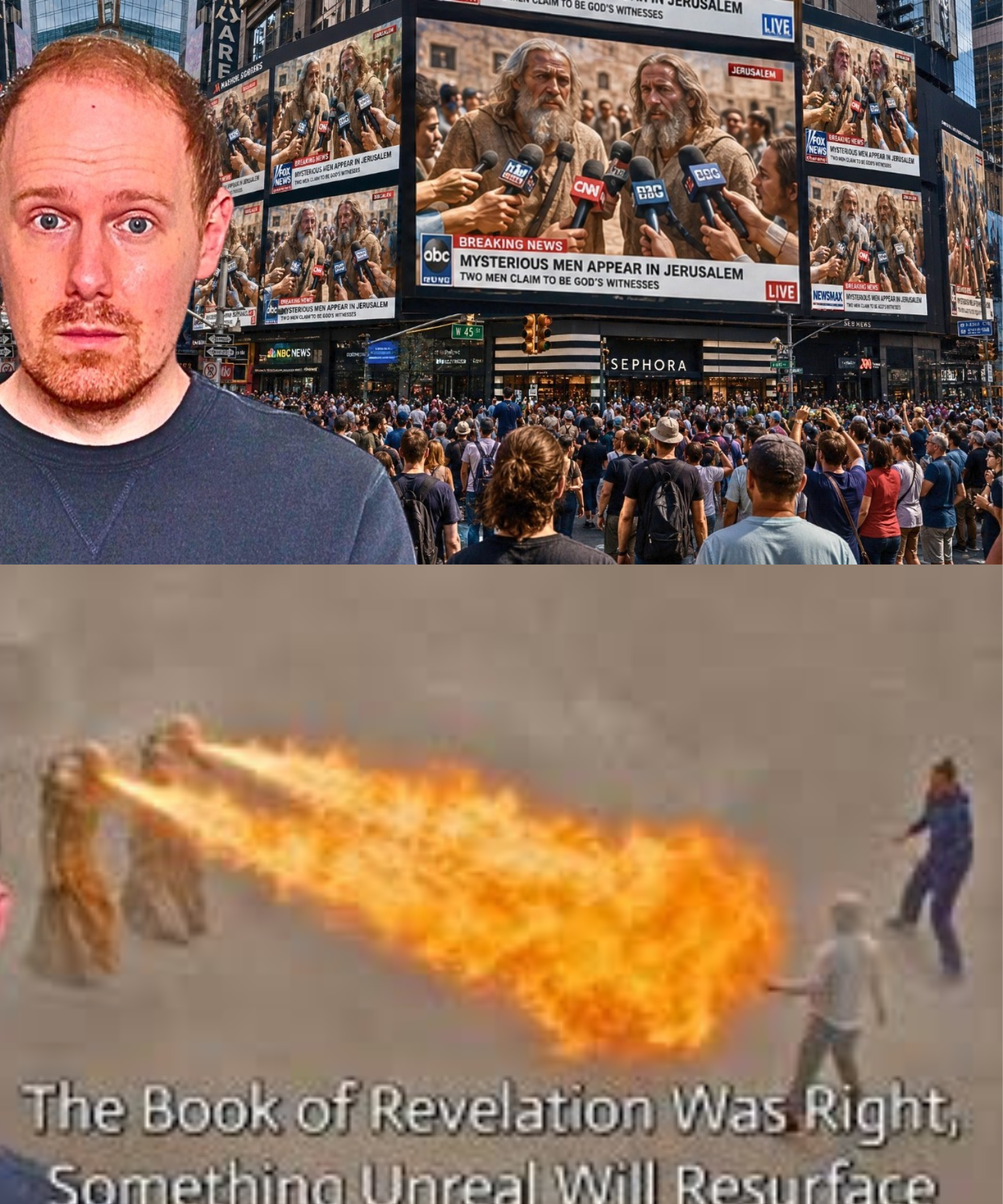
The Book of Revelation Was Right, Something Unreal Will Resurface
The Book of Revelation Was Right — Something Unreal Will Resurface
Part 1
The first thing that surfaced was not a monster. It was a door. At 4:44 in the morning, when New York City was still half-asleep and the Hudson River moved like black glass beneath the last scraps of night, a ferry captain named Louis Brenner saw something rise from the water near Pier 45. At first he thought it was debris, maybe a section of an old dock torn loose by the current. Then the thing lifted higher, water sliding off it in sheets, and the captain realized it was too smooth, too symmetrical, too deliberate. It was rectangular, taller than a man, black as burned iron, and marked with seven pale rings arranged around a central slit. The Hudson churned around it as if the river itself wanted to push it back down. Then, from somewhere below, came a sound like a trumpet heard through stone.
By sunrise, every news station in New York had a helicopter above the river. Police boats circled the object at a distance. Federal agents arrived before the mayor’s office had issued a statement. People gathered along the waterfront, holding phones, coffees, rosaries, protest signs, and theories. Some shouted that it was a military device. Others said it was part of an art installation. A man in a long coat stood near the rail and read from the Book of Revelation until officers asked him to move along. His voice carried over the crowd: “And I saw a beast rising out of the sea…” Someone laughed nervously. Someone else told him to shut up. Then the black door pulsed, and every phone on the pier died at once.
Dr. Miriam Cole saw the footage from her apartment in Queens and spilled coffee across her kitchen table. She was a biblical scholar, not a prophecy influencer, not a doomsday preacher, not one of those people who turned every eclipse and earthquake into a countdown. Her work at Columbia focused on apocalyptic literature: Revelation, Daniel, Ezekiel, the strange symbolic language of beasts, seals, bowls, trumpets, dragons, and cities falling under the weight of their own corruption. She had spent years telling students that Revelation was not a puzzle book for fear merchants. It was a vision of Christ’s victory over evil, written to churches under pressure. But when she saw the seven rings on the black door rising from the Hudson, she stood so quickly her chair fell backward.
Seven rings.
Seven seals.
Seven trumpets.
Seven bowls.
Revelation was full of sevens—not as decoration, but as warning, completion, judgment, fullness. Miriam did not believe the black door proved anything. Not yet. But she knew enough to fear cheap certainty and enough to fear dismissing what deserved attention. Her phone rang before she could call anyone. It was Father Gabriel Reyes from St. Michael’s in Queens.
“You saw it?” he asked.
“Yes.”
“Tell me I’m being dramatic.”
“You are being dramatic.”
“Good.”
“But I’m not sure you’re wrong.”
By noon, Miriam was standing inside a temporary command tent near the Hudson beside Dr. Caleb Ward, a geologist from Ohio State, and Naomi Reyes, a documentary filmmaker from Los Angeles who had been in New York filming a series on American religious panic. Caleb had been flown in because preliminary scans suggested the object was not floating. It was rooted in the riverbed, or perhaps had risen from something embedded beneath it. Naomi had been invited by no one, but she had connections, stubbornness, and a gift for standing where history was about to become footage.
Caleb studied the sonar map and frowned. “This thing goes down at least eighty feet into sediment.”
“How is that possible?” Naomi asked.
“It isn’t, if it just appeared last night.”
Miriam looked through the tent opening toward the river. “Maybe it didn’t appear.”
Caleb turned. “What does that mean?”
“Maybe it resurfaced.”
At 3:17 p.m., the black door opened one inch.
The smell that came out was not rot, sulfur, or seawater.
It smelled like old rain on hot pavement, hospital corridors, burned paper, and churches after funerals.
Everyone in the tent heard the same words, though no speaker recorded them clearly:
What was buried beneath your waters has learned your names.
Part 2
Ohio was the second place to hear the trumpet. It happened that same night on the shore of Lake Erie, just outside Cleveland, where the water turned perfectly still for eleven minutes despite a hard wind blowing off the north. Fishermen noticed first. Then a weather station recorded a pressure drop. Then a line of buoys began flashing in sequence, seven red pulses, one after another, repeating until the Coast Guard arrived. At 11:03 p.m., a black shape surfaced half a mile offshore. Smaller than the Hudson door, but made of the same dark material, marked with the same seven rings.
Caleb received the alert while still in New York and went pale.
“That’s impossible,” he said.
Miriam looked at him. “You keep using that word.”
“I’m a geologist. I’m allowed.”
The Ohio object did not open. Instead, it transmitted. Every radio within five miles picked up a low, layered sound. Some heard thunder. Some heard crying. Some heard their own names. A Cleveland police dispatcher fainted after hearing the voice of her dead mother say, “Do not stand near the water when the fifth ring opens.” A teenage boy filming from the pier later claimed the object whispered, “The lake remembers the bodies no one counts.” His video showed only black water and his own shaking hands.
By morning, America had two resurfaced objects and one national panic. New York was locked down near the Hudson. Cleveland’s waterfront was closed. Religious broadcasters began calling the objects “Revelation doors.” Skeptics mocked them until the Cleveland audio leaked and millions heard that impossible trumpet tone vibrating beneath ordinary static. Government officials insisted there was no evidence of supernatural activity, which calmed almost no one. The official term became “submerged anomalous structures.” The internet preferred “Abyss Gates.”
Miriam hated that phrase. But it haunted her because Revelation speaks of an abyss—a bottomless pit, a place of imprisoned destructive forces, opened under divine judgment. She kept telling herself the text was symbolic, visionary, theological. She also kept seeing the black door rise from the Hudson every time she closed her eyes.
The third point appeared in Los Angeles two days later.
Not in the Pacific, as everyone expected, but in the Los Angeles River after an unusual storm filled the concrete channel with rushing brown water. The rain had stopped, the helicopters were gone, and a maintenance crew near Glendale found the water circling around something lodged beneath the channel floor. By sunset, the concrete cracked. A black stone surface emerged through the floodwater, not a full door this time, but a circular plate marked with seven rings and a central eye. When the eye opened, every billboard within three miles flickered and displayed the same sentence:
The beast does not rise first from the sea. It rises first from appetite.
Naomi saw it from the 5 freeway and nearly crashed.
She called Miriam from the shoulder, her voice shaking. “It’s here.”
“What surfaced?”
“Not a door. A mirror.”
“A mirror?”
“That’s what it feels like.”
The Los Angeles plate reflected nothing physical. Not faces, not sky, not helicopters. It reflected scenes. A producer yelling at an assistant. A pastor counting cash after a televised sermon. A teenager crying alone beside a phone. A CEO signing layoffs while smiling for investors. A family eating dinner without speaking. A woman scrolling past a video of a starving child and tapping like on a celebrity photo. People who looked into the black plate did not see themselves. They saw what ruled them.
By nightfall, crowds gathered behind police lines. Some prayed. Some screamed. Some tried to livestream until their phones overheated. One influencer shouted, “Show me my destiny!” and collapsed when the plate flashed an image of him alone in a room surrounded by screens, unable to remember his own mother’s voice.
Naomi filmed none of it.
For once, the city of images did not deserve another camera.
Part 3
The first serious theory came from Caleb, and everyone hated it because it was too simple to be comforting. The three objects—New York, Ohio, Los Angeles—were not random. They formed a triangle across America: gateway, heartland, mirror. New York, where power entered and messages spread. Ohio, where forgotten grief settled into soil and water. Los Angeles, where image became appetite and appetite became export. The objects were made from the same unknown material, but geological analysis showed they had not been manufactured recently. They were embedded deep beneath their locations, possibly for centuries, possibly longer. Somehow, they had resurfaced together.
“Triggered by what?” Naomi asked.
Caleb looked exhausted. “That is the part I don’t know.”
Miriam had an answer she did not want. “Witness.”
The others stared at her.
“In Revelation, judgment is not only punishment. It reveals. It unveils. That’s what apocalypse means—uncovering. These things are not attacking first. They are exposing.”
“Exposing what?” Caleb asked.
Before Miriam could answer, the Hudson door opened another inch.
New York heard crying.
Not from the object itself, but from the city. People within a mile of the waterfront suddenly heard voices of those they had ignored, abandoned, exploited, dismissed, or forgotten. A landlord heard tenants begging for heat. A judge heard a mother pleading in a courtroom from fifteen years earlier. A priest heard every confession he had rushed through impatiently. A trader in a Wall Street office heard the voice of a laid-off man whose pension had collapsed. A woman jogging near the pier heard her little brother asking why she never answered his calls before he overdosed in Ohio. The city staggered under memory.
Emergency rooms filled with panic attacks. Churches filled too. So did bars.
Miriam stood near the barricade with Father Gabriel, watching the river object pulse in darkness. “Revelation was right,” a man beside them muttered. “Something unreal is resurfacing.”
Father Gabriel answered quietly, “Maybe what’s resurfacing is what we buried.”
That became the first truthful sentence Miriam had heard all week.
In Ohio, the Lake Erie object began revealing names. Not images, not accusations, but names. Names of missing persons, overdose victims, unidentified bodies, forgotten elders, children buried without markers, workers killed in accidents and reduced to statistics. Names scrolled across dead radios, hospital monitors, gas station pumps, church projectors, and old digital clocks. Hannah Miller, a hospice nurse outside Cleveland, saw one of the names appear on a medication dispenser at 2:30 a.m.: Luis Ortega. She knew him. He had died alone in a county facility three years earlier. No family came. She had forgotten him, not cruelly, but because the living keep moving or they collapse. Now his name blinked in green light until she whispered, “I remember.”
The dispenser went dark.
In Los Angeles, the mirror plate showed the hidden cost of performance. Actors saw children they had neglected. Pastors saw people wounded by their ambition. Activists saw hatred hiding inside justice. Skeptics saw compassion they had withheld because believers annoyed them. Believers saw pride wearing doctrine. Everyone saw enough to either repent or rage.
Many raged.
By the fourth day, riots broke out near the Los Angeles site. A crowd tried to smash the plate. Every hammer shattered before touching it. One man struck at the central eye with a crowbar. The plate reflected him as a child hiding under a table while his parents screamed. He dropped the crowbar and sobbed until police carried him away.
Naomi watched from a distance, shaking.
The mirror was not showing monsters.
It was showing origins.
Part 4
Washington wanted control, which meant Washington arrived late. Federal agencies built perimeters, restricted airspace, blocked access, classified data, and issued statements so careful they sounded like prayers written by lawyers. But no barricade could stop the objects from transmitting. New York kept hearing buried cries. Ohio kept receiving names. Los Angeles kept reflecting appetite. The country was no longer watching a mystery. It was being examined by one.
Miriam was summoned to a closed briefing in Washington with Caleb, Naomi, Father Gabriel, Hannah from Ohio, several scientists, military officers, psychologists, theologians, and officials who looked as if they had not slept since the first door rose. A senator asked Miriam whether the objects were proof that the Book of Revelation was literally unfolding in America.
She answered with great care. “Revelation is not a newspaper forecast. It is a prophetic unveiling of spiritual reality. I will not say these objects prove an end-times timetable. But I will say they are behaving in a way that resembles apocalyptic function. They reveal the hidden allegiance of cities.”
The room went silent.
A general asked, “Can they be destroyed?”
Caleb answered, “We have no evidence anything can damage them.”
Naomi added, “And if they’re revealing what’s hidden, destroying them may not solve the problem.”
The senator frowned. “What is the problem, then?”
Father Gabriel replied, “Us.”
Nobody liked that answer.
That night, the fourth event occurred. Not a new object. A voice. It came simultaneously from the Hudson door, the Lake Erie stone, and the Los Angeles mirror. Every live microphone near the three sites captured it. Every person within the perimeters heard it in their own language. It said:
You feared the beast from the sea, but fed the beast in the soul.
Then the seven rings on all three objects lit up, one at a time.
First ring: deception.
Second: greed.
Third: lust for power.
Fourth: contempt for the poor.
Fifth: worship of image.
Sixth: hatred disguised as righteousness.
Seventh: despair.
When the seventh ring lit, thousands across the country reported the same dream. A coastline at night. A black sea. Something massive beneath the water, not rising yet, only turning. Above the sea stood a city made of screens, towers, churches, banks, courts, studios, hospitals, homes. Every building had doors, and behind each door someone was making a choice.
In New York, Miriam woke from the dream with one sentence in her mouth: “The beast is fed before it is seen.”
She wrote it down before dawn.
By morning, the Hudson door had opened seven inches.
Inside was not darkness.
Inside was water moving upward, against gravity.
And in that water were reflections of American cities—not as they looked, but as they loved.
Some parts shone.
Many did not.
Part 5
The first city to respond was not New York, Los Angeles, or Washington. It was Cleveland. The names from Lake Erie had broken something open in Ohio. Churches, synagogues, mosques, shelters, hospitals, recovery centers, and ordinary families began organizing name vigils. People read aloud the names appearing through radios and monitors. Volunteers searched records for the unidentified dead. Families of overdose victims gathered near the closed waterfront and held photographs under plastic sheets while rain fell. No one knew whether the Lake Erie object was judging them, warning them, or simply returning what had been buried. But the act of naming changed the atmosphere.
Hannah Miller stood at a microphone outside a Cleveland hospice and read names for four hours. Her voice cracked. Others took turns. By sunset, the Lake Erie object stopped pulsing for the first time since it surfaced. The water around it calmed. The seven rings dimmed, though the fifth ring—contempt for the poor—remained faintly lit.
Miriam heard the report in New York and understood. The objects were not merely exposing. They were responding.
“If the rings represent sins,” Caleb said over the phone, “then repentance changes the signal.”
“That sounds too theological,” he added quickly.
Miriam almost smiled. “Reality has been sounding theological all week.”
In New York, Father Gabriel organized a citywide night of restitution. Not vague prayer. Specific acts. Landlords restoring heat. Churches opening doors. Wealthy parishioners paying medical debts anonymously. Lawyers reviewing old cases. Families calling estranged relatives. Volunteers feeding people under bridges near the Hudson. Some acts were sincere. Some were performative. The door did not seem impressed by performance. It responded only when hidden wrongs were named and concrete mercy followed.
A Wall Street executive publicly confessed to profiting from predatory loans and created a restitution fund. People called it a stunt until former victims began receiving payments. That night, the second ring—greed—dimmed on the Hudson door.
The crowd gasped.
Los Angeles struggled most. The mirror plate made repentance difficult because every act of repentance risked becoming content. Celebrities posted apologies. Influencers filmed service projects. Churches branded humility nights. The mirror showed all of it back as hunger. Naomi nearly gave up. Then Lucia Alvarez, an elderly woman from East L.A., did something small. She shut down her phone, gathered six neighbors, cooked a meal, and brought it to a family whose father had been deported. No cameras. No post. No announcement. That night, one narrow line of light crossed the Los Angeles plate, not a ring, just a crack in the darkness.
Naomi heard about it from the family days later. “Why didn’t she tell anyone?” she asked.
The mother shrugged. “Because she didn’t do it for anyone else.”
That became Los Angeles’s lesson.
Hidden mercy could starve the mirror.
For the next week, across America, people began asking not “What will resurface?” but “What have we fed?” It was an unbearable question. Some refused it. Some mocked repentance as hysteria. Some claimed the objects were alien psychological weapons. Some churches turned the rings into merchandise. Some politicians demanded military action. But enough people listened that the objects began to change.
The Hudson door opened no farther.
Lake Erie’s names slowed.
The Los Angeles mirror dimmed for several hours each night.
Then the sea off the Atlantic coast began to boil.
Something larger was coming.
Part 6
The boiling began beyond the continental shelf, east of the Carolinas, where fishermen reported dead silence on the radio and water rising in circular swells under a windless sky. Satellite images showed a dark shape beneath the surface, miles wide, moving slowly north toward the American coast. Not an animal, not a submarine, not a geological plume. A shadow. A boundary. A presence so large that even skeptics stopped making jokes for twenty-four hours.
News anchors called it “the Atlantic anomaly.” Prophecy channels called it “the Beast.” Scientists called it “unidentified subsurface mass.” Miriam refused to name it at all. In Revelation, the beast from the sea represented empire, blasphemous power, violence, worship twisted toward domination. It was not merely a creature. It was a system given body. If something was rising now, she feared it would not be defeated by missiles, arguments, or panic. It had been fed by the rings.
The three objects began transmitting together again.
What rises from the sea is shaped by what descends from the heart.
That sentence appeared on radios in Ohio, screens in Los Angeles, and the water surface near the Hudson.
The government prepared evacuation plans along parts of the East Coast. Navy vessels moved toward the anomaly and then stopped at a distance after instruments failed. The first submarine drone sent toward the shadow transmitted only eleven seconds of footage: black water, a surface like scales or stone, and thousands of human voices whispering not words, but wants. Power. Revenge. Hunger. Fame. Safety without surrender. Justice without mercy. Freedom without truth. Life without God.
The drone imploded.
Panic returned to America like fever.
Then Hannah Miller from Ohio appeared on national television and said something no strategist could have scripted. “If this thing is fed by what we refuse to repent of, then fear is another meal. Stop feeding it.”
The clip spread everywhere.
New York held a silence at noon. For three minutes, churches rang no bells, markets paused, schools stopped, subway platforms fell quiet. Not everyone participated. Enough did. The Hudson door’s first ring—deception—went dark.
Ohio held a day of names and service. The fifth ring dimmed.
Los Angeles held what Naomi called a hidden fast: no posting acts of mercy for twenty-four hours. For a city addicted to being seen, it was almost impossible. The mirror plate went fully dark for nine minutes.
Across the country, families reconciled, debts were forgiven, crimes confessed, lies exposed, addictions admitted, meals served, prayers whispered, apologies made, idols named. Not everywhere. Not everyone. Not permanently. But enough that the shadow off the coast slowed.
Miriam stood beside Father Gabriel at the Hudson site as the door began to close. Inch by inch. Water poured down its surface. The seven rings dimmed, though the seventh—despair—remained burning.
“Why despair?” Naomi asked through a video call.
Father Gabriel answered, “Because people can repent of sins and still believe mercy will fail.”
Miriam looked at the black river.
That was the final food.
Despair.
The belief that the beast had already won.
Part 7
The final confrontation did not look like war. It looked like vigils. On the seventh night after the Atlantic shadow appeared, Americans gathered in places where despair had taken root. Hospitals. Prisons. Recovery centers. Funeral homes. Empty churches. School gyms. Apartment rooftops. Shelters. Nursing homes. Beaches. Farm fields. Subway platforms. Studio lots. Kitchens. People lit candles, not as magic, but as refusal. Refusal to let despair call itself wisdom. Refusal to let fear become prophecy. Refusal to believe that evil’s unveiling meant evil’s victory.
Miriam stood in New York and read from Revelation—not the beast, not the bowls, not the terror, but the end: “Behold, the dwelling place of God is with man. He will wipe away every tear from their eyes.” Father Gabriel read beside her. People wept openly.
In Ohio, Hannah read names of the dead again, then added the names of the living who thought they were beyond hope. Addicts in treatment. Prisoners. Patients in hospice. Teenagers in psychiatric wards. Widows. Men who had not spoken to their children. Women who believed they had ruined everything. After each name, the crowd answered, “Mercy is not finished.”
In Los Angeles, Naomi stood before the dark mirror plate, cameras off, and read messages from people who had chosen hidden acts of love. No names. No credits. No proof. The plate reflected nothing. That was its own miracle.
At 11:59 p.m. Eastern, the Atlantic shadow rose.
Every screen in America went black.
For seven seconds, the country saw the same image: not a monster’s face, but a throne made of human desires, built from greed, cruelty, lust, pride, despair, and the hunger to be worshiped. Behind it moved a shape too large to comprehend. Then a voice like deep water said:
You made a body for what you served.
And another voice answered—not from the sea, but from thousands of candles, prayers, confessions, names, hidden mercies, and trembling human mouths:
Jesus Christ is Lord.
The Atlantic shadow convulsed.
The Hudson door slammed shut.
The Lake Erie stone sank beneath the water.
The Los Angeles mirror cracked down the center, then dissolved into rainwater and concrete dust.
Off the coast, the massive shape broke apart into black waves. The boiling stopped. Instruments returned. Radios cleared. The sea became sea again.
No one cheered at first.
The silence was too enormous.
Then, in New York, a child began singing “Amazing Grace” off-key near the barricade. Someone joined. Then another. Soon the song spread down the riverfront, through Ohio vigils, across Los Angeles streets, and into living rooms where people had been holding their breath.
The unreal had resurfaced.
But it had not triumphed.
Part 8
Years later, people still argued about what happened. Some called it the clearest fulfillment of Revelation in modern history. Others called it mass psychological crisis amplified by unknown technology, environmental anomalies, and religious symbolism. Government reports described the objects as “material events of unknown origin with psychosocial effects.” Theologians warned against date-setting and sensationalism. Skeptics remained skeptical. Believers remained divided. But few people who had stood near the doors, stones, mirrors, or vigils spoke carelessly afterward.
Miriam wrote the definitive book, The Unveiling in America. She insisted the events did not allow anyone to claim they had decoded the end of the world. Revelation was not a toy for panic. But she also insisted the events had behaved apocalyptically in the truest sense: they unveiled. They showed cities what they served. They showed sins as powers. They showed that beasts rise where worship has already gone wrong. Above all, they showed that the Lamb, not the beast, is the center of Revelation.
That was the part people forgot when they wanted fear.
In New York, the Hudson site became a memorial, not to the object, but to the cries that had been heard. The city built a small wall near the pier engraved with a line: What we bury in others returns as judgment on us. Beneath it were names of organizations serving the poor, the exploited, and the forgotten. Father Gabriel visited often.
In Ohio, the Lake Erie names project continued. Thousands of unidentified or forgotten dead were restored to records. Hannah’s phrase, “Mercy is not finished,” became a national grief ministry. In Los Angeles, the place where the mirror cracked was left unmarked except for a small plaque in the concrete: Hidden mercy starves the mirror.
Naomi never released all her footage. Some images, she said, were not for consumption. Her documentary, Something Unreal Resurfaced, avoided monster imagery and focused instead on people changed by the unveiling. Critics expected spectacle. They got repentance. It was less popular than it could have been and more important than anyone expected.
Caleb continued studying fragments recovered from the three sites. The material defied classification, but he no longer believed classification was the deepest issue. “The universe is stranger than our categories,” he told students, “but the human heart is often the strangest site of all.”
On the tenth anniversary, Miriam, Father Gabriel, Naomi, Caleb, and Hannah gathered quietly in New York at dawn. The Hudson flowed normally. Ferries moved. Joggers passed. Office lights blinked awake. The city looked unjudged, which is how cities always look between warnings.
Naomi asked Miriam, “Do you think it will happen again?”
Miriam watched the water.
“Revelation says evil resurfaces in many forms,” she said. “Empire. deception. violence. idolatry. despair. It does not need the same door twice.”
“That’s comforting,” Caleb muttered.
Father Gabriel smiled sadly. “The comfort is not that beasts never rise. The comfort is that the Lamb reigns.”
They stood in silence.
Across America, life continued. People lied and told the truth. Fed the poor and ignored them. Worshiped God and worshiped themselves. Made images and hid mercy. Remembered names and forgot others. The rings were no longer visible, but the sins they named had not vanished. Neither had grace.
The Book of Revelation had been right, though not in the cheap way people first claimed.
Something unreal did resurface.
It was not only from the sea.
It was from beneath the polished floor of American life, from under the rivers, behind the screens, inside the appetite, inside the despair, inside every place people thought hidden things stayed hidden forever.
And the warning remained:
Do not feed what you fear.
Do not worship what flatters you.
Do not despair as if evil owns the ending.
The sea may give up its monsters.
The cities may reveal their secrets.
The beast may rise in every age under different names.
But the final word does not belong to the beast.
It belongs to the Lamb who was slain and lives.