Sumerian Tablet Reveals 3 Signs That Appear Before Civilizations Fall — And the Third Is Now
Sumerian Tablet Reveals 3 Signs That Appear Before Civilizations Fall — And the Third Is Now
Part 1
The tablet arrived in New York City inside a cracked wooden box wrapped in newspaper from 1949, sealed with black wax, and marked with a sentence that made Dr. Evelyn Hart stop breathing before she even touched the lid: Do not translate the third sign unless your nation is ready to hear itself named. It had been delivered anonymously to the American Museum of Antiquities just after midnight, left at the security desk by a courier who claimed he had picked it up from an estate outside Cleveland, Ohio. By the time the guards checked the cameras, the courier’s face had blurred in every frame, not as if the footage had been erased, but as if the camera itself had refused to remember him.
Evelyn had seen fake Sumerian tablets before. Rich collectors loved them. Internet prophets loved them more. Every few months, someone claimed to have found a forbidden clay tablet revealing aliens, giants, secret gods, lost technologies, or the date of the end of the world. Most were tourist-shop garbage or modern fantasies scratched into old clay. But when Evelyn opened the box in the museum’s lower conservation lab, she knew immediately this was different. The clay was old. The firing pattern was right. The wedge marks were not decorative nonsense. They were deliberate, disciplined, and terrifyingly clean.
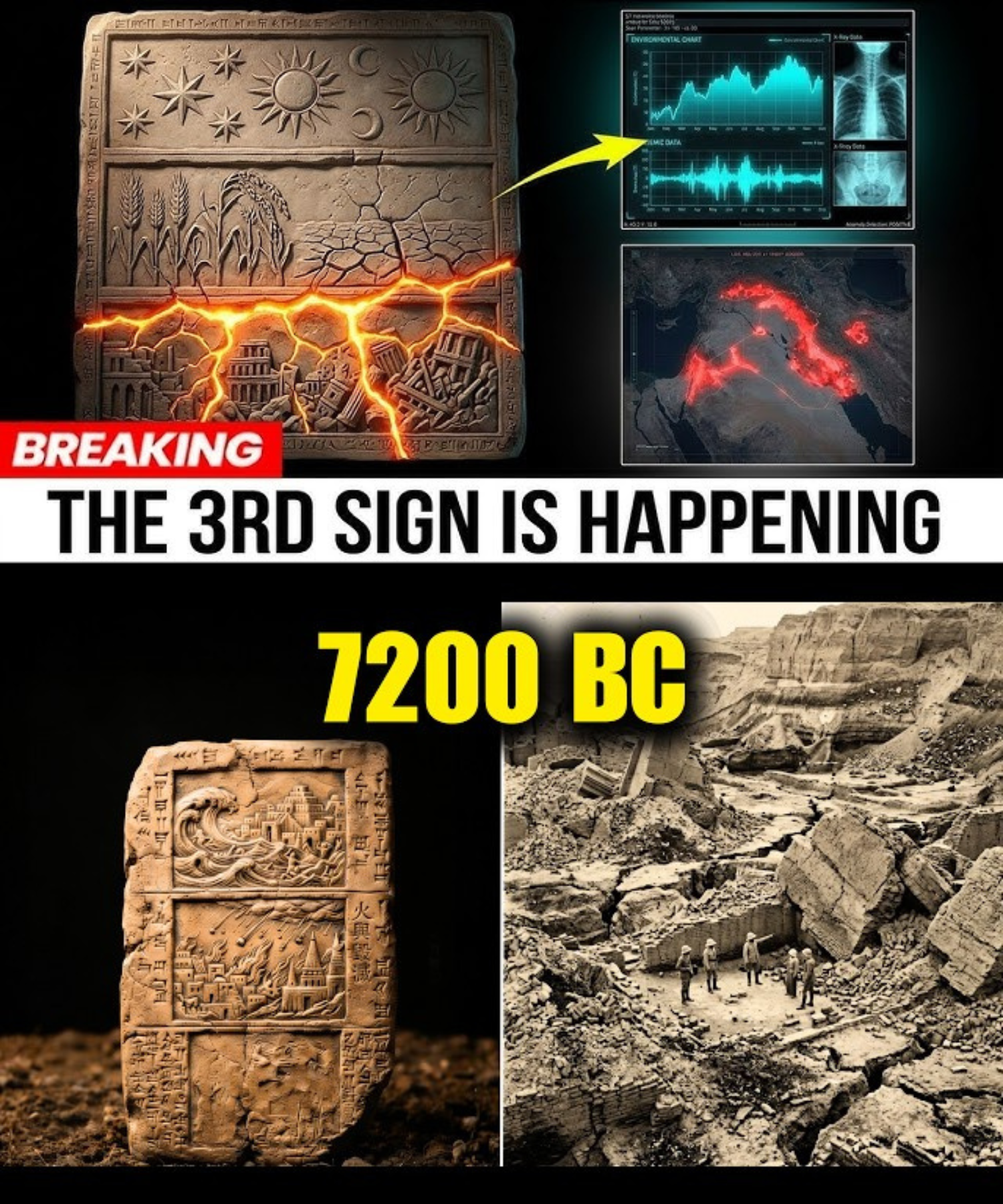
Across the front of the tablet were three columns.
At the top of each column was a symbol. The first showed a city wall with a broken measuring rod. The second showed a mouth speaking into an empty bowl. The third showed a child holding a lamp with no flame.
Beneath them was a title in Sumerian that Evelyn translated slowly, then again, hoping she had made a mistake.
The Three Signs Before the House Falls.
She called Dr. Caleb Ward in Columbus before sunrise. Caleb was an archaeologist and systems historian at Ohio State University, known for studying collapse patterns in ancient societies: drought, debt, soil failure, political rot, religious corruption, trade breakdown, elite arrogance, and the way ordinary people usually noticed disaster long before rulers admitted it. He answered the phone like a man prepared to hate whatever she was about to say.
“It is 4:12 in the morning,” he said.
“I have a Sumerian collapse tablet in New York.”
“Burn it.”
“It names three signs.”
“They all do.”
“The third symbol is a child with an unlit lamp.”
Caleb went silent.
“What?” Evelyn asked.
“I saw that symbol in Ohio.”
“Where?”
“In the Bellamy papers. A preacher from Cleveland copied it from an artifact that vanished in 1931. He wrote one sentence under it.” Caleb’s voice changed. “He wrote, When the children stop believing the future belongs to them, the third sign has begun.”
Evelyn looked at the tablet again. The clay seemed darker around the third column, as if many hands had touched that part over centuries.
By noon, Naomi Reyes joined the investigation from Los Angeles. She was a documentary filmmaker who had spent years studying how civilizations turned warning signs into entertainment before collapse. Her specialty was modern America: cities that glittered while families broke, churches that filled screens while neighbors went hungry, platforms that sold outrage as identity, and young people inheriting a country that asked them to perform hope while giving them debt, loneliness, climate fear, and screens instead of community.
Naomi stared at the tablet scan from her studio in Burbank.
“The first sign is structural,” she said. “The second is language. The third is generational.”
Evelyn nodded. “That is what I’m afraid of.”
The first column translated by evening.
First sign: The measuring rod breaks. The builders no longer measure houses by whether families can live in them, fields by whether they can feed the poor, laws by whether they guard the weak, or temples by whether truth is spoken. They measure only height, speed, gold, applause, and victory. When the measure breaks, the wall still stands, but the city has begun falling inward.
Caleb read the translation from Ohio and exhaled hard.
“That is New York,” he said.
Evelyn looked out the museum window toward Manhattan’s towers, glittering above streets where people slept under scaffolding.
“No,” she said softly. “It is America. New York is only where it learned to stand tall.”
That night, every digital billboard in Times Square flickered at exactly 11:11 p.m. For seven seconds, the ads vanished. No perfume, no stock app, no Broadway show, no luxury apartment, no politician, no streaming series.
Only one sentence appeared:
What do you measure before you call a city great?
Then the lights returned.
And all across New York, people suddenly felt the towers watching them back.
Part 2
The first sign spread through New York like a moral fever. At first, people treated the Times Square message as a hack, a stunt, a guerrilla art project, or another viral campaign selling something nobody had identified yet. But then the same sentence appeared on apartment listing sites, bank screens, subway arrival boards, courthouse monitors, church projectors, and the checkout kiosks of grocery stores where eggs cost more than some families could spare. What do you measure before you call a city great? It appeared for seven seconds each time, then vanished without a trace.
A luxury real estate developer saw it on the private elevator screen of a tower he had built over a demolished rent-stabilized block. A judge saw it while reviewing eviction cases. A pastor saw it on the screen where his church tracked online donations. A university president saw it during a fundraising gala. A mother in Queens saw it on an ATM after checking an account that had twenty-three dollars left before payday.
The Sumerian tablet had not caused the city to collapse.
It had caused the city to ask what it had already allowed to collapse.
Evelyn and Naomi walked through Manhattan with Jonah Pierce, a Brooklyn journalist who had been brought in after the leak. Jonah was skeptical of everything except human guilt. He knew New York well enough to know that the city could absorb almost any accusation and turn it into a brand. “Give it a week,” he said. “Someone will sell T-shirts.”
“Already happening,” Naomi replied, showing him her phone.
The shirt said: MEASURE GREATNESS DIFFERENTLY — NYC EDITION.
Evelyn looked exhausted. “The tablet warned that even warnings become goods.”
They visited a shelter beneath a church near Midtown where volunteers served soup two blocks away from a restaurant charging eighty dollars for a tasting menu. They visited a construction site where immigrant workers slept in crowded rooms while building apartments none of them could afford. They visited a hospital billing office, a courthouse, a food pantry, a school where children wrote essays about “my dream future” and several left the page blank.
At every stop, the first sign sharpened.
The measuring rod breaks when success no longer asks whom it crushes.
Caleb arrived from Ohio carrying photocopies of the Bellamy papers. Reverend Thomas Bellamy had preached in Cleveland, New York, and Los Angeles during the Great Depression. He had studied ancient collapse stories obsessively, convinced that civilizations do not fall first when enemies arrive. They fall when internal measurements rot. In one sermon, he wrote: “A people may build higher, faster, brighter, richer, and still be falling if they have forgotten how to measure justice.”
The sermon was dated 1931.
On the back, Bellamy had copied the three symbols from the vanished artifact: broken measuring rod, mouth over empty bowl, child with unlit lamp.
Under the first symbol, he wrote: The city calls itself blessed because its towers rise. God asks who was buried under the foundation.
That line became the center of Evelyn’s first public lecture at the museum. The room was packed. Some came for ancient Sumer. Some came for prophecy. Some came because they had seen the Times Square message and could not sleep.
Evelyn did not flatter them.
“This tablet is not valuable because it predicts America,” she said. “It is valuable because it describes a pattern human beings repeat. First, a society breaks its measuring rod. It begins measuring success by what can be counted upward—wealth, reach, territory, height, speed, military capacity, market value—while no longer measuring what is being hollowed out: trust, truth, family, soil, mercy, attention, childhood, rest.”
A man in the audience asked, “Are you saying America is falling?”
Evelyn paused.
“I am saying the first sign is visible.”
The room went very still.
That evening, New York’s tallest residential tower went dark from the top down. Not the whole city. Not a blackout. Just that building. Floor after floor, lights extinguished until only the lower floors remained lit: the lobby, the service entrance, the basement, the rooms where cleaners, guards, and maintenance crews worked overnight.
Across the glass facade, in reflected emergency lights, words appeared:
The foundation remembers what the penthouse forgets.
No one called it a hack after that.
Part 3
The second sign belonged to Ohio. Caleb knew it before the tablet was fully translated because he had spent years studying what happens when speech rots in communities that still look functional from the highway. The second symbol—the mouth speaking into an empty bowl—seemed strange at first. Evelyn translated the opening line late one night in New York and sent it to him without commentary.
Second sign: Words fill the city, but bread does not. The mouth grows large and the bowl remains empty. Oaths multiply, contracts multiply, songs multiply, decrees multiply, prayers multiply, entertainments multiply, accusations multiply. Yet the hungry are not fed, the lonely are not heard, the guilty are not corrected, and the wounded are not carried. When words no longer become deeds, the people begin starving while surrounded by sound.
Caleb read it in his office in Columbus and thought of every town between Cleveland and the Ohio River where campaign speeches had promised renewal, companies had promised jobs, churches had promised revival, influencers had promised truth, and families still drove thirty miles for groceries. Ohio was not empty. Ohio was full of words.
He drove to Mercy Ridge, a former factory town southeast of Cleveland where the plant had closed, reopened, closed again, and left behind a brick shell with broken windows and a sign that still read BUILDING AMERICA’S TOMORROW. The sign was rusted through the middle. Beneath it, someone had spray-painted: Tomorrow moved.
Naomi flew in from Los Angeles to film, but Caleb warned her not to make Ohio into a ruin aesthetic. “People live here,” he said. “If you film broken windows and ignore birthday parties, you are doing what the tablet condemns.”
She nodded. She had learned.
They met Ruth Bell, a retired cafeteria worker who ran a food table out of the basement of a church with failing heat. Ruth had no patience for academic drama. She listened to the translation of the second sign, then pointed to the church hall where volunteers were setting out soup, bread, canned peaches, and coffee.
“That tablet took four thousand years to say what every hungry person already knows,” she said. “People love speeches more than feeding.”
That afternoon, the second sign appeared publicly.
At a political rally in Columbus, the microphone cut out just as a candidate promised to “restore forgotten communities.” For seven seconds, every speaker in the arena emitted the sound of an empty bowl being struck by a spoon. Hollow. Repeating. Unbearable. Then the screens behind the stage displayed the words:
The mouth grows large. The bowl remains empty.
The crowd went silent.
By evening, the phrase was everywhere. Some used it sincerely. Many did not. Commentators accused opponents of empty bowls. Churches accused politicians. Politicians accused churches. Online accounts posted bowl emojis under speeches they disliked. The warning became another weapon almost immediately.
Caleb saw that and felt sick.
“The second sign protects itself,” Evelyn told him over the phone. “It exposes us every time we use it without feeding anyone.”
Ruth proved that point the next day. She brought an actual empty bowl to a town meeting where developers, officials, and nonprofit directors were arguing over funding language. She placed it on the table and said, “Every person who speaks puts a dollar in this bowl. Every dollar buys food before anyone writes a mission statement.”
People laughed.
She did not.
By the end of the meeting, the bowl held $412 and three personal checks.
That became the Ohio practice. Words had to become bread. Sermons became grocery deliveries. City council speeches became repair crews. Bible studies became elder visits. Activist meetings became childcare shifts. Corporate apology statements became wage corrections. Not everywhere. Not enough. But enough that the tablet’s second column began to feel less like doom and more like a test.
Then, in an abandoned school auditorium in Mercy Ridge, Caleb found the Bellamy artifact.
Not the original tablet, but a plaster cast made before the artifact vanished. It had been stored behind a stage curtain, mislabeled Drama Club Props 1932. Across the cast, the third symbol was clearer than on the Sumerian tablet: the child holding the unlit lamp was not crying. The child was staring forward, waiting.
Under the symbol, Bellamy had written:
The third sign is not that children lose innocence. It is that adults ask children to carry a future adults no longer believe in.
Caleb called Evelyn.
“The third sign is now,” he said.
Part 4
Los Angeles became the place where the third sign revealed itself because no city in America sold the future more beautifully while making so many young people afraid of inheriting it. Naomi returned to California with the cast image and could not stop seeing the child with the unlit lamp everywhere: in teenage actors waiting outside audition rooms, in students scrolling climate disaster clips between makeup tutorials, in young workers delivering food they could not afford to eat, in children performing happiness for family channels, in college graduates editing resumes for jobs that would not pay rent, in churches trying to make youth ministry look exciting while the kids quietly wondered whether anything was true.
The Sumerian tablet’s third column took Evelyn three nights to translate fully. She refused to send it in fragments. When she finally sent it to Naomi, Caleb, and Jonah, the message was worse than any of them expected.
Third sign: The children no longer ask what they will build. They ask what will remain. Their songs become shorter. Their eyes become older. Their games imitate the fears of their fathers. Their lamps are handed to them without oil, and the elders call this maturity. When the young no longer accuse the old, but quietly stop expecting them to answer, the house has already heard the crack in its foundation.
Naomi read it in her Los Angeles apartment and cried without making a sound.
The third sign was not rebellion.
It was resignation.
The next day, she visited a high school media class in East L.A. where students were making short films about “America in 2050.” She expected satire, disaster, maybe anger. What she saw was emptier. One film showed a girl walking through a flooded street without speaking. One showed a boy eating dinner with robots because his parents worked three jobs. One showed a church with screens but no people. One showed a desert full of wind turbines and no birds. One showed nothing but a lamp on a table slowly going out.
After class, Naomi asked the students why so many endings were quiet.
A seventeen-year-old named Marisol shrugged. “Screaming doesn’t change anything.”
That sentence became the third sign in one line.
Naomi brought Marisol and several students into the documentary, but only after getting consent and promising not to turn them into symbols of despair. She asked what adults misunderstood most.
“They think we’re dramatic,” one student said. “We’re not dramatic. We’re tired.”
“They think giving us technology means giving us a future,” another said.
“They ask us what we want to be,” Marisol said. “They don’t ask what kind of world would make wanting possible.”
The third sign appeared publicly that night.
Every billboard along a stretch of Sunset Boulevard went dark except for a single image: a child holding a lamp with no flame. No text. No brand. No explanation. Traffic slowed until horns filled the street. Then the words appeared:
Who emptied the lamp before handing it to the child?
The image vanished after seven seconds, but Los Angeles did not recover quickly.
Churches held youth prayer nights. Some were sincere. Some were badly organized emotional theater. Schools hosted forums. Parents posted apologies. Companies used the phrase in ads within forty-eight hours, proving again that collapse signs become products unless resisted. Naomi publicly refused an offer to direct a campaign called Light the Future. “You cannot sell oil back to children after stealing it,” she said.
In New York, Evelyn read the third sign at a museum event and saw adults weep more than the young. In Ohio, Ruth placed an unlit lamp on the food table and told every adult volunteer, “Do not ask a child to hope while you refuse to repair.”
Caleb studied the plaster cast late into the night. Beneath Bellamy’s note, almost invisible, was another line scratched by a child’s hand:
We are not afraid of tomorrow. We are afraid you do not love it.
That line broke him.
Part 5
The three signs converged in Washington, but the story did not belong there. That was what Miriam—no, Evelyn—insisted when officials invited her, Caleb, Naomi, Ruth, and several youth representatives to testify before a national committee on “civilizational resilience,” a phrase so empty Naomi nearly refused to attend. But Marisol, the student from Los Angeles, said, “If they’re going to talk about our lamps, we should bring the dark one.” So they went.
The hearing room was polished, cold, and full of people skilled in appearing concerned. Evelyn presented the tablet’s origin, translation, and limitations. She warned that it was not a magical prediction device and not a weapon for partisan panic. Caleb explained collapse patterns: broken metrics, failed language, generational resignation. Naomi showed clips from New York towers, Ohio food tables, Los Angeles classrooms. Ruth placed her empty bowl on the witness table. Marisol placed the unlit lamp beside it.
For a moment, the symbols were stronger than every speech.
Then the speeches began anyway.
One senator asked whether the tablet proved America was doomed.
Evelyn answered, “No. It proves we are not original.”
Another asked whether the third sign referred to mental health, economics, climate anxiety, family breakdown, education, technology, or loss of faith.
Marisol leaned toward her microphone. “Yes.”
The room laughed nervously.
She did not.
“You want us to pick one,” she said. “But we live inside all of them at once. We are told to dream while watching adults turn everything into a fight, a product, or a crisis they plan to outlive. That is not a future. That is homework assigned during a fire.”
The hearing room fell silent.
Ruth pushed the empty bowl forward. “You can respond to that with words. Or you can fill something.”
For once, the silence lasted.
After the hearing, nothing changed quickly. It never does. But small things started moving. A housing bill gained support because the first sign had made measurement visible. Food funding passed in several states because the second sign had made empty bowls harder to spin. Youth-led climate and community repair programs received real money rather than slogans because the third sign had become impossible to sentimentalize. Some politicians did it for optics. Some for conscience. Motives were mixed. Bread still fed people even when the donor needed repentance.
The tablet remained in New York, but replicas of the three symbols traveled: broken measuring rod, mouth over empty bowl, child with unlit lamp. The best communities did not display them as decorations. They used them as questions.
What are we measuring?
What words have not become bread?
Whose lamp did we empty?
In Ohio, the Mercy Ridge school reopened part of its old auditorium as a youth workshop where students repaired bicycles, learned cooking, filmed local histories, planted gardens, and interviewed elders about what had been lost and what could still be rebuilt. In Los Angeles, Naomi helped students make films not about hopeless futures, but about adults who finally showed up. In New York, Evelyn worked with churches, shelters, and universities to create “measuring days,” where institutions publicly measured not only money and growth, but loneliness, hunger, housing access, trust, and whether children believed anyone was listening.
The third sign did not vanish.
But in some places, one could see the faintest spark at the edge of the child’s lamp.
Part 6
The backlash came, as backlash always does when a warning begins touching money. Developers mocked the broken measuring rod as anti-growth. Influencers mocked the empty bowl as guilt theater. Politicians mocked the unlit lamp as youth pessimism. Religious leaders argued over whether the tablet was pagan and should be ignored, while some of them used its signs in sermon graphics anyway. Tech companies created AI-generated “future hope” campaigns. A luxury brand in Los Angeles printed the child-with-lamp symbol on jackets that cost more than a month of groceries in Mercy Ridge.
Naomi saw the jackets and nearly broke her phone.
Ruth had a better response. She bought one secondhand, cut it into strips, and used the fabric to patch worn chairs in the church basement. When asked why, she said, “If they turn our warning into fashion, we turn their fashion into furniture.”
That clip went viral for the right reasons.
Still, the danger was real. The tablet’s signs could become aesthetic. Collapse could become style. America had a terrifying talent for turning self-criticism into merchandise. Evelyn wrote an essay titled Do Not Decorate With Alarms. It argued that ancient warnings were not meant to make people feel deep; they were meant to stop destruction. “A fire alarm on a T-shirt,” she wrote, “does not save the house.”
Meanwhile, the tablet itself changed.
Not dramatically. Not glowing. No thunder. But one morning in the museum lab, the third column developed a hairline crack across the child’s lamp. Evelyn called Caleb immediately. He flew from Ohio the same day. Under magnification, the crack was not random. It followed the outline of the lamp’s bowl, as if the clay image were breaking open.
Inside the crack was a trace of dark residue.
Carbon.
Burned oil.
Impossible, because the tablet was solid clay.
Caleb stared at the scan. “Either this is contamination from restoration work—”
“It isn’t,” Evelyn said.
“—or the tablet is making a point.”
Naomi joined by video from Los Angeles. “What point?”
Evelyn looked at the cracked lamp.
“That the lamp was not always empty.”
They rescanned the third column using deeper imaging. Beneath the visible child with an unlit lamp was an earlier carving: the same child, same posture, but the lamp burning. Behind the child stood three adults. One held a measuring rod intact. One held a bowl full of grain. One held both hands open, not taking the lamp, not posing with it, just guarding the flame from wind.
Under the hidden image was a line almost too faint to translate:
Civilizations do not fall because children lose light. They fall because adults stop shielding it.
That changed everything.
The third sign was not inevitable.
The flame could be protected.
The question was whether adults would accept the unglamorous work of shielding rather than blaming the young for darkness.
In New York, measuring days became repair days. In Ohio, empty bowl meetings became community kitchens. In Los Angeles, future films became apprenticeships where adults gave students equipment, time, attention, and honest hope. Not inspiration. Infrastructure. Oil for lamps.
Marisol, the student whose words had silenced Washington, made a short film called Shield the Flame. It showed adults doing boring things: fixing a school roof, listening without checking phones, paying interns, planting shade trees, teaching a child to cook, apologizing, voting in local meetings, repairing a playground, reading bedtime stories, turning off cameras. The final line read: Hope is not a speech. It is maintenance.
The film spread everywhere.
For once, the young did not roll their eyes.
Part 7
Years passed, and the three signs became part of American language in ways nobody fully controlled. A broken measure meant success that hid harm. An empty bowl meant speech without service. An unlit lamp meant a future handed to children without protection. Sometimes people used the phrases sincerely. Sometimes lazily. Sometimes cynically. But in towns, churches, schools, unions, neighborhood groups, and even a few boardrooms where conscience survived the quarterly report, the signs became tools.
Mercy Ridge changed most visibly. The old factory did not become a tech campus or a museum of decline. It became a cooperative workshop and training center where teenagers learned trades, filmmaking, soil restoration, coding, cooking, and elder care in the same building. Ruth insisted on that combination. “A civilization falls when it separates hands, screens, food, and memory,” she said. “Put them back in one room.”
New York changed unevenly. Some institutions adopted new measures. A university began publishing annual loneliness and student debt reports beside endowment growth. A church measured how many elderly members received visits, not only how many viewers watched online. A housing nonprofit used the tablet’s first sign to shame donors into funding actual apartments rather than awareness campaigns. The city remained hard, unequal, loud, and hungry, but some measuring rods were repaired.
Los Angeles became the place where the lamp symbol transformed youth media. Students rejected polished despair and cheap optimism alike. They told stories about repair: ugly, slow, partial, real. Naomi taught them that hope without truth becomes propaganda, but truth without love becomes surrender. Marisol became a filmmaker known for refusing apocalypse aesthetics unless the story included someone planting, feeding, teaching, healing, or staying.
Evelyn kept studying the tablet. She found parallels in other ancient collapse texts: warnings about corrupt measures, hollow speech, abandoned children, elite blindness, failed offerings, neglected fields. The Sumerian tablet was unique, but its wisdom was not isolated. Civilizations had been telling themselves the truth for thousands of years. The tragedy was not ignorance. The tragedy was repetition.
On the tenth anniversary of the tablet’s arrival, the museum held a gathering with no gala, no wealthy dinner, no dramatic lighting. Students from Los Angeles brought lamps they had made by hand. Mercy Ridge volunteers brought bread in bowls. New York housing organizers brought measuring rods carved with names of families they had helped shelter. The three objects were placed together before the tablet.
Evelyn spoke briefly.
“The tablet did not save us,” she said. “Warnings do not save. Responses do.”
Caleb added, “Collapse is not always a cliff. Sometimes it is a habit. So is repair.”
Ruth, older now but still impossible to ignore, lifted the empty bowl. It was no longer empty. Inside was bread.
“Good,” she said. “Some of you finally learned what bowls are for.”
Everyone laughed.
Then Marisol lit the child’s lamp.
No mystical light filled the room. No ancient voice spoke. No proof arrived from heaven or underworld. Just a small flame, trembling because the room’s ventilation was bad.
Three adults instinctively cupped their hands around it.
Evelyn saw that and thought: there it is.
Not salvation.
But the posture that makes salvation possible.
Part 8
The tablet never declared that America would fall. That disappointed the doom merchants. It never declared America would survive either. That disappointed the optimists who wanted destiny without discipline. It did what real warnings do: it removed innocence from the room. Once you know the signs, you are responsible for what you do when you see them.
First, the measuring rod breaks.
A civilization begins calling itself great by measures that do not include the weak, the poor, the lonely, the soil, the children, the truth, or the cost hidden under triumph. It builds upward while hollowing inward. New York taught America to see that sign.
Second, the mouth grows large while the bowl remains empty.
Words multiply. Content multiplies. Speeches, prayers, campaigns, slogans, outrage, branding, statements, apologies, promises. But bodies remain unfed, debts unpaid, wounds untreated, wrongs uncorrected. Ohio taught America to hear that sign.
Third, the child holds an unlit lamp.
The young inherit not a future but a burden adults have renamed opportunity. They stop screaming and begin quietly expecting less. Their resignation is mistaken for maturity. Their exhaustion is marketed as realism. Los Angeles taught America to fear that sign.
But the hidden layer changed the ending.
The lamp had once burned.
It could burn again.
Not through nostalgia. Not through slogans. Not through pretending everything was fine. Through repaired measures, filled bowls, protected flames. Through adults willing to shield hope with money, time, honesty, repentance, policy, food, housing, teaching, listening, and sacrifice. Through institutions measuring what matters. Through words becoming bread. Through children seeing adults stay.
Years later, Evelyn visited the tablet alone after the museum closed. She was older, her hair silver, her hands slower. New York hummed beyond the walls. Ohio was far away, still working. Los Angeles was still glowing, still filming, still learning to shield instead of consume. America remained uncertain. Every civilization does, whether it admits it or not.
She stood before the three signs and read the title one last time.
The Three Signs Before the House Falls.
Then she looked at the repaired image beneath the third column, the hidden flame now visible in the museum display through careful imaging.
A guard entered quietly. “Dr. Hart? You okay?”
Evelyn smiled. “Yes.”
“What are you looking at?”
She thought for a moment.
“An alarm,” she said. “And maybe a mercy.”
Outside, a group of students passed the museum steps carrying lamps from a workshop in Queens. They were laughing, arguing, filming each other badly, full of the ordinary impatience of the young. One lamp went out in the wind. A boy stopped, turned back, and lit it from his friend’s flame. Then they kept walking.
The house had not fallen yet.
That did not mean it could not.
It meant there was still time to measure rightly, fill the bowl, and guard the lamp.