Sumerian Tablet Reveals 3 People You Must Find Before They Return — And Where Each Waits
Sumerian Tablet Reveals 3 People You Must Find Before They Return — And Where Each Waits
The tablet did not say their names like a warning. It hid them like coordinates—three figures from before the flood, three doors in human memory, and three places where the old world still seems to be waiting.
Every civilization has stories about people who crossed the boundary and never came back the same. The man who survived the flood. The sage who entered heaven and lost immortality. The king who was taken into the realm of the gods and returned with forbidden knowledge. To modern readers, they sound like myths. To the ancient Mesopotamians, they were not just characters. They were warnings carved into clay.
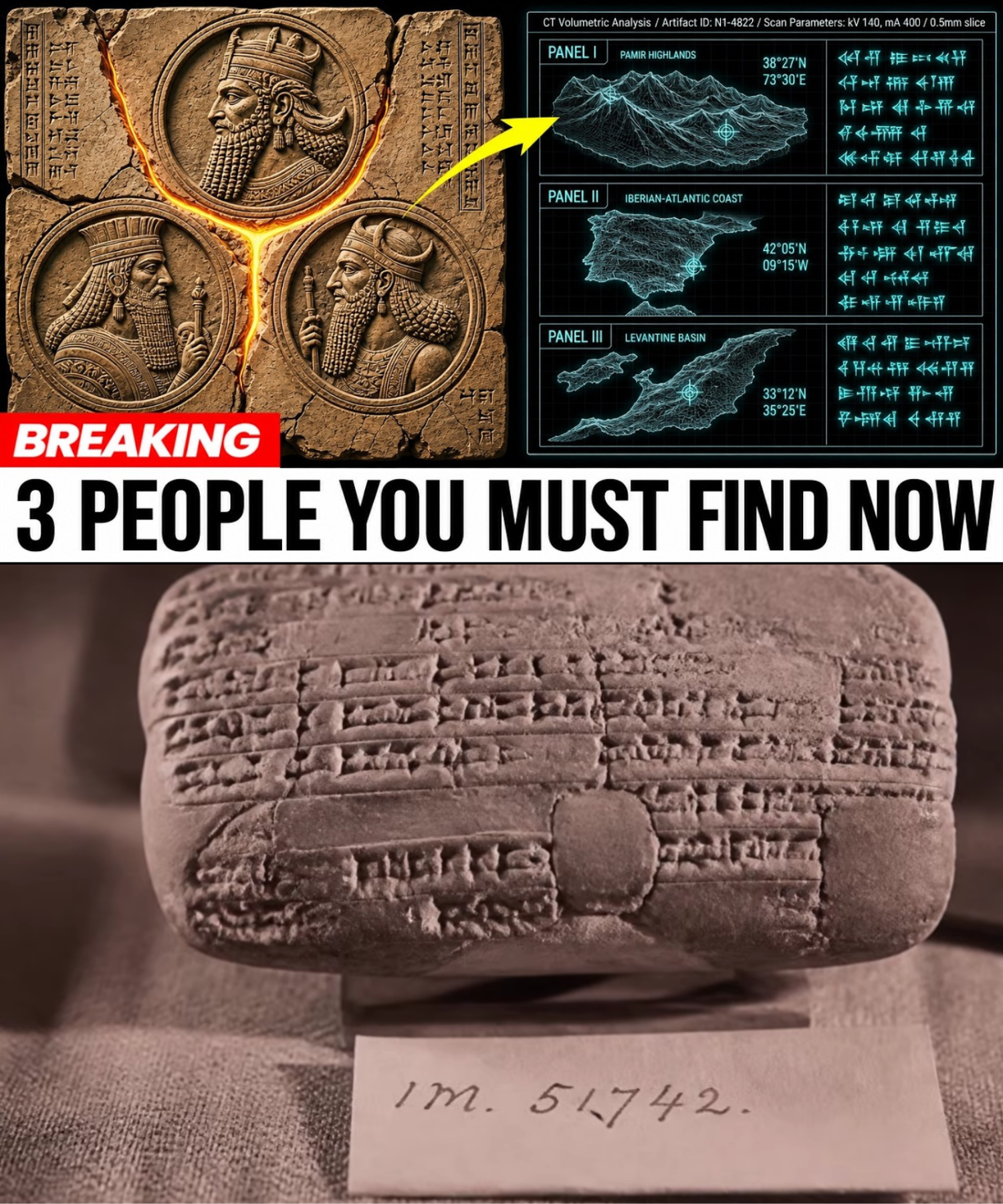
The viral claim says a Sumerian tablet reveals three people you must find before “they” return. It sounds like a prophecy from a buried temple, the kind of message a priest would hide beneath a city before the gods abandoned the earth. But the real mystery is not one clean tablet with a simple list. The real mystery is stranger. Across Sumerian and Mesopotamian tradition, three human figures appear again and again at the edge of divine contact. They are not ordinary kings. They are not gods. They stand in between.
One survives the destruction of the world.
One is offered eternal life and refuses it.
One is taken into heaven and receives the secrets of the gods.
Their names are Ziusudra, Adapa, and Enmeduranki.
And if you read the old texts symbolically, each one waits in a different place.
Ziusudra waits beyond the flood.
Adapa waits at the gate of heaven.
Enmeduranki waits where heaven and earth meet.
That is the pattern people are beginning to notice. Three men. Three thresholds. Three ancient locations. Three warnings about what humanity was given, what humanity lost, and what humanity may face again when the divine world returns to settle its account.
The first figure is Ziusudra, the flood survivor.
Long before later flood stories became famous across the world, the Sumerians preserved the memory of a king warned before catastrophe. The gods decide that a flood will sweep over the land. The text is damaged, broken, and incomplete, but enough survives to reveal the shape of the story. A king survives. A boat endures the waters. The storm lasts seven days and seven nights. When the sun god Utu appears again, Ziusudra opens the boat and offers sacrifice.
In later Mesopotamian tradition, this figure becomes closely connected with Utnapishtim, the immortal flood survivor in the Epic of Gilgamesh. Gilgamesh travels to find him because he wants the secret of eternal life. That is the crucial detail. The flood survivor does not simply represent survival. He represents hidden knowledge after judgment. He knows what the world was like before destruction. He knows why it ended. He knows what the gods did when humanity became too loud, too violent, too unbearable.
That is why Ziusudra is the first one you must “find.”
Not physically, as if he is hiding in a cave with a lantern. You must find what he represents: the witness who remembers the world before the flood. In mythic geography, he waits at the edge of waters, beyond ordinary human reach, in the place where survival became immortality. Some traditions connect the immortal flood survivor with a distant, sacred region, a place beyond the normal world, sometimes imagined near the rising sun. He is not in the city. He is not in the palace. He is not among the living crowd.
He waits beyond the disaster.
That matters because every civilization thinks the flood is behind it. But ancient myths often treat the flood as a warning, not merely a memory. Humanity can be destroyed when it becomes corrupt. Kings can lose their kingdoms. Cities can vanish beneath mud. Temples can fall silent. Human achievement can be erased so completely that only a survivor’s testimony remains.
To “find Ziusudra” is to find the memory of judgment before judgment returns.
If the old world ended once, why do we assume ours cannot?
The second figure is Adapa, the man who almost became immortal.
Adapa is one of the strangest figures in Mesopotamian myth. He is a sage of Eridu, connected with Ea, the god of wisdom and the deep waters. He is not simply clever. He is dangerously wise. In the myth, Adapa breaks the wing of the South Wind and is summoned before Anu, the high god of heaven. Before he goes, Ea warns him not to eat or drink anything offered there, telling him it will be the food and drink of death.
But when Adapa reaches heaven, Anu offers him the food and water of life.
Adapa refuses.
That refusal changes everything.
He had immortality placed before him, and because he trusted the warning of his divine master, he turned it away. Anu is astonished. The man could have crossed the boundary. He could have eaten life. He could have become something more than human. Instead, he is sent back to earth, mortal, wise, and forever marked by the thing he did not receive.
This is not just a story about a mistake.
It is a story about humanity’s lost chance.
Adapa waits at the gate of heaven because he is the man who reached the threshold and failed to pass through it. He saw the door open. He stood before the highest power. He was offered the thing every king, magician, hero, and grieving soul desires: life that does not end. But he refused because wisdom itself had become a trap.
That is the terrifying part.
Adapa was not destroyed by ignorance.
He was destroyed by obedience to the wrong instruction at the wrong moment.
In modern terms, Adapa is the human being trapped between knowledge and trust. He has wisdom, but not enough. He has access, but not freedom. He has the chance, but not discernment. He is close enough to immortality to smell it, yet he returns to earth empty-handed.
To “find Adapa” is to find the moment where humanity lost eternal life.
That is why he matters before the return. If the old powers come back, if the divine world opens again, if humanity once more stands at the gate between mortality and something beyond it, the question of Adapa returns with force. Will we recognize the food of life when it is offered? Or will we refuse the very thing we were created to desire?
The third figure is Enmeduranki, the king of Sippar.
His name appears in the ancient traditions of kings before the flood. Sippar was the city of the sun god, later associated with Shamash, the god of justice, light, and divination. Enmeduranki is remembered as a king who stood near the boundary of heaven and earth. Later Mesopotamian traditions say he was taken into the divine realm and taught secrets: the mysteries of heaven and earth, divination, signs, and sacred knowledge.
This makes him different from Ziusudra and Adapa.
Ziusudra survives catastrophe.
Adapa loses immortality.
Enmeduranki receives forbidden knowledge and brings it back.
He is the king as initiate, the ruler who sees behind the curtain. He is not merely a political figure. He becomes a bridge between cosmic order and human administration. If Ziusudra waits beyond the flood and Adapa waits at heaven’s gate, Enmeduranki waits at Sippar, the city of the sun, the place where divine light becomes law, omen, and interpretation.
To “find Enmeduranki” is to find the lost science of reading signs.
Ancient Mesopotamians did not see the universe as silent. They believed the gods wrote messages in stars, storms, dreams, animal livers, eclipses, births, disasters, and unusual events. The trained diviner did not invent meaning. He read it. In this worldview, history was not random. It was written across heaven and earth, and only those taught the secrets could understand it.
That is why Enmeduranki is so dangerous.
He represents knowledge that gives power over kings, cities, and decisions. A ruler who can read divine signs can claim authority beyond politics. A priestly tradition that traces itself to heavenly instruction can shape empires. The secret of Enmeduranki is not immortality. It is interpretation. Whoever controls the signs controls the future.
That may be the most modern warning of all.
We live in an age drowning in signs. Data, headlines, weather patterns, wars, markets, disease, artificial intelligence, surveillance, social unrest, collapsing trust, strange skies, ancient discoveries, and spiritual confusion all compete for interpretation. Everyone sees the signs. Few know how to read them. The danger is not that humanity lacks information. The danger is that humanity has lost wisdom.
Enmeduranki waits wherever signs are misunderstood.
Now the question becomes: why these three?
Because together they form a map of the ancient human condition.
Ziusudra shows that humanity can be judged.
Adapa shows that humanity can lose immortality.
Enmeduranki shows that humanity can receive forbidden knowledge.
Flood. Death. Secrets.
These are the three doors of the old world.
The flood survivor tells us what happened when civilization became unbearable to the gods. The sage of Eridu tells us what happened when a human reached heaven and failed to receive life. The king of Sippar tells us what happened when heaven shared its knowledge with earth. Together, they create a pattern that feels less like isolated myth and more like a warning system.
Before “they” return, you must find the survivor, the failed immortal, and the initiated king.
But who are “they”?
In viral retellings, “they” often means the Anunnaki, the gods of Mesopotamian tradition, imagined by modern audiences as returning beings from the sky. Some describe them as gods. Others as ancient astronauts. Others as fallen powers, watchers, or divine rulers who once shaped civilization. Ancient texts themselves are complex and do not support every modern claim made about them. The Anunnaki are not a simple alien species in the original myths. They are divine beings of the Mesopotamian religious world, connected with heaven, earth, underworld, judgment, and cosmic authority.
But the emotional force of the return idea is real.
Ancient Mesopotamian myths often describe a time when gods and humans were closer. Kingship descended from heaven. Sages taught humanity. Floods came from divine decision. Heaven could be entered. Immortality could be offered. Secrets could be received. In those stories, the boundary between divine and human was not fixed in the way modern people assume. It opened, closed, punished, and transformed.
So the fear is this: if that boundary opened once, could it open again?
And if it did, would humanity be ready?
That is where the three figures become more than characters.
They become tests.
Ziusudra asks whether we remember judgment.
Adapa asks whether we can recognize life.
Enmeduranki asks whether we can read signs without becoming proud.
Fail all three, and the return becomes disaster.
Modern people often think ancient myths are primitive attempts at science. That view is too shallow. Myths are not laboratory reports, but they are not meaningless. They preserve fears, patterns, moral warnings, cosmic structures, and memories of human crisis. A myth can be untrue as a newspaper report and deeply true as a map of the soul. The point is not that Ziusudra, Adapa, and Enmeduranki are waiting in physical coordinates with passports and secret keys. The point is that each one waits in the part of human history we keep trying to forget.
Ziusudra waits in every ruined city that thought it could not fall.
Adapa waits in every human heart that stands before life and chooses the wrong master.
Enmeduranki waits in every age that has information but no wisdom.
That is why the “tablet” matters even if the viral claim exaggerates it. The old Mesopotamian texts do reveal something. Not a treasure map in the modern sense, but a spiritual geography. They tell us where to look if we want to understand humanity’s ancient danger.
Look to the waters.
Look to the gate.
Look to the sun-city.
The waters are where judgment came and one survivor remembered.
The gate is where immortality was offered and refused.
The sun-city is where heavenly secrets entered human rule.
These locations are not random. Water, gate, and sun are among the oldest symbols in human religion. Water destroys and renews. Gates separate worlds. The sun reveals, judges, and measures time. The three people are attached to three cosmic functions: survival, choice, and revelation.
This is why the story feels so powerful.
It is not only about Sumer.
It is about us.
We are still afraid of floods, even if our floods are climate, war, debt, disease, migration, social collapse, or spiritual darkness. We are still obsessed with immortality, now through technology, medicine, cryonics, genetic engineering, and digital consciousness. We are still desperate to read signs, using data models, algorithms, prophecy channels, intelligence reports, market forecasts, and artificial intelligence as modern omens.
We have become Sumer again, but with brighter screens.
The gods have different names now.
Power. Progress. AI. Empire. Science. Security. Wealth. Nation. Self.
But the old questions remain.
Can civilization survive its own corruption?
Can humanity receive life without being deceived?
Can knowledge be carried without becoming poison?
The three figures answer with their lives.
Ziusudra says survival is possible, but only when warning is heard before destruction.
Adapa says wisdom can still fail if it lacks truth.
Enmeduranki says knowledge from above can guide or corrupt depending on who holds it.
This is the deeper warning before “they return.”
Maybe the return is not only about ancient gods descending in fire. Maybe the return is the return of the same conditions that made the old myths necessary. The return of flood-level corruption. The return of immortal ambition. The return of forbidden knowledge. The return of kings and priests claiming secret access to higher powers. The return of humanity standing between heaven and earth, more powerful than wise.
In that sense, the three people have already returned as questions.
Ziusudra is asking whether we see the flood coming.
Adapa is asking whether we know what life really is.
Enmeduranki is asking whether we can interpret signs without worshipping ourselves.
That is why the article’s title feels like a warning. “You must find them” does not mean launching an expedition with shovels and drones. It means recovering the memory each one carries before our own civilization repeats the old pattern.
Find Ziusudra before the flood becomes unavoidable.
Find Adapa before humanity refuses true life for false safety.
Find Enmeduranki before knowledge becomes a throne for the proud.
Where does each wait?
Ziusudra waits in the place beyond disaster, where only the humbled survive.
Adapa waits at the gate of heaven, where humanity must choose between deception and life.
Enmeduranki waits in the city of the sun, where signs are read and judgment becomes visible.
And if the ancient powers return—whether as myth, history, technology, empire, or spiritual reality—the one thing we cannot say is that we were never warned.
The clay warned us.
The flood warned us.
The lost food of life warned us.
The king taken into heaven warned us.
The old tablets may not give a modern countdown, but they give something more unsettling: a pattern. They say the world has faced judgment before. They say humanity once stood close to immortality and lost it. They say heavenly knowledge entered human hands and changed civilization forever.
That is enough to make the past feel alive.
And perhaps that is the real secret of the tablet.
It does not tell us to search the desert for three bodies.
It tells us to search history for three wounds.
The wound of destruction.
The wound of mortality.
The wound of knowledge without holiness.
Until those are healed, every civilization is only waiting for the old story to begin again.