Scientists Finally Opened the Sumerian “Handbag of the Gods” and the Discovery Is Disturbing
Scientists Finally Opened the Sumerian “Handbag of the Gods” and the Discovery Is Disturbing
For thousands of years, it was hiding in plain sight.
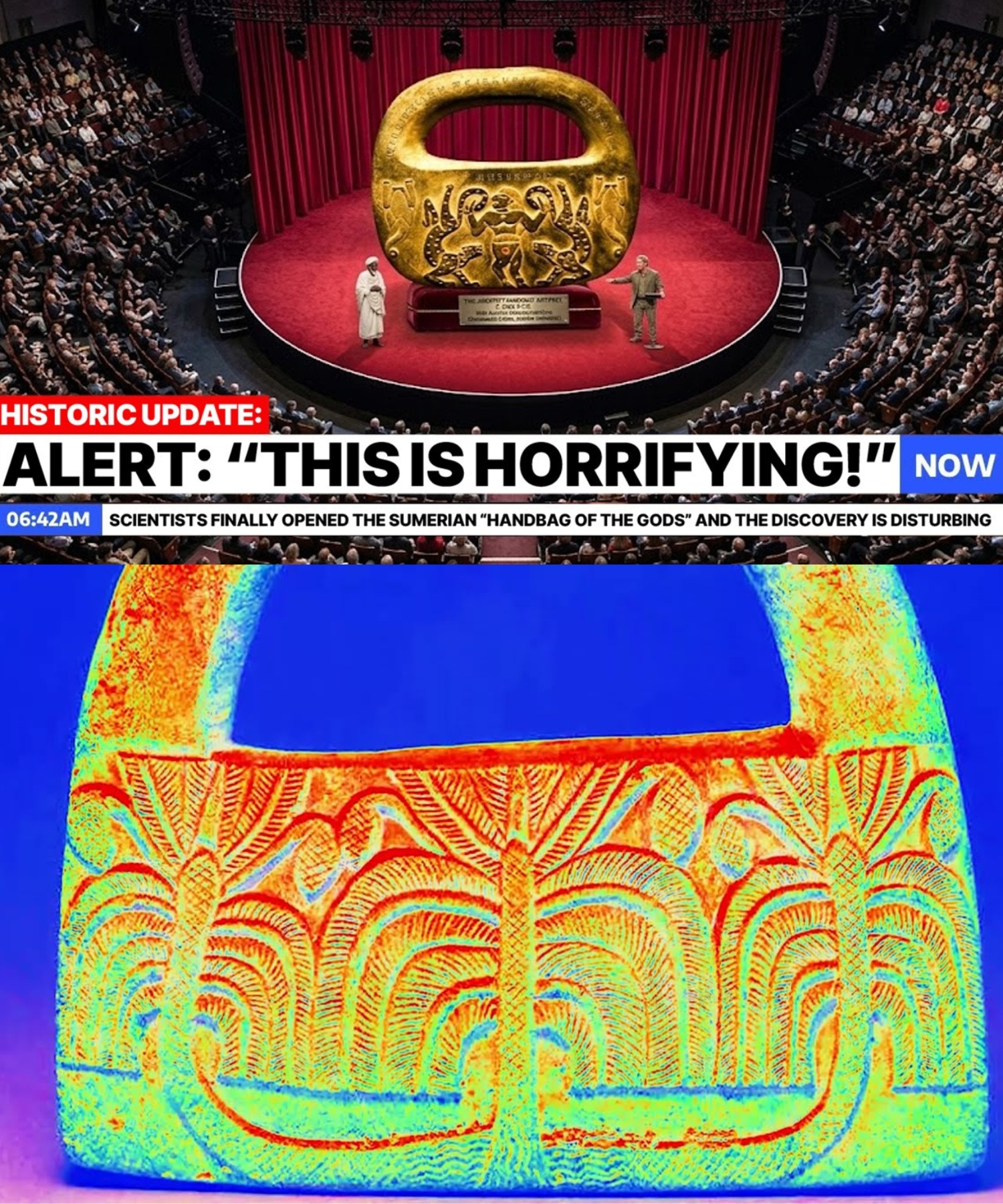
Carved into palace walls, held in the hands of winged beings, carried beside sacred trees, kings, and divine symbols, the object looked strangely familiar. It had a handle. It had a boxlike body. It looked almost exactly like a handbag. And for modern viewers, that was the most unsettling part. Why would gods, sages, and supernatural guardians from ancient Mesopotamia be carrying something that looked as if it belonged in a modern city street?
For decades, people stared at the carvings and felt the same uncomfortable shock.
The figure was ancient.
The object looked modern.
That single detail was enough to ignite theories across the world. Some called it the “handbag of the gods.” Others claimed it was proof of lost technology, forgotten science, or a mysterious connection between civilizations separated by oceans and thousands of years. The same strange shape seemed to appear in Mesopotamian reliefs, Mesoamerican art, and other ancient imagery. To some, it was only a coincidence. To others, it was a clue left by a world that knew far more than we had been told.
But when scientists and historians finally began to “open” the mystery of the so-called handbag, the answer did not make the object less disturbing.
It made it more disturbing.
Because the artifact was never just a bag.
It was a tool of purification.
A container connected to ritual power.
A symbol carried by beings who were not ordinary men.
And the more researchers studied it, the more it seemed to reveal something chilling about the ancient Mesopotamian mind: their world was filled with invisible dangers, and the “handbag” may have been part of a spiritual defense system designed to protect kings, temples, palaces, and perhaps civilization itself from forces they believed were always waiting at the edge of order.
The object often appears in the hands of supernatural figures known by many scholars as apkallu, ancient wise beings or protective spirits connected to Mesopotamian tradition. Sometimes they are human-headed and winged. Sometimes they have the head of a bird. Sometimes they wear fish-like garments, giving them an appearance so strange that even modern museum visitors pause in front of them.
These figures do not look like ordinary servants.
They look like guardians.
They stand beside palace doors, sacred trees, royal scenes, and ritual spaces. Their bodies are carved with precision. Their muscles are tense. Their wings are powerful. Their clothing is covered with patterns and symbols. One hand often holds a cone-like object. The other carries the bucket that modern audiences have nicknamed the handbag.
At first glance, the scene can look almost peaceful, even decorative.
But ancient Mesopotamian art was rarely just decoration.
The palaces of Assyria and Mesopotamia were built as political theaters, religious machines, and magical fortresses. Walls did not merely display power; they performed power. Images were not simply pictures; they were part of a living system of protection. The king did not rule only in a political world. He ruled in a universe crowded with gods, demons, omens, curses, spirits, blessings, and terrifying unseen forces.
In that world, a carved guardian holding a bucket was not background art.
It was a warning.
It told every visitor who crossed the threshold that the palace was protected by powers older than any army. It told enemies, spirits, and perhaps even the king himself that this space had been ritually guarded. The “handbag” was not an accessory. It was part of a cosmic security system.
That is where the discovery becomes disturbing.
Modern people often imagine ancient religion as simple myth. They picture gods in the sky, priests in temples, and rituals performed for harvests or victory. But Mesopotamian religion was far more intense than that. It was a constant negotiation with a universe believed to be alive with danger. A sickness might be caused by a demon. A failed crop might signal divine anger. A strange birth, an eclipse, or a malformed animal could be read as an omen. A king’s mistake could threaten the balance between heaven and earth.
Fear was not separate from faith.
It was woven into daily life.
The bucket, known in Akkadian as a ritual vessel, is often associated with purification. The cone or purifier held in the other hand may have been dipped into the liquid inside the bucket and used to sprinkle or bless a person, object, doorway, or sacred tree. Some scholars have suggested that the cone may resemble the male part of a date palm, linking the image to fertility and renewal. Others emphasize its purifying and protective meaning.
Either way, the message is clear: something had to be cleansed.
Something had to be guarded.
Something invisible had to be kept away.
And that is what changes the entire way we see the “handbag of the gods.” It was not a mysterious purse carried by ancient astronauts. It was not proof that gods needed luggage. It was a ritual container tied to the ancient fear that corruption, pollution, and evil could enter the world through unprotected spaces.
Doorways mattered.
Palace walls mattered.
Trees mattered.
Kings mattered.
Every boundary between one space and another could become dangerous. Every threshold could be an opening. And if an opening existed, something could pass through it.
That idea haunted Mesopotamian civilization.
The people of Sumer, Akkad, Babylon, and Assyria built some of the earliest cities in human history. They invented writing systems, recorded laws, tracked stars, organized armies, built temples, and created administrative systems of stunning complexity. Yet beneath all that order was a deep anxiety. Civilization was fragile. Floods came. Droughts came. Invaders came. Disease came. Kings died. Cities burned. Gods could withdraw favor. Demons could slip through cracks in the human world.
To build a city was to challenge chaos.
To protect a city, one needed more than walls.
One needed ritual.
The so-called handbag belonged to that struggle. It represented not technology in the modern sense, but spiritual technology: a device, symbol, and ritual tool through which ancient people attempted to manage invisible danger. It was a container of sacred liquid, purification, blessing, and control.
But why does that feel disturbing?
Because it reveals a world where people believed danger was everywhere.
Not metaphorically.
Literally.
In Mesopotamian thought, the universe was not empty space. It was crowded. The unseen was not imaginary; it was active. Spirits, demons, gods, and omens pressed against the boundaries of human life. A palace could be magnificent and still vulnerable. A king could be powerful and still terrified. A temple could be holy and still require constant protection.
That is why protective figures were placed near entrances.
They stood watch where worlds met.
The “handbag” was often shown in precisely these charged spaces, where the human and divine, the clean and unclean, the protected and the dangerous, came close together. The image says something that modern people may find hard to accept: the ancient world did not believe safety was natural. Safety had to be made. It had to be performed, repeated, carved, spoken, sprinkled, sealed, and guarded.
The palace was not safe because it was strong.
It was safe because rituals made it strong.
This is the deeper shock behind the discovery. When scientists and historians “opened” the meaning of the object, they did not find a simple explanation that killed the mystery. They found a doorway into an entire system of fear, order, power, and supernatural protection.
The handbag was not strange because it looked modern.
It was strange because it belonged to a worldview that modern people have almost forgotten.
A worldview where evil was not merely a human choice, but a force. Where pollution could be spiritual. Where a king’s body, a temple doorway, or a sacred tree could become a battlefield between order and chaos. Where ritual objects were not symbolic props but instruments of cosmic maintenance.
And perhaps that is why the image continues to disturb us.
We do not live in the same world as the Mesopotamians. We do not read the liver of a sheep to predict royal danger. We do not place clay figurines beneath palace thresholds. We do not carve winged guardians into the walls of government buildings and expect them to repel demons.
Or at least, we tell ourselves we do not.
But modern life has its own rituals of protection. We lock doors. We scan faces. We encrypt information. We install cameras, passwords, alarms, firewalls, and surveillance systems. We cleanse spaces with law, technology, medicine, and architecture. We create invisible barriers everywhere. The ancient Mesopotamians used ritual buckets and protective spirits. We use code, steel, and data.
The fear beneath both worlds may not be so different.
Something dangerous is outside.
Something must be kept away.
That uncomfortable connection is what makes the “handbag of the gods” more than an archaeological curiosity. It becomes a mirror between ancient fear and modern fear. The object forces us to admit that human beings have always lived with the suspicion that the world is not fully safe.
The ancient reliefs show gods and sages carrying protection.
Modern people carry devices that promise the same thing.
The disturbing part is not that the ancients were superstitious.
The disturbing part is that we may still be more like them than we think.
There is another layer to the mystery. The figures holding these ritual buckets are often connected to wisdom from before the flood, ancient sages who were believed to have taught humanity important arts and knowledge. In Mesopotamian tradition, civilization itself was not merely invented by humans struggling alone. It was given, revealed, guided, or protected by beings associated with divine knowledge.
That means the “handbag” may also point to a question much larger than one object.
Where did civilization come from?
The Sumerians and their neighbors did not see writing, kingship, ritual, farming, temples, and law as ordinary inventions. They saw them as sacred gifts, dangerous gifts, powerful gifts. Knowledge was not neutral. It could build cities, but it could also bring judgment. It could organize society, but it could also corrupt rulers. It could connect humans to gods, but it could also open doors that should remain closed.
This is where the story becomes truly unsettling.
The bucket and cone may represent purification, fertility, and protection, but they are carried by beings who stand between worlds. They are not fully human. They are linked to wisdom, ritual, and supernatural power. They appear in spaces where the king’s authority is being reinforced and sanctified. They suggest that power itself had to be cleansed, watched, and defended.
In other words, even the king was not safe from contamination.
Even the ruler needed protection.
Even the palace needed purification.
That is a terrifying political idea.
The Assyrian kings were among the most powerful rulers of the ancient Near East. Their armies conquered cities. Their inscriptions boasted of victories. Their palaces were designed to overwhelm anyone who entered. Yet on the walls of those same palaces, supernatural figures endlessly repeated acts of protection.
Why would such powerful kings need so much guarding?
Because in Mesopotamian thought, power attracted danger.
A king stood closer to the gods than ordinary people, but that also meant he stood closer to judgment. His body, palace, and decisions carried cosmic weight. If he failed, the land could suffer. If he was cursed, the kingdom could weaken. If impurity entered his world, the balance between heaven and earth might tremble.
So the guardians stood in stone.
And the bucket remained in their hand.
The “handbag” was not cute. It was not casual. It was not random.
It was a silent part of the machinery of kingship.
Every carved figure holding the bucket seemed to repeat the same message: this place is watched, this ruler is guarded, this threshold is sealed, this order must not collapse.
That message becomes even more powerful when we remember where many of these reliefs were found: ancient palaces like the Northwest Palace at Nimrud, built to project imperial power. Visitors entering these spaces would have been surrounded by images of kings, gods, protective spirits, sacred trees, and inscriptions declaring royal achievements. The architecture itself was meant to make a person feel small.
But the protective figures reveal a hidden weakness inside that power.
The empire feared what it could not see.
That is the disturbing discovery at the center of the handbag mystery. The object is not disturbing because it proves some wild fantasy. It is disturbing because it proves something real: one of the greatest civilizations of the ancient world lived with a constant sense that reality had to be ritually defended.
The bucket carried by the gods was a container of order in a universe always threatening to return to chaos.
That meaning is far more haunting than any simple conspiracy.
It also explains why the object appears again and again. Repetition was part of its force. In modern museums, we may see one relief at a time, isolated behind glass. But in ancient palaces, these figures appeared in sequence. They formed a visual rhythm. One guardian after another. One bucket after another. One act of purification after another. The viewer was not seeing a single image, but entering an environment saturated with supernatural protection.
Imagine walking through such a palace.
The stone eyes of winged beings follow you. Their hands hold the bucket and cone. Their wings fill the walls. Cuneiform inscriptions cut across their bodies like spells in stone. The king’s power is everywhere, but so is the warning that power depends on forces beyond human control.
That experience would not have felt like decoration.
It would have felt like entering a guarded universe.
The more we understand the handbag, the less simple it becomes. It is a vessel, but also a symbol. It is connected to water, but also purification. It appears beside trees, but also beside kings. It is carried by beings of wisdom, but also by protective spirits. It belongs to ritual, but also politics. It reflects fear, but also hope.
It is disturbing because it sits at the intersection of everything ancient Mesopotamia believed about survival.
The world is dangerous.
Order is fragile.
Knowledge is sacred.
Power must be purified.
The unseen is real.
Protection must be renewed.
That is not a small message to carry in a carved bucket.
So why do modern people keep calling it a handbag?
Because the human eye reaches for what it knows. We see a handle and a container, and we compare it to something familiar. That familiarity creates the shock. It collapses the distance between now and then. It makes the ancient figure feel strangely close, as if it has stepped out of a lost world carrying an object from ours.
But the real meaning moves in the opposite direction.
The object is not modern.
It invites us to become ancient for a moment.
To see the world as Mesopotamians saw it: alive, unstable, sacred, dangerous, watched by powers, threatened by chaos, and held together through ritual acts that had to be performed again and again.
That may be the discovery that unsettles people most.
The “handbag of the gods” is not evidence that ancient people were visited by modern technology. It is evidence that ancient people developed a sophisticated symbolic language for dealing with invisible fear. They built cities, wrote laws, and organized empires, yet they still believed the world could be spiritually polluted. They had mathematics and astronomy, yet they also guarded doorways with supernatural figures. They were not primitive. They were complex.
And complexity is always more disturbing than fantasy.
Fantasy gives us a simple answer: aliens, lost machines, secret devices.
History gives us something harder: human beings, afraid and brilliant, trying to hold back chaos with every tool they had.
The bucket was one of those tools.
The more scientists study it, the more it stops being a meme and becomes a key to the ancient mind. It tells us that Mesopotamian civilization was not built only on irrigation, trade, writing, and warfare. It was also built on ritual protection. The empire needed accountants, soldiers, farmers, and scribes, but it also needed guardians. It needed symbols that could stand between order and disaster.
That makes the “handbag” one of the most misunderstood objects in ancient art.
Not because no one can explain it.
Because the explanation is darker than people expected.
It was not a bag of treasures.
It was not a fashion accessory of the gods.
It was a ritual vessel carried by beings who existed to purify, bless, defend, and warn.
And the warning may be the part that still speaks loudest.
Every civilization believes it has defeated chaos. Every empire thinks its walls are strong enough. Every age believes its knowledge makes it safer than the one before. But the Mesopotamians carved a different truth into stone. They knew that order must be protected constantly. They knew that power without purification becomes dangerous. They knew that the visible world is never the whole world.
The winged figures still stand in museum halls today, silent and severe.
Their empires are gone.
Their kings are dust.
Their temples are broken.
But the object remains in their hands.
A bucket.
A purifier.
A “handbag” that was never a handbag.
And once its meaning is opened, it leaves behind a disturbing thought: perhaps the ancients were not trying to show us what the gods carried.
Perhaps they were trying to show us what humanity feared.