Romans Were Eating in His Stable…In 1986
Romans Were Eating in His Stable… In 1986
Part 1
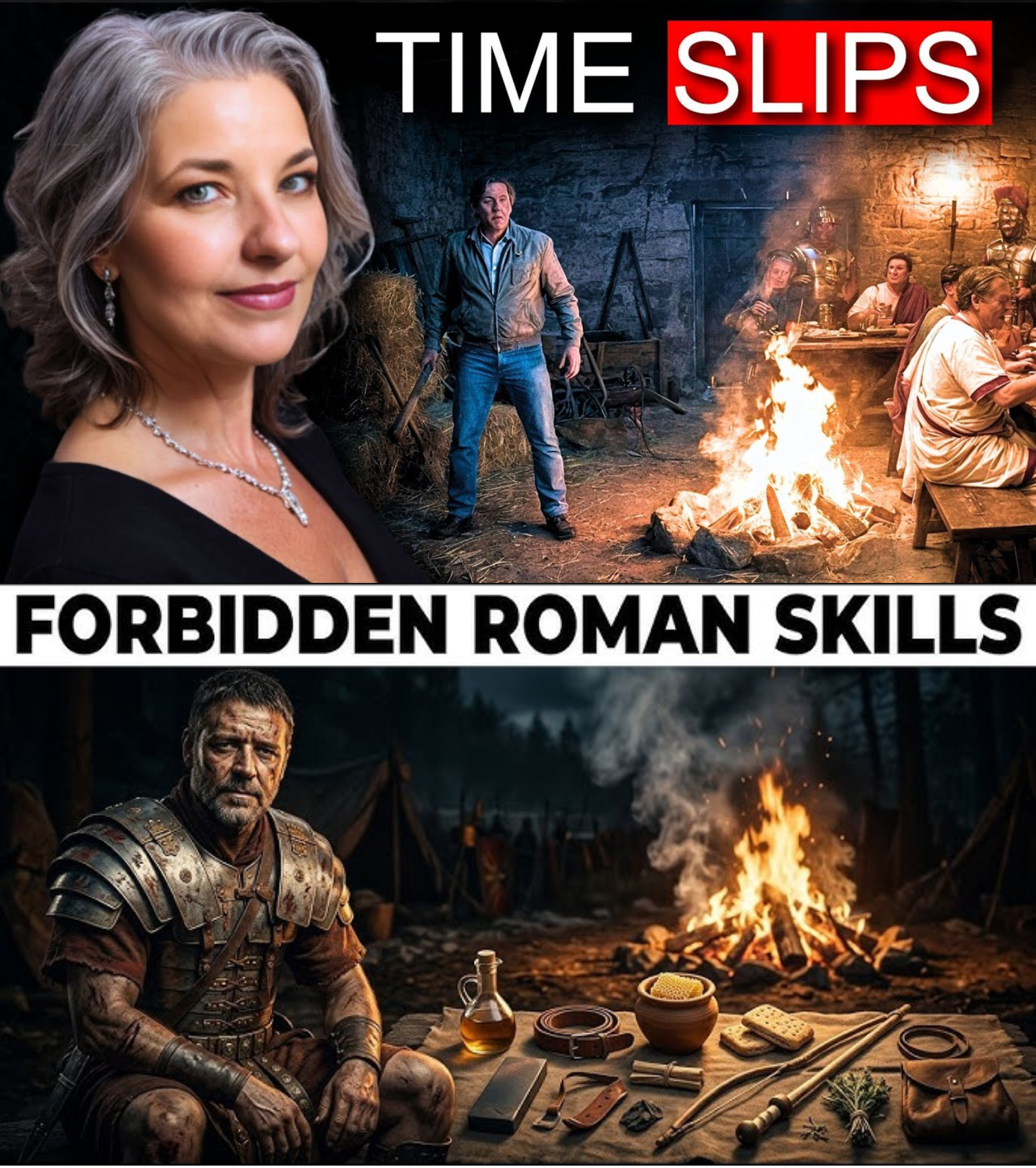
In the winter of 1986, Henry Calloway was living alone on a farm outside Ashland, Ohio, in a white farmhouse with peeling shutters, a leaning red stable, and forty-seven acres of frozen field nobody in his family wanted anymore. His wife had died the year before, his daughter Ellen had moved to New York, and his son David had gone west to Los Angeles chasing stunt work and neon dreams. Henry was seventy-one, stubborn as fence wire, and the kind of man who believed every strange noise had a practical explanation until the night he opened his stable door and found six Roman soldiers sitting in the hay, eating bread by lantern light.
At first, he thought it was a prank. The men wore rough wool tunics, leather armor, and sandals that made no sense in an Ohio January. Their cloaks were dark with rain, though no rain had fallen that night. A bronze helmet rested beside a feed bucket. One man had a short sword strapped to his waist. Another was holding a clay cup and staring at Henry as if Henry were the strange one. They had built no fire, yet steam rose from their clothes. On the floor between them lay a round loaf, olives, dried fish, and something like cheese wrapped in linen. The stable smelled wrong too—not just of hay, manure, and old wood, but of smoke, iron, sweat, and a dry foreign dust that reminded Henry of old church incense.
Henry lifted his shotgun, though his hands shook badly.
“Who the hell are you boys?” he said.
The tallest soldier stood slowly. He was broad-shouldered, bearded, with tired eyes and a scar down his left cheek. He spoke in a language Henry did not understand. Latin, Henry would later learn, though at that moment it sounded like rocks rolling in a river. The man pointed toward the stable door, then toward the sky, then pressed his palm against his own chest.
Henry did not shoot. Something in the man’s face stopped him. The soldier looked frightened, not dangerous. The others watched Henry with the same expression Henry had seen in young men during Korea: hungry, exhausted, lost, trying not to show fear.
Henry backed away and slammed the stable door shut.
He stood in the snow for nearly a minute, breathing hard, shotgun clutched to his ribs. Then he ran to the farmhouse and called Sheriff Dodd.
By the time the sheriff arrived, the stable was empty.
The hay was disturbed. The clay cup remained near the feed bucket. The bread was gone. In the mud near the door were footprints—not boot prints, not modern tread, but flat sandal marks pressed into half-frozen earth. Sheriff Dodd stared at them, then at Henry.
“You been drinking tonight?”
Henry had not touched liquor in twenty-three years.
The sheriff took the cup anyway. Two days later, he returned it with a tight, embarrassed expression. “Lab says it’s old clay,” he said. “Could be some antique thing. Maybe from a collector.”
“Collector walked through my snow wearing Roman sandals?”
Sheriff Dodd sighed. “Henry, I don’t know what you saw.”
Henry did not tell anyone else for three weeks. Then the Romans came back.
This time, there were only three of them, and one was bleeding.
Part 2
The second appearance happened during a blizzard so heavy that the entire county seemed erased. Henry had gone to the stable to check on his old mare, Ruth, when he heard voices from inside—low, urgent, panicked voices. He opened the door and found three Romans crouched near the wall, one lying on his back with a wound across his stomach. Blood had soaked into the hay. The tall soldier with the scar was there again, kneeling beside him. When he saw Henry, he raised both hands, pleading.
Henry should have run. Instead, he fetched towels, iodine, and the first-aid kit from the farmhouse.
The wounded man cried out when Henry pressed cloth against the wound. He was young, no older than twenty. His face was gray, lips trembling, eyes fixed on the stable rafters as if he expected them to become a sky. Henry muttered uselessly in English while the scarred soldier spoke rapidly in Latin. Ruth the mare stood strangely calm in her stall, watching.
Henry had been a medic in Korea before he became a farmer. He knew when a wound was bad. The young Roman was dying.
“Damn it,” Henry whispered. “What are you boys doing here?”
The scarred soldier seemed to understand the tone if not the words. He touched the wounded man’s forehead, then took something from around his own neck and pressed it into Henry’s palm. It was a small bronze token stamped with an eagle and letters Henry could not read. Then the air in the stable changed. The lantern flame bent sideways though there was no wind. The walls seemed to stretch away, and for one impossible second Henry saw beyond the stable—not Ohio, not snow, but a dry road under a brutal sun, stone buildings, shouting men, dust, and a hill in the distance with three dark shapes raised against the sky.
Then everything snapped back.
The wounded Roman was gone. The scarred soldier was gone. The blood remained.
That was when Henry called Ellen in New York.
His daughter answered from a cramped apartment in Queens, irritated because it was almost midnight and she had work in the morning. Henry had never been good at explaining feelings, let alone miracles or madness. He told her men were appearing in the stable. Men dressed as Romans. He told her about the wound, the blood, the token, the road, the hill. Ellen went quiet for a long time.
“Dad,” she said carefully, “are you sleeping?”
“I know what I saw.”
“You’ve been alone too much.”
“I know what I saw.”
The next weekend she drove from New York to Ohio, bringing her twelve-year-old daughter Claire, because no babysitter was available and because Ellen secretly feared Henry was losing his mind. Claire was sharp-eyed, restless, and fascinated by anything adults tried to explain away. She found the bronze token in Henry’s kitchen drawer before dinner and asked why it had Latin on it.
Ellen froze. “You can read that?”
Claire shrugged. “A little. We’re doing ancient Rome in school.”
Henry leaned forward. “What does it say?”
Claire squinted at the token. “Something like… Legio X. Tenth Legion, maybe.”
Ellen looked at her father. Henry looked back without triumph. He only looked tired.
That night, Claire insisted on sleeping in the room facing the stable. Around 2 a.m., she woke to a warm orange glow moving beneath the stable door. She shook her mother awake. Ellen told her to go back to sleep. Then they both heard it: laughter. Men laughing. Cups striking wood. A song rising in a language neither of them understood.
Henry was already outside with his coat over pajamas, moving through the snow like a man walking toward judgment.
When they opened the stable door, the Romans were there again.
And this time, they were not alone.
At the far end of the stable stood a woman in a dark veil, holding a baby wrapped in cloth.
Part 3
Ellen screamed, not loudly, but with the strangled sound of a person whose world has refused to remain solid. The Romans turned at once. One reached for his sword. The scarred soldier barked a command, and the man stopped. The veiled woman did not move. She stood near Ruth’s stall, impossibly calm, her face half-hidden, the baby sleeping against her chest.
Claire stepped forward before anyone could stop her.
The woman looked at the girl, and Claire later swore the air became warm around them, as if summer had entered the stable through an invisible door. The baby stirred. One of the soldiers crossed himself—but not the way Catholics did. It was older, awkward, almost secretive.
Henry whispered, “Who is she?”
No one answered.
Then the scene flickered. The stable walls blurred. For a heartbeat, Henry’s Ohio barn became another stable—lower, darker, built from stone and mud, smelling of animals and straw. Outside it, men shouted in a language that sounded like danger. Hooves struck ground. A torch passed by an opening in the wall. The scarred soldier stood between the woman and the door, sword drawn, not as an enemy but as a guard.
Then the Ohio stable returned.
The woman was gone. The baby was gone. The Romans vanished with her.
Ellen dropped to her knees in the hay, shaking. Claire began to cry. Henry stood frozen, staring at the place where the woman had been. On the floor lay a strip of dark blue cloth.
Ellen wanted to burn it. Claire begged to keep it. Henry placed it in an old cigar box with the bronze token and the clay cup. By morning, Ellen had made up her mind. She called a professor she knew from a publishing house in New York, a historian named Dr. Miriam Vance who specialized in Roman military records and early Christianity. Miriam thought Ellen was describing either a hoax or a psychological break, but when Ellen mentioned the token, the clay cup, and the blue cloth, Miriam asked for photographs.
Two days later, Miriam arrived in Ohio with equipment, notebooks, and a face that grew more unsettled with every item she examined.
“The token could be forged,” she said. “The cup could be antique. The cloth…” She paused. “The weave is wrong for anything modern I know.”
Henry folded his arms. “Wrong how?”
“Too old.”
Miriam arranged for tests through a private lab in New York. The results did not make the situation clearer. The cup appeared ancient. The bronze token’s corrosion was consistent with extreme age. The cloth contained traces of dust and pollen from a dry Mediterranean environment.
Ellen accused Miriam of encouraging Henry’s delusion. Miriam snapped back, “I came here to disprove it.”
Claire, listening from the hallway, wondered why adults became angry whenever reality got larger.
For weeks, nothing happened. No voices. No glow. No Romans. Miriam stayed in Ohio longer than planned, sleeping in the guest room, recording temperature changes in the stable, interviewing Henry, Ellen, and Claire separately. By early March, she had nearly convinced herself the appearances were tied to grief, stress, and suggestion.
Then Los Angeles entered the story.
David Calloway, Henry’s son, came home from California after Ellen called him in tears. He arrived in a leather jacket, sunglasses, and skepticism so thick it might as well have been armor. David had spent fifteen years working on movie sets, watching fake blood, fake ruins, fake miracles. He walked into the stable, looked around, and laughed.
“You people seriously lost it.”
That night, the Romans returned while David was inside alone.
They did not come laughing this time. They came running.
Part 4
David burst from the stable pale as flour, bleeding from a cut over his eyebrow, and shouting that something was coming through the walls. Behind him, the stable shook hard enough to knock snow from the roof. Henry, Ellen, Claire, and Miriam ran outside as a sound like distant thunder rolled beneath the ground. The stable door flew open, and for the first time the vision spilled out into the yard.
Not fully. Not clearly. But enough.
A Roman street shimmered through the falling snow like a film projected onto smoke. Men ran past with torches. A horse reared. Somewhere a woman screamed. The scarred soldier stumbled into view, dragging another man by the arm. Behind them, shadows moved—figures in darker armor, not Roman, not familiar, pressing forward through chaos. The scarred soldier looked directly at Henry and shouted one word.
“Porta!”
Miriam, shaking, translated automatically. “Gate.”
The vision collapsed. The yard became Ohio again. David sat in the snow, staring at his hands. “That wasn’t a trick,” he whispered. “I know tricks. That wasn’t one.”
After that, the family stopped asking whether the stable was haunted and started asking why the stable was open.
Miriam’s research led to a bizarre possibility. Henry’s farm sat near an old glacial fault line, not dangerous but geologically unusual. Beneath the stable was limestone, iron-rich groundwater, and a layer of magnetic stone. Marcus Hale, a geologist from Ohio State, came to test the ground and found electromagnetic spikes inside the stable at irregular intervals. He did not believe in time portals. He believed in instruments. But the instruments behaved badly in the stable. Compasses spun. Cameras glitched. Audio recordings captured faint Latin when no one was speaking.
Miriam found another clue in Roman records. A fragmentary late antique text mentioned a missing group of soldiers from Legio X who vanished while escorting a woman and child through a rural outpost during a period of unrest. The record was incomplete, dismissed by scholars as a copying error or legend. But one phrase matched the word the scarred soldier had shouted: porta in stabulo—gate in the stable.
The stable was not sending Henry visions at random. It was overlapping with another stable, another time, another crisis. The Romans eating in 1986 were not ghosts. They were travelers caught at the edge of two worlds.
David wanted to call television people in Los Angeles. Ellen threatened to never speak to him again if he did. Miriam warned that publicity would destroy the site and possibly endanger whatever connection existed. Henry said nothing. He had become strangely protective of the Romans, especially the scarred soldier. A farmer knows the look of animals caught in storms. A veteran knows the look of men caught in history.
Claire spent more time in the stable than anyone allowed. She sat near Ruth’s stall with a notebook, writing down sounds. She began recognizing repeated Latin words: bread, road, danger, child, gate, mercy. One evening, she heard singing before anyone else. She opened the stable door and found the scarred soldier alone, sitting on an overturned bucket. He looked older than before, though only weeks had passed in Ohio.
Claire did not run. She held out an apple.
The soldier stared at it, then smiled faintly. “Malum,” he said.
“Apple,” Claire answered.
He pointed to himself. “Cassianus.”
“Claire.”
That was how they learned his name.
Cassianus visited three more times before April. Each time, he seemed less like an apparition and more like a man trying to survive a puzzle God had not explained to him. Through gestures, drawings, Miriam’s Latin, and Claire’s patience, they pieced together his story. He had been assigned to guard a woman and child fleeing violence. His unit found shelter in a stable. A strange light opened. Sometimes it led to Henry’s farm. Sometimes it did not. Time moved unevenly. For Cassianus, only days had passed.
“Who is the woman?” Miriam asked one night.
Cassianus looked at the ground. He made the sign again, older and awkward, touching forehead, chest, shoulders. Then he said a name.
“Mariam.”
No one spoke.
Even David, who had mocked everything, went silent.
Part 5
By summer, Henry’s farm had become the center of a secret held by six people and one old mare. New York had Miriam’s lab results. Ohio had the stable. Los Angeles had David’s growing fear that the story was too big to keep hidden forever. Claire had Cassianus, who appeared often enough to become real to her in the terrible way temporary things become real. He showed her how Romans counted on their fingers. She taught him the word “snow,” though he hated the stuff. He seemed fascinated by electric light and terrified of airplanes. He once stood outside the stable at dawn and watched a jet cross the sky, then sank to his knees.
Henry and Cassianus formed a bond without many words. They shared bread, silence, and the unspoken recognition of men who had seen blood. Cassianus showed Henry the scar on his cheek and pointed to himself, then made a motion like a sword. Henry showed him the scar near his ribs from Korea. Cassianus touched it gently, then nodded. Soldiers across two thousand years understood enough.
But the gate was becoming unstable. The appearances lasted longer. The stable changed temperature without warning. Once, Ellen walked in and found half the floor covered in dry Mediterranean dust while snow fell outside. Another time, Ruth panicked as invisible horses thundered through the walls. Marcus recorded a spike so strong it killed every battery in his equipment. Miriam believed the overlap was widening.
“The two times are pulling on each other,” she said. “Or one is bleeding into the other.”
“What happens if it opens fully?” Ellen asked.
Miriam had no answer.
The answer came in August, when Cassianus arrived wounded again, this time with an arrow in his shoulder and terror in his eyes. Behind him, through the shimmering air, the other stable burned. Men shouted. The woman Mary clutched the child. Another soldier fell near the door. Cassianus grabbed Henry’s arm and shouted, “Porta! Claude! Claude!”
“Close,” Miriam translated. “He wants us to close it.”
But closing it meant abandoning them.
Claire screamed, “We can help them!”
David said, “With what? A shotgun and a pickup truck?”
Henry looked at Mary through the unstable light. She looked back—not pleading, not commanding, only seeing him. That was worse. Henry had spent a year after his wife’s death believing his life had narrowed to chores and memories. Now a woman from another age stood in his stable holding a child while history tried to kill them.
Henry made his decision.
He loaded the shotgun, grabbed a crowbar, and stepped toward the shimmer.
Ellen tried to stop him. “Dad!”
Henry turned. “I couldn’t save enough men in Korea. Maybe I can save one now.”
David swore and followed him. Cassianus staggered after them. Miriam shouted that they were insane. Claire tried to run too, but Ellen held her back with both arms.
For five minutes, Henry Calloway and his son were gone from 1986.
They returned covered in smoke and dust, dragging a wounded Roman soldier between them. Cassianus came last, carrying the bronze helmet he had left behind months earlier. Behind him, the other stable collapsed in flames. The shimmer narrowed. Through it, Mary stood with the child at the far side of the burning room. Cassianus shouted to her. She looked toward Henry one final time.
Then the gate closed.
The Ohio stable went dark.
On the floor lay a single piece of charred wood from a stable that had burned two thousand years earlier.
Part 6
After the gate closed, Henry’s farm became ordinary in the cruelest possible way. No voices. No warmth. No Latin singing. No sudden dust. No Romans eating bread in the hay. Ruth returned to being an old mare with bad knees. The stable returned to smelling of Ohio. Cassianus was gone. Mary was gone. The child was gone. History had sealed itself.
Claire refused to accept it. She spent every evening in the stable, sitting on the bucket where Cassianus had once sat, repeating Latin words until Ellen begged her to stop. David returned to Los Angeles but called twice a week, which was more than he had called in the previous ten years. He stopped talking about movie deals. He started asking Henry if he was sleeping.
Miriam took the artifacts back to New York under strict secrecy. The charred wood, the cloth, the token, the cup, the blood samples, the dust—all tested impossibly old, impossibly consistent, impossibly real. She wrote a paper she knew she could never publish. She locked copies in three safe-deposit boxes: one in Manhattan, one in Cleveland, one in Los Angeles with David. “If anything happens to me,” she told them, “the world gets everything.”
But the world almost got everything anyway.
In 1987, a young lab assistant in New York leaked a rumor about Roman artifacts from an Ohio farm. A tabloid ran a headline: Time Gate in Farmer’s Barn? Most people laughed. A few did not. Strange cars began passing Henry’s farm. Men in suits visited Sheriff Dodd. David received a call from someone in Los Angeles offering money for film rights to a story no one should have known. Miriam realized someone was following her near Columbia University.
Then Henry disappeared.
It happened in October. Ellen found the stable door open, Henry’s coat hanging on a nail, and the bronze token lying in the center of the floor. There were no footprints, no signs of struggle, no shimmer. Just the token and a smell of smoke.
For three days, the county searched fields, woods, ditches, and abandoned wells. Nothing. Ellen broke down. David flew in from Los Angeles. Claire stopped speaking. Miriam blamed herself. Sheriff Dodd, older and more frightened than he wanted to admit, told them privately that he had seen a flash of orange light over the stable the night Henry vanished.
On the fourth day, Henry returned.
He was found sitting in the stable at dawn, barefoot, covered in dust, with his hair and beard longer than they had been three days before. To him, eight months had passed.
He told them he had been on the other side.
Not in the burning stable, not exactly, but in a place between roads, a dry borderland where lost things gathered. He had seen Roman soldiers who had vanished in battles, children who had died during migrations, women carrying water jars, men speaking languages he did not know, and doors opening briefly into different times and places. He had not seen Mary again. But he had seen Cassianus.
“Alive?” Claire asked, crying.
Henry smiled sadly. “Alive enough.”
Cassianus had told Henry the gate was not an accident. It opened where acts of shelter mattered. Stables, barns, caves, basements, hospitals, places where frightened people took refuge. Time thinned there because mercy had weight. The woman and child had passed through many dangers, protected by people history never named. Cassianus was one of them. Henry had become another.
“What child?” Ellen asked, though everyone knew what they were afraid to say.
Henry shook his head. “Some things I wasn’t allowed to ask.”
Part 7
Years passed. Henry died in 1994, quietly, in his sleep, with Claire reading beside his bed. Before he died, he asked to be taken once more to the stable. Ellen and David carried him in a wheelchair across the yard. The stable was older now, sagging at the roofline, but still standing. Henry looked at the hay, the stall, the door.
“They were hungry,” he whispered.
“Who?” Claire asked.
“The Romans.”
Those were his last words.
After his death, Ellen wanted to sell the farm. David wanted to preserve it. Claire, now grown and studying history in New York, insisted the stable mattered. They argued for months. Then Miriam, older and sick, revealed her final evidence: Henry’s testimony from the eight missing months, recorded in secret, along with artifacts from the borderland he had brought back unknowingly in his coat pocket—sand containing pollen from ancient Judea, a coin from a Roman province, and a scrap of parchment with Cassianus’s name written in a hand that matched no modern ink.
Miriam died before she could decide whether to publish. Claire made the decision for her.
In 2001, Claire Calloway released the archive under the title The Stable Files. Academics mocked it. Religious readers embraced it too quickly. Skeptics called it grief mythology. Filmmakers called David. New York publishers called Ellen. Conspiracy shows called everyone. The farm became infamous for a season, then faded into the fog of American weirdness—another impossible story people half-remembered, argued about, and moved past.
But the stable remained.
Claire refused to turn it into a carnival. No gift shop. No dramatic reenactments. No neon sign. She allowed scholars to study it under strict rules and pilgrims to visit quietly. Some came from New York, some from Ohio, some from Los Angeles, some from overseas. Most saw nothing. A few heard singing. One veteran from California sat in the hay and wept for an hour, saying he smelled smoke from a battlefield he had never named. A mother from Cleveland said she felt warmth around her newborn son. A priest from Brooklyn said the place felt like “a wound God had stitched but not erased.”
In 2016, Claire discovered one final message carved into the underside of the old feed trough. The carving had not been there when she was a child. She was sure of it. The letters were crude, Latin, and unmistakable.
Misericordia aperit portam.
Mercy opens the gate.
Claire sat on the stable floor and laughed through tears.
At last, she understood why Romans had been eating in Henry’s stable in 1986. They had not come because of power, science, or accident. They had come because they were hungry, hunted, and in need of shelter. The gate had opened in a place where an old lonely farmer still had enough mercy to lower his gun.
Part 8
By 2026, the Calloway stable had become a quiet American legend. Not famous enough for everyone, but sacred to those who knew. A weathered sign near the lane read: Private Property. Visitors by appointment. No filming without permission. Please enter with respect. Claire, now a professor in New York, returned every summer to maintain the place. David, retired from Los Angeles stunt work and older than he liked admitting, repaired the roof each spring. Ellen, once determined to escape the farm forever, planted flowers near the stable door.
The world had changed beyond anything Henry could have imagined. Phones could show wars live. Artificial intelligence could imitate voices. People could argue across continents without looking one another in the face. Yet the stable remained stubbornly physical: wood, hay, dust, silence. Visitors expecting spectacle often left disappointed. Visitors needing mercy sometimes left changed.
One December evening, Claire hosted a small group of students from New York, Ohio, and Los Angeles. They had spent the semester studying memory, faith, and historical evidence. Most were skeptical. Claire liked them that way. She told them the story plainly: Henry, 1986, Romans eating bread, the woman and child, Cassianus, the burning stable, the gate, the missing months, the final inscription. She did not demand belief. She never did.
A student from Los Angeles raised her hand. “Do you think it was really Mary?”
Claire looked toward Ruth’s old stall, empty for decades now. “I think my grandfather saw a mother and child who needed protection. Sometimes that is enough to make a place holy.”
A student from Ohio asked, “And the Romans?”
“They were men far from home,” Claire said. “Hungry, frightened, following orders, then following conscience. That might be the oldest human story there is.”
Snow began falling outside. The students grew quiet. Somewhere in the stable, wood creaked. The air shifted—not dramatically, not like the old stories, but gently. A warm smell of bread moved through the room. Everyone noticed. No one spoke.
Then, from the far corner near the feed bucket, came the faint sound of a cup being set on wood.
Claire closed her eyes.
For one second, the stable was not past or present. It was every place where mercy had made room for the hunted. A farmhouse in Ohio. A stone shelter in an ancient land. A hospital room. A church basement. A kitchen table. A border crossing. A barn in winter. A place where someone opened a door instead of looking away.
When Claire opened her eyes, nothing was there except a small round loaf resting on the floor.
The students stared at it, pale and silent.
Claire picked it up carefully. It was warm.
The next morning, she wrote one sentence in the visitor log, the same sentence she would later use to end her final book about the Calloway stable:
History does not only remember kings, wars, and empires. Sometimes it remembers the night hungry soldiers found bread in an old man’s barn, and mercy opened the gate.
And somewhere beyond the reach of clocks, perhaps Cassianus laughed again among his brothers, eating in a stable that should not have existed, grateful that one winter night in 1986, in the middle of Ohio, an old American farmer chose not to shoot strangers at his door.