OMG! The Bible Hid The Real Story of Yeshua (Jesus)
OMG! The Bible Hid The Real Story of Yeshua (Jesus)
For centuries, readers of the Bible have believed they understood the story of Jesus. But what if the pages you think you know have been carefully edited, curated, or even omitted? What if the man known as Yeshua—the historical figure whose life changed the course of human history—was far more complex than the canonical texts reveal?
The controversy begins with a simple fact: the earliest manuscripts of the New Testament were copied by hand, generation after generation, long before printing existed. Scribes were human. They made choices. Some words were altered, some passages emphasized, some letters corrected, and some stories preserved—or excluded—according to theological, political, or cultural needs. Over centuries, these edits created a text that became the Bible as most people know it today.
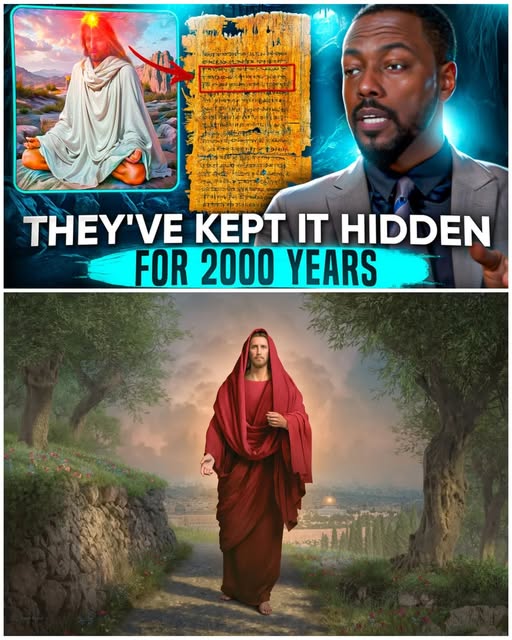
Yet outside the canonical books, fragments of the life and teachings of Yeshua survive in apocryphal gospels, letters, and historical records that never made it into the standard New Testament. These texts describe a man whose life included teachings, miracles, and interactions that differ in key ways from the stories most Christians have memorized. Some scholars argue that these apocryphal accounts preserve the memories of communities whose voices were later marginalized or silenced. Others suggest they contain symbolic or allegorical truths that the canonical authors chose to downplay or reinterpret.
One striking example is the Gospel of Thomas, discovered in 1945 near Nag Hammadi in Egypt. Unlike the narrative gospels, Thomas is a collection of sayings attributed to Jesus. It emphasizes personal spiritual insight, inner knowledge, and the discovery of divine truth within oneself. Some of these sayings parallel canonical teachings, but others suggest a radically different approach to salvation and the role of the disciple. The focus is on enlightenment rather than hierarchical authority, challenging the structure and dogma that later Christianity institutionalized.
Historical sources outside the gospels add another layer of intrigue. Roman historians, Jewish chroniclers, and early Christian apologists offer fragments that hint at Yeshua’s presence in regions, interactions, and conflicts that the canonical texts do not fully explore. Some reports focus on his teachings about social justice, interactions with marginalized communities, and public confrontations with religious leaders. These glimpses suggest a figure engaged in both spiritual and political life, whose story might have been simplified or reinterpreted for early Christian audiences seeking legitimacy in a Roman world.
Even the miracles and parables of Jesus, familiar to modern readers, might have had layers of meaning that were gradually filtered. Certain events appear in some manuscripts but not others; the order of stories changes; details shift subtly in ways that could transform the interpretation. Scholars debate whether these differences are errors, deliberate edits, or reflective of multiple traditions preserved orally before being written down. In any case, they hint at a life that was multifaceted and perhaps intentionally presented differently to different audiences.
The question becomes: why would some stories be hidden, altered, or omitted? The answer likely involves power, politics, and theology. Early Christian leaders faced the challenge of unifying diverse communities under shared beliefs while navigating Roman rule and Jewish traditions. Emphasizing certain teachings and de-emphasizing others could strengthen authority, clarify doctrine, or protect fledgling communities. Over time, the choices of early councils, scribes, and editors created a version of the story that was coherent for public teaching but may have left out aspects of Yeshua’s life that were important to other groups.
This is not merely academic speculation. Each discovery of a manuscript, fragment, or ancient letter reshapes our understanding of history. Archaeologists and textual scholars continue to uncover evidence that adds texture and complexity to Yeshua’s life. The study of Semitic languages, regional customs, and socio-political conditions of first-century Judea reveals nuances that the canonical texts may only hint at. Details about daily life, family relationships, trade, and political unrest illuminate the environment in which he lived, offering context that can dramatically affect interpretation of his teachings.
Some modern researchers take these revelations further, suggesting that early Christianity might have encompassed a spectrum of beliefs and practices more diverse than most people imagine. Communities in Syria, Egypt, Mesopotamia, and beyond developed different emphases on ethics, ritual, and mystical experience, all connected to the life of Yeshua. Certain manuscripts preserved some of these variations; others were suppressed or lost. Understanding this diversity is crucial to appreciating the complexity of early Christian history and the many voices that contributed to it.
Yet the core of the story remains compelling. Across all sources, Yeshua emerges as a teacher, healer, and prophet whose life provoked change and inspired devotion. Even if some details were obscured, his message of love, compassion, justice, and spiritual insight resonates across centuries. The discoveries of hidden texts and overlooked fragments do not erase the historical and spiritual impact of his life; they enrich it, offering a more nuanced, human, and profound portrait of the man behind the legend.
The implications of these findings are profound for believers and historians alike. For the faithful, they invite a deeper exploration of the historical Yeshua and a reflection on the ways in which the church has interpreted, emphasized, and transmitted his teachings. For historians and scholars, the texts provide invaluable data for reconstructing first-century Judea, the development of early Christian communities, and the complex interplay between religion, politics, and culture in the ancient world.
In the end, the story of Yeshua may be more layered than any single book can capture. Hidden teachings, variant sayings, and suppressed accounts all point to a life that cannot be fully summarized in a few chapters or even a single gospel. The Bible, as revered and canonical as it is, contains only part of the picture. Understanding the full story requires patience, scholarship, and a willingness to look beyond the familiar pages to the fragments, translations, and discoveries that illuminate a man who walked the hills of Galilee, spoke with authority, and inspired movements that would shape the world forever.
The real story of Yeshua is, in a sense, still unfolding. Every new manuscript, every archaeological discovery, and every scholarly insight adds another brushstroke to the portrait of a figure whose life, death, and teachings continue to captivate, challenge, and inspire. For those willing to look closely, the hidden layers of the Bible reveal a Yeshua who was as complex, human, and revolutionary as the world itself. And perhaps that complexity is exactly why his story has endured for two millennia and continues to reveal new truths today.