Footage From Florida’s Swamps Reveals the Aftermath Nobody Expected
Footage From Florida’s Swamps Reveals the Aftermath Nobody Expected
At first, the swamp looked alive.
The water shimmered under the moonlight. Sawgrass moved in the wind. Frogs called from somewhere deep in the dark, and the black surface of the canal reflected the stars like nothing terrible had happened there. But when the camera kept rolling, when the light swept across the bank, when the hunters stepped quietly through the mud and waited for the usual eyes to appear, the truth became harder to ignore.
The swamp was too quiet.
That was the part nobody expected. Florida’s Everglades have always been imagined as a place crawling with life — alligators, raccoons, deer, rabbits, bobcats, birds, snakes, fish, frogs, insects, and every strange sound that belongs to a wetland after sunset. But the latest footage from deep inside Florida’s swamps does not show a wild paradise roaring back. It shows something more unsettling: a landscape still breathing, but missing pieces of itself.
And somewhere in that silence, the python problem becomes impossible to dismiss.
For years, people talked about Burmese pythons in Florida like they were a bizarre headline. Giant snakes in the Everglades. Hunters wrestling monsters from roadside canals. Viral photos of men holding reptiles longer than pickup trucks. Tourists gasping at videos of alligators and pythons locked in the same black water. It sounded like a swamp horror story, the kind of thing made for television.
But the aftermath is not a monster movie.
It is an ecological crime scene.
The footage begins like so many Florida night hunts do: a slow drive along a levee road, headlights cutting through humid darkness, hunters scanning the edges where pavement meets grass and canal water. Burmese pythons are difficult to see. Their pattern blends into mud, leaves, roots, and shadow. They do not need to move much to disappear. A snake longer than a human body can lie beside a road and look like nothing more than a fallen branch.
That is part of what makes them so dangerous.
They are massive, but secretive.
Powerful, but patient.
Present, but nearly invisible.
Then the camera catches one.
A thick body stretched along the canal bank. A head low against the ground. Muscles gathered beneath patterned skin. The hunters move fast because they have to. One grabs behind the head. Another controls the body. The snake coils, twists, and throws its weight with shocking force. In the footage, you can see how quickly the mood changes. The swamp stops being scenery and becomes a fight.
This is the image most people know.
The capture.
The struggle.
The giant snake pulled from the dark.
But the real story begins after the camera turns away from the snake and back toward the swamp. Because once the python is removed, the question becomes much bigger: what did it already take?
That is where the aftermath becomes terrifying.
Burmese pythons did not arrive in Florida as ancient monsters. They are not villains in their native range. They are animals doing what animals do: hunting, breeding, hiding, surviving. The problem is that they were placed in the wrong ecosystem. Released pets, escaped snakes, and repeated introductions helped create a breeding population in South Florida, and the Everglades gave them exactly what they needed — heat, water, cover, prey, and almost no natural control strong enough to stop them.
At first, the invasion was easy to underestimate.
One snake here.
Another sighting there.
A few removals.
A strange story from a road crew or a park worker.
But pythons do not need permission to become a population. A large female can lay dozens of eggs. Hatchlings vanish into the grass. Adults spread through canals, marshes, tree islands, levees, and remote wetland. By the time humans understand the scale, the snakes are already part of the map.
And when an invasive predator becomes part of the map, the native animals become the evidence.
The missing raccoons.
The missing rabbits.
The missing opossums.
The missing foxes.
The fewer bobcats.
The fewer small mammals that once moved through the night like ordinary background life.
That is what the footage reveals if you know how to watch. Not just the python itself, but the absence around it. The swamp still makes noise, but some of its old voices are gone. A trail camera that should capture mammals may record long stretches of emptiness. A night road that once showed eyeshine may show only water, insects, and the occasional reptile sliding back into cover.
The Everglades did not become dead.
It became changed.
That difference matters.
Dead landscapes are obvious. Changed landscapes are more dangerous because they can fool the eye. Tourists still see birds. Alligators still surface in canals. Fish still ripple the water. Grass still grows. The sunset is still beautiful. The air still smells of mud, rain, and heat. To someone passing through, the swamp looks wild enough.
But scientists and hunters know better.
A healthy ecosystem is not just what you see. It is also what should be there and is not.
The footage from Florida’s swamps has become so disturbing because it captures that hidden loss. A python removed from the roadside is dramatic, but the real horror is inside its stomach, in the animals that will not breed again, in the holes left in food webs, in the silent spaces where native species once performed jobs the ecosystem depended on.
A raccoon is not just a raccoon.
It is a nest predator, a scavenger, a seed mover, a forager, a food source, a participant in the wetland’s endless exchange. An opossum is not just an opossum. A rabbit is not just a rabbit. A bobcat is not just a beautiful predator crossing a trail camera at dawn. Each animal is a thread. Pull enough threads out of the swamp, and the whole pattern begins to distort.
That is what the pythons have done.
They did not simply eat animals.
They changed relationships.
The Everglades had predators before pythons. Alligators ruled the water. Panthers moved through the uplands. Raptors hunted from above. Native snakes, turtles, fish, and mammals all played their roles. Predation itself is not the problem. The problem is a new predator entering a system that did not evolve with it at this scale, a predator large enough to eat everything from birds and rabbits to deer and alligators.
A python does not choose symbolically.
It consumes opportunity.
If it can swallow the animal, the animal becomes food.
That brutal simplicity is what makes the footage so hard to watch. A python does not look angry. It does not look evil. It waits in the grass, motionless, almost peaceful. Then the strike comes. The coils tighten. The prey stops breathing. The snake swallows, disappears, and the swamp absorbs the silence.
For years, the public focused on the biggest snakes: sixteen feet, seventeen feet, eighteen feet, sometimes more. Those giants make headlines because size is easy to understand. But the real danger is not only the record-breaker. It is the breeding population. It is the number of snakes no one sees. It is the females hidden in remote marsh. It is the eggs under cover. It is the juveniles growing quietly into another generation.
That is why removal programs matter, even when they cannot erase the problem overnight.
Python hunters, wildlife contractors, researchers, and state agencies have removed thousands upon thousands of snakes from Florida. They search roads at night. They track radio-tagged males to breeding females. They use thermal cameras, trained eyes, local knowledge, and brutal patience. They enter water and brush where most people would not put a foot. They work in mosquitoes, heat, mud, darkness, and risk.
Every python removed matters.
But every removal also reminds people how many remain.
That is the terrible math of invasive species. A single dramatic capture does not mean victory. A record challenge does not mean the swamp is safe. A viral video does not mean the population is collapsing. The work must continue season after season, road after road, nest after nest. The snakes are too secretive, too widespread, and too well adapted to be treated like a problem that can be solved in one weekend.
The footage shows that exhaustion.
You can see it on the faces of hunters after they pull a huge snake from the grass. There is excitement, yes. Relief. Adrenaline. Sometimes pride. But beneath it is something heavier. They know this is not the last one. They know another snake is out there. Another female. Another clutch. Another dark stretch of canal where a pattern may appear under the headlights for one second and vanish before anyone can move.
That knowledge changes the way the swamp feels.
Before pythons, the Everglades were dangerous in familiar ways. Alligators, heat, storms, deep water, insects, and distance all demanded respect. But pythons added something new: the fear of a hidden imbalance. A predator large enough to reshape the mammal community, yet quiet enough that most visitors will never see it.
That is a different kind of fear.
Not the fear of being attacked.
The fear of watching a world change without making enough noise.
Some of the most haunting footage is not of a python alive, but of what happens after. Researchers open the stomach of a removed snake and find feathers, fur, hooves, claws, bones, or the partially digested remains of native wildlife. Suddenly the invasion stops being abstract. The missing animals are no longer statistics. They are physical. They were alive. They moved through the same grass. They became evidence inside the body of the snake.
That is the kind of image that stays with people.
A swamp can hide a loss for years.
A stomach reveals it in seconds.
The alligator-python footage adds another twist. Sometimes an alligator wins. Sometimes a python wins. Sometimes both die. Viewers see a massive gator dragging a python through the water and feel a strange kind of relief, as if the native swamp is fighting back. In a way, it is. Alligators can kill pythons. Other animals may prey on eggs or juveniles. Nature does not simply surrender.
But relying on alligators to fix the python problem is wishful thinking.
The system is too complex.
The snakes are too established.
The aftermath is already too deep.
Still, those encounters matter symbolically. They show that the Everglades are not passive. The swamp resists. Native predators adapt. Humans intervene. Scientists study. Hunters remove. Agencies coordinate. Communities pay attention. The python invasion may be severe, but it is not invisible anymore.
And visibility is the first step toward responsibility.
For a long time, the python crisis was treated like a Florida oddity, almost a joke. Giant snakes in the swamp. Another weird Florida story. But the footage has changed that tone. When people see the size of the snakes, when they learn how many mammals have declined, when they watch hunters pull a living constrictor out of a canal at night, the joke starts to rot.
This is not weird entertainment.
This is a warning about what happens when human carelessness crosses with ecological opportunity.
The pet trade played a major role in the story. Exotic animals entered homes, collections, breeding operations, and markets. Some escaped. Some were released when owners could no longer handle them. A snake that is manageable as a juvenile can become an animal too large, too expensive, and too dangerous for an ordinary household. In Florida’s climate, release did not mean death. It meant possibility.
That possibility became a population.
The aftermath now belongs to everyone.
Not only scientists. Not only state agencies. Not only hunters. Anyone who buys, sells, releases, or ignores invasive species becomes part of the story. The Everglades are paying for decisions made far from the marsh — in homes, markets, storms, policy gaps, and moments when someone thought releasing a pet into the wild was kinder than killing it or turning it over.
Nature does not care about intention.
A released predator is still a predator.
One of the hardest truths in the footage is that the python problem is not only about snakes. It is about delay. Humans often wait until damage is obvious before acting seriously. By then, the problem has roots. The same pattern appears with invasive fish, insects, plants, mammals, and diseases around the world. A few early warnings are dismissed. The species spreads. The cost of control rises. Eradication becomes unlikely. Management becomes permanent.
Florida’s swamp footage feels like a case study in waiting too long.
Now the work is not simply to remove pythons.
It is to protect what is left.
That means supporting long-term detection, improving removal tools, tracking breeding females, studying ecosystem recovery, preventing spread into new areas, educating the public, strengthening reporting systems, and refusing to let attention fade when the viral clips stop trending.
Because the swamp does not recover on social media time.
Recovery, if it comes, will be slow.
A rabbit population cannot return overnight. Bobcats do not rebound because one large snake was removed. Raccoons and opossums need habitat, breeding success, safety, and time. Some areas may recover better than others. Some losses may be harder to reverse. Scientists will need years of data to understand where native species are returning and where the damage remains severe.
That is why the word “aftermath” matters.
Aftermath is not the moment after disaster.
It is the long life that follows it.
The Everglades are living in that long life now.
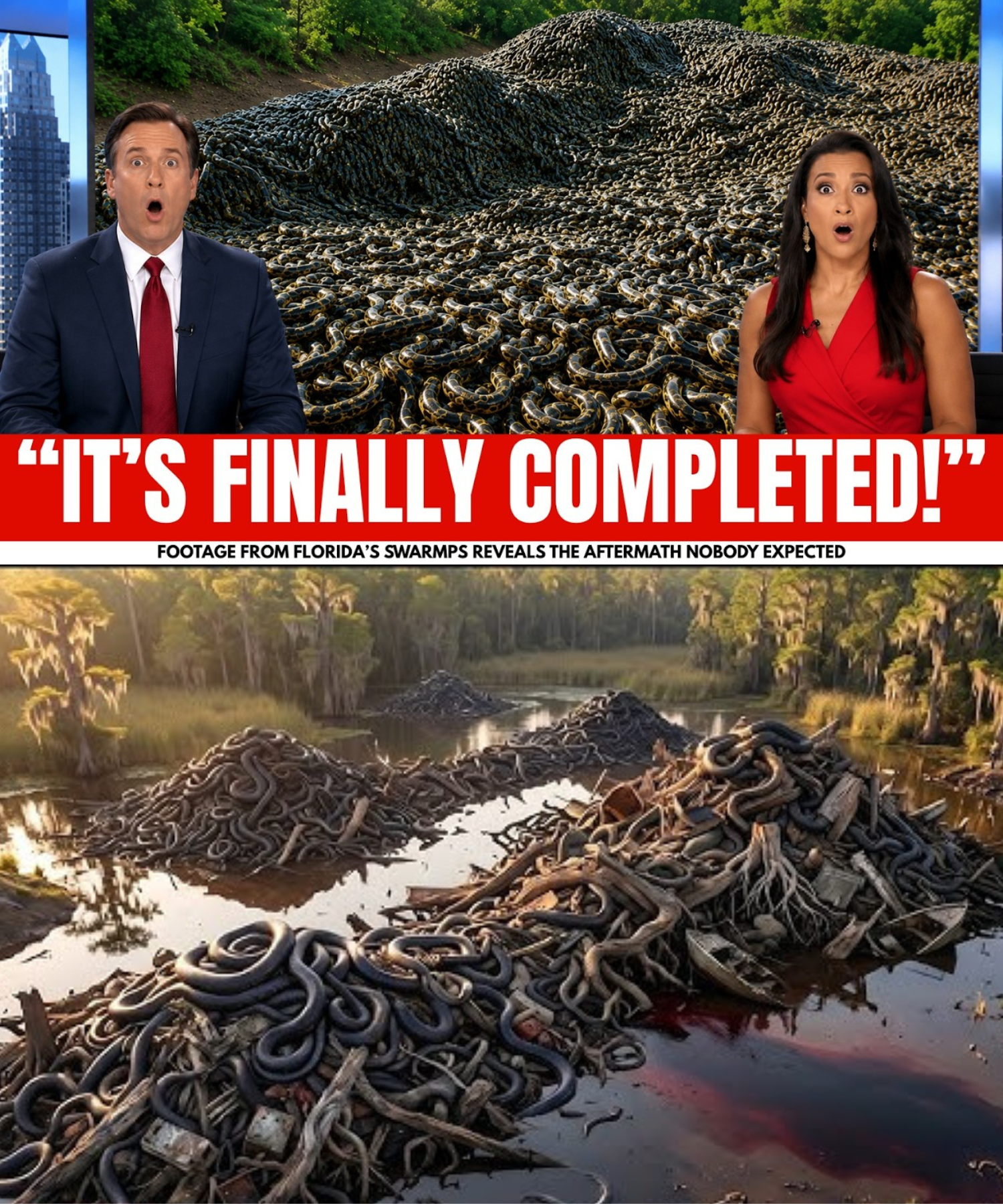
The latest footage does not show a clean ending. It shows a battle still underway. It shows hunters walking levees in darkness. It shows pythons coiled under grass. It shows empty stretches where animals should be. It shows alligators still ruling some waters, birds still lifting from marsh, and humans still trying to undo a mistake that nature has already absorbed into its systems.
It is terrifying because it is not hopeless.
Hopeless stories let people look away.
This one does not.
The swamp is damaged, but not gone. Native species are reduced, but not imaginary. The pythons are established, but not untouchable. Every captured female matters. Every nest prevented matters. Every acre protected from further spread matters. Every person who learns not to release exotic pets matters. Every program that survives beyond the headline matters.
The Everglades are still fighting.
The question is whether people will keep fighting with them.
By the end of the footage, the camera returns to the water. Nothing spectacular happens. No giant snake lunges from the dark. No alligator erupts from the canal. No hunter celebrates. The lens simply holds on the swamp as night settles over the grass.
That quiet is the real ending.
A silence full of missing animals.
A silence full of hidden snakes.
A silence full of work still undone.
Florida’s swamps have revealed the aftermath nobody expected: not a single monster, not a final victory, not a simple disaster, but a changed ecosystem asking whether humans can repair what humans allowed to happen.
The water still moves.
The sawgrass still bends.
The frogs still call.
But now, when the camera searches the darkness, we know what else to look for.
Not only the snake in the grass.
The empty space around it.