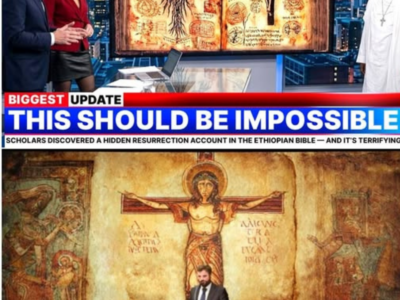
DID AN AI REALLY UNCOVER HIDDEN TEACHINGS OF JESUS BEYOND THE BIBLE WE KNOW?
DID AN AI REALLY UNCOVER HIDDEN TEACHINGS OF JESUS BEYOND THE BIBLE WE KNOW?
A viral narrative spreading across social media claims that an advanced artificial intelligence system used in a research environment at Oxford was able to analyze ancient Ethiopian religious manuscripts that have remained largely inaccessible or unreadable for centuries.
The story suggests that through multispectral imaging, linguistic reconstruction, and pattern recognition technologies, the system was able to recover fragments of text that were previously invisible to the human eye.
According to the circulating account, these manuscripts include versions of early Christian writings preserved within the Ethiopian Orthodox tradition, which differs in canon size and structure from the more widely known Western Bible.
While the Western Bible typically contains 66 books, the Ethiopian canon is often described as containing more, with some traditions referencing additional texts such as Enoch and other early religious writings preserved in Ethiopian monastic communities.
The viral claim centers around one particularly dramatic idea: that the AI reconstruction allegedly revealed new passages associated with the post-resurrection period of Jesus, a span of time often summarized briefly in the canonical Gospels as the 40 days between resurrection and ascension.
In the standard Biblical narrative, this period is described in only a few passages, leaving significant gaps in detail about teachings or events that may have occurred.
The internet story suggests that the AI was able to reconstruct damaged or nearly erased sections of parchment using multispectral scanning techniques.
These methods are real and widely used in manuscript preservation.
They involve analyzing ink and parchment at different wavelengths of light, including infrared and ultraviolet, to detect differences in material composition that are not visible under normal conditions.
In some cases, even impressions left by ancient writing tools can be detected when ink has fully faded.
However, the more controversial part of the viral narrative is not the technology itself, but the interpretation of what it supposedly revealed.
Online posts claim that reconstructed passages contain warnings attributed to Jesus about future religious institutions, spiritual corruption, and a condition described as a kind of inner emptiness or disconnection from spiritual truth.
Some versions of the story describe this as a warning about leaders who use faith for control rather than compassion.
It is important to note that these interpretations are not verified historical findings.
While Ethiopia does indeed preserve some of the oldest Christian manuscripts in the world, and while multispectral imaging is a legitimate academic technique used by institutions globally, there is no confirmed scholarly consensus supporting the sensational claims circulating online about newly revealed theological messages or hidden post-resurrection dialogues.
The story appears to blend real historical elements with speculative and dramatized interpretations.
Ethiopia’s religious manuscript tradition is genuinely significant.
Monasteries such as those preserving the Garima Gospels are known for safeguarding ancient texts written in Ge’ez, a classical language used in Ethiopian liturgy.
Some manuscripts have been dated to the early centuries of Christianity, making them among the oldest surviving illustrated Christian documents.
What makes the viral story compelling is not only the mention of ancient texts, but also the idea of modern artificial intelligence acting as a bridge between lost history and present understanding.
The notion that machines can recover information thought to be permanently lost has already been demonstrated in archaeology and manuscript restoration projects around the world.
In real academic contexts, AI and imaging technology have helped restore damaged texts from sites such as ancient Herculaneum scrolls and other degraded archives.
Yet the leap from recovering letters and words to reconstructing full theological narratives is where the viral story enters speculative territory.
Experts in manuscript studies typically emphasize that reconstruction is probabilistic.
Even when AI suggests likely character patterns, human scholars must verify interpretations carefully, and uncertain passages are usually marked as incomplete rather than definitively translated.
The circulating narrative also references broader themes that often appear in internet discussions about ancient religious texts: hidden knowledge, lost books excluded from canonical scripture, and alternative versions of early Christian history.
These themes have existed for centuries in various forms, but social media has amplified them into highly shareable, emotionally engaging stories that blur the line between documented history and imaginative reconstruction.
Another element fueling the spread of the story is its connection to spiritual interpretation.
Claims about humanity entering a state of disconnection, distraction, or moral decline are highly resonant in modern digital culture, where concerns about technology, attention, and meaning are widely discussed.
The viral account frames ancient text reconstruction as if it directly comments on modern life, although there is no academic evidence that the manuscripts contain such modern psychological language.
Still, the fascination is understandable.
Ancient manuscripts represent a rare connection to the earliest phases of written religious tradition.
The idea that unseen passages might still exist within fragile parchment encourages the imagination.
When combined with artificial intelligence, which already feels like a tool capable of uncovering hidden layers in data, the narrative becomes especially powerful.
Scholars who study Ethiopian Christianity emphasize that its manuscript tradition is rich, diverse, and historically important in its own right.
It preserves texts that are not only religious but also cultural records of a continuous theological tradition that has remained active for over a millennium.
However, serious academic work in this field proceeds cautiously, with peer review, translation verification, and historical cross-referencing rather than sudden revelations of dramatic new doctrine.
In contrast, viral online content tends to compress complexity into emotionally charged storytelling.
The idea of a machine revealing “forbidden knowledge” or “hidden teachings” spreads rapidly because it combines mystery, authority, and technology into a single narrative arc.
But such stories often lose the nuance required to distinguish between confirmed findings and interpretive speculation.
As of now, there is no verified academic publication confirming the dramatic claims circulating in viral posts about Oxford AI uncovering radically new post-resurrection teachings in Ethiopian manuscripts.
What does exist is an ongoing field of research into manuscript preservation, digital restoration, and the study of ancient Christian texts in Ethiopia and beyond.
The real story behind this viral phenomenon may be less about hidden religious revelations and more about how modern technology reshapes the way we imagine the past.
When AI enters the equation, even ordinary restoration work can be reframed as something extraordinary, especially once it reaches social media platforms where engagement often depends on curiosity and emotional impact.
Whether one views the narrative as misunderstood research, exaggerated reporting, or creative storytelling inspired by real technology, it highlights a broader truth: humanity remains deeply fascinated by the possibility that history still holds undiscovered layers waiting to be revealed.
And as long as ancient texts, advanced imaging, and artificial intelligence continue to intersect, stories like this will keep emerging—some grounded in fact, others stretching far beyond it.