Chinese Monks Finally Reveal Why Mount Kailash Was Never Meant to Be Climbed —The Reason Is Chilling
Chinese Monks Finally Reveal Why Mount Kailash Was Never Meant to Be Climbed — The Reason Is Chilling
They say the mountain does not reject climbers because it is too high. It rejects them because the summit was never meant for human feet.
Mount Kailash stands in western Tibet like a white pyramid cut from another world. Its slopes rise with unnatural symmetry, its dark rock faces are marked by snow lines that look almost carved, and its summit remains untouched in an age when human beings have climbed Everest, crossed oceans, landed machines on Mars, and mapped nearly every corner of the planet. Yet Kailash still stands apart. Not conquered. Not claimed. Not photographed from a victorious summit. Not reduced to another trophy in the long history of human ambition.
For many pilgrims, that is not a failure of mountaineering. It is the point.
The story that has recently stirred fascination online is framed around monks who finally “revealed” the reason Mount Kailash was never meant to be climbed. Whether told by Tibetan Buddhist monks, Chinese religious custodians, Hindu sages, Jain pilgrims, or Bon practitioners, the core warning remains the same: Kailash is not a mountain in the ordinary sense. It is a threshold. It is a sacred axis. It is a place where heaven, earth, and the unseen world meet. To climb it would not be exploration. It would be violation.
That is the chilling part.
The danger is not only avalanche, altitude, ice, or stone.
The danger is arrogance.
Most mountains invite conquest. Kailash demands surrender. Around the world, climbers speak of “bagging peaks,” “claiming summits,” and “standing on top of the world.” But Kailash reverses that instinct. It asks human beings to circle, bow, endure, pray, and leave the summit alone. The path is not upward. The path is around. The lesson is not victory. The lesson is humility.
For Hindus, Mount Kailash is revered as the abode of Lord Shiva, the great ascetic, destroyer, transformer, and cosmic yogi. To place a boot on that summit would be unthinkable to many believers, like walking onto the roof of a living temple. For Buddhists, Kailash is associated with powerful tantric symbolism and the sacred geography of the universe. For Jains, it is linked with liberation and the first Tirthankara. For followers of Bon, Tibet’s ancient spiritual tradition, it is a deeply holy center of power. Four traditions, different in doctrine, different in ritual, different in history, all turn toward the same mountain with reverence.
That alone makes Kailash extraordinary.
Many mountains are sacred to one people. Kailash is sacred across worlds.
The monks’ warning, as it is often retold, begins with a simple observation: human beings misunderstand height. We assume the highest place is the place we must reach. We assume that if something stands above us, our destiny is to stand above it. But sacred mountains are not ladders for human ego. They are reminders that some realities must remain above us, not because we are weak, but because reverence is part of wisdom.
This is why the traditional pilgrimage is not an ascent. It is a circumambulation, known as kora in Tibetan Buddhism and parikrama in Hindu and Jain traditions. Pilgrims travel around the mountain, often across harsh terrain, thin air, freezing winds, and punishing passes. The journey is physically demanding, but its meaning is spiritual. Each step around Kailash becomes an act of devotion. The pilgrim does not conquer the mountain. The pilgrim allows the mountain to transform them.
That difference may be difficult for a modern mind to accept. We live in a culture that. We live in a culture that measures success by access. If a place exists, we want to enter it. If a peak exists, we want to climb it. If a boundary exists, we want to cross it. Technology has trained us to treat mystery as a problem waiting to be solved. But Kailash belongs to an older understanding: some mysteries are not solved by entering them. Some are preserved by restraint.
According to the chilling interpretation, the summit of Kailash is not empty. It is not simply rock and snow waiting for the first successful climber. It is spiritually occupied. In symbolic language, it is the throne of divine presence, the axis of the cosmos, the center around which worlds turn. To climb it would be to confuse the sacred center with a sporting objective.
The mountain, in this view, is not saying, “You cannot.”
It is saying, “You must not.”
That distinction is everything.
There are many legends surrounding Kailash. Some say time behaves strangely near it. Some claim those who come too close with impure motives feel disoriented or aged. Others speak of failed attempts, sudden weather, inexplicable fear, or climbers turning back after sensing they had crossed an invisible line. These stories are difficult to verify, and many belong more to folklore than documented history. Yet legends often preserve emotional truths. Whether or not every tale is literally true, they all point toward the same warning: this mountain is not passive. It watches the intention of those who approach.
For a pilgrim, intention matters.
A pilgrim approaches Kailash to be humbled. A conqueror approaches to be celebrated. The mountain tolerates the first and refuses the second.
That is why the refusal to climb Kailash has become almost as famous as any summit achievement. In a world obsessed with first ascents, the most powerful story may be the ascent that never happened. Great climbers have respected the taboo. Governments have restricted climbing. Religious communities have protested the idea. Travelers who complete the kora often describe the experience not as tourism, but as a confrontation with themselves. The mountain does not need a climber on top to prove its power. Its power is proven by the fact that humanity has left it alone.
And leaving something alone may be one of the hardest spiritual disciplines left to us.
The alleged revelation from monks is chilling because it exposes a weakness in modern civilization. We do not know how to stop. We do not know how to stand before a boundary and accept that the boundary may be sacred. We call restraint fear. We call reverence superstition. We call untouched places “unconquered,” as if the world exists only to become a checklist of human achievement.
Kailash refuses that language.
It does not ask, “Can you climb me?”
It asks, “Why do you need to?”
That question cuts deeper than any ice axe.
Imagine a climber standing at the base of Kailash with the best equipment on Earth. Oxygen, ropes, satellite devices, thermal layers, GPS, weather models, drones, medical support. Everything modern ambition can provide. Then imagine the silence of the mountain answering with something older than technology: you have brought tools, but have you brought humility?
That is the real test.
The chilling reason Kailash was never meant to be climbed is not that the mountain hides a monster, a portal, or a curse waiting to strike anyone who steps too high. Those ideas make good rumors, but the deeper fear is more serious. The real danger is that climbing Kailash would prove humanity has become unable to recognize the sacred. It would show that even when millions say, “This place is holy,” the ambitious still hear only, “This place is available.”
In that sense, Kailash is a moral boundary.
It asks whether the world can still honor something beyond ownership.
The mountain has survived precisely because so many people have agreed that its highest point should remain untouched. That shared agreement is rare. It crosses religion, nationality, language, and generation. It says that not every summit needs a flag. Not every mystery needs invasion. Not every sacred place must be converted into content, spectacle, or personal glory.
For believers, the mountain’s unclimbed summit is not an absence. It is a presence.
No human footprint is the offering.
No summit photo is the proof.
No victory claim is the prayer.
The untouched peak itself becomes the message.
There is also an environmental truth hidden inside the spiritual one. High-altitude sacred landscapes are fragile. Pilgrimage routes already face pressure from tourism, roads, waste, and climate change. A climbing culture built around conquest would bring more infrastructure, more expeditions, more damage, and more disrespect. In this way, ancient reverence has protected what modern regulation alone might struggle to preserve. The taboo is not merely religious. It is ecological wisdom expressed through sacred language.
The old monks understood something many modern people are only beginning to rediscover: reverence protects.
When a place is sacred, people behave differently. They lower their voices. They walk carefully. They leave offerings instead of trash. They accept discomfort as part of devotion. They see the land not as an object, but as a relationship. The moment the sacred disappears, the mountain becomes merely a resource, a challenge, a product, a backdrop.
Kailash still resists becoming that.
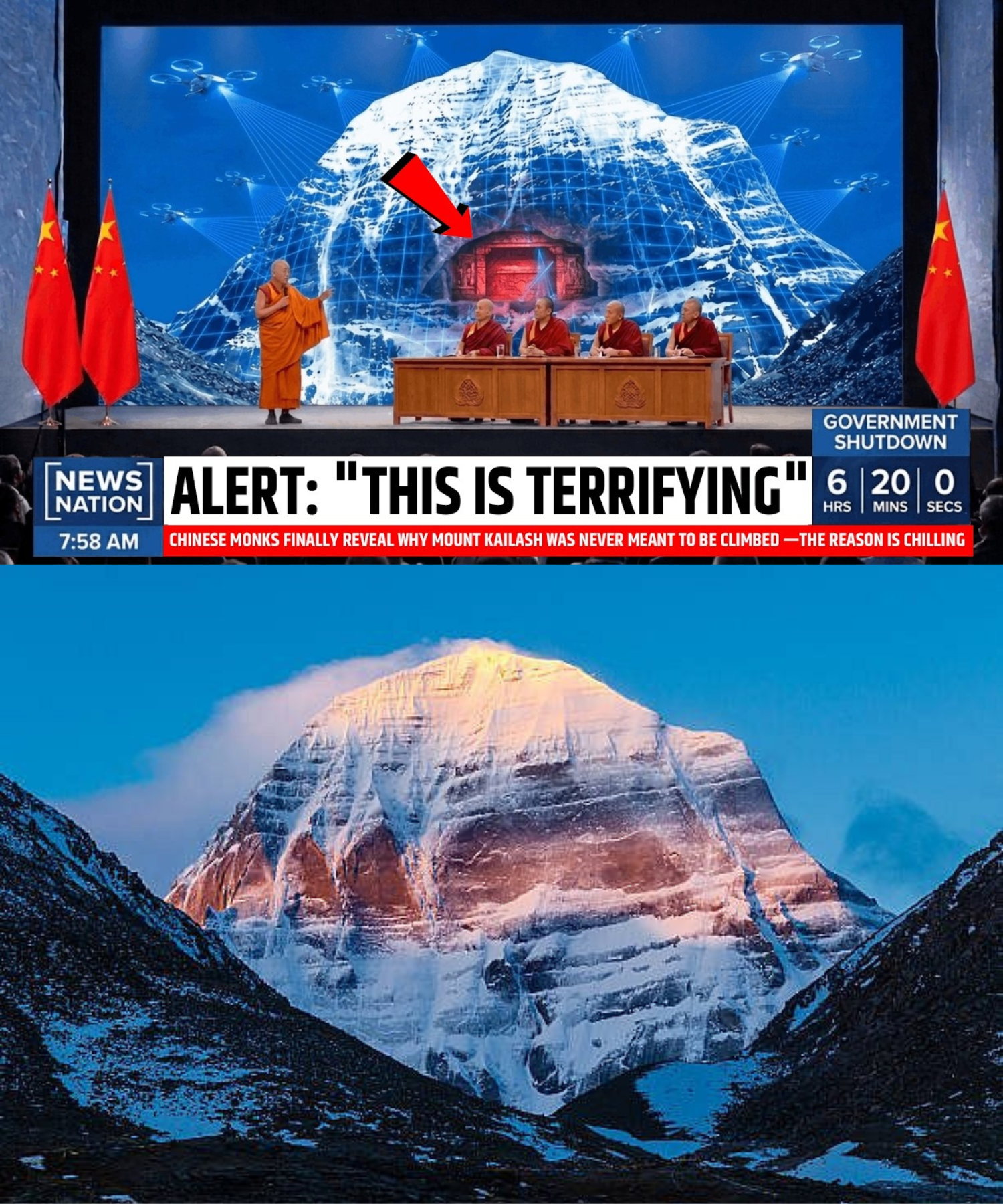
This is why pilgrims can return from the kora changed without ever touching the summit. The journey around the mountain may be more transformative than standing on top could ever be. To circle Kailash is to admit that the center is not you. With every step, the pilgrim moves around something greater. That physical motion becomes spiritual instruction. The ego wants the straight line to the top. The soul takes the long way around.
There is something deeply beautiful in that.
And something deeply frightening.
Because if Kailash is right, then much of modern life is wrong. If the highest form of encounter is not conquest but reverence, then our culture has misunderstood success. If the sacred center must remain untouched, then boundaries are not always obstacles. If the summit belongs to God, gods, enlightened beings, cosmic order, or the mystery beyond language, then the human role is not always to claim. Sometimes it is to witness.
The mountain’s silence becomes a sermon.
Do not climb everything.
Do not own everything.
Do not explain everything.
Do not mistake access for wisdom.
The world’s fascination with Kailash comes from this tension. People want to know why no one has climbed it. They expect a physical explanation: impossible weather, deadly slopes, hidden cliffs, government enforcement. Those factors matter, but they do not reach the heart of the mystery. The mountain is not unclimbed only because it is difficult. Many difficult mountains have been climbed. It remains unclimbed because enough people still believe that climbing it would be spiritually wrong.
That belief is more powerful than any wall.
And perhaps more chilling than any curse.
A curse threatens punishment after violation. A sacred boundary asks for understanding before violation happens. One is fear. The other is wisdom. Kailash survives because it has inspired wisdom in those who might otherwise have treated it as a prize.
Still, the temptation remains. There will always be someone who sees the untouched summit and thinks, “Why not me?” There will always be ambition disguised as courage. There will always be outsiders who dismiss local and religious reverence as old superstition. That is why the monks’ warning must be repeated. The summit is not waiting for the right climber. It is waiting for humanity to remain worthy of not climbing.
That is the paradox.
Kailash tests climbers by asking them not to climb.
It tests explorers by asking them not to enter.
It tests the modern world by asking it not to consume one of the few great mysteries it has not yet swallowed.
The reason is chilling because it suggests that the greatest danger on Kailash is not death. Many mountains can kill. The greater danger is desecration—the possibility that a human being could stand on the summit and, in doing so, lose something more important than life: the ability to bow.
That is why Kailash remains one of the most powerful mountains on Earth. Not because it is the tallest. It is not. Not because it is technically impossible. Experts debate that. Not because it hides a simple secret at the top. The secret is visible from below.
The mountain is sacred because it is not ours.
In the end, the monks’ revelation is not really about Mount Kailash alone. It is about every boundary human ambition wants to cross without asking what the boundary means. It is about forests we cut before understanding them, rivers we poison before honoring them, ancient tombs we open for spectacle, technologies we build before developing wisdom, and mysteries we destroy by demanding they entertain us.
Kailash stands against that impulse.
White, silent, distant, and untouched.
It tells the world that some heights are not reached by climbing. Some are reached by restraint. Some summits are not meant to carry footprints because their purpose is to remind us that the sacred still exists beyond possession.
So when people ask why Mount Kailash was never meant to be climbed, the answer is both simple and terrifying.
Because the summit is not empty.
It is holding the last lesson humanity keeps trying to forget:
Not everything above us ismeant to be conquered.