A Fungus That Turns Animals Into Zombies Is Spreading Across North America — This Is Terrifying
A Fungus That Turns Animals Into Zombies Is Spreading Across North America — This Is Terrifying
The scariest thing in the forest may not have teeth.
It may be smaller than a grain of dust, drifting silently through caves, clinging to insects, hiding in soil, waiting on wings, skin, and bark until the right body passes by. It does not roar. It does not chase. It does not need claws. It enters quietly, grows patiently, and then does something far more disturbing than killing its host.
It changes behavior.
That is the part that makes people stop laughing when scientists use the word “zombie.” Not because animals are rising from the dead like something from a movie, but because some fungi have evolved the ability to hijack living creatures before they die. They turn insects into vehicles. They make hosts climb, bite, mate, wander, wake, or spread spores in ways that serve the parasite rather than the animal. The body keeps moving, but the purpose no longer belongs fully to the creature inside it.
And now, across North America, the word “fungus” is no longer just a quiet word from biology class.
It has become a warning.
For years, the public treated zombie fungi as a tropical nightmare, something from rainforests where ants climb leaves and die with fungal stalks bursting from their heads. Those images are real, and they are horrifying. But the larger story is no longer limited to distant jungles. In North America, fungal pathogens are already reshaping wildlife. Cicadas are being turned into living spore spreaders. Bats are waking from hibernation and starving under a white fungal growth. Amphibians have faced fungal waves capable of emptying forests of song.
This is not a human zombie apocalypse.
It is worse in a quieter way.
It is an ecological one.
The most famous example is the so-called zombie-ant fungus, a group of fungi associated with insects and often described through the terrifying behavior of infected ants. The fungus infects the insect, grows through its body, and manipulates its movements in ways that help the fungus reproduce. The ant may leave the safety of its colony, climb to a precise location, clamp its jaws onto vegetation, and die there. Later, fungal growth erupts from the corpse and releases spores onto the forest below.
To humans, it looks like possession.
To the fungus, it is strategy.
That single fact is enough to disturb anyone who thinks nature is gentle. Evolution does not care whether something looks cruel. If a behavior helps spores reach the next host, that behavior can be selected, refined, and repeated across generations. The fungus does not need intelligence in the human sense. It does not need a plan. It only needs chemistry, timing, and a host vulnerable enough to be rewritten.
That is what makes fungal manipulation so unnerving.
It reveals that behavior is not always sacred.
A living body can be turned into a tool.
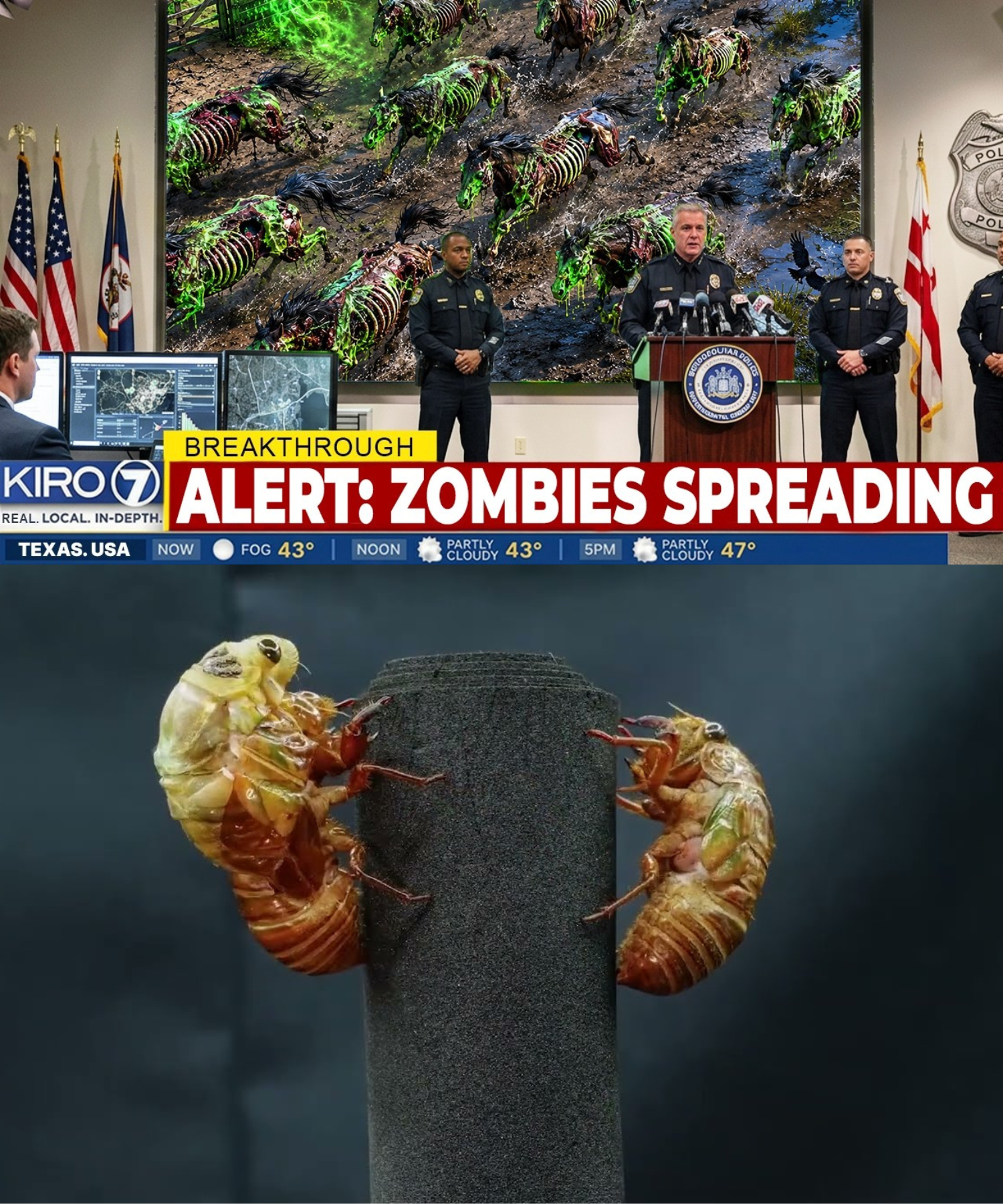
In North America, one of the strangest examples comes from cicadas. Periodical cicadas already feel like creatures from another world. They spend years underground, feeding quietly on tree roots, then emerge in overwhelming numbers after 13 or 17 years. They fill the air with sound, mate frantically, lay eggs, and die. Their entire adult life is brief, loud, and urgent.
Then Massospora enters the story.
The fungus infects cicadas and transforms them in a way that sounds almost too grotesque to be real. The back portion of the insect’s body can be replaced by a chalky mass of fungal spores. Yet the cicada may keep flying. It may keep attempting to mate. It may spread the fungus as it moves through the swarm, turning reproduction itself into a delivery system for infection.
That is where the “zombie” label feels painfully accurate.
The cicada is alive, but its body has become a spore machine.
What makes Massospora especially disturbing is that infected cicadas do not simply drop dead immediately. In many cases, they continue behaving in ways that spread the fungus. Some males even mimic female mating signals, attracting other males and increasing contact. It is not just death. It is behavioral sabotage. The fungus turns desire into transmission.
A forest full of cicadas is already overwhelming. Add a parasite that weaponizes mating behavior, and the scene becomes almost cinematic: insects screaming in the trees, infected bodies shedding spores, the living and the doomed moving through the same swarm, while most humans walking underneath never realize the horror show taking place above them.
But cicadas are only part of the story.
The fungus that has caused some of the greatest wildlife damage in North America does not create the classic movie image of a zombie. It does not make animals attack. It does not make them bite people. It does not turn them into monsters. Instead, it attacks something more delicate: the rhythm of hibernation.
White-nose syndrome has devastated bat populations across North America. The disease is caused by a cold-loving fungus that grows on hibernating bats, especially around the muzzle, ears, and wings. To a casual observer, the infected bat may look as if it has been dusted with pale powder. But beneath that appearance is a deadly invasion of the skin.
Bats survive winter by entering hibernation and carefully conserving energy. Their bodies slow down. Their fat reserves become a lifeline. Every unnecessary awakening costs precious fuel. White-nose syndrome disrupts that fragile balance. Infected bats may wake too often, burn through their energy, leave roosts in winter, and starve before spring arrives.
It is not a zombie story in the Hollywood sense.
It is more tragic than that.
A bat wakes when it should sleep. It moves when stillness is survival. It burns the energy it cannot replace. It may crawl or fly into cold daylight, confused, weakened, and doomed. The fungus does not need to make the bat hunt anyone. It only needs to disturb the body’s ancient winter strategy.
That is enough.
The result has been catastrophic. Entire colonies have collapsed. Species that once filled caves in large numbers have declined sharply. Some bats have disappeared from places where they were once common. And when bats vanish, the damage spreads beyond the cave. Bats eat enormous numbers of insects, including agricultural pests. They are part of the night’s hidden economy, controlling insect populations while most humans sleep.
Lose the bats, and the consequences move outward.
More insects.
More pressure on crops.
More pesticide use.
More ecological imbalance.
This is the part many people miss. A fungal disease in a cave is not only a cave problem. A sick bat is not only one dead animal. Wildlife disease can ripple through farms, forests, rivers, and human economies. The world is connected in ways that become visible only when something breaks.
That is why the spread of fungal pathogens across North America is so frightening. It is not one monster. It is a pattern. Fungi are exploiting environments changed by travel, trade, climate pressure, habitat disruption, and human movement. Spores can ride on boots, gear, animals, soil, plants, and global commerce. Once established in the right environment, fungi can be extremely hard to remove.
A virus may burn through a population quickly.
A fungus can wait.
It can persist in soil, caves, wood, skin, or environmental reservoirs. It can survive after hosts leave. It can return with the season. It can exploit weakness slowly. That patience makes fungal threats feel different from other diseases. They do not always explode in obvious ways. Sometimes they creep, county by county, cave by cave, species by species, until the map has changed.
By the time the public notices, the fungus may already be everywhere.
Amphibians know this story too well. Around the world, chytrid fungi have been linked to devastating amphibian declines. Frogs and salamanders breathe and regulate water through their skin, making that skin vital to survival. A fungus attacking the skin is therefore not superficial. It can interfere with the very systems that keep the animal alive.
In some forests, the arrival of chytrid disease was followed by silence.
That detail matters. People often think extinction looks dramatic. A final animal collapsing under a spotlight. A last cry. A clear ending. In reality, extinction often sounds like nothing. Fewer calls at night. Fewer eggs in a pond. Fewer tadpoles. Fewer adults returning after rain. Then one season, the chorus simply does not come back.
Fungus can remove a voice from a landscape.
And when enough voices disappear, the place becomes something else.
The terrifying truth is that fungi are not villains in nature. They are essential. They break down dead wood, recycle nutrients, form partnerships with plants, shape soil, support forests, and quietly make life possible. Without fungi, ecosystems would collapse under their own dead matter. They are among Earth’s great recyclers and connectors.
That is what makes the dangerous ones so unsettling.
They come from a kingdom of life we usually ignore.
Fungi are not animals. They are not plants. They operate by rules many people barely understand. They grow through threads. They digest externally. They spread by spores. Some form vast underground networks. Some live harmlessly inside hosts. Some become deadly only when conditions shift. Their world is hidden, chemical, patient, and older than human fear.
When a fungus becomes a pathogen, it brings that hidden logic into conflict with animals we can see and love.
A bat hanging in a cave.
A frog on a wet leaf.
A cicada buzzing in summer heat.
An ant gripping a branch after death.
These are the images that make the story feel personal.
Scientists are not saying that a fungus is about to turn humans into zombies. That is important. The leap from insect manipulation to human mind control is enormous. Human body temperature, immune defenses, physiology, and behavior are not the same as those of ants or cicadas. The fungi that manipulate insects are often highly specialized. They are adapted to particular hosts and environmental conditions. They do not simply jump into people and rewrite human brains.
But that should not make us comfortable.
The danger is not that tomorrow morning people will wake up as fungal zombies. The danger is that wildlife systems are already experiencing fungal disasters, and those disasters can change the world humans depend on.
A bat collapse can affect insect control.
An amphibian collapse can alter food webs.
A cicada infection can reveal how parasites manipulate behavior.
A fungal invasion can expose how quickly disease moves through a connected continent.
The terror is ecological, not cinematic.
And ecological terror is harder to escape.
You can turn off a horror movie. You cannot turn off a collapsing ecosystem.
One reason fungi are getting more attention now is that the world is warming and changing. Many fungi prefer certain temperature ranges. For a long time, mammal body heat offered some protection against many fungal pathogens. But a warmer world may place pressure on fungi to tolerate higher temperatures. That does not mean every fungus will become a human threat, and it does not mean zombie fungi are coming for people. But it does mean fungal biology deserves more respect than it has received.
The fungal kingdom is adaptable.
Humanity is only beginning to appreciate how adaptable.
Meanwhile, the spread of white-nose syndrome has shown how devastating an introduced fungal pathogen can be when it reaches wildlife with little defense. In Europe, bats appear to have coexisted with related fungi differently, but in North America the impact has been severe. That pattern is familiar in invasion biology. A pathogen that is manageable in one ecosystem can become catastrophic in another where hosts have not evolved resistance.
The same principle has played out again and again across history.
Move organisms around the planet, and sometimes invisible disasters follow.
The frightening part is that humans are very good at moving things. We move timber, soil, animals, food, plants, equipment, tourists, cargo, and ourselves. We enter caves. We visit parks. We hike, climb, ship, trade, and travel. Most of the time, we do not see what comes with us.
Spores do not need permission.
That is why conservationists emphasize decontamination, cave closures, monitoring, and careful handling of wildlife. These measures may sound small compared with the scale of the problem, but in disease ecology, small actions matter. Cleaning boots before entering another cave can matter. Not disturbing hibernating bats can matter. Reporting sick wildlife can matter. Protecting habitat can matter. Reducing stress on vulnerable species can matter.
The public often wants one dramatic solution.
Nature often needs thousands of careful ones.
There is also a deeper emotional problem. Fungal diseases do not always create animals people easily sympathize with. Bats are misunderstood. Cicadas are treated as annoying. Frogs are noticed mostly when they vanish. Insects are dismissed until they stop performing the ecological jobs people never thanked them for. That makes fungal wildlife disease easier to ignore.
But ecosystems do not care which animals are popular.
They care which roles are filled.
Bats fill roles. Amphibians fill roles. Insects fill roles. Fungi fill roles too. When a disease knocks one piece out of place, other pieces shift. Sometimes the system absorbs the shock. Sometimes it does not. The frightening thing is that humans often cannot predict which loss will matter until after the loss has happened.
A cave without bats may still look like a cave.
A forest without frogs may still look like a forest.
A summer without healthy cicadas may still sound loud for a while.
But beneath the appearance, the system has changed.
That is why the phrase “zombie fungus” is useful, even if it is not scientifically precise for every case. It captures public attention. It makes invisible parasitism visible. It forces people to look at the strange reality that organisms can manipulate one another in ways that feel almost supernatural. But the phrase can also mislead if it turns real science into fantasy.
The truth is not that fungi are plotting against animals.
The truth is that evolution has produced forms of infection more disturbing than fiction.
Massospora does not need to understand cicada desire to exploit it.
Ophiocordyceps does not need to understand fear to make an ant climb.
White-nose syndrome does not need to understand winter to wake a bat at the wrong time.
That is the cold genius of biology.
It works without intention.
It kills without hatred.
It manipulates without thought.
And because there is no villain, there is no surrender.
Only adaptation, prevention, treatment research, monitoring, and the slow work of protecting species before they disappear.
The most haunting scenes are not found in laboratories. They are found in the field. A cave floor scattered with dead bats. A cicada flying with part of its body replaced by spores. A frog species no longer calling after rainfall. A researcher holding a tiny animal and knowing that an invisible organism has already moved farther than anyone wanted to believe.
These are not imaginary nightmares.
They are warnings from the living world.
The good news is that scientists are not helpless. Researchers are studying fungal genetics, host immunity, environmental persistence, possible treatments, biological controls, vaccines, and habitat strategies. Some bat populations show signs of survival or resistance. Monitoring has improved. Public awareness is higher than it was when white-nose syndrome first appeared. Wildlife managers know more now about how these diseases move and how human behavior can worsen or slow their spread.
But recovery will not be quick.
Bats reproduce slowly. Many species have only one pup per year. Amphibian populations can crash faster than they recover. Insects may be abundant, but their parasites can be difficult to track. Fungal spores can persist long after the first outbreak. The timeline of damage is often short. The timeline of healing is long.
That imbalance is terrifying.
It takes years to grow a colony.
It can take one pathogen to empty it.
The deeper lesson is that the world is full of invisible relationships. Humans live beside them, depend on them, and disturb them without noticing. A fungus in a cave may seem remote until bat declines affect insect populations. A pathogen in amphibians may seem like a niche issue until entire food webs shift. A zombie cicada fungus may seem like a grotesque curiosity until it shows how easily behavior can become part of a parasite’s life cycle.
Nature is not a collection of separate creatures.
It is a web of influence.
Sometimes beautiful.
Sometimes horrifying.
A fungus that turns animals into zombies is spreading across North America, but the real horror is not that animals become monsters. It is that living systems can be altered from the inside before anyone sees the full damage. A body can keep moving while its purpose is changed. A cave can look quiet while a disease spreads. A forest can still stand while its voices disappear.
That is the warning hidden in the word “zombie.”
Not the dead rising.
The living being redirected.
And if that does not frighten us, perhaps we have not understood the story yet.