4 Fallen Angels FOUND in a Cave Beneath the Euphrates River – Is This the Sign of Jesus’ Return?
4 Fallen Angels FOUND in a Cave Beneath the Euphrates River – Is This the Sign of Jesus’ Return?
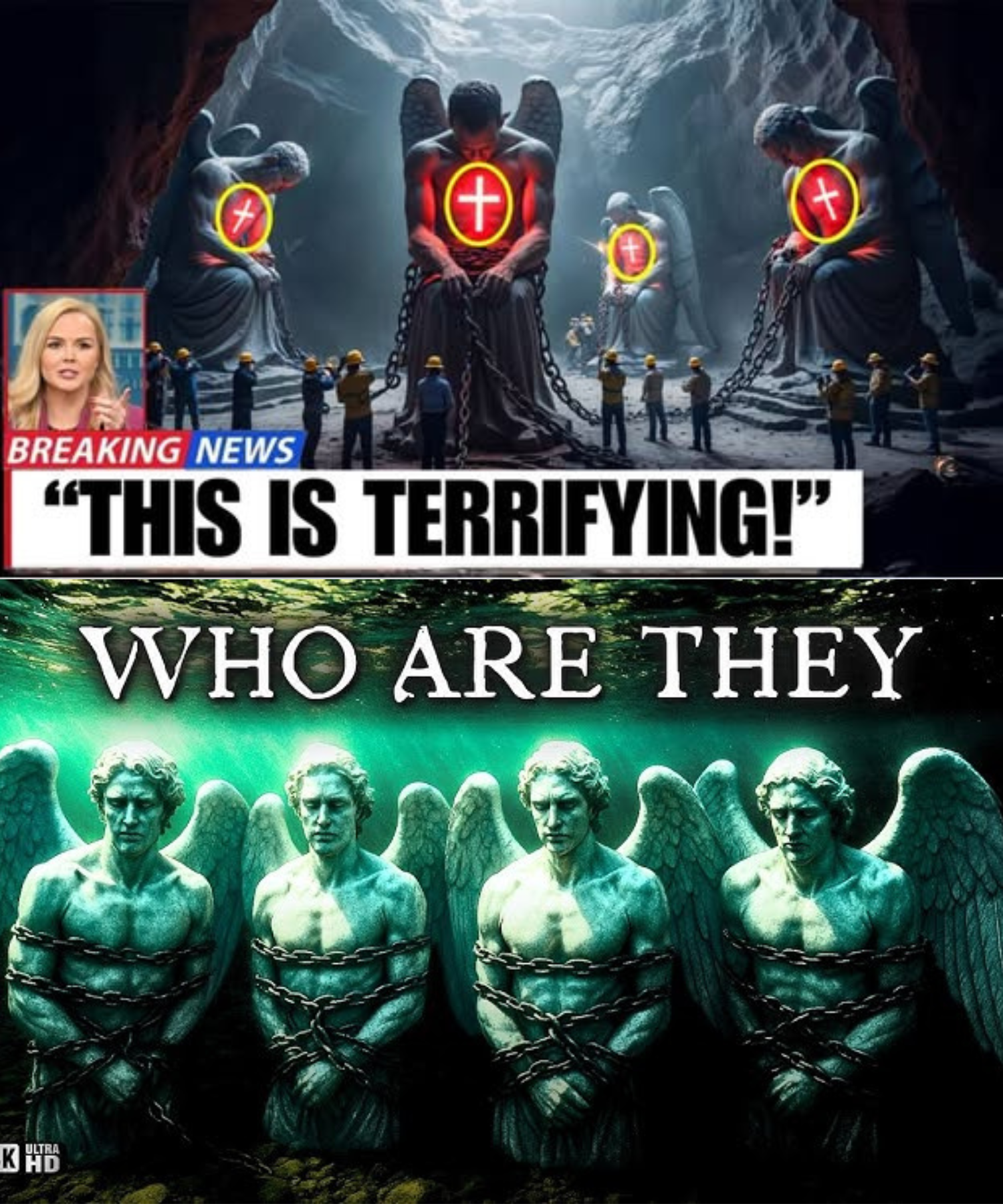
The footage was too dark to prove anything, but the sound was enough to make people stop breathing. Somewhere beneath the Euphrates, witnesses claimed they had found a sealed chamber—and inside it, something tied directly to one of the most terrifying prophecies in Revelation.
For years, the Euphrates River has been at the center of end-times speculation. Every time the water level drops, every time cracked riverbeds appear on social media, every time someone films a tunnel, a cave, or a strange echo beneath the ancient banks, the same verse returns like a warning from the edge of history: “Release the four angels who are bound at the great river Euphrates.”
To some, it is symbolic language from the Book of Revelation. To others, it is a prophecy waiting for one final physical sign. And now, with viral claims spreading that four fallen angels were discovered in a cave beneath the Euphrates, the question has exploded again: is this only another internet myth, or is the world being forced to look at a prophecy it has ignored for too long?
The story begins with a video that allegedly shows workers or explorers entering a hidden opening near a dried section of the Euphrates. The camera shakes as it moves through a narrow stone passage. The walls appear ancient, damp in places, marked by shadows that make every crack look deliberate. Then the audio changes. A low rumble rises beneath the voices of the men filming. It is not loud at first. It sounds like wind trapped underground. Then it deepens, almost like a distant metallic groan.
The people in the video stop walking.
Someone whispers a prayer.
Then the screen cuts.
That was all the internet needed.
Within hours, the clip was reposted under dozens of titles. Some called it proof that the four angels of Revelation had been found. Others said scientists had uncovered beings chained beneath the river. Some claimed governments were hiding the discovery. Others insisted the sounds were proof of supernatural prisoners waiting to be released. The more dramatic the claim became, the faster it spread.
But there is a serious problem.
No credible archaeological report has confirmed the discovery of fallen angels beneath the Euphrates. No official excavation team has verified such a chamber. No scientific institution has presented biological, geological, or photographic evidence of chained supernatural beings. Most versions of the story appear to come from viral prophecy videos, edited footage, and speculative commentary rather than verified field reports.
Still, the claim refuses to die because it touches something real.
The Euphrates is not an ordinary river in biblical imagination. It runs through the heart of ancient Mesopotamia, the land of some of humanity’s earliest cities, empires, temples, wars, and writings. It is connected to the world of Genesis, Babylon, Assyria, prophecy, exile, judgment, and apocalyptic expectation. When people hear that something strange has been found beneath the Euphrates, they do not think only of geology. They think of Eden, Babylon, Revelation, and the end of the age.
That is why the story feels so powerful even without proof.
The Book of Revelation presents the Euphrates as a boundary of terrifying judgment. In Revelation 9, the sixth trumpet sounds, and a voice commands that four angels bound at the great river Euphrates be released. These beings are not described as gentle messengers. They are connected with catastrophic judgment, prepared for a specific hour, day, month, and year. Their release unleashes devastation on a scale that horrifies even readers familiar with apocalyptic language.
Then, later in Revelation 16, the Euphrates appears again when its waters dry up to prepare the way for kings from the east. For prophecy watchers, these two passages have become inseparable from modern images of shrinking rivers, exposed riverbeds, and strange structures emerging from mud and stone.
The emotional logic is simple.
If Revelation mentions the Euphrates…
And the Euphrates is changing…
And caves or hidden openings are being found…
Then maybe prophecy is unfolding in front of us.
But biblical interpretation is rarely that simple.
Some scholars read Revelation’s Euphrates language symbolically, seeing the river as an ancient boundary between Israel’s world and invading empires from the east. In that view, the four bound angels represent forces of judgment released by God’s command, not necessarily physical beings chained in a literal cave. Others read the passage more literally, believing that powerful angelic or demonic beings are truly restrained until the appointed time. Still others see the imagery as both spiritual and historical, using the Euphrates as a symbol of judgment, empire, invasion, and divine timing.
The viral cave story takes the most literal reading and turns it into a visual claim: the beings have been found.
That is where caution becomes essential.
Faith does not require believers to accept every video posted online. In fact, Jesus repeatedly warned His followers not to be deceived. A dramatic clip, a terrifying sound, or a title written in capital letters is not the same as truth. If a discovery of this magnitude were real, it would demand careful evidence: location data, original footage, independent witnesses, official excavation records, expert analysis, and transparent documentation.
None of that has been publicly established.
Yet the absence of proof does not mean the story is meaningless. It reveals a deeper spiritual anxiety. People are watching the world change quickly: wars, droughts, earthquakes, economic instability, moral confusion, artificial intelligence, surveillance systems, and global unrest. Many sense that history is moving toward something serious, even if they cannot define it. When they see the Euphrates in the news or online, prophecy language becomes the lens through which they interpret fear.
The river becomes a clock.
Every exposed stone becomes a warning.
Every cave becomes a possible doorway.
Every unexplained sound becomes a sign.
That is what makes the fallen angels story so gripping. It is not only about a cave. It is about the fear that the spiritual world is closer than modern people want to admit. For centuries, secular culture has trained people to treat angels, demons, judgment, and prophecy as distant religious concepts. But Revelation does not speak as if spiritual forces are metaphors for human psychology alone. It speaks of powers, thrones, beasts, angels, bowls, trumpets, seals, and a cosmic war behind human history.
The viral story takes that hidden war and places it under a riverbed.
That image is terrifying because it suggests that the unseen world is not floating somewhere far away. It is beneath our feet, waiting for a command.
But if the story is unverified, how should believers respond?
Not with panic.
Not with mockery.
With discernment.
The first response should be honesty. We should say clearly: no reliable evidence proves that four fallen angels were physically discovered beneath the Euphrates. The videos and claims circulating online should be treated as speculative, dramatic, and unconfirmed.
The second response should be biblical seriousness. Revelation 9 is real Scripture. It contains a terrifying image of divine judgment tied to the Euphrates. Whether interpreted literally, symbolically, or both, it is not a passage meant for entertainment. It calls readers to recognize that human history is accountable to God and that judgment is not a fantasy.
The third response should be repentance. End-times claims often become distractions. People watch videos, argue about dates, debate signs, and chase the next shocking thumbnail, while ignoring the plain commands of Christ: repent, forgive, love your enemies, care for the poor, remain awake, do not be deceived, and be ready.
If a prophecy story makes people more fearful but not more holy, something is wrong.
The most chilling possibility is not that fallen angels are physically chained under a cave. The most chilling possibility is that people could watch endless prophecy content and still refuse to change their lives. They could obsess over the Euphrates while ignoring pride, bitterness, lust, greed, hatred, prayerlessness, and spiritual laziness. They could fear the release of judgment but never seek mercy.
That is the real danger.
The Bible’s end-times warnings are not given so people can become professional spectators of disaster. They are given so people will wake up before it is too late.
The Euphrates story also reminds us that the ancient world is still physically present. Beneath the soils of Iraq, Syria, and Turkey lie ruins, tunnels, tablets, tombs, and cities connected to the earliest chapters of civilization. Low water levels and drought can expose archaeological remains, but exposed ruins are not automatically supernatural. Ancient irrigation works, caves, storage chambers, foundations, and burial spaces may all appear when water shifts. A real archaeological discovery near the Euphrates would be fascinating without needing to become proof of imprisoned angels.
The problem comes when every discovery is forced into prophecy before evidence is examined.
That does damage in two directions. It damages science by turning real archaeology into rumor. It damages faith by making believers look careless with truth. Christians should be the first to value truth, because Christ Himself is the Truth. If a claim is false, exaggerating it does not serve God. It only feeds confusion.
At the same time, skeptics should not miss why these stories resonate. The Book of Revelation has shaped the imagination of billions. The Euphrates is not just a river; it is a biblical symbol loaded with history. In a world already anxious about collapse, the idea of something sealed beneath it waiting for release feels like a nightmare written in ancient language.
That emotional power is why the article title works.
Four fallen angels.
A cave beneath the Euphrates.
A sign of Jesus’ return.
Each phrase strikes a different nerve: fear of the supernatural, fascination with hidden places, and hope that Christ will return to end evil.
For Christians, the return of Jesus is not meant to be only a terrifying thought. It is also the blessed hope. The same Bible that speaks of judgment also speaks of redemption. The same Revelation that describes terrifying trumpets also reveals Christ as the victorious Lamb, the King of kings, the One who wipes away every tear. The end is not merely the release of destruction. It is the final unveiling of God’s justice and mercy.
That matters because fear-based prophecy content often forgets the center of Revelation.
The center is not the beast.
Not the Antichrist.
Not the angels bound at the Euphrates.
Not the armies.
Not the plagues.
The center is Jesus Christ.
The book begins as “the revelation of Jesus Christ.” Every symbol, warning, judgment, and vision must be read through Him. If a viral story about fallen angels makes people think more about demons than Christ, it has already become spiritually distorted.
So what should we make of the alleged cave?
As evidence, it remains unproven.
As prophecy speculation, it is dramatic but uncertain.
As a spiritual warning, it is useful only if it drives people back to Scripture, prayer, repentance, and discernment.
Maybe the cave footage is edited.
Maybe the sounds are natural echoes, machinery, water movement, or added audio.
Maybe the tunnels are ordinary ancient structures.
Maybe the entire story is a manufactured viral myth.
But the biblical warning remains whether the video is real or fake.
History is moving toward judgment.
Humanity is not in control.
Spiritual realities are not imaginary.
Jesus will return, but no viral video gives anyone permission to set dates, spread fear, or abandon careful truth.
The Euphrates will continue to fascinate prophecy watchers because Revelation has placed it inside the imagination of the last days. Every drought, flood, exposed ruin, and rumored cave will likely trigger new waves of speculation. Some claims will be false. Some discoveries may be real but misunderstood. Some may be serious enough to examine carefully.
But believers must remember that watching signs is not the same as being ready.
Being ready means living faithfully when the world is confused.
Being ready means refusing deception even when deception is packaged as religious excitement.
Being ready means loving truth more than sensationalism.
Being ready means belonging to Christ before the final hour arrives.
If four fallen angels are ever truly released at the Euphrates, the world will not need a blurry video to know something has changed. Revelation describes judgment on a scale no algorithm could hide and no government could explain away. Until then, every claim should be tested, every fear brought before God, and every prophecy discussion centered on Jesus rather than panic.
The cave beneath the Euphrates may be nothing more than rumor.
But the question it raises is real.
If the final days began sooner than you expected, would you be ready?
Not merely informed.
Not merely frightened.
Ready.
Because the most important sign is not hidden under a river.
It is hidden in the human heart.