26 Scientists Re-analyzed the Younger Dryas Layer — What They Found Beneath It Ends the Debate
26 Scientists Re-analyzed the Younger Dryas Layer — What They Found Beneath It Ends the Debate
The layer was thin, dark, and easy to miss. But beneath it, scientists found the remains of a world that changed almost overnight.
For decades, the Younger Dryas has been one of the most unsettling mysteries in Earth history. Around 12,800 years ago, as the planet was warming after the last Ice Age, the Northern Hemisphere suddenly plunged back into severe cold. Temperatures dropped. Ice expanded. Ecosystems shifted. Animals disappeared. Human cultures changed. Then, after roughly 1,200 years, the world warmed again.
To many scientists, the explanation has long seemed terrestrial: melting ice sheets released enormous volumes of freshwater into the North Atlantic, weakening ocean circulation and disrupting climate. It is a powerful model, and it still dominates mainstream discussion. But another theory has refused to disappear.
The Younger Dryas Impact Hypothesis says something came from the sky.
Not necessarily one giant asteroid like the one that ended the age of the dinosaurs. The proposed event is stranger: a fragmented comet, airbursts, debris showers, shockwaves, fires, impact dust, and a chain reaction that destabilized ice, atmosphere, ocean, ecosystems, and human societies. For believers in the theory, the evidence lies in a narrow boundary layer found at sites across the world: platinum spikes, microscopic spherules, nanodiamonds, charcoal, melted grains, and unusual geochemical signatures.
For critics, those same signals are either misidentified, unreproducible, contaminated, naturally produced, badly dated, or overinterpreted.
That is why the phrase “26 scientists re-analyzed the Younger Dryas layer” carries so much force. It suggests a courtroom moment, a final forensic test, a team of experts returning to the scene and discovering the one thing everyone missed. But the real story is more complicated—and more fascinating.
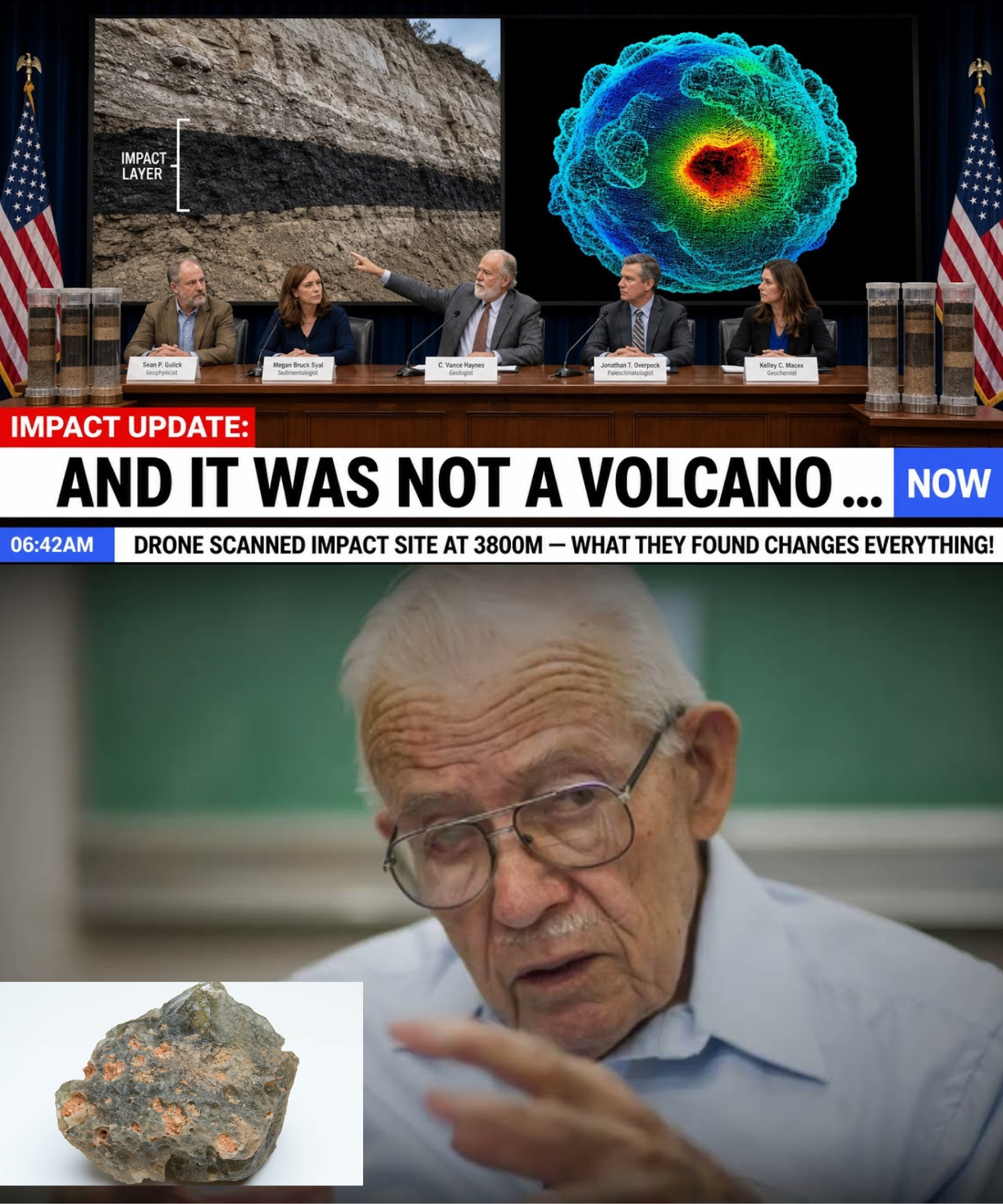
The Younger Dryas layer is not one identical black stripe found everywhere on Earth. It is a boundary interval, sometimes associated with black mats, organic-rich deposits, charcoal, microspherules, or chemical anomalies. In some places, it appears dramatic. In others, it is subtle or absent. In archaeology, geology, and paleoclimatology, this matters because timing is everything. If an impact or airburst happened, the strongest evidence should appear at the right moment, in the right layer, across enough sites to show a global or hemispheric event.
That is what the supporters claim they keep finding.
And that is what critics say has not been proven consistently enough.
The new wave of analysis focuses not only on what sits inside the boundary, but what lies beneath it. That is where the story becomes dramatic. Beneath the Younger Dryas boundary are the final pages of the late Ice Age world: megafauna bones, human tools, pollen records, lake sediments, charcoal traces, and ecological signals from a planet already under stress but not yet transformed by the sudden cold reversal.
If the layer contains a cosmic signature, then the material beneath it is the “before.”
Before the cooling.
Before the ecological shock.
Before the disappearance of some megafauna populations.
Before changes in human settlement patterns.
Before the black horizon became the dividing line between two worlds.
That is why the reanalysis matters. The question is not simply whether some strange particles exist in the layer. The question is whether the layer marks a sudden event sharp enough to separate one world from another.
At sites such as Pilauco in southern Chile, impact-hypothesis researchers have argued that the boundary contains microscopic spherules, platinum and gold peaks, native iron particles, micro-charcoal, and signs of major biomass burning. The southern location matters because much of the early evidence came from North America and parts of the Northern Hemisphere. A similar signal far south would suggest the event was broader than skeptics wanted to allow.
To supporters, this is the pattern they have been waiting for: multiple continents, similar timing, exotic markers, sudden ecological disruption.
To critics, it is still not enough.
They argue that microspherules can form in wildfires, volcanism, lightning, industrial contamination, or other terrestrial processes. They point out that not every site produces the same markers. They question whether all deposits are precisely synchronous. They argue that a worldwide catastrophe should leave clearer crater evidence, more uniform stratigraphy, and a more coherent physical mechanism. In their view, the hypothesis keeps shifting: first an impact, then multiple airbursts, then comet dust, then ice-sheet impacts whose craters disappeared. A theory that constantly changes shape can become difficult to disprove, but also difficult to trust.
The most painful blow to the impact hypothesis came from Greenland.
When the huge Hiawatha crater was identified beneath the Greenland ice sheet, some supporters saw a possible smoking gun. A crater under ice seemed perfect: it could explain why no obvious surface crater had been recognized before. It was large, hidden, and dramatic. But later dating placed the Hiawatha impact at around 58 million years ago—far older than the Younger Dryas. That did not kill the broader hypothesis, because supporters can still argue for airbursts or other impact sites, but it removed one of the most visually compelling candidates.
In science, a beautiful candidate can die under a date.
That is exactly what happened.
Still, the impact hypothesis survived because it was never dependent on Hiawatha alone. Its strongest supporters argue that the real evidence is distributed in the boundary layer itself: the microscopic debris of an event that may not have left a single crater. Tunguska, the 1908 Siberian airburst, flattened forest without leaving a classic crater. If a larger fragmented comet exploded above ice sheets or multiple regions, the geological signature could be scattered, subtle, and difficult to identify thousands of years later.
That possibility keeps the door open.
But a door open is not the same as a verdict.
The phrase “what they found beneath it ends the debate” is therefore best understood as dramatic storytelling rather than settled science. What lies beneath the layer does not end the debate in a simple way. It sharpens it. Beneath the boundary, researchers see the late Pleistocene world; inside the boundary, some claim to see the fingerprints of cosmic catastrophe; above it, they see a colder, altered world. The argument is over whether those three pieces are causally connected.
This is where the debate becomes more than geology.
If the impact hypothesis is right, then human history may have been shaped by a sky event far more recently than most people imagine. The end of the Ice Age was already a time of enormous change, but a cometary event could have added sudden violence to the transition. Fires, atmospheric dust, ice melt, ocean disruption, and ecological stress may have collided in one of the most dramatic turning points since humans became a major force on the planet.
If the hypothesis is wrong, the lesson is different but equally important. It would show how seductive catastrophe can be. Humans love clean explanations. A cosmic blast is easier to picture than complicated interactions among ice sheets, meltwater, ocean circulation, vegetation, animals, and human adaptation. A comet gives the story a villain. Climate systems rarely do.
That is why the Younger Dryas debate has become so intense. It is not only about particles in sediment. It is about how we tell the story of collapse.
Was the world struck?
Or did it unravel?
Supporters of the impact theory often emphasize the drama of suddenness. They point to abrupt cooling, widespread burning, platinum anomalies, microspherules, and the disappearance or decline of megafauna. They argue that too many unusual signals cluster around the same time to be coincidence. Some suggest that the event may have altered human societies, disrupted Clovis culture in North America, and left echoes in flood myths and ancient memory.
Critics reject that leap. They warn that megafaunal extinctions were not globally simultaneous in a way that requires one impact. They argue that human cultures did not vanish everywhere at once. They point out that climate change at the end of the Pleistocene was complex, regionally varied, and already underway. They also stress that extraordinary claims require extraordinarily clean evidence.
A comet that changed the world cannot be built from ambiguity alone.
This is why “beneath the layer” matters so much. In a good stratigraphic sequence, the order of layers is a timeline. Beneath means earlier. Above means later. A sudden boundary can act like a page turn. But if layers are disturbed, eroded, mixed, or poorly dated, the story becomes unreliable. A microscopic particle in the wrong context can mislead. A charcoal peak can mark local burning rather than global catastrophe. A platinum spike can be fascinating, but only if its timing, source, and distribution are secure.
The best Younger Dryas research now lives in this careful territory: not asking simply whether dramatic markers exist, but whether they form a synchronous, reproducible, global-enough pattern that cannot be explained by known terrestrial processes.
That is a much harder question.
And it is exactly why the debate continues.
Still, the dramatic power of the evidence cannot be denied. Imagine the scene 12,800 years ago if the impact hypothesis is even partly right. A fragmented comet enters Earth’s path. Pieces explode in the atmosphere. Shockwaves roll across ice and forest. Fires ignite. Dust rises. Meltwater pulses into oceans. Animals already stressed by climate and human pressure face sudden ecological chaos. Human groups see skies burn, landscapes change, and familiar hunting worlds collapse.
Whether or not this happened exactly that way, the possibility is haunting.
Because it reminds us that civilization rests under a sky that has not always been gentle.
The Younger Dryas is not ancient in cosmic terms. It happened within the span of human memory as a species. People were here. They made tools. They hunted. They gathered. They buried their dead. They told stories. They watched the weather. If something catastrophic appeared in the sky, human eyes saw it. If fires spread, human lungs breathed the smoke. If animals vanished, human communities felt the loss.
This is why the debate captures the public imagination.
It is not about dinosaurs. It is about us.
The layer sits near the threshold between the Ice Age world and the world that eventually gave rise to agriculture, cities, writing, and history as we know it. If a cosmic event helped trigger or intensify the Younger Dryas, then the path to civilization may have passed through a disaster we are only beginning to understand.
But caution is necessary.
There is a dangerous temptation to turn every unresolved ancient mystery into proof of a lost advanced civilization, a worldwide apocalypse, or a suppressed truth. The Younger Dryas debate is often pulled into those narratives. Some popular commentators use the impact hypothesis to suggest that an advanced prehistoric civilization was destroyed and erased. That is not what the evidence proves. Even if an impact event occurred, it would not automatically prove a lost global civilization. It would prove a major natural event at a critical time in human prehistory.
That alone would be extraordinary.
There is no need to add unsupported claims.
The responsible version of the story is dramatic enough: scientists are still fighting over whether a boundary layer dating to about 12,800 years ago preserves evidence of a cosmic event that may have contributed to abrupt climate change and ecological disruption. Some evidence looks compelling. Some has been challenged. Some findings have not replicated cleanly. Some new studies support the hypothesis. Some major reviews reject it. The argument is alive because neither side has delivered a final piece that everyone accepts.
So what did the reanalysis really reveal?
It revealed that the Younger Dryas boundary remains one of the most contested layers in Earth science.
It revealed that beneath the layer lies a world on the edge of transformation.
It revealed that the evidence for catastrophe is strong enough to keep serious researchers engaged, but not strong enough to force universal agreement.
It revealed that the debate cannot be settled by one proxy alone. Platinum is not enough. Charcoal is not enough. Spherules are not enough. Nanodiamonds are not enough. Craters are not enough unless correctly dated. The case must be built from convergence: timing, chemistry, mineralogy, stratigraphy, climate response, ecological change, and physical mechanism.
Only convergence can end the debate.
The most powerful conclusion may be this: the Younger Dryas layer is not a simple answer. It is a crime scene where the evidence has been weathered, buried, scattered, and argued over for nearly thirteen thousand years. Some investigators see impact debris. Others see natural processes. Some see a global fire signal. Others see regional burning and dating problems. Some see the fingerprints of a comet. Others see the human desire for a single catastrophic cause.
The truth may eventually include parts of both.
Perhaps a cosmic event happened, but it was not solely responsible for the Younger Dryas. Perhaps comet dust or airbursts contributed to climate disruption already driven by meltwater and ocean circulation changes. Perhaps some impact markers are real while other claimed markers are not. Perhaps the event was smaller, more regional, or more complex than early versions proposed. Science often moves not by choosing the most dramatic extreme, but by refining the question until reality finally fits.
That may be where the Younger Dryas debate is heading.
Not toward a simple yes or no.
Toward a more complicated history of a world already unstable, possibly struck by cosmic debris, and certainly transformed by forces powerful enough to reshape climate, ecosystems, and human futures.
The title says the debate has ended. The science says something more interesting.
The debate has matured.
It has moved from wild dismissal and dramatic certainty into a harder phase: dating, replication, proxy validation, geochemical sourcing, and global comparison. That is where real answers will come from. Not from viral declarations. Not from one spectacular image. Not from one site. From patient work across many sites, by researchers willing to be wrong.
That is the part science does better than mythology.
It can change its mind.
The Younger Dryas layer still waits in sediments, caves, lake cores, ice records, and archaeological sites across the world. Beneath it lies the late Ice Age world. Above it lies the cold reversal that interrupted warming and shaped the path toward the Holocene. Within it may lie evidence of fire, dust, impact, climate shift, ecological collapse, or all of them tangled together.
Whatever the final answer becomes, the layer has already done something important.
It has forced scientists to look again.
At the sky.
At the ice.
At the sediments.
At the fragility of climate.
At the possibility that human history can be redirected by forces arriving without warning.
The debate is not truly over.
But the question has become impossible to ignore.
And sometimes, in science, that is the first sign that history is about to change.