What They Found In Oregon Is So Disturbing, Even Archaeologists Can’t Explain It
What They Found In Oregon Is So Disturbing, Even Archaeologists Can’t Explain It
The discovery was not buried under a palace or hidden inside a tomb. It was waiting in the dry silence of Oregon’s high desert, beneath ash, stone, and Ice Age animal remains—and once archaeologists understood what they were looking at, the old story of America’s first people began to crack.
For decades, the history of the first Americans was told with confidence. People crossed from Asia into North America near the end of the Ice Age, passed through an opening between the great ice sheets, and spread across the continent around 13,000 years ago. Their tools became known as Clovis points, and for many years, Clovis was treated as the beginning of the human story in the Americas.
It was a clean story.
Maybe too clean.
Because Oregon has been quietly producing evidence that refuses to fit inside it.
In the lonely desert country of eastern and south-central Oregon, archaeologists have found traces of people who appear to have been here long before the old timeline allowed. Not monuments. Not cities. Not temples. Something stranger, smaller, and harder to dismiss: stone tools buried beneath ancient volcanic ash, extinct animal remains, dried human waste containing genetic evidence, and a scraper with blood residue from an Ice Age bison.
Each discovery, taken alone, might be explained, debated, or challenged.
Together, they point toward something disturbing.
People may have been living in Oregon thousands of years earlier than generations of textbooks suggested.
And they were not alone.
They were sharing the land with extinct camels, ancient bison, horses, and other animals from a vanished world.
The site that has recently drawn major attention is Rimrock Draw Rockshelter, near Riley, Oregon. At first glance, it does not look like a place capable of rewriting history. It is not glamorous. It is not grand. It is a rock shelter cut into a rugged desert landscape, the kind of place where wind scrapes across dry ground and the horizon seems to hold more secrets than answers.
But archaeology often changes history through small things.
A tooth fragment.
A stone flake.
A scraper.
A layer of ash.
A trace of blood.
At Rimrock Draw, archaeologists uncovered stone tools and fragments of extinct animal teeth, including camel and bison. Some of the finds were buried beneath volcanic ash from a Mount St. Helens eruption dated to more than 15,000 years ago. Even more startling, radiocarbon testing on tooth enamel produced an age of about 18,250 years before present.
That date is not just old.
It is dangerous to old assumptions.
If humans were in Oregon more than 18,000 years ago, then the first Americans were not simply late arrivals moving neatly through an ice-free corridor after the glaciers opened. They were already present in the American West during the Ice Age, living in a landscape filled with animals that no longer exist.
The most chilling detail may be the scraper.
One finely crafted orange agate tool reportedly contained preserved bison blood residue. Think about what that means. This was not just a rock. It was used. Someone held it. Someone shaped it. Someone pressed it into the work of survival. It may have been used to process an animal in a world where humans and megafauna still crossed paths.
That single object brings the ancient scene frighteningly close.
Not a theory.
A hand.
A blade.
Blood.
A dead animal.
A person surviving in Oregon before history said they should be there.
That is the kind of evidence that unsettles people. It is not dramatic in the Hollywood sense, but it is deeply human. It collapses the distance between now and then. It reminds us that the past was not a museum display. It was hunger, cold, skill, danger, and decision.
Rimrock Draw is not the only Oregon site that challenged the old model. Paisley Caves, in south-central Oregon, became famous after researchers studied ancient coprolites—dried fecal remains—dated to around 14,300 years ago. It may sound strange, even unpleasant, that ancient waste could become one of the most important pieces of evidence in American archaeology. But that is the power of science. Sometimes the most ordinary remains tell the most extraordinary truth.
The Paisley evidence helped show that humans were in Oregon before the Clovis culture. That alone was enough to disrupt the old timeline. But the site also became controversial, as researchers debated contamination, DNA movement, dating, and interpretation. Some challenged parts of the evidence. Others strengthened the case through additional analysis, including chemical biomarkers.
That controversy matters because it shows how serious the question is.
Archaeologists do not rewrite history because a headline sounds exciting. They argue. They test. They challenge. They demand better evidence. When a site claims to push human presence in North America back thousands of years, the evidence must survive intense scrutiny.
And Oregon’s evidence keeps returning to the same problem.
The old story is too small.
The discoveries do not suggest a cartoon version of the past. They do not prove lost giants, aliens, or some impossible forgotten empire. They reveal something far more realistic—and in many ways more disturbing. Human beings were tougher, earlier, and more adaptable than many experts once believed.
They were here when the land looked different.
They were here before familiar animal communities existed.
They were here when North America still belonged to the Ice Age.
Imagine Oregon 18,000 years ago. The climate was colder. Lakes filled basins that are now dry. Volcanic ash marked the land. Giant animals moved across open country. Small human groups followed water, animals, stone sources, and shelter. They carried knowledge not written in books but stored in memory, hands, and survival habits.
They knew which stones fractured cleanly.
They knew where to find shelter.
They knew how to track animals.
They knew how to process hides, meat, bone, and plant materials.
They knew how to live in a world most modern people would not survive for a week.
That is the part that should humble us.
The first Americans were not primitive wanderers stumbling through an empty continent. They were experts. Their tools may look simple to modern eyes, but simplicity can be deceptive. A scraper, a blade, a sharpened point—these were technologies built from observation, practice, and necessity. A bad tool could mean hunger. A good one could mean survival.
What makes Oregon especially important is its location. If people were in the Pacific Northwest very early, it strengthens the idea that the first Americans may have moved along the Pacific coast or through western routes earlier than once believed. The old ice-free corridor model no longer explains everything neatly. Some researchers now argue that people may have followed coastlines, kelp forests, rivers, and interior routes in complex waves of movement.
The difficulty is that much of the ancient coastline is now underwater. Sea levels rose after the Ice Age, drowning many places where early people may have camped. If the first migrations followed the coast, some of the most important evidence may be beneath the Pacific.
That makes inland Oregon sites even more precious.
They are surviving windows into a deeper human past.
But the discoveries also raise a darker question: what happened to the animals?
Extinct camels. Ancient bison. Horses. Mammoths elsewhere. Giant ground sloths. Saber-toothed cats. North America once held a cast of Ice Age creatures that feels almost mythological now. By the end of the Pleistocene, many were gone. Scientists still debate why. Climate change was severe. Ecosystems shifted. Human hunting may have added pressure. Disease, habitat loss, and ecological collapse may have combined in ways no single theory can explain completely.
If humans were in Oregon more than 18,000 years ago, then people and megafauna may have interacted for longer than the old model allowed.
That does not automatically mean humans caused the extinctions.
But it does mean the story is more complicated.
And complicated stories are often the most truthful ones.
This is why the Oregon discoveries feel disturbing. They do not provide a simple answer. They open a door into uncertainty. They tell us humans were here earlier, animals were here with them, and the world changed dramatically. But they do not give us a clean explanation for how those people arrived, how many groups came, what routes they used, what languages they spoke, what they believed, or how they understood the giant animals around them.
The ground gives evidence.
It does not always give closure.
There is also a deeper human element. Many Indigenous communities have long traditions of deep presence on the land, with stories that reach back into times of floods, giant animals, volcanic events, and landscape transformation. Archaeology and oral history are different kinds of evidence, but they should not be treated as enemies. When scientific dates move earlier, they often come closer to what Indigenous peoples have said in other forms for generations: we have been here a very long time.
That matters.
Because the old version of American prehistory often made Indigenous presence seem recent, shallow, or temporary. Sites like Rimrock Draw and Paisley Caves help push against that. They show that human history in Oregon reaches into deep time. The people of this land were not late footnotes in history. They were part of the continent’s ancient story.
Still, scientists remain careful. They should. Evidence this old must be tested again and again. Natural processes can move objects. Layers can be disturbed. Dates can be debated. DNA can be contaminated. Stone tools can be misidentified. Archaeology is powerful because it is cautious.
But caution does not erase the shock.
At Rimrock Draw, archaeologists found evidence suggesting human occupation more than 18,000 years ago. At Paisley Caves, researchers found pre-Clovis evidence that helped challenge the long-standing model. These sites are not isolated curiosities. They are part of a growing pattern across the Americas, where older and older sites are forcing researchers to rethink migration, adaptation, and the beginning of human life on this continent.
That is why the old “Clovis-first” story collapsed.
Not because of one discovery.
Because too many discoveries refused to obey it.
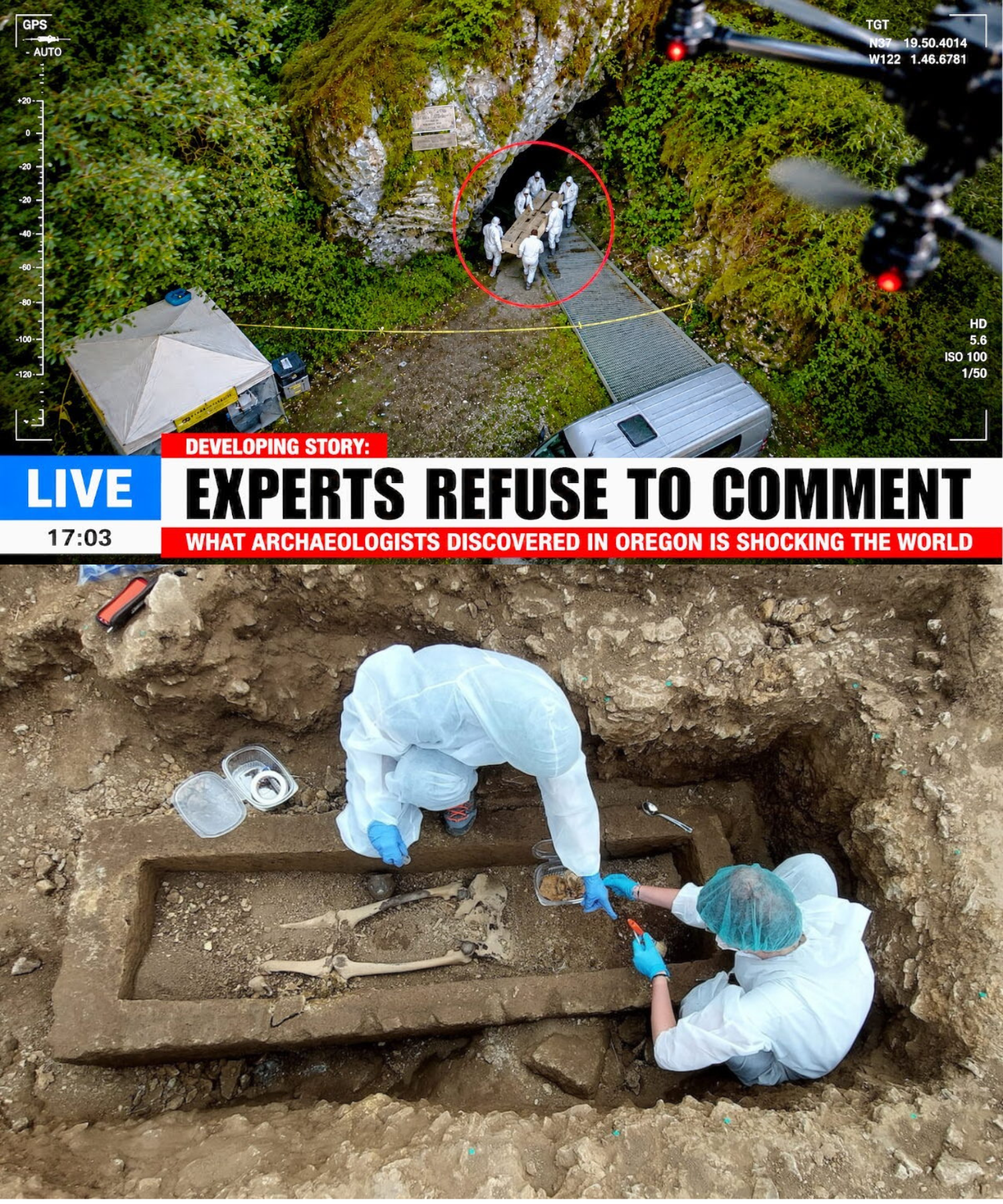
The most haunting part of the Oregon evidence is how ordinary it is. We often imagine history-changing discoveries as dramatic: a golden mask, a buried city, a stone temple, a royal tomb. But here, the evidence is quieter. A cave deposit. A dried coprolite. A tooth fragment. A scraper. Ash. Blood residue.
These are the remains of daily life.
And daily life is where real history begins.
Someone sat under that rockshelter.
Someone made a tool.
Someone processed an animal.
Someone cooked near a fire.
Someone walked through a landscape filled with creatures we will never see alive.
Someone lived in Oregon when the world was colder, wilder, and more dangerous than it is now.
That should shake us more than treasure.
Because treasure tells us about wealth.
Tools tell us about survival.
The discoveries also remind us that history is never finished. Every generation inherits a version of the past, and every generation must be ready to revise it. The people who defended Clovis-first were not stupid. They worked with the evidence they had. But evidence changes. New sites are excavated. New dating methods improve. New technologies reveal what older methods missed. Old assumptions lose their authority.
That is how knowledge grows.
Painfully.
Reluctantly.
But powerfully.
Oregon’s high desert has now become part of that larger transformation. Its dry caves and rockshelters preserve traces that wetter landscapes might have destroyed. Its volcanic layers provide time markers. Its animal remains connect humans to a vanished ecological world. Its artifacts ask questions that cannot be ignored.
How early did humans reach the American West?
Were they coastal migrants, inland explorers, or both?
How did they survive the Ice Age environment?
How did they interact with extinct animals?
How much of the earliest story is still hidden beneath desert sediment, cave floors, and drowned coastlines?
The answer is not complete yet.
But the direction is clear.
The first American story is older than we were told.
And Oregon may hold some of its most unsettling chapters.
So yes, what they found in Oregon is disturbing—not because it proves some wild fantasy, but because it breaks the comfort of a simple timeline. It reminds us that human history is deeper, messier, and more mysterious than our textbooks once allowed. It forces archaeologists to confront evidence that does not fit easily. It asks the public to accept that the past is not a finished story.
The old model said humans arrived late.
Oregon says look again.
The old model said Clovis was the beginning.
Oregon says people were here before.
The old model offered certainty.
Oregon offers ash, stone, blood, teeth, and questions.
And beneath the dry silence of the high desert, more evidence may still be waiting—evidence that could push the story even farther back, into a time when America was not empty, but alive with people whose names are lost, whose languages are gone, and whose smallest tools are now powerful enough to rewrite the history of a continent.