wait…where did the nephilim go after the flood? the bible’s answer is disturbing
I grounded this draft in the biblical trail: Genesis says the Nephilim were on earth “in those days—and also afterward”; Numbers records the spies claiming the Anakim came from the Nephilim; Deuteronomy mentions giant peoples such as the Emim, Zamzummim, Anakim, and Rephaim; and Jude/2 Peter speak of rebellious angels kept for judgment. (BibleGateway)
Wait… Where Did the Nephilim Go After the Flood? The Bible’s Answer Is Disturbing
The Flood was supposed to erase them.
That is what makes the Nephilim one of the most unsettling mysteries in the Bible. They appear before the Flood in Genesis, standing like shadows at the edge of the ancient world, connected to violence, corruption, and the strange rebellion of the “sons of God.” Then the waters come. The earth is judged. The old world is buried. Every living thing outside the ark is swept away. And yet, generations later, when Israel stands near the border of the Promised Land, the spies return shaking with fear and say something that should not be possible: “We saw the Nephilim there.”
That single statement opens one of the darkest questions in biblical history.
Where did they go?
The Bible does not answer the question in the simple way modern readers want. It does not pause the story and give a clean explanation. It does not draw a family tree, reveal a secret cave, or explain whether the Nephilim survived, returned, or were remembered through another giant race. Instead, it leaves a trail of disturbing clues: giant clans in Canaan, ancient peoples called Rephaim, terrifying warriors like Og of Bashan, and New Testament warnings about rebellious angels bound in darkness until judgment.
The result is not a neat answer.
It is a shadow moving through Scripture.
The first appearance of the Nephilim comes in Genesis 6, just before the Flood narrative. The passage is short, but it has haunted readers for centuries. It says the “sons of God” saw that the daughters of humans were beautiful and took them as wives. Then it says the Nephilim were on the earth in those days, “and also afterward,” when the sons of God had children with human women. These offspring were described as mighty men of old, men of renown.
Then, almost immediately, the story turns dark.
Human wickedness becomes great. The thoughts of the human heart become continually evil. Violence fills the earth. God determines that the world has become corrupt, and the Flood is announced. The placement of the Nephilim passage right before the Flood is not accidental. Whether the Nephilim themselves caused the corruption, symbolized it, or were part of a broader rebellion, the text places them inside the atmosphere of a world that had crossed a line.
That alone is disturbing.
The Bible introduces them not as heroes to be admired, but as figures from a ruined age.
The word “Nephilim” itself is mysterious. Some connect it to a root meaning “fallen ones.” Others understand it through the Greek translation tradition as “giants.” The exact meaning remains debated, but the biblical image is clear enough: they were extraordinary, feared, and associated with a world out of order. They were not ordinary men living ordinary lives. They belonged to the memory of something ancient and terrifying.
Then the Flood comes.
Genesis describes the waters rising over the earth, covering the mountains, and destroying all flesh outside the ark. Noah, his family, and the animals with them survive. That should close the Nephilim chapter forever. If they were living beings before the Flood, they should have died with the rest of the corrupt world. The ark was not carrying Nephilim bloodlines, at least not according to the plain story of Genesis.
But then comes Numbers 13.
Moses sends spies into Canaan. They return with fruit from the land, proof that it is abundant. But most of them are terrified. They speak of fortified cities and powerful people. Then they say they saw the descendants of Anak there, and in one of the Bible’s most chilling lines, they claim the Anakim come from the Nephilim. They add that they felt like grasshoppers in their own eyes, and that they appeared the same to those giants.
This is the line that changes everything.
Because now the Nephilim are not only before the Flood.
They are somehow “afterward.”
There are several ways to understand this, and each one carries its own disturbing weight.
The first possibility is that the spies were exaggerating. Numbers 13 is not presented as a calm scientific report. It is a fear-filled speech from men who do not want to enter the land. They may have used the word Nephilim to terrify the people, reaching back to an ancient name associated with giants and violence. In that reading, they did not literally mean pre-Flood beings had survived. They meant, “The people there are so huge and terrifying that they are like the Nephilim of old.”
This interpretation protects the Flood narrative from contradiction.
But it still shows how powerful the memory of the Nephilim was.
Even if the spies exaggerated, they chose the most frightening name available. They did not say, “We saw tall men.” They said, “We saw the Nephilim.” That means the name still carried terror generations after the Flood. It was not forgotten. It was a word that could make a nation tremble.
The second possibility is that the phrase “and also afterward” in Genesis 6 points to a later recurrence. In this view, the same kind of rebellion that produced the Nephilim before the Flood happened again after the Flood. The original Nephilim died, but another outbreak occurred later, producing the giant clans seen in Canaan. This is the theory many readers find most disturbing, because it suggests the Flood did not permanently end the supernatural corruption. It cleansed the earth, but the rebellion tried to return.
That reading makes Canaan feel like more than a military challenge.
It becomes a spiritual battleground.
The third possibility is that the Bible’s later giant clans were not literally Nephilim, but were connected to the same ancient category of fear. Deuteronomy speaks of peoples such as the Emim and Zamzummim, described as numerous, powerful, and tall like the Anakim. It also connects them with the Rephaim, another mysterious group associated with giant figures and ancient territories. Og king of Bashan, whose bed is described as enormous, is linked to the remnant of the Rephaim. These names create a network of giant peoples in the land east of the Jordan and in Canaan.
They are not always called Nephilim directly.
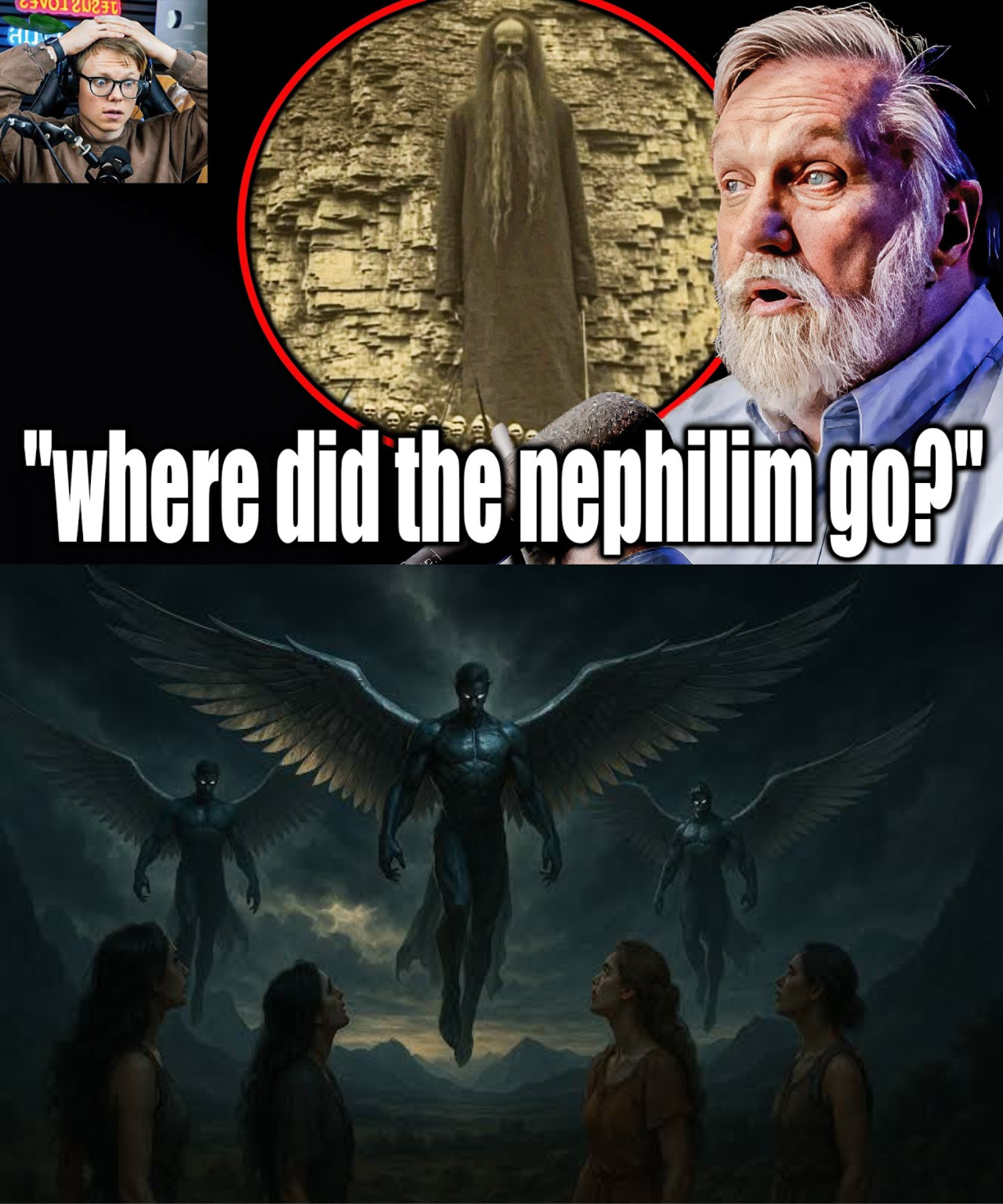
But they feel like echoes.
Anakim. Rephaim. Emim. Zamzummim. Og of Bashan. Goliath of Gath later appears as another towering warrior in Israel’s story. The Bible keeps returning to the image of giants standing in the way of God’s people. The pattern is hard to ignore. The ancient terror of Genesis seems to reappear in the land Israel is called to enter.
That is why the question is not only biological.
It is theological.
The Nephilim represent more than height. They represent opposition. They represent the old violence. They represent the world before judgment trying to cast a shadow over the world after judgment. When Israel reaches the Promised Land, the fear is not just that the cities are strong. The fear is that the ancient nightmare is still there, waiting behind the walls.
This is why the spies collapse in fear.
They are not only afraid of losing a battle.
They are afraid that the old chaos survived.
But the Bible’s most disturbing answer may not be about where the bodies of the Nephilim went. It may be about where their spirits went.
This idea comes not mainly from Genesis or Numbers, but from later Jewish tradition and from hints in the New Testament. Jude speaks of angels who did not keep their proper place but abandoned their dwelling, now kept in darkness for judgment. Second Peter speaks of angels who sinned and were cast into gloomy chains. Many interpreters connect these passages to the rebellion of Genesis 6, where heavenly beings crossed a forbidden boundary with human women.
If that connection is correct, the fathers of the Nephilim did not escape judgment.
They were imprisoned.
But what about the Nephilim themselves?
Ancient Jewish writings outside the Protestant canon, especially traditions around Enoch, develop a chilling answer: the bodies of the giants died, but their spirits became wandering evil spirits. This idea influenced later demonology for many readers. In that tradition, demons are not fallen angels themselves, but the disembodied spirits of the dead giants, restless beings born of an unnatural union, destroyed in the Flood, and left roaming the earth.
The Bible does not state this as directly as later tradition does.
But the idea is disturbing because it explains why the Nephilim story did not simply disappear. Their bodies may have drowned, but the corruption associated with them did not vanish from human memory. The evil that marked the pre-Flood world continued to haunt the post-Flood world through fear, violence, idolatry, and spiritual rebellion.
In other words, the Flood ended their age.
It did not erase the war behind them.
This is where the story becomes darker than most people expect. Many readers imagine the Flood as a clean reset: evil world destroyed, righteous family preserved, new beginning established. But the Bible is more honest than that. After the Flood, Noah’s family still carries human sin. Violence returns. Nations rebel. Babel rises. Idolatry spreads. The giants appear in the land. Israel trembles at the border. The old problems come back under new names.
That is the disturbing pattern of Scripture.
Judgment can wash the earth, but the human heart still needs redemption.
The Nephilim mystery exposes that truth in a dramatic way. Whether they survived only as a terrifying memory, returned through another supernatural rebellion, or echoed through later giant clans, the message is the same: evil does not die simply because one generation is judged. It returns. It adapts. It hides in bloodlines, empires, cities, kings, fears, and spiritual powers.
That may be why the Bible never gives a comfortable explanation.
A comfortable explanation would make the Nephilim a solved puzzle. Scripture treats them more like a warning. They stand at the edge of the story to remind readers that humanity once became so corrupted that the whole earth had to be judged. Then their shadow appears again in Canaan, showing Israel that entering God’s promise would require facing not only armies, but ancient fear.
When the spies said, “We saw the Nephilim,” they were really saying, “The nightmare is still alive.”
Caleb and Joshua saw the same land differently.
That contrast matters. The fearful spies saw giants and felt like insects. Caleb and Joshua saw the promise of God and believed the land could be taken. The issue was not whether the enemies were large. The issue was whether God was larger. The Nephilim language became a test of faith. Would Israel be ruled by the terror of ancient giants, or by the word of the God who had already split the sea?
That is why the Bible’s giant stories often end in confrontation.
Og is defeated. The Anakim are driven out from many areas. Goliath falls to David. The giant is never treated as unbeatable when God is with His people. The terror is real, but it is not ultimate. The Bible allows the giants to look frightening, but it never allows them to become gods.
That may be the final answer.
Where did the Nephilim go after the Flood?
Into memory.
Into fear.
Into the names of later giant clans.
Into the shadowy traditions of imprisoned angels and wandering spirits.
Into the battlefield of Canaan.
Into the nightmares of men who forgot what God had already done.
And ultimately, into defeat.
The Bible does not preserve the Nephilim to satisfy curiosity. It preserves them to show what happens when the boundaries between heaven and earth, obedience and rebellion, power and corruption are violated. It shows that the ancient world before the Flood was not destroyed for small reasons. Something had gone terribly wrong. Violence had filled the earth. Human nature had become deeply corrupted. The Nephilim stood as a sign of that broken order.
After the Flood, their name returns like a ghost.
That return is disturbing because it suggests that the battle with evil did not end when the waters receded. The ark landed on a cleansed earth, but not on a perfected one. Noah stepped into a new world, but the old darkness still had ways of reappearing. By the time Israel reached Canaan, the giants were waiting in the story again, daring God’s people to believe fear more than promise.
That is the Bible’s deeper answer.
The Nephilim went where all ancient evil goes when God judges it but humanity still remembers it.
They became a warning.
A warning that rebellion has consequences.
A warning that power without holiness becomes monstrous.
A warning that the past can return if people mistake fear for truth.
A warning that the enemies of God may look enormous, ancient, and impossible to defeat, but they are still not eternal.
The Flood buried the old world.
But the Bible wants us to understand something chilling: some shadows do not vanish the moment the water dries.
They wait.
They reappear under different names.
And they are defeated only when God’s people stop running from them.