This Was Found in a Cave Beneath America’s Euphrates River — Jesus Warned About This
This Was Found in a Cave Beneath America’s Euphrates River — Jesus Warned About This
Part 1
The cave opened beneath the Ohio River at 3:16 in the morning, just outside Cincinnati, where the water was supposed to move east to west in a dark, industrial calm, carrying barges, bridge shadows, old factory runoff, and the memory of towns that had built their lives along its banks. Nobody called it the Euphrates, not officially. But old preachers in the Ohio Valley sometimes did when they wanted people to listen. They said every nation had a river where its sins eventually surfaced. For America, they said, it might not be the Euphrates of Scripture, but the Ohio, the Mississippi, the Hudson, the Los Angeles River buried in concrete, the waters that carried industry, bodies, baptism, poison, money, and mercy. Rivers remembered what cities tried to flush away.
The first sign was not a flood. It was absence. A section of the Ohio River near an abandoned steel dock pulled back from the bank like a curtain being drawn by an unseen hand. Tugboat operators noticed the current bending strangely around a black depression in the mud. At first, they thought a sinkhole had opened under the riverbed. Then the water withdrew farther, exposing a stone arch beneath layers of silt, roots, and rusted cable. The arch was not large, but it was too clean to be natural. Its top carried three carved symbols: a cup, a chain, and an eye with a tear beneath it.
By sunrise, police had blocked the access road. By noon, federal geologists were on-site. By evening, the story had reached New York, where Dr. Miriam Cole watched the first drone footage from her office at Columbia University and felt the same cold unease she always felt when a discovery looked too ready for headlines. She was a historian of biblical imagination in America, and she knew what would happen as soon as someone said cave, river, ancient warning, and Jesus in the same sentence. People would stop reading carefully. They would start trembling, accusing, selling, predicting, and filming themselves in parking lots with dramatic music behind them.
Then she saw the inscription above the arch.
It was not ancient Hebrew. It was English, carved by a nineteenth-century hand, worn but readable:
Do not enter looking for the end of the world. Enter only if you are willing to see what ended in you.
Miriam leaned closer to the screen.
“That is not archaeology,” she whispered. “That is a confession.”
In Ohio, Dr. Caleb Ward arrived before dusk. Caleb was a geologist and environmental historian from Ohio State University, known for ruining sensational stories by explaining water pressure, industrial history, bad records, and human arrogance. He stood in the mud near the exposed arch, boots sinking, raincoat open, staring at the stonework. Around him, workers pointed floodlights toward the riverbank. The water still curved around the opening, as if refusing to touch it.
A local woman named Ruth Bell stood behind the barricade with a thermos and a face that looked carved by decades of refusing foolishness. She ran a food pantry upriver in Mercy Ridge and had come because her grandfather once worked the abandoned docks. She looked at Caleb and said, “You experts finally found the river’s basement.”
Caleb glanced back. “You knew about this?”
Ruth shrugged. “Old men talked. Most old men talk too much. Once in a while, they’re useful.”
In Los Angeles, Naomi Reyes received the footage from Miriam before the national networks got it. She was a documentary filmmaker who had spent years watching sacred stories get turned into cheap panic. Her producer wanted a special called The Cave Beneath America’s Euphrates. Naomi refused before the pitch was finished. “We are not making a countdown to apocalypse,” she said. “We are making a film about why Americans keep wanting one.”
That night, a small remote camera entered the arch.
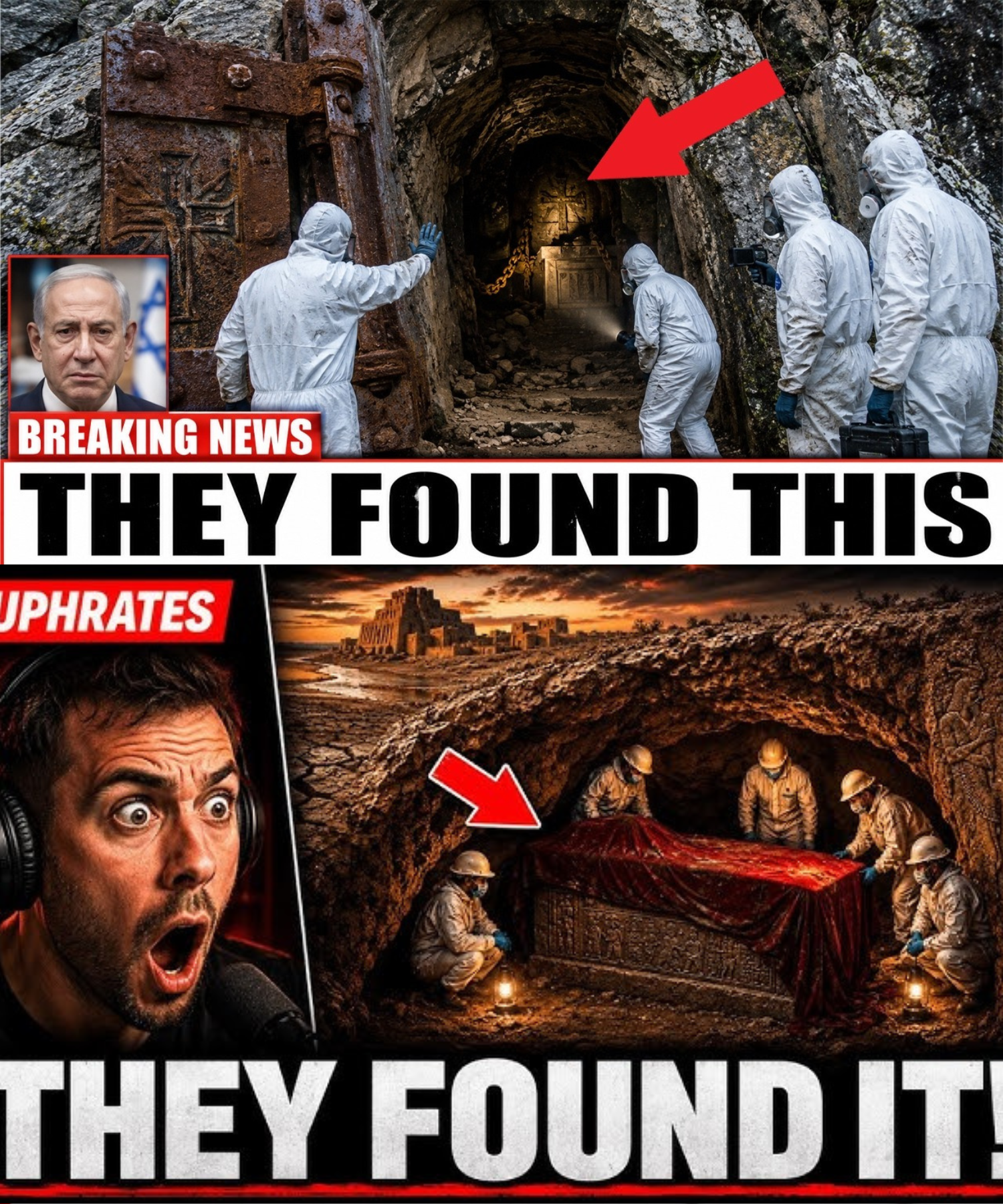
The passage descended beneath the riverbed, dry inside despite the water above it. Along the walls were carved scenes of American life: factories, churches, courtrooms, battlefields, hospitals, prisons, banks, schools, and people standing at riverbanks with their hands over their ears. At the end of the passage was a stone door.
On the door was written:
He warned you about the cup you drink, the chains you bless, and the least ones you refused to see.
Then the camera feed cut to black.
Part 2
The first argument was over whether to call it a religious site, an industrial structure, a hoax, a nineteenth-century moral installation, or a dangerous underground cavity requiring immediate sealing. Caleb argued for structural caution. Miriam argued for historical caution. Ruth argued for moral caution, which she defined as “not acting like idiots before the river finishes talking.” Naomi filmed none of the first meeting because she knew the temptation. Rooms full of experts arguing can make viewers feel smarter without making them wiser.
The site’s records were tangled. The abandoned dock had once belonged to Harlan Ironworks, a company tied to coal, steel, river freight, and war contracts in the late nineteenth and early twentieth centuries. Beneath that, property maps showed older settlement routes, Native displacement, Underground Railroad activity, flood camps, cholera burials, labor strikes, and at least one religious society called the River Watchers. The River Watchers were not famous. They were workers, widows, Black churchmen, immigrant Catholics, Quakers, former soldiers, and itinerant preachers who believed that America’s rivers carried evidence against it. They built hidden memorials where official monuments refused to stand.
The cave had likely begun as a natural limestone cavity connected to old river channels. It had been reshaped by human hands, perhaps over decades. Some sections were early industrial. Some were devotional. Some were older than the dock. Some parts had clearly been repaired after floods. The stone arch was not ancient Mesopotamian. It was American, but not ordinary. That disappointed the internet and deepened the story.
By the second day, the leaked footage had already become wild. Videos claimed the cave held fallen angels, demonic chains, hidden prophecy, proof of Revelation, or the physical cup of wrath described in Scripture. One Los Angeles channel declared that Jesus had warned about “this exact river cave.” Miriam publicly corrected the claim. “Jesus warned about judgment, hypocrisy, neglect of the poor, false religion, and hearts that refuse repentance,” she said. “If this cave matters, it matters because it brings those warnings home—not because it gives us a tourist map of the apocalypse.”
That clip spread, though not as fast as the false ones.
The first human entry happened three days later. Caleb led the structural team. Miriam entered as historical advisor. Ruth entered because she said if men were going to misread a moral cave, they needed supervision. Naomi entered last, camera lowered, after everyone agreed which areas could be filmed.
The air inside was cool and dry. The sound of the river overhead came through stone like distant breathing. Their headlamps revealed carvings along the first corridor. A cup overflowing into a river. A chain wrapped around a courthouse column. A child standing outside a church door. A soldier washing blood from his hands. A banker weighing coins against bread. A preacher pointing toward heaven while stepping over a man on the ground.
Naomi whispered, “This is not subtle.”
Ruth answered, “Neither are we.”
The stone door at the end of the passage did not open by pushing. Caleb found grooves in the floor connected to a pressure channel. When the river level shifted outside, water moved through a hidden side shaft and lifted a counterweight inside the wall. The door had once been designed to open only when the river withdrew to a certain point—during drought, extreme low water, or engineered diversion.
Caleb stared at the mechanism with grim admiration. “It opens when the river is wounded.”
Miriam touched the inscription lightly without tracing it.
He warned you about the cup you drink, the chains you bless, and the least ones you refused to see.
“What does it mean?” Naomi asked.
Miriam looked down the passage.
“It sounds like Matthew 25, the cup of suffering, and the warnings against religious blindness,” she said. “But here, it has been translated into America.”
Ruth nodded. “Then America better read slowly.”
Part 3
The first chamber was called the Room of Cups because every shelf held cups, bottles, ladles, communion chalices, whiskey flasks, medicine vials, tin mugs, and dented canteens. Some were labeled with names. Some with places. New York. Cincinnati. Cleveland. Los Angeles. New Orleans. Chicago. Appalachia. Selma. Wounded Knee. Flint. Each cup held residue, not liquid. Dust, rust, ash, dried mud, coal powder, river silt, old medicine, and, in one small glass vial, water so dark it looked like ink.
On the wall was carved:
You were warned that not every cup is blessing. Some cups are filled by the suffering of others, and the powerful drink first.
Miriam recognized the theological echo immediately. Jesus had spoken of the cup He would drink, of suffering, obedience, and the cost of redemption. But the River Watchers had turned the symbol toward America. What cups had the nation offered itself? Prosperity filled by exploited labor. Security filled by war. Comfort filled by poisoned land. Religious confidence filled by ignored suffering. Medicine priced beyond the sick. Clean water for some, poisoned water for others.
One shelf held small bottles labeled from hospitals across the country. Ruth picked up a sealed empty morphine vial with a tag: Mercy Ridge, 1912 — company clinic refused treatment until wage debt paid. Her face hardened.
“My grandfather told stories about this,” she said. “Men paid the company to die slowly.”
Another shelf held communion cups from churches that had split over race, immigration, class, and politics. Some tags included dates and names of excluded families. One read: Queens, New York, 1938 — family turned away for sitting in the wrong pew. Another: Ohio Valley, 1904 — workers denied burial rites after strike violence. Naomi filmed the tags in silence.
Then Caleb found the Los Angeles shelf. It contained bottled water brands, film studio canteen cups, and a cracked glass from a migrant labor camp outside the city. The tag read: They drank from silver cups at the premiere while the men who built the set slept beside irrigation ditches.
Naomi lowered her camera.
Miriam looked at her. “You okay?”
“No,” Naomi said. “But keep going.”
At the center of the room stood a stone basin shaped like a chalice. Inside it was a single sentence carved in the bottom:
If you ask to sit at My right hand, can you drink the cup of those you made invisible?
No one spoke for a long time.
Outside, the internet was still arguing about demons. Inside, the cave was naming water bills, hospital debts, church exclusions, poisoned rivers, labor camps, and the cost of comfort. It was not less frightening than demons. It was more frightening because no exorcism could make it someone else’s problem.
The second chamber lay beyond a narrow arch, marked by chains carved into the stone. Caleb tested the air before entering. Safe. Dry. But something about the darkness ahead made everyone slow down.
Ruth stepped first.
Inside, thousands of metal links hung from the ceiling.
Not all iron. Some gold. Some silver. Some made of paper, folded contracts, marriage licenses, prison records, mortgage notes, immigration documents, school discipline reports, medical bills, military orders, and baptism certificates. Chains of law. Chains of money. Chains of family. Chains of religion. Chains of debt. Chains of identity.
On the far wall, carved in large letters, was another warning:
You were told the truth would set you free. So you learned to call your chains truth.
Part 4
The Room of Chains became the part of the discovery America hated most. Cups could still be poetic. Chains were harder to romanticize. Every hanging link named a form of bondage America had blessed in the language of order, tradition, success, safety, faith, or common sense. Prison labor contracts. Sharecropping records. Factory debt notes. Marriage laws that trapped abused women. Church documents used to silence victims. Redlining maps. School punishment ledgers. Immigration detention files. Addiction treatment bills. Military discharge papers. Police arrest records for children. Student loans. Payday lending agreements. Non-disclosure forms from religious institutions. Each chain had been preserved by someone who wanted future generations to understand that slavery rarely introduces itself honestly.
Miriam read one paper chain aloud and nearly stopped.
Los Angeles, 1987 — church settlement requiring silence after youth minister abuse complaint.
Naomi turned away.
Ruth muttered, “There’s a chain people still polish.”
Another chain held old prison records from New York and Ohio, showing men leased for labor after minor convictions. Another held a baptism certificate attached to a boarding school intake form for a Native child whose name had been changed. Lena Redhawk, a Shawnee advisor called in after the first day, stood beneath that chain and said nothing for several minutes. Then she said, “Do not film this one.”
Naomi lowered the camera immediately.
The cave had rules, whether written or not.
The Room of Chains forced a national argument after the first approved images were released. Some praised the chamber as prophetic art. Others called it anti-American. Some said it attacked the Church. Others said it attacked capitalism, law, family, patriotism, or all of civilization. Ruth heard that and laughed without humor. “If naming a chain feels like attacking your world,” she said, “maybe check what your world is built from.”
That quote made her famous for three exhausting days.
In Los Angeles, Vale Media released a special claiming the Room of Chains proved a “hidden demonic covenant beneath America’s Euphrates.” Naomi publicly responded with one sentence: “You do not need demons to explain paperwork humans signed willingly.” Her correction did not go as viral as the demon theory, but it reached the people who needed it.
The third chamber, beyond the chains, was smaller and colder. It was called the Room of the Least Ones because the walls were covered with carved faces: children, prisoners, strangers, hungry families, sick bodies, elderly women, laborers, migrants, disabled veterans, enslaved people, displaced Native families, addicts, widows, and unnamed dead. Each face was simple, almost crude, but together they became unbearable. At the center stood a table with empty plates.
On the wall behind the table was written:
I was hungry, and you debated policy. I was thirsty, and you studied prophecy. I was a stranger, and you protected your comfort. I was sick, and you calculated cost. I was in prison, and you called Me consequence.
Miriam closed her eyes.
“Matthew 25,” she whispered.
Ruth said, “In American.”
The room had no artifacts at first glance. Then Naomi noticed that each empty plate was inscribed underneath. Names. Thousands of names. Some from New York shelters. Some from Ohio factory towns. Some from Los Angeles encampments. Some from prisons. Some from hospitals. Some from border crossings. Some only first names. Some unknown.
Caleb stood beside the table, pale.
“This is not a cave,” he said.
Ruth answered, “No. It’s a witness stand.”
Part 5
New York hosted the first public exhibit because the cave itself could not safely receive crowds. Miriam insisted the exhibit be called The Cave Beneath Our River, not America’s Euphrates Prophecy. The museum board wanted something more marketable. Ruth threatened to come to New York and rename the donors. The board discovered humility.
The exhibit recreated the three chambers with approved images, artifacts, and context. It did not show restricted items. It did not allow selfies near the plates. It did not sell souvenir cups or chain bracelets, despite one marketing consultant’s suggestion that “symbolic merchandise could fund charity.” Miriam looked at him as if he had proposed selling nails at Calvary.
The exhibit’s exit did not lead to the gift shop. It led to a map of local organizations serving the hungry, sick, imprisoned, addicted, unhoused, and forgotten. Some visitors complained that they had come for mystery, not volunteering. A museum guide replied, “The cave anticipated that.”
In Ohio, Mercy Ridge built its own smaller version in the parish hall. Ruth called it The River Table. People brought cups representing what they had received at someone else’s cost, paper chains naming what held them or others captive, and plates bearing the names of people they had stopped seeing. It was messy. Too emotional for some. Too political for others. Too religious for skeptics. Too practical for people who preferred religious feelings. In other words, it worked.
A man named Peter brought an empty whiskey bottle and placed it in the cup section. “This is the cup I made my family drink from,” he said. His daughter, now grown, stood across the room and did not forgive him that night. But she stayed. That counted.
A nurse named Denise brought a hospital bill from a patient who died delaying treatment. She placed it among the chains. “We call it a system,” she said. “Sometimes it is a chain with better fonts.”
A teenage boy named Marcus placed a paper plate on the table with his own name written underneath. When Ruth asked why, he said, “Because I got good at being invisible before anybody noticed.”
Ruth hugged him so hard he complained about his ribs.
In Los Angeles, Naomi screened early footage at a community center under the freeway. Angela Brooks, a formerly homeless outreach worker, watched the Room of the Least Ones and said, “People always want Jesus to warn about the end. He keeps warning them about the person sleeping outside their door.” That became the central line of Part Five.
The film Naomi was making took its title from the cave’s first inscription: Not the End of the World. Her producer hated it. “But the story is apocalyptic,” he said. Naomi answered, “Apocalypse means unveiling. The cave unveiled us.”
The strongest response came from a group of pastors in New York who visited the exhibit and then quietly canceled a prophecy conference scheduled around the cave. Instead, they held a service at a homeless shelter, where they read Matthew 25 and then served dinner without filming it. Ruth heard about that and said, “Miracles still happen.”
The cave had begun to do its work.
Not by proving the end was near.
By proving the ignored were already here.
Part 6
The fourth chamber was discovered by accident, or by timing, depending on whom one asked. Heavy rain raised the Ohio River overnight. The exposed arch nearly disappeared under rising water, and the research team expected the cave to seal itself again. Instead, pressure from the river activated a lower channel behind the Room of the Least Ones. A stone panel shifted, revealing steps descending to a chamber beneath the first three. Caleb almost refused to enter because the water level made everything dangerous. Ruth said the river had opened it for a reason. Caleb said the river did not issue permits. They waited until it was safe.
The lower chamber was bare except for a large stone mirror set into the far wall. Not glass. Polished black stone, reflective enough to show shapes but not details. Above it was carved:
You asked what Jesus warned about. Look.
One by one, the team approached.
The mirror did not show monsters. It did not show angels. It did not show a future apocalypse. It showed each person scenes from their own life, not visibly to others, but with enough force that no one spoke afterward.
Miriam saw classrooms where she had taught compassion while ignoring lonely students. She saw lectures where she had been right and unkind. She saw herself using careful language to avoid costly action.
Caleb saw reports he had written that warned of poisoned water, then filed away after agencies ignored them. He saw communities he had studied but never revisited. He saw data turned into distance.
Naomi saw edits. So many edits. Moments where she cut a person’s complexity for pacing. Times she made suffering beautiful enough for viewers to consume. Times she told herself awareness was action.
Ruth stood before the mirror longest. Later, she said only, “It showed me people I fed with my hands while judging them in my head.” No one asked more.
The mirror did not accuse like an enemy. It revealed like a surgeon.
At the bottom of the stone was one final line:
The warning was never hidden beneath the river. It was hidden beneath your excuses.
When this chamber became public, people reacted differently. Some dismissed it as psychological suggestion. Some called it miraculous. Some wanted to experience it. The team refused public access. Not because they wanted secrecy, but because the mirror room was too vulnerable to becoming spiritual tourism. The approved report described it without displaying full imagery. That angered everyone who believed discovery meant entitlement.
Miriam defended the decision. “If the cave teaches anything, it is that not every revelation exists for consumption.”
The national conversation shifted again. The cave had accused systems. Now it accused individuals. That was less comfortable. People liked denouncing poisoned water, unjust prisons, greedy corporations, corrupt churches, exploitative media. The mirror asked where each person participated. Not as guilt theater. As truth.
Naomi’s film changed after the mirror. She added her own confession about editing suffering. Caleb added his about distance. Miriam added hers about correctness without tenderness. Ruth added hers about judgment inside service. Their admissions gave the film a weight no artifact could provide.
The warning Jesus had given was not new. It had been in Scripture for two thousand years. Beware hypocrisy. Beware loving honor. Beware neglecting the least. Beware gaining the world and losing the soul. Beware calling Lord, Lord, while refusing obedience. Beware cups, chains, and invisible neighbors.
The cave did not add to His warning.
It removed the excuse that America had not heard.
Part 7
The river began rising for good in the seventh month. Hydrologists said the exposure window was closing. The cave would soon flood again, perhaps for years, perhaps permanently if the river shifted. Some researchers wanted to remove artifacts quickly. Ruth and Lena opposed any rushed extraction. Miriam argued for selective preservation, digital documentation, and leaving what belonged to the cave. Caleb worried about loss. Naomi worried about theft disguised as rescue. The debate lasted weeks.
In the end, the team chose custody over possession. Some fragile documents were removed with full documentation. Many objects remained. The cups stayed. Most chains stayed. The plates stayed. The mirror stayed. The cave had not opened to become a museum warehouse. It had opened to speak. Once it had spoken, the river could keep what the river had guarded.
A final ceremony was held at the entrance before the water covered the arch. Not a spectacle. No livestream. Representatives from New York, Ohio, Los Angeles, Native communities, churches, synagogues, mosques, labor groups, hospitals, prisons, shelters, and local families gathered at a safe distance. They read names from the plates. They read Matthew 25. They read from the prophets. They read anonymous confessions from the mirror room. They read commitments made in response: hospital debt relief funds, prison visitation programs, clean water initiatives, food pantry expansions, church abuse transparency reforms, documentary ethics pledges, labor memorial projects, housing support.
Not enough.
But real.
Ruth spoke last.
“People keep saying the cave is closing,” she said. “Good. Maybe now we stop staring into holes and start answering what came out of this one.”
Then the river rose over the arch.
By sunset, the entrance was gone.
The internet mourned the loss of access. Conspiracy channels claimed the government had sealed the cave to hide proof of demons. Vale Media released a special called The Cave They Buried Again. Naomi ignored it. Her film premiered two months later under the final title: The Warning Was the Mirror.
It opened with the river withdrawing.
It ended with the river returning.
Between those movements, America was given a question: not what was found under the river, but what the river found under America.
The film did not trend like the demon videos. It lasted longer. Churches used it during Lent. Universities used it in ethics courses. Environmental groups used it in water justice campaigns. Prison ministries used the Room of Chains. Hospitals used the Room of Cups. Food pantries used the Room of the Least Ones. Filmmakers used the mirror confession.
The cave was underwater again.
The warning was not.
Part 8
Years later, people still argued about the cave beneath America’s Euphrates River. Some believed the River Watchers had built a prophetic chamber inspired by the words of Jesus. Some believed it was a nineteenth-century moral archive shaped by abolitionists, workers, immigrants, and preachers. Some believed older water-memory traditions lay beneath it all. Some believed the mirror room was mass suggestion. Some believed the cave itself was a miracle. Some believed the whole thing had been exaggerated. The arguments never fully ended because arguments are easier to keep alive than obedience.
But the fruit remained.
New York kept the public archive and the exhibit, though the exhibit changed over time. The final room no longer showed dramatic cave footage. It showed local volunteer lists, legal aid clinics, water testing maps, prison visitation schedules, and a simple question on the wall: Who is outside your gate now?
Ohio kept The River Table. Ruth ran it until her knees failed, then from a chair, then through Marcus, who grew into the kind of young man who could ask hard questions without sounding like he enjoyed it. Peter stayed sober, then relapsed, then returned, then stayed sober longer. Denise helped build a medical debt relief fund. Caleb worked on river restoration projects and stopped pretending reports were enough if no one followed them.
Los Angeles kept Naomi’s film alive. The Warning Was the Mirror became known not as the most shocking documentary of its year, but as one of the hardest to rewatch. Naomi taught young filmmakers that mystery is not a substitute for responsibility. “If your film uncovers a warning,” she said, “ask who is asked to change. If the answer is only the audience’s enemies, you have made propaganda.”
The Ohio River kept moving. Some years low. Some years swollen. Barges still passed. Cities still drank, dumped, prayed, forgot, remembered. The cave did not reopen in public view. Once, after a drought, sonar detected the arch again beneath shallow water, but the team chose not to expose it. Ruth, near the end of her life, said, “The river can keep the door. We got enough homework.”
At her funeral, Miriam read the first inscription:
Do not enter looking for the end of the world. Enter only if you are willing to see what ended in you.
Then Naomi read the last:
The warning was never hidden beneath the river. It was hidden beneath your excuses.
No one applauded. Ruth would have hated that.
On the tenth anniversary of the cave’s opening, people gathered along the river in three cities: New York at the Hudson, Ohio at the original site, Los Angeles at the concrete channel of its own wounded river. They did not claim the waters were the same. They claimed responsibility was. Cups were placed on tables. Paper chains were torn. Plates with names were set out. People confessed, served meals, visited hospitals, wrote letters to prisoners, funded water testing, paid bills, said names, and sat before mirrors they could not blame on archaeology.
That night, Naomi stood at the Ohio riverbank beside Caleb and Miriam. The water was dark. A barge moved slowly under distant lights. The cave was somewhere below, silent again.
“Do you think we understood it?” Caleb asked.
Miriam looked at the river. “Sometimes.”
Naomi said, “Sometimes may be all we get before the next warning.”
A low sound came from beneath the water then—not thunder, not a voice, not anything dramatic enough for a headline. Just a deep shift, stone or current or memory moving below the surface.
They listened.
No one reached for a camera.
Jesus had warned about this.
Not a hidden cave only.
Not a river only.
Not an apocalypse people could watch from a safe distance.
He warned about cups filled by suffering, chains mistaken for truth, poor people left outside religious gates, and hearts that would rather study signs than obey mercy.
The cave beneath America’s Euphrates did not reveal a new warning.
It revealed that the old warning had been waiting under the noise, under the river, under the country, under every excuse.
And once America saw it, even briefly, it could no longer say the water had been silent.