They Scanned Nefertiti Bust — What Showed Up Wasn’t Supposed to Be There
CT IMAGING UNEARTHS UNEXPECTED TRUTH IN ICONIC EGYPTIAN MASTERPIECE
In the hushed galleries of Berlin’s Neues Museum, where crowds from around the world still gather in silent awe before one of history’s most captivating faces, modern technology has pierced the veil of time and uncovered a secret that no one expected to find.
The iconic limestone and stucco bust of Queen Nefertiti, the 3,300-year-old symbol of ancient Egyptian elegance and power, has long been celebrated for its flawless symmetry, elegant neck, and serene, idealized beauty.
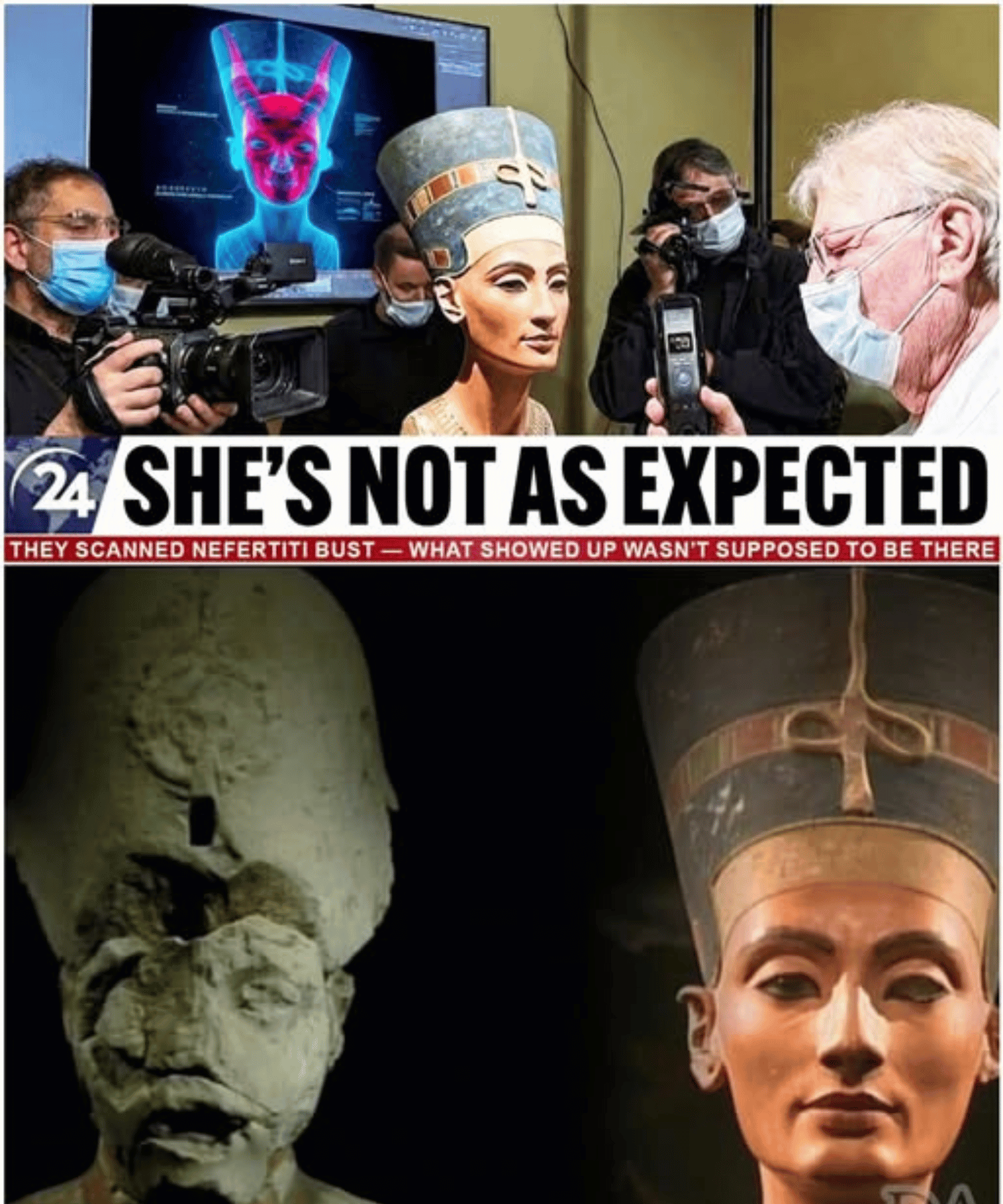
But when scientists trained high-resolution CT scanners on the priceless artifact, they discovered something that shattered the illusion of perfection: an entirely different, more human face hidden beneath the outer layers—a raw, realistic portrait carved into the limestone core with wrinkles, creases, and imperfections the world was never meant to see.
This revelation, emerging from layers added by the ancient sculptor Thutmose, has sent shockwaves through Egyptology, forcing experts to reconsider how the queen truly appeared and how master artists of the Amarna period approached their royal subjects.
The drama unfolded in 2006 when a team led by Dr. Alexander Huppertz at Berlin’s Charité hospital decided to subject the bust to a cutting-edge 64-section spiral CT scan.
What began as a routine conservation assessment—aimed at understanding the artifact’s internal structure and vulnerabilities—quickly turned into one of the most startling archaeological insights in decades.
As the scanner sliced through the bust in submillimeter increments, a ghostly image emerged on the monitors: beneath the smooth, painted stucco exterior lay a meticulously carved limestone core depicting Nefertiti with noticeably different features.
The inner face showed creases around the mouth and eyes, a slight bump on the nose, less prominent cheekbones, and subtler eyelid contours.
It was not a rough preliminary sketch but a finished, highly detailed sculpture in its own right.
Picture the moment in the imaging lab: researchers leaning forward in tense silence as layer after layer of digital data revealed the queen’s “hidden” visage.
The outer stucco, applied in varying thicknesses by Thutmose’s workshop around 1345 BC, had been carefully sculpted and painted to create the flawless, ageless beauty that has mesmerized generations.
But the underlying limestone told a different story—one of realism, perhaps even a truer likeness captured during the revolutionary Amarna artistic style under Pharaoh Akhenaten.
The differences were subtle yet profound: faint lines suggesting maturity, a more pronounced nasal bridge, and a less idealized jawline.
Until the scan, no one knew how deep the stucco extended or whether a complete second face existed underneath.
The CT images proved it did—and it was exquisite.
This discovery carries explosive implications for our understanding of Nefertiti herself.
Wife of the heretic pharaoh Akhenaten, who upended traditional Egyptian religion in favor of the sun disk Aten, Nefertiti was more than a queen—she was a co-ruler, possibly even a pharaoh in her own right.
The idealized outer bust, with its perfect symmetry and striking blue crown, projected divine, eternal beauty.
The inner face, however, suggests Thutmose first captured a living, breathing woman in her prime, complete with the natural marks of life at court.
Some experts speculate the sculptor added the outer layers to align with royal aesthetic ideals or to repair and perfect the work.
Others see it as evidence of a multi-stage creative process where the core served as a highly refined model before the final cosmetic adjustments.
The bust’s journey to this revelation adds layers of historical intrigue.
Discovered in 1912 by German archaeologist Ludwig Borchardt in the ruins of Thutmose’s workshop at Amarna, it was spirited to Germany amid controversial division of finds with Egyptian authorities.
For decades, it sat as a symbol of both ancient glory and modern diplomatic tension, with Egypt repeatedly demanding its return.
Early X-rays and scans in the 1990s offered hints, but the 2006 CT scan—published in the journal Radiology in 2009—delivered the definitive bombshell.
It not only exposed the hidden face but also revealed construction details: thin stucco on the face and ears contrasted with thicker layers on the rear crown, along with tiny fissures and bonding variations that inform ongoing preservation efforts.
The human element behind the artifact heightens the drama.
Thutmose, the chief sculptor, worked in a revolutionary era where art broke from rigid conventions to embrace more naturalistic portrayals.
Family scenes from Amarna show Akhenaten and Nefertiti with elongated features, intimate gestures, and even signs of aging or emotion—departures from the godlike stiffness of prior dynasties.
The inner limestone face aligns with this Amarna realism, suggesting the outer stucco was a deliberate elevation to divine status.
When the scan data was processed, it allowed virtual separation of the layers, offering a 3D view of both faces side by side.
The result is haunting: two versions of the same queen, one raw and human, the other eternal and untouchable.
Conservation experts were equally stunned by the structural insights.
The scan identified weak points where the plaster and limestone meet, areas prone to future damage from humidity or vibration.
This knowledge has guided careful handling protocols for the bust, which remains one of the museum’s star attractions.
Yet the revelation has also fueled controversy.
Egyptian officials and some scholars argue the hidden face strengthens claims for repatriation, suggesting the artifact holds deeper truths about their heritage still locked away in Berlin.
Others see it as proof of masterful ancient technique that transcends modern borders.
Broader questions ripple through Egyptology.
Was the inner face a preliminary study kept for reference?
Did Thutmose intend viewers to see only the perfected version?
Or does the dual-face design carry symbolic meaning—perhaps representing the queen’s mortal and divine aspects?
The bump on the nose and facial creases humanize a figure often reduced to icon status.
In an age when digital reconstructions and facial approximations of ancient royals proliferate, this physical evidence from the artist’s own hand feels profoundly intimate, as if Nefertiti herself stepped forward from the stone after millennia of silence.
Recent renewed interest, including high-profile 3D scans released after public campaigns and viral videos re-examining the 2009 data, has only amplified the mystery.
Some speculate further non-invasive imaging could reveal pigments, tool marks, or even hidden compartments, though the core discovery remains the most compelling.
The bust, standing just 48 centimeters tall, continues to captivate because it bridges worlds: the ancient workshop where it was born, the modern scanners that dissected it, and the timeless fascination with beauty, power, and hidden truth.
As visitors still line up daily in Berlin, many now gaze at Nefertiti with fresh eyes, imagining the living woman beneath the legend.
The scan did more than expose layers of stucco and stone—it exposed the humanity of a queen who helped reshape an empire.
In the quiet hum of the museum halls, where spotlights illuminate that famous crown and gaze, the artifact whispers of its secrets no longer.
What was never supposed to be seen has been revealed, forever altering how we perceive one of antiquity’s greatest masterpieces.
The desert sands of Amarna may hold more clues, but for now, the bust stands as a testament to ancient genius and modern curiosity.
A queen once hidden in plain sight has shown her true face at last—and it is more compelling, more alive, and more powerfully human than anyone dared imagine.
The scanners have fallen silent, but the conversation they started echoes louder than ever through the corridors of history.
Nefertiti’s mystery endures, deeper and more beautiful than her flawless surface ever suggested.