New Excavation at the Antikythera Shipwreck Reveals More Than the Mechanism
DEADLY SHIPWRECK UNEARTHS LOST WORLD OF ANCIENT GENIUS
In the treacherous waters off the remote Greek island of Antikythera, where jagged cliffs plunge into an unforgiving sea, a team of modern archaeologists has just pulled off one of the most dramatic underwater recoveries in recent memory.
What they hauled from the depths in the spring and summer of 2025 is not just another handful of relics—it is a revelation that stretches far beyond the famous Antikythera Mechanism, that enigmatic bronze device long hailed as the world’s first analog computer.
This latest excavation has exposed the raw, beating heart of an ancient ship on the brink of catastrophe more than 2,000 years ago, offering a heart-pounding glimpse into engineering brilliance, perilous trade routes, and the fragile lives swallowed by the Mediterranean in a single, violent storm.
Picture this: a massive Roman-era cargo vessel, groaning under the weight of priceless Greek statues, luxury goods, and perhaps the most sophisticated scientific instrument of its age, battling fierce winds somewhere around 60-50 BCE.
One wrong turn near the treacherous reefs of Antikythera, and it all ends in chaos—timbers splintering, cargo tumbling into the abyss, crew members fighting for their lives as the ship plunges to the seafloor 50 meters below.
For over a century, that wreck has tantalized explorers, yielding treasures that redefined our understanding of ancient technology.
But now, in 2025, the sea has given up secrets that make the story even more riveting.
The 2025 campaign, led by the Swiss School of Archaeology in Greece in collaboration with Greek authorities, was no ordinary dive.
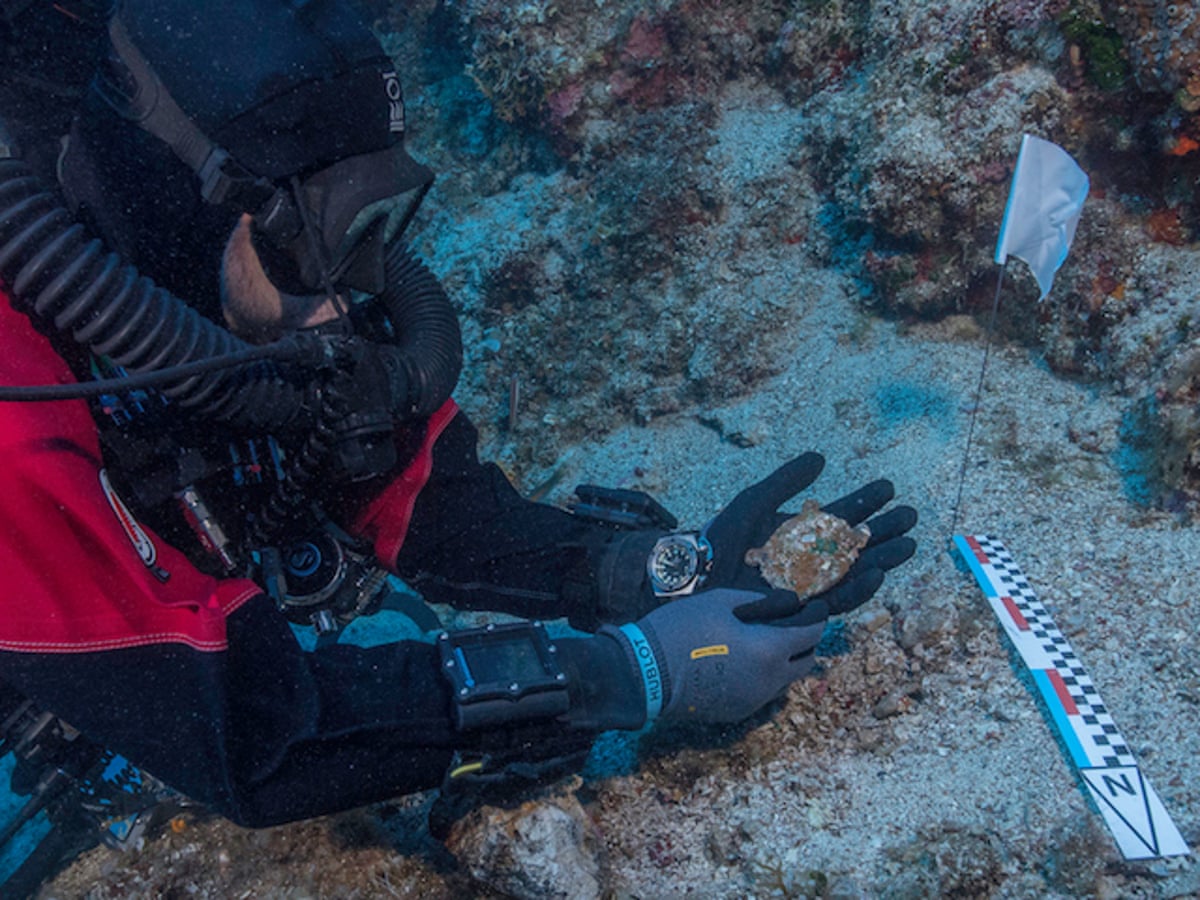
From mid-May to mid-June, international teams of technical divers, using advanced rebreathers and precision tools, braved the site’s challenging conditions.
What they found was nothing short of cinematic.
The star of the show: a rare, still-connected section of the ship’s hull—three outer planks firmly attached to an internal frame, recovered intact thanks to a custom-designed support system.
This was no scattered fragment.
It was a preserved snapshot of ancient shipbuilding genius, the first time archaeologists had excavated such an articulated piece from this legendary wreck.
As the support cradle gently lifted the wooden assembly from the seabed, the team held its collective breath.
The planks, made of elm and oak, thinner than previously recovered timbers—suggesting they came from an upper section of the hull or perhaps a repair—measured roughly 40 centimeters wide and 70 centimeters long.
Preliminary dating points to around 235 BCE for the wood itself, hinting the ship may have undergone significant maintenance or that it incorporated timbers from earlier vessels.
Analysis confirms the “shell-first” construction method typical of Mediterranean shipbuilding between the 4th and 1st centuries BCE: builders first assembled the outer hull planking, then added internal framing for strength.
This technique allowed for larger, more seaworthy vessels capable of hauling heavy luxury cargoes across stormy seas.
The discovery sent shockwaves through the archaeological community.
For decades, scholars pieced together the ship’s construction from isolated fragments recovered in the 1970s by Jacques Cousteau’s team and earlier sponge divers.
Now, with this connected section, they can visualize the vessel’s robust design in stunning detail—reinforced for long voyages, yet ultimately no match for the forces that doomed it.
Additional wood fragments, often found alongside lead, copper, and tar residues, paint a vivid picture of a ship meticulously caulked and protected against the corrosive sea.
These finds are rewriting textbooks on ancient naval architecture, revealing a level of sophistication that rivals modern engineering in its ingenuity.
But the hull was only the beginning.
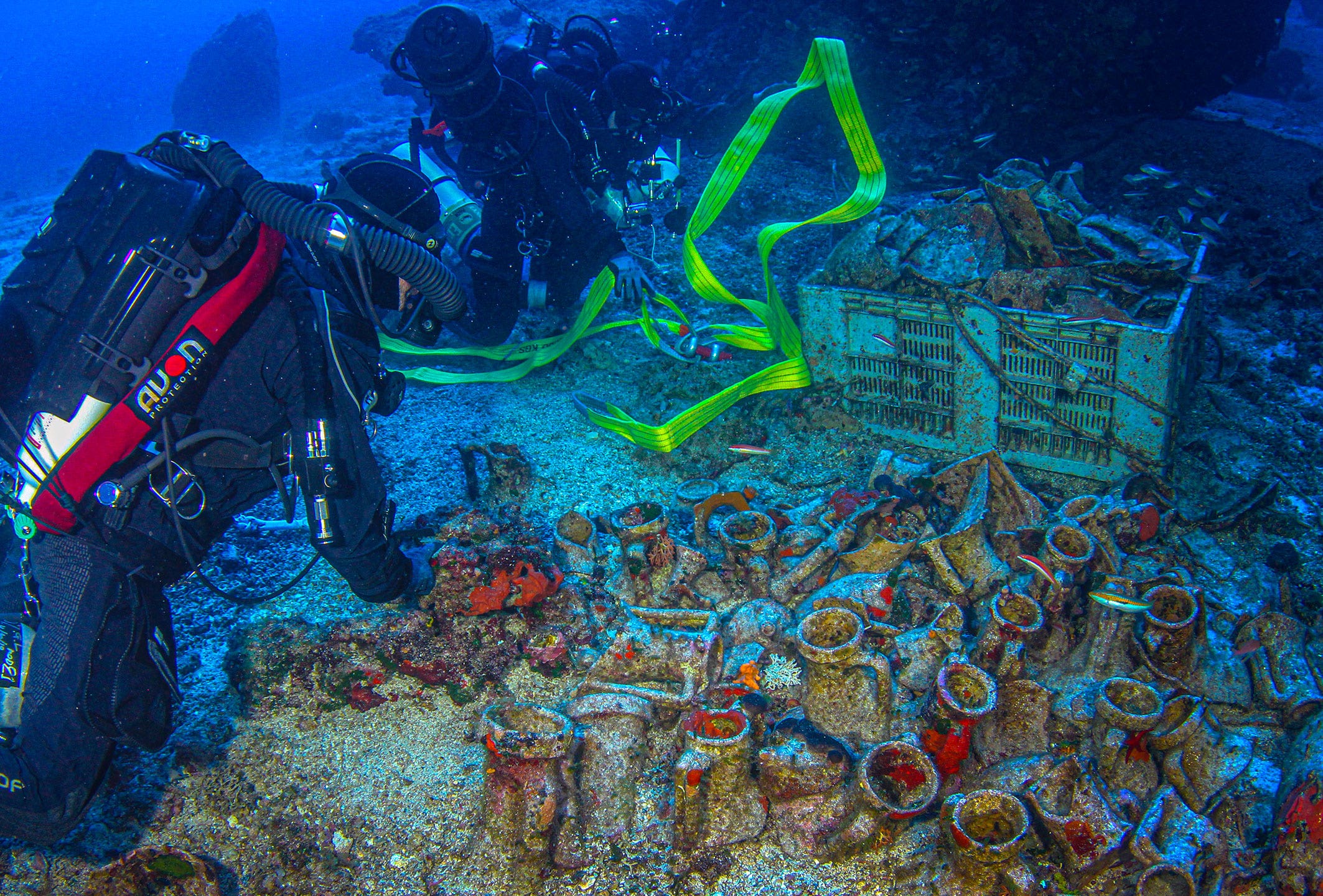
The excavation yielded over 50 artifacts that bring the daily drama of life aboard into sharp, almost haunting focus.
A sprouted terracotta mortar—evidence of crew members grinding or mixing food on the go—offers an intimate window into onboard culinary practices.
Amphoras from the island of Chios suggest the ship carried fine wines or oils, staples of elite trade.
Small fragments of a nude male statue, possibly marble, hint at the larger treasures still potentially buried beneath boulders or sediment.
Even human remains and possible olive pits have surfaced in recent seasons, evoking the personal stories of sailors, merchants, and perhaps passengers who never reached their destination.
The Antikythera shipwreck’s story began dramatically in 1900 when Greek sponge divers, sheltering from a storm, stumbled upon the site near Point Glyphadia.
What they recovered over the following year stunned the world: bronze and marble statues, jewelry, coins, and that mysterious geared contraption pulled from the depths in 1901.
The Antikythera Mechanism, with its intricate bronze gears, dials, and inscriptions, has fascinated scientists for over a century.
X-ray imaging and 3D modeling have revealed it could predict eclipses, track planetary movements, and perhaps even chart the ancient Olympic Games—functions so advanced they seemed impossible for its era.
Recent studies have only deepened the mystery and wonder.
Techniques borrowed from gravitational wave astronomy have confirmed the device’s calendar ring likely featured 354 or 355 holes, aligning with a lunar calendar rather than a solar one.
This precision—holes positioned with an average variation of just 0.028 millimeters—underscores the extraordinary craftsmanship of its creators, possibly drawing on Babylonian astronomy, Platonic philosophy, and Greek mechanical know-how.
Yet debates rage on: some simulations suggest the triangular gear teeth might have caused jamming after only a few months of use, raising questions about whether it was a flawless masterpiece or an ambitious prototype prone to mechanical quirks.
The 2025 finds elevate the wreck beyond a mere vehicle for the Mechanism.
They suggest the ship was part of a bustling luxury trade network, ferrying Greek art to Roman elites in the waning days of the Republic.
Statues of heroes like Heracles, whose massive marble head was recovered in earlier digs, point to a cargo of cultural prestige.
Speculation swirls about a possible second wreck nearby, with anchors and containers hinting at a convoy caught in the same disaster.
Boulders once mistaken for debris may conceal more colossal figures, waiting to emerge.
Diving at Antikythera is no easy feat.
Depths around 40-50 meters demand technical expertise, mixed-gas rebreathers for extended bottom time, and remotely operated vehicles for real-time monitoring.
Strong currents and steep, boulder-strewn terrain add layers of danger.
Yet these challenges have preserved the site remarkably well, shielding it from looters and casual disturbance.
The 2025 team’s success in lifting the hull section intact represents a technical triumph, blending archaeology with engineering innovation.
As conservation begins on the newly recovered wood—kept stable in specialized labs—the excitement builds.
Further analysis could reveal exact tree species origins, trade routes for the timber, and even climate data from the era.
Isotopic studies on human teeth might identify the crew’s homelands.
And the hold, where the Mechanism was found, remains largely unexplored, promising potential additional gears or even another device.
This is more than archaeology; it is a thriller unfolding in real time.
The Antikythera wreck embodies humanity’s eternal drive to explore, innovate, and conquer the unknown—only to be humbled by nature’s fury.
Each artifact recovered pulls us deeper into that fateful voyage, where genius cargo met disaster in the blue depths.
With ongoing seasons planned, who knows what else the sea will surrender?
A complete statue?
More mechanism fragments?
Clues to lost knowledge that could reshape our view of the ancient world?
The waters off Antikythera guard their secrets jealously, but in 2025 they whispered—and what they revealed was nothing short of astonishing.
The ship that sank carrying the Mechanism has now delivered something equally profound: a fuller, more human story of ambition, craftsmanship, and the thin line between triumph and tragedy on the ancient seas.
As researchers pore over these treasures, one thing is clear—the greatest discoveries at Antikythera may still lie ahead, buried in the sand, waiting for the next daring dive into history’s most captivating shipwreck.