Japan’s Underwater Pyramid Was Declared Natural — Then Divers Found Something Terrifying
LOST CIVILIZATION RISES AS TERRIFYING SECRETS EMERGE FROM DEPTHS
Deep beneath the turbulent waves off Japan’s southernmost Yonaguni Island, where hammerhead sharks glide through cobalt-blue currents and strong riptides test even the most experienced divers, lies a colossal enigma that has haunted science for nearly four decades.
What began as a routine shark-hunting expedition in 1986 became one of the most explosive archaeological controversies of our time.
A local diver named Kihachiro Aratake descended into the depths and came face to face with what appeared to be a massive, perfectly terraced underwater pyramid—complete with sharp right angles, straight staircases, and platforms that looked engineered by human hands rather than the blind forces of geology.
For years, experts declared it a natural sandstone formation shaped by waves and tectonic shifts.
Then divers returned with cameras, tools, and eyes wide open.
What they found next sent chills through the scientific community and ignited theories of a lost Ice Age civilization buried by rising seas.
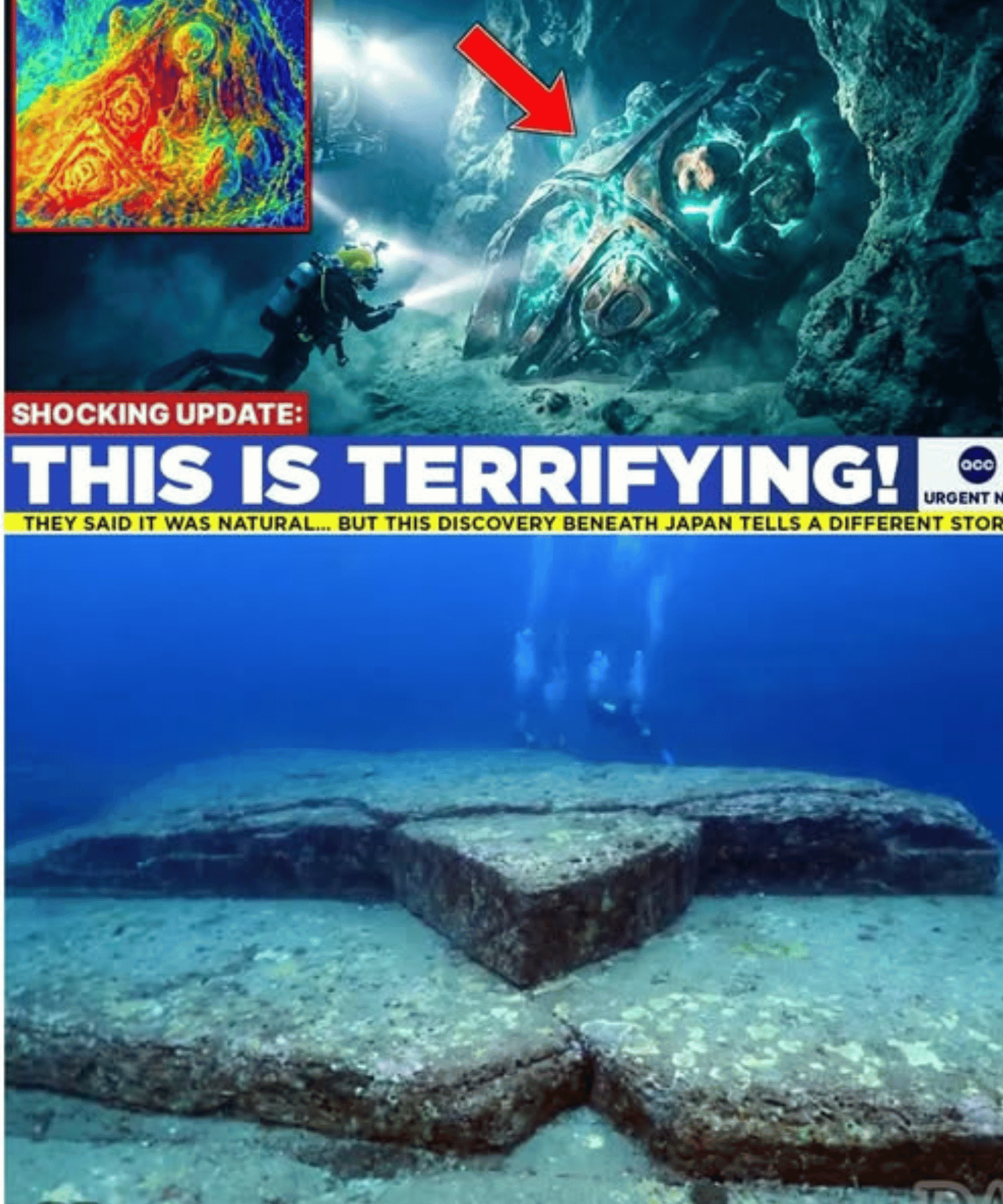
The structure, now known as the Yonaguni Monument, rises dramatically from the seafloor at depths between 5 and 40 meters.
Measuring roughly 50 meters long, 20 meters wide, and 25 meters high, it resembles a colossal stepped pyramid or ziggurat.
Flat terraces stack like giant stairs.
Narrow channels run perfectly straight, suggesting ancient drainage or roads.
Sharp 90-degree angles slice through the rock with uncanny precision.
A towering central “stage” platform dominates the complex, flanked by what look like hallways, pillars, and even a possible archway.
To the untrained eye—and many trained ones—it screams deliberate design.
Yet mainstream geologists long insisted it was all a trick of nature: sandstone bedrock fractured along natural joints, eroded by powerful ocean currents into these deceptively regular shapes.
Marine geologist Masaaki Kimura of the University of the Ryukyus refused to accept the easy explanation.
For over 15 years, he dove the site repeatedly, mapping every feature with scientific rigor.
Kimura documented tool marks, post holes, and carvings that he insists could only come from human hands.
He pointed to a distinctive “face” carved into one massive stone—hollow eye sockets, a ridge for a nose, and a faint mouth—resembling ancient megalithic art.
Nearby lay what appeared to be a stone relief of an animal, possibly a wild boar or mythological creature.
He found traces of what might have been ancient fire pits and even claimed small artifacts resembling stone tools scattered in the sediment.
According to Kimura, the monument was once part of a thriving coastal city built more than 10,000 years ago, when sea levels were far lower during the last Ice Age.
A massive earthquake and subsequent flooding submerged it, erasing it from history—until Aratake’s accidental discovery.
Imagine the terror of the first deep descent.
Visibility drops in swirling currents.
Powerful tides threaten to slam divers against razor-sharp rock edges.
Hammerhead sharks patrol the area, adding primal danger to scientific curiosity.
Aratake, searching for new dive spots, nearly collided with the massive structure looming out of the gloom like a submerged temple from a forgotten empire.
What he saw that day shattered his understanding of Japan’s ancient past.
Word spread like wildfire among local divers.
Soon, teams returned equipped with underwater cameras, measuring tools, and 3D scanning technology.
The more they documented, the harder it became to dismiss as pure geology.
The debate exploded into open warfare between camps.
On one side stood geologists like Robert Schoch of Boston University, who argued the parallel bedding planes in the sandstone naturally split into step-like formations.
Similar patterns appear on land above water, he noted.
No definitive artifacts, inscriptions, or organic remains have ever been conclusively dated to human activity at the precise site.
The Japanese government and cultural authorities have largely stayed neutral, refusing to declare it a protected archaeological treasure—fueling accusations of cover-up or institutional caution.
Yet the “terrifying” discoveries kept coming.
Advanced 3D scans revealed symmetrical features difficult to attribute solely to erosion.
Submerged roads seemed to connect the main monument to smaller outlying structures, suggesting a planned urban layout.
Channels carved into the rock align with possible ancient water management systems.
Some divers reported entering narrow passageways that felt too regular, too purposeful.
In one heart-pounding moment, explorers claimed to find what looked like a carved monolith resembling a turtle or dragon—symbols with deep resonance in ancient Asian mythology.
These finds, captured on high-definition video, went viral, drawing freedivers, archaeologists, and conspiracy enthusiasts from around the globe.
The timeline adds dramatic weight.
During the last Ice Age, Yonaguni Island connected to a now-submerged landmass.
Sea levels rose rapidly around 10,000–12,000 years ago, flooding coastal settlements worldwide.
If humans built the monument, it would predate the Egyptian pyramids by thousands of years and rewrite everything known about early seafaring civilizations in East Asia.
Kimura believes it could represent the legendary lost continent of Mu—a Pacific counterpart to Atlantis—home to an advanced society with sophisticated stone-working skills.
The precision engineering, he argues, rivals anything from that era and suggests knowledge of geometry, astronomy, and large-scale construction long before supposed “primitive” tribes.
Diving the site today remains an adrenaline-fueled adventure.
Strong currents can reach dangerous speeds.
Visibility fluctuates wildly.
One wrong move and a diver could be swept into the open ocean or pinned against the stone.
Yet thrill-seekers and researchers keep coming.
Recent expeditions using drone technology and sonar mapping have revealed even more structures in the vicinity—possible smaller pyramids, walls, and what some interpret as harbor remains.
These new scans, released in recent years, have intensified the mystery rather than resolving it.
The monument refuses to yield easy answers.
Skeptics counter with powerful evidence.
No pottery shards, no metal tools, no clear human remains.
The rock itself shows natural fracturing patterns consistent with tectonic activity in this seismically active zone.
Similar “stepped” formations exist elsewhere without human intervention.
Declaring it man-made, they warn, risks pseudoscience and distracts from genuine archaeological priorities.
Yet even some neutral observers admit the site’s eerie regularity challenges simple explanations.
If nature alone sculpted this, it performed with almost artistic precision.
The human drama surrounding Yonaguni runs as deep as the waters above it.
Aratake, the humble diver who stumbled upon history, never sought fame but became a local legend.
Kimura devoted his career to defending the artificial origin theory, facing professional ridicule yet never wavering.
International teams have risked their lives filming documentaries, only to leave with more questions than footage.
Tourists now flock to Yonaguni for guided dives, turning the scientific puzzle into a booming adventure economy.
Meanwhile, the monument sits silently on the seabed, battered by currents, guarding secrets that could upend human history.
What if it truly represents a lost chapter of civilization?
A sophisticated culture thriving at the end of the Ice Age, building monumental architecture, navigating oceans, and then vanishing beneath the waves as glaciers melted and seas rose.
The implications terrify and excite in equal measure.
It would mean advanced societies existed far earlier and in places long dismissed as backwaters.
It would force reevaluation of global flood myths—from Noah to Atlantis to Japanese legends of submerged kingdoms.
It would prove humanity’s story is far older, far more interconnected, and far more fragile than textbooks claim.
As climate change raises sea levels once again, the Yonaguni discovery feels prophetic.
Nature has reclaimed these stones, just as it might reclaim our own coastal cities.
The “natural versus artificial” debate masks a deeper terror: how easily advanced societies can disappear, leaving only eroded monuments as warnings.
Divers who descend into the blue abyss report an uncanny feeling—an ancient presence watching from the stone, daring modern humanity to understand before it’s too late.
New technologies promise breakthroughs.
LiDAR underwater scanning, genetic analysis of sediment, and AI-enhanced imaging could finally settle the argument.
Until then, the pyramid stands as a defiant riddle, declared natural by some, revealed as extraordinary by others.
The terrifying truth may not be aliens or conspiracy, but the humbling realization that our ancestors achieved wonders we still struggle to comprehend—and that the ocean keeps many more secrets locked away.
The currents continue to swirl around Yonaguni.
Sharks patrol.
Divers descend with pounding hearts.
And the monument waits in silent majesty, a submerged sentinel bridging forgotten past and uncertain future.
Whether carved by human genius or nature’s patient hand, it forces us to confront the abyss—not just of the ocean, but of our own incomplete history.
The next diver who touches those ancient stones might uncover the final clue.
Until that moment, Japan’s underwater pyramid remains one of Earth’s greatest unsolved mysteries, beautiful, imposing, and utterly terrifying in its implications.