James Webb Telescope Just Captured First Real Image of Another World
James Webb Telescope Just Captured First Real Image of Another World
For the first time, the distant planet was not just a shadow, a wobble, or a number in a database. It appeared as light—faint, strange, and real—beside a star hundreds of light-years away.
For decades, humanity has known that other worlds exist beyond our Solar System. Scientists have found thousands of exoplanets, planets orbiting stars far from the Sun, but most of them were discovered indirectly. They were not seen in the ordinary sense. Astronomers detected them by watching stars dim when planets passed in front of them, or by measuring tiny gravitational wobbles as planets tugged on their host stars. These discoveries were revolutionary, but they often left the public with an uncomfortable truth: we knew the planets were there, but we could not really see them.
Then the James Webb Space Telescope changed the feeling of the search.
When Webb captured the exoplanet HIP 65426 b in infrared light, the image did not look like science fiction. It did not show blue oceans, alien mountains, glowing cities, or clouds drifting over continents. Instead, the planet appeared as a small blob of light in several different colors, separated from the overwhelming glare of its star. To anyone expecting a postcard from another Earth, the image might seem simple. But to astronomers, it was breathtaking.
That faint light was another world.
HIP 65426 b is a young gas giant, far more massive than Jupiter and orbiting far from its host star. It is not a planet where humans could walk. It is not a second Earth. It is hot, enormous, young, and alien in the truest sense. But the importance of the image is not that this particular planet looks habitable. The importance is that Webb proved it could directly separate a planet’s light from the light of its star and study that world in wavelengths invisible to the human eye.
That is one of the hardest things in astronomy.
A star is blinding. A planet beside it is like trying to see a firefly next to a stadium floodlight from hundreds of miles away. The planet does not shine like a star. It reflects light or glows weakly with its own heat. From Earth’s perspective, the star and planet appear extremely close together. The star’s glare overwhelms nearly everything nearby. To see the planet, astronomers must block or subtract the star’s light with extraordinary precision.
Webb did this using coronagraphs—tiny masks inside its instruments that suppress the star’s brightness so the dim planet can emerge. The result was not just one image, but multiple views in different infrared bands. Each color represented a different wavelength, showing the planet in ways human eyes could never naturally perceive. The shapes looked slightly different in each view because Webb’s optical system and instruments process light differently, but the meaning was the same: the planet was there.
A distant world had been caught in its own light.
That sentence is easy to read quickly, but it is enormous.
For most of human history, planets were limited to the few wandering lights visible in our own sky. Mercury, Venus, Mars, Jupiter, and Saturn were known to ancient observers. Later telescopes revealed Uranus, Neptune, moons, rings, asteroids, comets, and the deep architecture of our Solar System. But worlds around other stars remained invisible, imagined, and debated. Only in the last few decades did exoplanets move from speculation into certainty.
Now they are moving from certainty into sight.
That transition matters because direct imaging gives astronomers something indirect methods cannot fully provide. When scientists detect a planet by transit, they know it crosses in front of its star. When they detect it by radial velocity, they know its gravity tugs on the star. These methods are powerful, but they often reveal the planet through its effect on something else. Direct imaging lets scientists study the planet itself: its brightness, temperature, atmosphere, orbit, and possibly weather.
Webb’s first direct image of HIP 65426 b became a promise.
Not the final answer.
A promise.
If Webb can see this young giant planet, then future telescopes may see smaller, colder, more Earth-like worlds. They may separate the light of rocky planets from their stars. They may analyze atmospheres for gases linked to chemistry, geology, oceans, or even life. They may one day let humanity look at a pale dot and say not only, “A planet exists there,” but “that planet has air, weather, seasons, and perhaps something alive.”
That is why the image matters even though it is only a blob.
The first photographs of Pluto were not beautiful by modern standards. Early pictures of Mars were blurry. The first images of Earth from space were technically simple compared with today’s satellite views, yet they changed human consciousness. The first direct images of exoplanets are doing something similar. They are not yet giving us alien landscapes. They are giving us a new relationship with the universe.
The universe is becoming less abstract.
HIP 65426 b is especially useful because it is easier to image than many other exoplanets. It is massive, young, warm, and far from its star. Young gas giants still radiate heat from formation, making them bright in infrared. A planet far from its star is easier to separate from the star’s glare. In other words, Webb’s first target was not chosen because it resembled Earth. It was chosen because it was the kind of planet Webb could study well.
That is how science often works.
You begin with what is possible.
Then you push toward what once seemed impossible.
The image also demonstrates why infrared astronomy is so powerful. Webb was built to observe infrared light, which allows it to study cool objects, distant galaxies, star-forming regions, dusty environments, and planets glowing with heat. Earth’s atmosphere interferes with some infrared observations, so a telescope in space has an extraordinary advantage. Webb can look at wavelengths that ground-based instruments struggle to capture clearly.
This means Webb is not only seeing farther.
It is seeing differently.
And seeing differently is how revolutions begin.
The emotional power of the image comes from what it suggests about the next generation of discoveries. Imagine a future telescope using advanced starshades or coronagraphs to image a rocky planet orbiting in the habitable zone of a nearby star. At first, it may appear only as a dot. But that dot’s color could change as it rotates. Its atmosphere could show oxygen, methane, carbon dioxide, water vapor, or other gases. Its brightness could hint at clouds, oceans, ice, deserts, or vegetation-like reflectance. Scientists might watch seasons unfold across a world no human will ever visit.
A dot could become a planet.
A planet could become a place.
That is the dream behind exoplanet imaging.
For now, HIP 65426 b is a giant world glowing in infrared, not a living Earth. But every great journey begins with an imperfect first step. Webb’s image tells astronomers that the technical path is real. Block the star. Capture the planet. Separate the signal. Study the light. Repeat with better targets, better tools, better models, and more ambitious questions.
The public often wants space discoveries to answer immediately whether we are alone. Science rarely moves that fast. Instead, it builds the ladder rung by rung. First, prove planets exist around other stars. Then measure how common they are. Then identify rocky ones. Then study atmospheres. Then look for biosignatures. Then test every explanation carefully before saying anything as profound as “life.”
Direct imaging is one of the most important rungs on that ladder.
The image also changes the way we think about distance. HIP 65426 b is hundreds of light-years away. That means the light Webb captured left that planetary system centuries ago, crossing interstellar space before touching a telescope built by humans on a small planet around an ordinary star. The planet in the image is not only far away in space. It is also a messenger from the past. We see it as it was when its light began the journey.
Every astronomical image is a time capsule.
But this one feels different because it is not only a star, galaxy, or nebula. It is a world. A place formed from dust and gas, orbiting its own sun, moving through its own years, perhaps with storms larger than planets in our Solar System, perhaps with chemistry we are only beginning to understand.
That is the miracle of the image.
It turns “exoplanet” from a category into a reality.
The James Webb Space Telescope was designed to answer some of the biggest questions in astronomy: How did the first galaxies form? How do stars and planets emerge from dust? What are the atmospheres of distant worlds made of? Are the ingredients for life common in the universe? The direct image of HIP 65426 b sits inside that larger mission. It is one piece of a much greater search.
And that search is becoming more urgent.
The number of known exoplanets has exploded. Scientists now know planets are common. Many stars have them. Some systems are packed with worlds. Some planets orbit close enough to be scorched. Others drift far into cold darkness. Some are giant gas planets. Some are rocky. Some orbit red dwarf stars. Some may have atmospheres. Some may have lost them. The galaxy is no longer a dark sea of lonely stars. It is a galaxy of worlds.
That realization is one of the greatest shifts in human thought.
A few centuries ago, the idea of planets around other stars was philosophical speculation. A few decades ago, it was difficult to prove. Today, it is an observational fact. Tomorrow, it may become visual and chemical reality. We may not only know that other worlds exist; we may compare them, classify them, and recognize which ones are most like home.
The direct image of a distant world also reminds us of how small Earth is and how precious it becomes in comparison. People sometimes think discovering other planets makes Earth less special. The opposite may be true. The more worlds we find, the more we understand how delicate our own is. A planet needs the right conditions to support familiar life: stable temperature ranges, chemistry, atmosphere, liquid water, geology, protection from harmful radiation, and countless interacting systems. Other worlds may be common, but habitable worlds may still be rare.
Webb’s image does not make Earth ordinary.
It makes Earth more astonishing.
Because when we see a giant planet glowing near another star, we are reminded that planets can take many forms. Some are infernos. Some are frozen. Some are massive storms. Some are newborns. Some are stripped cores. Some may be ocean worlds. Some may be rocky deserts. Our own world, with forests, oceans, cities, clouds, insects, whales, children, music, grief, prayer, and memory, is not guaranteed by the universe. It is a gift of conditions so precise that science can study them for centuries and still remain humbled.
That humility is part of why space images matter.
They do not only inform.
They enlarge the soul.
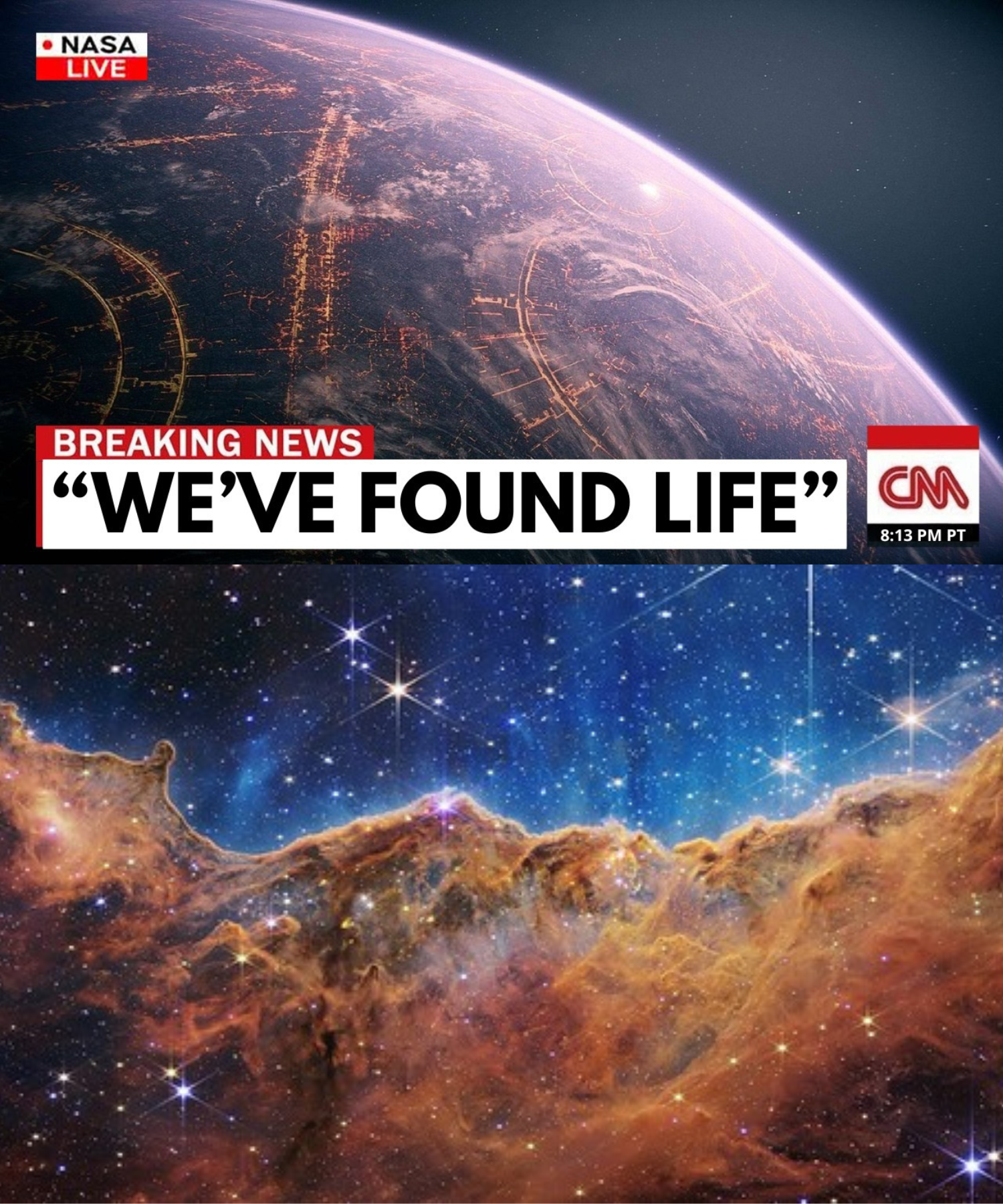
A small infrared point beside a star can make human conflicts feel smaller, not because they are unimportant, but because they exist inside a vastness we constantly forget. We live under one sky, on one planet, with one shared future, while the universe quietly reveals that creation is far larger than our arguments.
The discovery also carries a warning about how headlines can mislead. Saying Webb captured the “first real image of another world” sounds dramatic, but it must be understood carefully. Other exoplanets had been directly imaged before Webb. Webb’s milestone was its own first direct image of an exoplanet and the extraordinary infrared detail it provided. Also, this was not a surface photograph. We are not seeing continents or oceans. We are seeing light from a gas giant separated from its star.
That distinction does not weaken the story.
It makes the achievement more honest.
Science does not need exaggeration. The truth is already breathtaking.
A telescope launched from Earth, unfolded in space, cooled behind a giant sunshield, and aimed across hundreds of light-years was able to isolate the faint infrared glow of a planet orbiting another star. That is not a small thing. That is civilization reaching across darkness with mathematics, engineering, patience, and imagination.
The image is also a tribute to collaboration. Webb is not the work of one person or one nation alone. It represents decades of planning, engineering, testing, failure, correction, risk, and international partnership. Thousands of people contributed to a telescope that can now look at ancient galaxies and distant planets. When we see the image of HIP 65426 b, we are seeing not only a planet. We are seeing human cooperation made visible.
That may be one of the most hopeful parts of the story.
At a time when humanity often seems divided, Webb shows what we can do when knowledge becomes a shared mission. We can build instruments so precise they can detect light from distant worlds. We can launch them into space. We can process the data. We can ask questions no generation before us could answer.
And we can do it together.
The next step will be harder. Seeing young giant planets is one thing. Imaging smaller rocky worlds near their stars is much more difficult. Earth-like planets are smaller, dimmer, and closer to the glare of their host stars. They do not glow as brightly in infrared. Their atmospheres, if they have them, require careful spectral analysis. Distinguishing life-related gases from non-biological chemistry is extremely complex. The search for life will require not one image, but many lines of evidence.
Still, Webb has opened the door.
Future missions may walk through it.
One day, perhaps, humanity will receive a direct image of a planet not unlike Earth. It may appear as a tiny blue-white dot. Scientists will analyze its atmosphere. They will argue over its chemistry. They will model its climate. They will search for signs that cannot easily be explained by geology alone. The announcement, if it ever comes, may be cautious and technical. But everyone will understand what is at stake.
We will be asking whether life has happened twice.
That question has haunted humanity for centuries. Are we alone? Is Earth unique? Does life appear wherever conditions allow, or is it an astonishing accident? Are there forests under other suns? Oceans under alien moons? Microbes beneath ice? Intelligence looking back? The first real images of other worlds do not answer those questions, but they bring them closer.
HIP 65426 b is not the destination.
It is the first distant torch in the fog.
It shows us that worlds can be seen.
That is why the image matters even if it looks simple. It is not meant to satisfy the imagination completely. It is meant to awaken it. It tells us that somewhere in the darkness, around a star too faint for ordinary eyes, a planet is moving through its orbit. It has been there all along. We only just learned how to see it.
For thousands of years, humans looked up and turned the night sky into stories. Stars became gods, hunters, animals, ancestors, maps, omens, and promises. Now we are beginning to learn that around many of those stars are worlds. The myths did not know the details, but they understood the emotional truth: the sky was never empty.
The James Webb Space Telescope has not finished the story.
It has barely begun it.
Its first direct image of an exoplanet is a beginning, a proof of possibility, a reminder that the universe is filled with places we have not yet imagined clearly enough. The image does not show us an alien landscape. It shows us something more important at this stage: a planet’s presence.
A real world.
A captured light.
A door opening.
And beyond that door, perhaps, the long-awaited answer to whether Earth is the only home life has ever known.