I Put a Hidden Camera in a Remote Cave… What Came Out Wasn’t Human
I Put a Hidden Camera in a Remote Cave… What Came Out Wasn’t Human
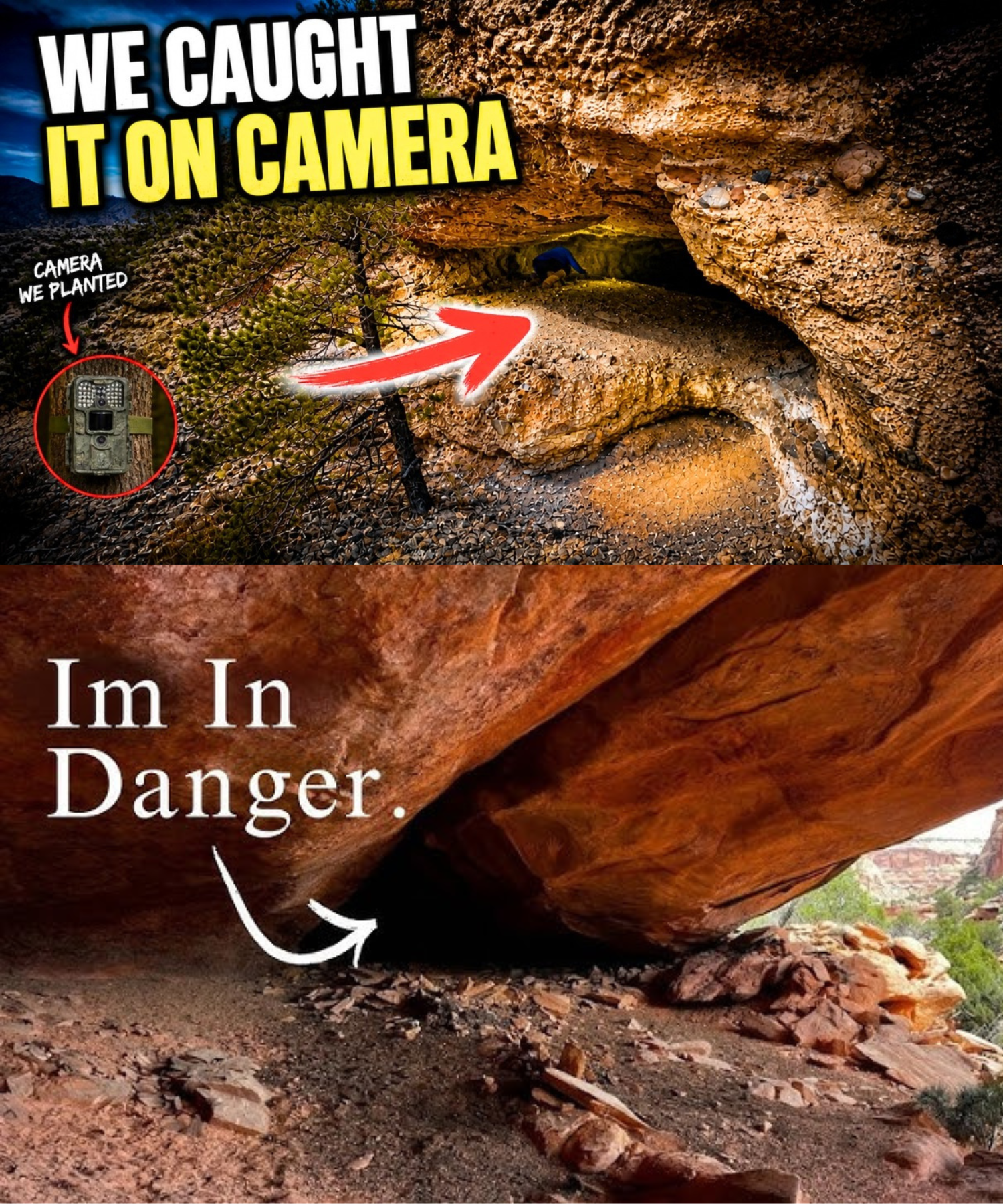
The camera was meant to catch coyotes. Instead, at 3:06 a.m., something crawled out of the cave on two legs, stopped beneath the moonlight, and looked directly into the lens.
I had no reason to believe anything strange lived in Black Hollow Cave.
That is what I told myself for weeks. I repeated it when I hiked the old logging road alone. I repeated it when I found claw marks too high on the pine trees. I repeated it when my dog refused to leave the truck. I repeated it when the wind moved through the mouth of the cave and made a sound almost like breathing.
Black Hollow was not famous. It was not one of those tourist caves with railings, colored lights, and gift shops selling plastic helmets. It was just a dark opening in a limestone ridge deep in the Appalachian backcountry, the kind of place locals knew by rumor and hunters avoided after sunset. The entrance sat halfway up a steep slope behind a wall of mountain laurel, hidden unless you knew exactly where to look. Even in daylight, the place felt wrong—not evil, exactly, but watchful.
The first time I found it, I was tracking deer sign.
It was late November, cold enough that my breath showed between the trees. I had been following a dry creek bed when I noticed bones scattered near the base of the ridge. Not one animal. Several. Raccoon, deer, something smaller, maybe fox. Most of them were old and clean, but one deer leg still had strips of hide attached. At first, I thought it was a predator den. Coyotes, maybe. Bobcat, possibly. Bears had been seen in that area too.
Then I noticed the arrangement.
The bones were not simply scattered. They formed a rough semicircle around the cave entrance, as if dragged there and left deliberately. The long bones pointed outward. The skulls, three of them, faced the cave.
That was enough to make me step back.
Still, I did not think “monster.” I thought “animal behavior I don’t understand.” Nature can look ritualistic when you catch it from the wrong angle. Scavengers drag pieces around. Floodwater moves bones. Humans leave strange things in the woods. Teenagers get bored. Hunters dump carcasses. There were a dozen explanations more reasonable than the thought that something inside the cave had arranged the remains.
But when I leaned closer to look at the mud, I saw a print.
It was not human.
It was not bear.
At least, I did not think so.
The heel was narrow. The front was wide. There were long toe impressions, five of them, with claw marks at the tips. The print was nearly fourteen inches from heel to toe, pressed deep into wet soil near the cave mouth. There were others nearby, but most were smeared. One set seemed to lead out of the cave and down toward the creek.
Two-legged.
That was the detail I kept coming back to.
The tracks did not move like a bear on all fours. They did not show the staggered pattern of an animal dropping its front paws. They moved in a line, one after another, like something walking upright.
I left before dark.
For three nights, I tried to forget about it. I told myself I had misread the tracks. I searched online for bear prints, raccoon prints, coyote dens, limestone caves, scavenger behavior. The more I read, the less certain I became. A black bear standing or stepping oddly can leave confusing prints. Mud distorts everything. People see what fear teaches them to see.
But fear also has a memory.
I could not stop thinking about those bones facing the cave.
That was why I bought the hidden camera.
It was a simple trail camera with infrared night vision, motion detection, and a weatherproof case. I told myself I wanted to identify the predator. Maybe I would get a bobcat. Maybe a bear. Maybe coyotes dragging carcasses to a den. Maybe nothing at all. A boring explanation would have been a relief.
The next Saturday, I hiked back before noon.
The forest was silent in that late-season way, all dead leaves and gray trunks and thin sunlight. I carried the camera, extra batteries, a strap, and a small pouch of scent lure I had used for wildlife photography. My plan was to mount the camera on a white oak about thirty feet from the cave entrance, angled low enough to catch whatever came in or out. I would leave it for four nights, then return.
The cave mouth looked darker than before.
That sounds ridiculous, but it did. The opening cut into the ridge like a wound. Around it, the bone circle remained. Something had moved the deer skulls closer together. One of them now sat upright on a flat stone, empty eye sockets facing the trail.
I stood there longer than I should have.
Then, because pride is sometimes stronger than wisdom, I mounted the camera anyway.
The whole time, I felt watched.
Not imagined watched. Not the vague unease people talk about in haunted places. This was specific. Like something in the cave had retreated just beyond sight and was studying the sound of my breathing. Twice, I turned suddenly with the flashlight, expecting to catch eyeshine inside the entrance. I saw only blackness.
Before leaving, I sprinkled a little scent lure near the rocks, not too close to the cave, then backed away.
I did not return for five days.
By then, part of me hoped the camera had been stolen. That would have been easier. A vandal, a hunter, a prankster—any human interference would bring the story back into the ordinary world.
But the camera was still there.
The bones were not.
Every single bone had been removed.
The ground near the cave was swept clean—not naturally, not by rain. The mud had been scraped smooth, as if something had dragged branches or hands across it to erase tracks. Even the deer skull on the flat stone was gone.
My stomach dropped.
I removed the camera and put it in my pack without checking the footage. I did not want to watch it there. The woods felt too quiet, and for the first time, I noticed there were no birds calling near the ridge. Nothing moved. No squirrels. No crows. No wind.
Halfway back to the truck, I heard a knock behind me.
One sharp sound.
Wood against wood.
I stopped.
Another knock came from deeper in the trees.
Then another, farther to the left.
Three knocks, spaced evenly.
I walked faster.
By the time I reached the truck, my hands were shaking so badly I dropped the keys in the leaves. I drove home without looking in the rearview mirror until I hit the main road.
That night, I watched the footage.
The first clips were ordinary. Wind moving branches. A raccoon nosing around the rocks. A fox passing at 9:42 p.m. on the first night. A deer approaching the cave, freezing, then bolting so violently it slipped in the mud. That clip bothered me. The deer stared into the cave for almost twenty seconds before running. Nothing visible came out. No sound was recorded on that model, but the animal reacted as if something had called to it from the dark.
The second night showed nothing until 1:18 a.m.
The camera triggered on the cave entrance. At first, the frame appeared empty. Then something pale moved just inside the opening. It was low to the ground, almost flat, like an animal crawling on its belly. The infrared light caught part of a shoulder, then a narrow head. The shape withdrew before I could understand it.
I replayed that clip twelve times.
The third night was worse.
At 2:57 a.m., the camera caught a figure standing at the mouth of the cave.
Standing.
Not crouching. Not crawling. Standing upright in the black entrance, so tall that its head nearly touched the upper rock ledge. Its body was thin, almost starved-looking, with arms hanging past the knees. The skin—if it was skin—looked pale gray under infrared. The head was smooth, the face difficult to see, but the eyes reflected briefly when it turned.
They were too far apart.
I paused the video and sat there staring at the screen until my eyes watered.
The figure did not move for nearly a minute. It simply stood half inside the cave, facing the woods. Then it stepped forward.
The movement was wrong.
Human beings shift weight from hip to foot. Bears lumber. Apes swing. This thing moved as if its joints were not built for the shape it was using. Its knees bent slightly backward. Its shoulders rolled under the skin. When it reached the area where the bones had been, it lowered itself without bending normally, folding downward like a spider collapsing into shadow.
Then it picked up one of the skulls.
Not with a paw.
With fingers.
Long fingers.
It carried the skull back into the cave and disappeared.
I wanted to stop watching.
I did not.
The fourth night had the clip that changed everything.
At 3:06 a.m., the camera activated again. Rain had fallen earlier, and the rocks shone under infrared. For twenty seconds, nothing appeared. Then the creature crawled out of the cave on all fours. This time, the camera caught it clearly enough that I could no longer pretend it was a bear.
It was hairless across most of the torso, though dark strands hung along the spine and shoulders. The arms were too long, the ribcage narrow, the back ridged sharply beneath the skin. Its head was large but not round, the mouth wide, the jaw protruding slightly. It moved on all fours for several feet, then suddenly rose onto its hind legs.
That was when it looked at the camera.
Not past it.
At it.
Directly.
The eyes flashed white.
The creature tilted its head, as if noticing the small red glow of the sensor. Then, slowly, it walked toward the tree.
Each step brought it closer until its face filled the frame.
I could see the mouth.
No lips. Just a dark line pulling open to reveal small, uneven teeth. It sniffed the camera. One long finger reached out and touched the lens. For a moment, the image blurred against pale skin.
Then the camera shook violently.
The next frames were chaotic: ground, leaves, a flash of the cave, the creature’s arm, then darkness. Somehow, the camera had stayed attached to the tree, but the angle had shifted downward.
For thirteen minutes, the footage showed only leaves.
Then something whispered.
My camera was not supposed to record clear audio beyond a few feet, but it caught this. A faint sound, broken and breathy, like air being forced through a throat not made for speech.
It sounded like my name.
I shut the laptop.
For a long time, I sat in the dark kitchen, listening to the refrigerator hum.
I had never told anyone where I put the camera. I had not spoken my name near the cave. I had not even used the voice function on the device because there was none. Maybe it was not my name. Maybe it was wind through the microphone. Maybe I heard what fear wanted me to hear.
But the next morning, there were scratches on my back door.
Five long lines, cut into the paint.
I called my brother first. Not the police. Not animal control. My brother, Sam, because he had spent twenty years in forestry and knew the mountains better than anyone I trusted. I showed him the footage without saying what I thought it was. He watched silently, arms crossed, expression hard.
When the creature looked into the camera, Sam stepped backward.
“What is that?” I asked.
He did not answer.
He made me play the final audio three times. Then he said, “You need to delete this.”
That response frightened me more than disbelief would have.
Sam finally told me a story he had heard from old survey crews years before. They called them “ridge crawlers.” Not ghosts. Not demons. Not exactly animals. Things seen near caves, abandoned mines, and deep sinkholes. Pale, thin, mostly nocturnal. Sometimes on four legs, sometimes on two. Workers blamed them for missing pets, mutilated deer, strange calls, and the feeling of being followed near limestone ridges. Sam had dismissed the stories as mountain folklore.
Until he saw my footage.
“What do they want?” I asked.
He looked toward the back door.
“To be left alone.”
That should have been the end of it. I should have destroyed the camera, forgotten the cave, and moved. Instead, I did what people always do when fear mixes with curiosity.
I went back.
Not alone this time. Sam came with me, carrying a rifle he never raised but never set down. We reached Black Hollow just after noon. The cave entrance had changed again. The bones were back, but not in a semicircle. This time, they were stacked in a pile against the left side of the entrance.
On top of the pile sat my camera strap.
Cut cleanly.
The camera itself had been mounted where I left it, but the strap should have been around the tree. I had removed it when I took the camera home. I still had it in my pack, or thought I did. I opened the pack with shaking hands.
The strap was gone.
Sam muttered a word under his breath and told me we were leaving.
Before we turned away, a sound came from inside the cave.
A knock.
Then another.
Then another.
Three knocks.
Same rhythm as the woods.
Sam raised the rifle.
The air coming from the entrance smelled like wet stone and old meat. Deep inside, something shifted. Not close. Far enough that the cave swallowed most of the sound, but large enough that loose pebbles rolled near the mouth.
Then, from the darkness, the whisper came again.
This time Sam heard it too.
My name.
He grabbed my jacket and pulled me backward so hard I nearly fell.
We did not run at first. Running felt like admitting we were prey. But after twenty steps, something inside the cave screamed.
Not roared.
Screamed.
High, furious, almost human, but stretched into a sound no human throat should make.
We ran.
Branches tore my face. My boots slipped in leaves. Behind us, rocks clattered down the slope. I never looked back, but Sam did once. His face went white, and he shouted, “Move!”
We made it to the truck. Something hit the tree line as I started the engine. I saw only a pale flash between trunks before the truck lurched forward.
Neither of us spoke until we reached town.
That night, I uploaded the footage to a private drive, then copied it onto two hard drives. I told myself that if anything happened, someone needed proof. I also knew proof would not save me. The footage could be called fake. The creature could be dismissed as a costume, a sick bear, CGI, a hoax. People believe what keeps their world intact.
But I had seen the cave.
I had heard my name.
For the next two weeks, nothing happened. No scratches. No knocks. No sightings. I began to wonder if distance mattered. Maybe the thing had only followed my scent to the house once. Maybe taking the camera had angered it, and returning to the cave had ended whatever connection I had created. Maybe Sam was right: leave them alone, and they leave you alone.
Then I received an envelope in my mailbox.
No stamp.
No address.
Inside was a printed photograph.
It showed the entrance of Black Hollow Cave at night. The angle was low, from somewhere inside the tree line. In the center of the image, standing at the cave mouth, was me.
Not from the day I installed the camera.
From the day I returned with Sam.
Someone—or something—had photographed us.
On the back, written in muddy brown streaks, were three words:
DO NOT WATCH.
I burned the photograph.
I deleted the public copy of the footage before ever posting it. The private drives are hidden now, and I have not opened them in months. Sam refuses to discuss it. He says memory is dangerous if you feed it. Maybe he is right.
But sometimes, late at night, I hear knocking from the woods behind my house.
Three knocks.
A pause.
Three more.
I never answer.
People ask why I do not release the footage. They say the world deserves to know. They say science needs proof. They say mystery should be exposed, examined, explained. Maybe they are right about most things. But there are places in this world that remain hidden because they have learned to hide. There are caves that are not empty. There are eyes in the dark that notice when we look too long.
I put a hidden camera in a remote cave because I wanted answers.
What came out was not human.
And the worst part is not that it saw the camera.
The worst part is that it saw me.