How a Tiny Pill BROKE the MUSLIM World Apart
The Captagon Empire: How One Tiny Pill Turned Syria Into a Narco-State and Addicted a Generation
In December 2024, as Syrian rebels advanced on Damascus, they expected to find weapons or military resistance. Instead, they discovered something far more shocking: industrial-scale drug factories hidden inside ordinary buildings, military bases, and even a facility officially listed as producing potato chips.
When they forced open the doors, they found no snacks — only pill presses, chemical precursors, and millions of tiny white tablets. One rebel cracked open a fake plastic orange. Hundreds of pills spilled out.
Within weeks, similar discoveries were made across regime-controlled areas. Over 200 million Captagon pills were seized in just four months. Syria, it turned out, had become the world’s largest producer of one of the most destructive drugs in the Middle East.
From German Medicine to Global Crisis
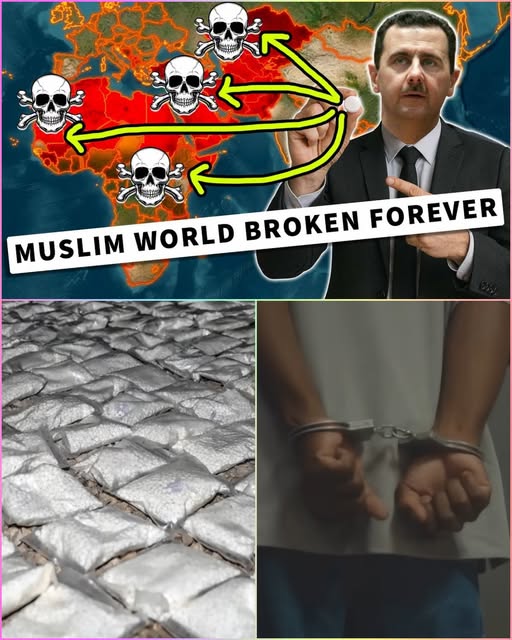
Captagon was not always an illicit drug. It was developed in 1961 by German pharmaceutical company Degussa as fenethylline — a combination of amphetamine and theophylline. Doctors initially prescribed it for narcolepsy and ADHD, praising its ability to increase alertness and focus with fewer side effects than pure amphetamine.
By the 1970s and early 1980s, it was used by truck drivers, students, and even some military personnel across Europe and parts of the Middle East. Then the problems emerged: severe addiction, hallucinations, violent outbursts, and paranoia. In 1986, the World Health Organization banned it for medical use worldwide.
Production should have ended there. Instead, counterfeit operations began in the 1990s, particularly in Bulgaria. The drug found its most receptive market in the Middle East, where strict Islamic prohibitions on alcohol and narcotics created a unique opening. Because Captagon had once been a legitimate medicine, it carried less stigma than other street drugs. Many young people viewed it as a “performance enhancer” rather than a hard drug.
The effects were powerful: intense energy, confidence, suppressed appetite, and the ability to stay awake for days. In conservative Gulf societies, it offered a discreet way to party or work long hours without the smell of alcohol. In war zones, fighters on both sides reportedly used it to increase aggression and endurance.
Assad’s Narco-State
The turning point came during the Syrian civil war. As international sanctions crushed the economy and traditional revenue sources collapsed, Bashar al-Assad’s regime turned to Captagon as a lifeline.
Production was not the work of rogue elements. It was state-sponsored. Assad’s brother, Maher al-Assad, who commanded the elite Fourth Armored Division, was repeatedly identified as a central figure in the operation. Entire military facilities and industrial zones were converted into pill factories. Ports like Latakia became major export hubs.
By the early 2020s, Syria was producing an estimated 80% of the world’s Captagon supply. Analysts valued the trade at between $5.7 billion and $57 billion annually — with the regime itself earning roughly $3–5 billion per year. Captagon had become more valuable than Syria’s legal exports.
The smuggling methods were remarkably creative. Pills were hidden inside fake fruits, olive oil cans, flour crates, rubber tires, and even hollowed-out sunflower seeds. One Saudi seizure found over 5 million pills inside pomegranates. Another uncovered 46 million pills hidden in flour.
The Human Cost Across the Gulf
While Assad profited, the human damage spread across the region — especially in Saudi Arabia, which became the world’s largest consumer of Captagon.
Hundreds of thousands of young Saudis became addicted. In a country with some of the strictest drug laws in the world, the pills spread through universities, construction sites, and underground parties. Stories emerged of students taking pills to study, then becoming dependent; of families discovering sons stealing to fund their habit; of young people experiencing psychosis, violent mood swings, and irreversible psychological damage.
Rehabilitation centers across the Gulf and Jordan reported surging demand. The social stigma surrounding addiction meant many suffered in silence. Meanwhile, Jordan — caught on the main smuggling route — saw rising local consumption and deadly clashes with traffickers along its border.
Addiction as a Weapon
Assad did not just sell drugs for money. He used them as geopolitical leverage. By flooding neighboring countries with Captagon, the regime created a crisis that gave Damascus bargaining power. Gulf states desperate to stop the flow of pills had little choice but to engage with Assad.
This strategy contributed to Syria’s readmission to the Arab League in May 2023. In private, officials acknowledged the uncomfortable reality: only Assad could turn off the tap he had created.
After Assad: The Crisis Evolves
When Assad’s regime collapsed in December 2024, the new Syrian authorities moved quickly. They dismantled dozens of major production facilities and publicly burned millions of pills. By mid-2025, officials claimed production had dropped by around 90%.
However, the problem has not disappeared. Production has fragmented. Smaller labs operated by criminal networks and militias have emerged in Syria and neighboring countries, making the trade harder to eradicate. In May 2025, authorities in Lebanon and Iraq seized large shipments and discovered new clandestine labs.
More concerning is the risk that users will switch to even more dangerous substances. Crystal methamphetamine — cheaper to produce and more destructive — is already gaining ground in parts of the region as Captagon supplies tighten.
Saudi Arabia has responded with extreme severity, executing over 140 people for drug offenses in the first half of 2025 alone. Yet executions do not address addiction, family breakdown, or the overwhelmed rehabilitation systems across the Gulf.
A Legacy That Outlives the Dictator
Captagon began as a legitimate medicine in a German lab and ended as a multi-billion-dollar weapon that bankrolled a dictator, addicted a generation, and poisoned regional relations.
Bashar al-Assad is gone. His factories have been raided. But the infrastructure of addiction he helped build remains. The economic desperation, social frustrations, and demand for escape that made Captagon so successful have not disappeared.
The Muslim world now faces a long and difficult recovery — one that will require not only dismantling remaining production networks, but also confronting the deeper social and economic conditions that allowed this tiny pill to cause such devastation.
Assad may have fallen, but the crisis he weaponized will take decades to heal.