Grok AI Finally Reveals How Ancient Egyptians Cut Granite — The Proof Is Shocking!
Grok AI Finally Reveals How Ancient Egyptians Cut Granite — The Proof Is Shocking!
The shocking proof was not hidden in a secret chamber. It was lying in plain sight at Aswan: an unfinished granite monument, abandoned halfway through the cut, still carrying the scars of the workers who tried to free it from the bedrock.
For years, one question has refused to die: how did the ancient Egyptians cut granite? Not limestone. Not soft sandstone. Granite. The hard, crystalline stone used in obelisks, statues, sarcophagi, temple blocks, and some of the most astonishing monuments ever created by human hands. To the casual eye, the problem seems impossible. Granite is tough. Copper is soft. The Egyptians did not have modern diamond saws, steel machinery, electric drills, or laser cutters. Yet they shaped, bored, polished, transported, and installed stone that still leaves engineers and tourists staring in disbelief.
That is why the internet loves the mystery.
One viral title says artificial intelligence has finally solved it. Another says Grok AI has revealed the secret. Another claims the proof is so shocking that archaeology can no longer deny it. These headlines work because they touch a real feeling: the official explanation often sounds too simple for the result. Copper tools? Sand? Stones used as hammers? Human labor? Ropes, sledges, water, patience, and skill? How could such ordinary things produce such extraordinary monuments?
But sometimes the truth is more shocking than fantasy.
Because the real secret may not be that the Egyptians had lost machines.
The real secret may be that they mastered slow violence.
They learned how to defeat granite not by overpowering it in one dramatic strike, but by attacking it grain by grain, hour by hour, day by day, with methods so patient that modern people can barely imagine the discipline required. They did not need one impossible tool. They needed a system: quarry knowledge, stone selection, pounding stones, copper saws, tube drills, quartz sand, abrasive slurry, water, leverage, organized labor, and craftsmen who understood the behavior of stone through experience passed down over generations.
The most important witness is the Unfinished Obelisk at Aswan.
It is one of the greatest accidental documents in ancient engineering history. Unlike completed monuments, it did not disappear into a temple or stand polished in a royal landscape. It remained in the quarry, still attached to the bedrock, abandoned when cracks made it unusable. Because it was never finished, it preserves the process. Visitors can still see the trenches around it, the tool marks, the rough cutting zones, and the sheer ambition of the project. It is like walking into an ancient worksite minutes after the laborers left—except the silence has lasted for thousands of years.
The obelisk is enormous. Had it been completed, it would have been among the largest ancient obelisks ever attempted. It was not carved from a separate block already lying loose. It was being born directly from the granite quarry. Workers had to isolate it from the surrounding bedrock, shaping its sides and cutting channels around it before freeing the underside. Then it would have had to be transported, finished, raised, and installed.
The fact that they even attempted it tells us something crucial.
These people were not guessing.
They had done this before.
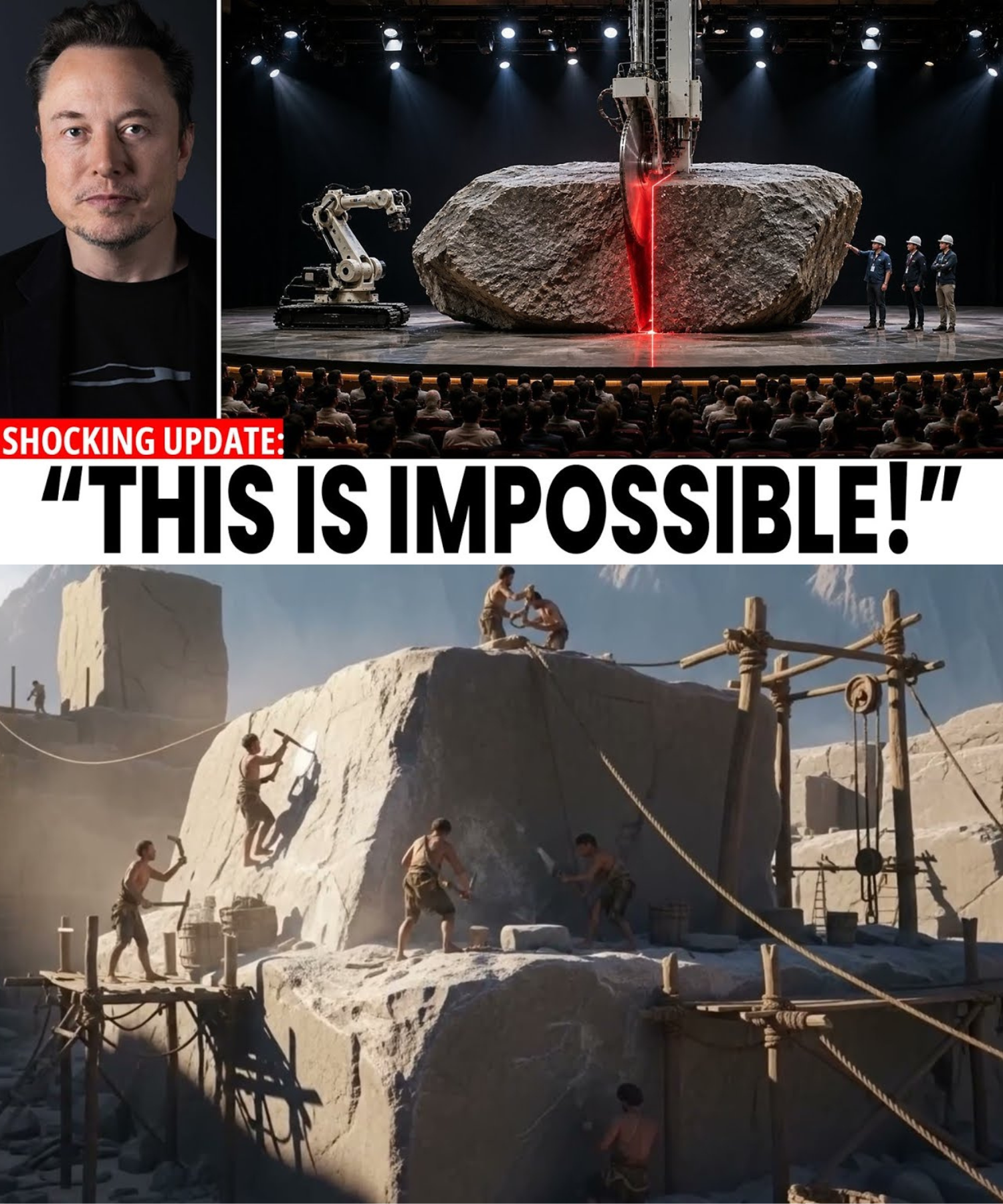
The first method visible at Aswan is pounding. Ancient workers used hard dolerite hammerstones to pound channels into the granite. Dolerite is tougher than the granite surface in practical use, especially when shaped into heavy pounding stones. The technique is brutally simple: repeated blows crush and bruise the granite, gradually removing material. It is slow, exhausting, and noisy. But it works.
Modern people often underestimate ancient labor because they underestimate repetition. We imagine technology must mean speed. But ancient monumental work often meant coordination over long periods. A team of workers standing in a trench, swinging stone pounders in rhythm, could slowly eat into granite. Not elegantly. Not instantly. But reliably. Every blow removed a little. Every day deepened the channel. Every week changed the shape of the rock.
That is not primitive.
That is disciplined engineering with simple tools.
The second method is abrasive cutting. Copper alone cannot slice granite like a steel blade. That is the point skeptics love to repeat. But copper did not have to be the true cutting material. In many ancient stoneworking methods, the metal tool served as a holder, guide, or pressure device, while the abrasive did the real cutting. Quartz sand, harder than copper and capable of scratching components of granite, could grind away stone when pressed and dragged between tool and surface.
This changes the entire question.
It was not copper versus granite.
It was abrasive against granite.
A copper saw with sand becomes less like a knife and more like a grinding machine powered by human arms. The blade moves back and forth, the abrasive bites into the stone, and a groove slowly forms. The copper wears down too, leaving traces, but the process can cut hard stone. With enough time, pressure, abrasive, and skill, the impossible becomes measurable.
This also explains why ancient cut marks can look so clean. A long saw guided carefully through stone can produce straight grooves. A tube drill used with abrasive can bore circular holes. The marks left behind may appear astonishing to modern observers, especially when seen on hard stone, but they do not automatically require unknown technology. They require a correct understanding of how abrasion works.
The Egyptians also drilled hard stones. Tube drilling is one of the most debated topics in alternative-history circles because drilled holes in granite sometimes show spiral markings that look, at first glance, like signs of advanced machine tools. But experimental archaeology has shown that copper tubes with abrasive slurry can drill stone. The tube does not cut like a modern drill bit. Instead, the abrasive grinds beneath the rotating tube, creating a core. The process is slow, but it produces real results.
Again, the shocking part is not that the Egyptians had lasers.
The shocking part is that they could achieve so much without them.
The ancient craftsman’s advantage was not hidden electricity. It was intimate material knowledge. He knew which stone could be worked and which should be rejected. He knew how grain, fracture, heat, pressure, and polishing behaved. He knew when to pound, when to saw, when to drill, when to grind, and when to stop before a flaw ruined months of work. The Unfinished Obelisk proves even experts could fail. A crack ended the project. The stone won.
That failure is one of the strongest arguments against the idea of effortless lost technology.
If the Egyptians had a magic granite-cutting machine, why abandon the obelisk because of a flaw? Why leave it scarred in the quarry? Why show evidence of trenching, pounding, and unfinished extraction? The site looks exactly like a place where human workers were solving a brutal material problem with known tools and enormous labor.
But this does not make the achievement smaller.
It makes it more human—and therefore more impressive.
There is a strange insult hidden inside many “lost technology” claims. They pretend to honor ancient builders, but often they rob them of their real genius. Instead of saying, “These craftsmen organized labor, understood materials, developed techniques, and achieved astonishing precision,” the theory says, “They must have had something we cannot see.” The wonder is moved away from the workers and into imaginary machines.
The truth gives the craftsmen their greatness back.
Picture the Aswan quarry in heat and dust. Men stand in narrow trenches, swinging dolerite pounders against the granite. Others clear debris. Supervisors mark lines. Specialists check cracks. Water carriers move constantly. Scribes track rations and labor. Toolmakers repair copper implements. The sound of stone striking stone echoes all day. Nothing about this is mystical. Everything about it is monumental.
Then picture a workshop where a granite vessel, statue, or sarcophagus is being shaped. Rough work comes first. Harder stone tools remove bulk. Abrasives refine surfaces. Copper saws cut grooves. Tube drills bore holes. Sand and slurry become invisible teeth. Polishing stones and finer grit bring the surface toward a finish that can shine like dark water. Every stage requires skill. Every mistake costs time. Every finished object represents not one miracle, but thousands of controlled actions.
That is the “proof” AI can help highlight if used honestly.
An AI system can compare tool marks, analyze patterns, summarize experimental archaeology, detect misinformation, and show how multiple techniques fit together. But AI does not magically discover truth from nothing. It depends on evidence. When people say “Grok revealed it,” what they often mean is that an AI explanation made the conventional archaeological answer sound newly convincing—or newly controversial. But the evidence itself did not begin with AI. It began with quarries, artifacts, marks, experiments, and the work of Egyptologists and material scientists.
The real story has been there all along.
At Giza and other sites, archaeologists have found saw marks, drill cores, tool traces, copper residue, and hard-stone artifacts. In museum studies, scholars read tool marks almost like fingerprints. A chisel mark differs from a saw mark. A grinding pattern differs from percussion damage. A drilled hole carries clues about the tool, the abrasive, the motion, and the pressure. Stone remembers contact.
Granite remembers everything.
That is why the proof is not one dramatic object. It is a pattern across many objects and sites. The same families of techniques appear again and again: pounding, sawing, drilling, grinding, polishing. Not one tool for everything. Not one secret machine. A toolkit matched to different tasks.
Still, some mysteries remain.
Ancient Egyptian hard-stone workmanship was not easy. Some objects show astonishing precision. Some cuts look remarkably clean. Some drill marks invite debate over speed, feed rate, and tool pressure. Some sarcophagi and statues are so finely finished that modern observers understandably struggle to imagine the labor behind them. Archaeologists can explain the basic methods, but that does not mean every detail of every object is fully understood.
That uncertainty is where sensational claims grow.
But uncertainty is not evidence for fantasy.
A gap in our understanding does not automatically become proof of lost technology. It is simply a gap. The proper response is more research: microscopic analysis, residue testing, quarry surveys, experimental replication, 3D scanning, and careful comparison. The wrong response is to declare that because something looks difficult, it must be impossible.
Difficulty is not impossibility.
Ancient Egypt is proof of that.
The Egyptians lived in a world where royal projects could concentrate labor on a scale modern people rarely experience outside industrial states. Their society could organize quarrying, transport, food supply, skilled craft, temple planning, and long-term construction. They also had generations of accumulated know-how. A modern person watching one worker with a copper tool may think, “This would take forever.” But the Egyptians did not work as isolated individuals with weekend schedules. They worked as organized teams inside a civilization built around monumental permanence.
Time was one of their tools.
So was belief.
For the Egyptians, granite was not just construction material. It was a stone of eternity. Its hardness mattered symbolically. A king wanted his name to last. A god’s temple needed permanence. An obelisk was not a decoration; it was a sun-ray in stone, a statement of divine order rising into the sky. To carve granite was to fight decay. Every hard cut was a religious and political act.
That mindset helps explain the effort. Why spend such labor on stone so difficult to work? Because difficulty was part of the meaning. Soft materials perish. Granite endures. The harder the stone, the stronger the claim to eternity.
This is where modern viewers often misunderstand ancient monuments. We ask, “How could they do this without modern machines?” The Egyptians may have asked, “How could we honor the gods and kings with anything less?”
Their answer was labor transformed into permanence.
The Unfinished Obelisk teaches this better than any theory. It shows ambition and failure together. It shows that the Egyptians knew how to cut granite, but not without risk. It shows that even a civilization capable of extraordinary stonework could be defeated by a crack hidden in the material. It shows technique, not magic. It shows effort, not ease.
That is why it is so valuable.
A completed monument hides the struggle beneath polish. The unfinished one exposes the battle.
And the battle is beautiful.
The grooves around the obelisk are not signs of ignorance. They are records of method. The rough channels show where workers attacked the bedrock. The abandoned mass shows planning at giant scale. The fissures show why the project ended. The whole site tells a story that no conspiracy theory can improve: ancient engineers pushed their tools, labor force, and material knowledge to the edge of possibility. Sometimes they succeeded. Sometimes the stone broke their dream.
That is human history at its best.
Not perfect. Not magical. Relentless.
If Grok AI, or any AI, “reveals” anything useful about Egyptian granite cutting, it should reveal the hidden sophistication of simple methods. It should help people see that a copper saw with abrasive sand is not laughable. It is clever. A dolerite pounder is not crude. It is effective. A tube drill is not impossible. It is ingenious. A polished granite surface is not evidence that humans had help from aliens. It is evidence that humans can become astonishingly good at difficult things when skill, organization, time, and purpose align.
The proof is shocking because it forces a reversal.
The ancient Egyptians were not less impressive if they used simple tools.
They were more impressive.
Anyone can imagine a lost super-machine doing the work. It takes more imagination, and more respect, to picture human beings solving the problem through observation, repetition, and mastery. It takes humility to admit that a civilization without electricity could still understand materials deeply. It takes discipline to see greatness where the internet wants mystery at any cost.
The granite was not cut by one secret.
It was cut by many ordinary truths working together.
Harder stones can pound softer surfaces into submission.
Abrasives can grind what metal cannot slice.
Copper can guide the cut even if sand does the cutting.
Water can carry slurry and dust.
Teams can multiply force.
Time can replace engines.
Skill can turn slow methods into precise results.
That is the real revelation.
No hidden laser is needed to make Egypt astonishing. No alien engineer is required to explain Aswan. No forbidden technology has to be smuggled into the story. The scars are still there in the stone, and they speak plainly. The ancient Egyptians cut granite by understanding granite. They respected its hardness, exploited its weaknesses, and attacked it with the right combination of impact, abrasion, patience, and organization.
And if that answer feels too simple, maybe the problem is not the evidence.
Maybe the problem is that modern people have forgotten how powerful patience can be.
We live in an age of instant results, powered tools, digital shortcuts, and mechanical force. The Egyptians lived in an age where a monumental project could be stretched across seasons, where thousands of repeated motions could become architecture, where a ruler’s command could mobilize a quarry, and where religious purpose could turn unbearable labor into sacred duty.
That is the world carved into the Unfinished Obelisk.
Not a world of helpless primitives.
Not a world of vanished machines.
A world of craftsmen who knew that stone does not surrender to arrogance. It surrenders to method.
So the next time someone points at Egyptian granite and says, “Impossible,” look closer. Look at Aswan. Look at the channels. Look at the drill marks. Look at the saw grooves. Look at the unfinished stone abandoned because a crack ruined everything. The proof is not hidden.
It is written in the wounds of the granite.
And what it reveals is more shocking than any rumor: ancient Egyptians did not need impossible technology to cut impossible stone.
They had something rarer.
Mastery.