Forensic Scientist Discovers What Mary Magdelene’s Face REALLY Looked Like | Philippe Charlier
Forensic Scientist Discovers What Mary Magdalene’s Face REALLY Looked Like | Philippe Charlier
For nearly two thousand years, Mary Magdalene has had many faces. But none of them may have been hers.
She has been painted as a repentant sinner, a grieving witness, a saint in red robes, a mysterious woman with long flowing hair, and one of the most misunderstood figures in Christian history. Artists gave her beauty. Theologians gave her controversy. Legends gave her journeys across the sea. But the real woman from Magdala, the woman who followed Jesus, stood at the crucifixion, and according to the Gospels was among the first witnesses to the resurrection, disappeared behind centuries of imagination. Then, in a quiet crypt in southern France, modern forensic science attempted something extraordinary: to look past the paintings and the myths and reconstruct the face of a woman whose skull has long been linked by tradition to Mary Magdalene.
The result was not a golden icon.
It was a human face.
That is what made the reconstruction so powerful. It did not show the distant, untouchable figure of religious art. It showed a middle-aged woman with a round face, high cheekbones, a pointed nose, dark hair, and an expression that seemed neither holy nor sinful, but alive. Suddenly, one of the most famous women in Christian memory was no longer only a symbol. She had bone structure. She had age. She had features. She had the quiet gravity of someone pulled out of legend and placed back into the world of flesh.
The scientist at the center of this work was Philippe Charlier, a French biological anthropologist and forensic specialist known for examining historical remains with the tools of modern science. Alongside visual forensic artist Philippe Froesch, Charlier worked on a skull preserved in the Basilica of Saint-Maximin-la-Sainte-Baume in Provence, France. Local tradition has long claimed that these relics belong to Mary Magdalene. That claim is deeply controversial, and Charlier himself did not pretend otherwise. He did not say science had proved the skull belonged to her. In fact, the responsible truth is more cautious: the reconstruction revealed the face of the woman whose skull is preserved there, a woman tradition identifies as Mary Magdalene, but whose identity remains unconfirmed.
That caveat matters.
Without it, the story becomes cheap sensationalism. With it, the story becomes something far more interesting. It becomes a meeting point between faith, history, legend, and forensic science. It becomes a rare moment when researchers do not claim to solve every mystery, but still manage to make the past feel startlingly close.
The skull itself was not simply taken from a shelf and handed to a lab. It was housed inside a reliquary, protected behind glass, surrounded by centuries of devotion. This was not an anonymous archaeological bone found in the dirt. It was a sacred object to many believers, part of a tradition rooted in medieval Provence. That meant the researchers had to work with care. They could not simply cut into it, remove samples, or treat it like ordinary evidence from a crime scene. The skull had to be studied in place, using non-destructive methods.
So the team turned to photography.
Hundreds of high-resolution images were taken from different angles, capturing the skull’s contours through the glass. From those photographs, the researchers created a three-dimensional digital model. This process, known as photogrammetry, allowed them to examine the skull virtually, measuring and analyzing its shape without physically removing it from its protective case. In the age of modern forensic science, this is where the mystery began to change form. A relic became data. A face hidden beneath bone began to emerge.
But facial reconstruction is not magic. It is not a machine that looks at a skull and prints a perfect portrait. It is a careful combination of anatomy, probability, population data, artistic judgment, and forensic method. The skull can reveal the broad architecture of a face. It can suggest the size and position of the nose, the shape of the cheekbones, the jawline, the brow, the eye sockets, and the general proportions of the head. Soft tissue depth markers help estimate the thickness of flesh over specific points of bone. Muscles can be layered digitally. Skin can be modeled. But some details remain uncertain.
A skull cannot tell you exactly how a person smiled.
It cannot fully reveal the texture of the skin, the emotion in the eyes, the exact weight of the cheeks, or the expression most familiar to those who loved her. That is why every honest facial reconstruction must stand between science and interpretation. It can be close to biological reality, but it cannot resurrect a person completely.
Still, even a careful approximation can be astonishing.
When the reconstructed face appeared, many people reacted with surprise because it did not resemble the familiar European image of Mary Magdalene. For centuries, Western art often portrayed her with pale skin, delicate features, and flowing auburn or golden hair. Those paintings told us more about the artists and their cultures than about a Jewish woman from the ancient Near East. The reconstruction based on the Saint-Maximin skull suggested a woman of Mediterranean appearance, with dark hair and features shaped by the skull itself rather than by devotional tradition.
That shift alone changed how many people saw her.
Mary Magdalene has always carried the burden of other people’s stories. In Christian scripture, she is presented as a devoted follower of Jesus and a key witness to the events surrounding his death and resurrection. Yet later traditions blurred her identity with other women in the Bible, including the unnamed sinful woman and Mary of Bethany. Over time, she was often remembered not primarily as a disciple, but as a repentant prostitute, even though that label is not directly supported by the Gospel accounts. The result was a figure both famous and distorted, honored and misunderstood.
That is why seeing a possible face connected to her tradition feels so emotionally charged.
It strips away some of the theatrical layers. It does not settle theological debates. It does not prove where her body ended up. It does not confirm the legends that brought her to France. But it forces viewers to stop thinking of Mary Magdalene only as an idea. Whether or not the skull is truly hers, the reconstruction reminds us that behind every religious figure, every relic, every medieval legend, there was once a real human body.
A face makes history harder to dismiss.
The story of how Mary Magdalene’s supposed relics came to Provence is itself wrapped in legend. According to medieval tradition, Mary Magdalene, along with others connected to the early Christian story, fled persecution and arrived on the coast of southern France. From there, the legend says, she spent years in penitence and prayer in the region of Sainte-Baume before dying near Saint-Maximin. This tradition became deeply important in Provence, where churches, pilgrimages, and relics helped shape local devotion for centuries.
Historians, however, remain cautious. The earliest Christian traditions do not clearly support the Provençal story. Other traditions place Mary Magdalene’s later life and burial elsewhere. Medieval Europe was full of competing relic claims, and the remains of famous saints were often linked to local churches in ways that strengthened pilgrimage, identity, and authority. For believers, relics carried sacred presence. For historians, they raise difficult questions about memory, politics, devotion, and evidence.
That is what makes Charlier’s work so delicate.
He was not simply reconstructing a skull. He was entering a battlefield of belief.
On one side are those who want the relics to be authentic, who see the skull as a direct connection to one of Christianity’s most beloved women. On the other side are skeptics who see the tradition as medieval legend, not historical fact. Between them stands forensic science, not declaring victory for either side, but asking what the bones themselves can reveal.
The answer was limited, but fascinating.
The skull appeared to belong to a woman who died around the age of fifty. The facial reconstruction suggested a mature woman, not a youthful fantasy. That alone is important. Religious art often freezes saints into symbolic forms, but forensic reconstruction restores age. It allows the face to carry time. Lines, gravity, structure, and maturity become part of the story. This was not a mythical beauty designed to decorate a chapel wall. This was someone who had lived.
The analysis of hair associated with the skull added another layer. The hair appeared dark brown, supporting the reconstructed image of a woman with darker hair rather than the light-haired Magdalene of many Western paintings. Researchers also examined material found on the hair, including traces connected to ancient or historical preservation and care. These details do not prove identity, but they help build the biological and material profile of the person behind the relic.
What made the public reaction so strong was the emotional contradiction at the heart of the project. The scientists were cautious, but the image was unforgettable. People could hear the warning — we do not know if this is truly Mary Magdalene — and still feel shaken by the possibility. That is the power of a face. It bypasses abstract debate. It meets the viewer directly.
For believers, the reconstruction offered something intimate. It allowed them to imagine looking into the face of a woman who may have stood near Jesus, followed him when others fled, and carried news that would become central to Christianity. For skeptics, it offered something else: a fascinating case study in how science can examine tradition without fully confirming it. For historians, it opened questions about relic culture, medieval memory, and the long afterlife of biblical figures in European imagination.
And for ordinary viewers, it created a strange silence.
Because when you look at the reconstructed face, the first thought is not about doctrine. It is not about carbon dating. It is not even about controversy. The first thought is simpler.
She looks real.
That realism is both the strength and the danger of the reconstruction. A realistic face can make people forget uncertainty. It can encourage headlines that say science has revealed Mary Magdalene’s true appearance, when the truth is more careful. Science reconstructed a face from a skull connected to a powerful tradition. It did not prove the skull’s identity. It did not travel back to first-century Galilee. It did not erase the gaps in the historical record.
But it did something meaningful.
It gave anonymity a human form.
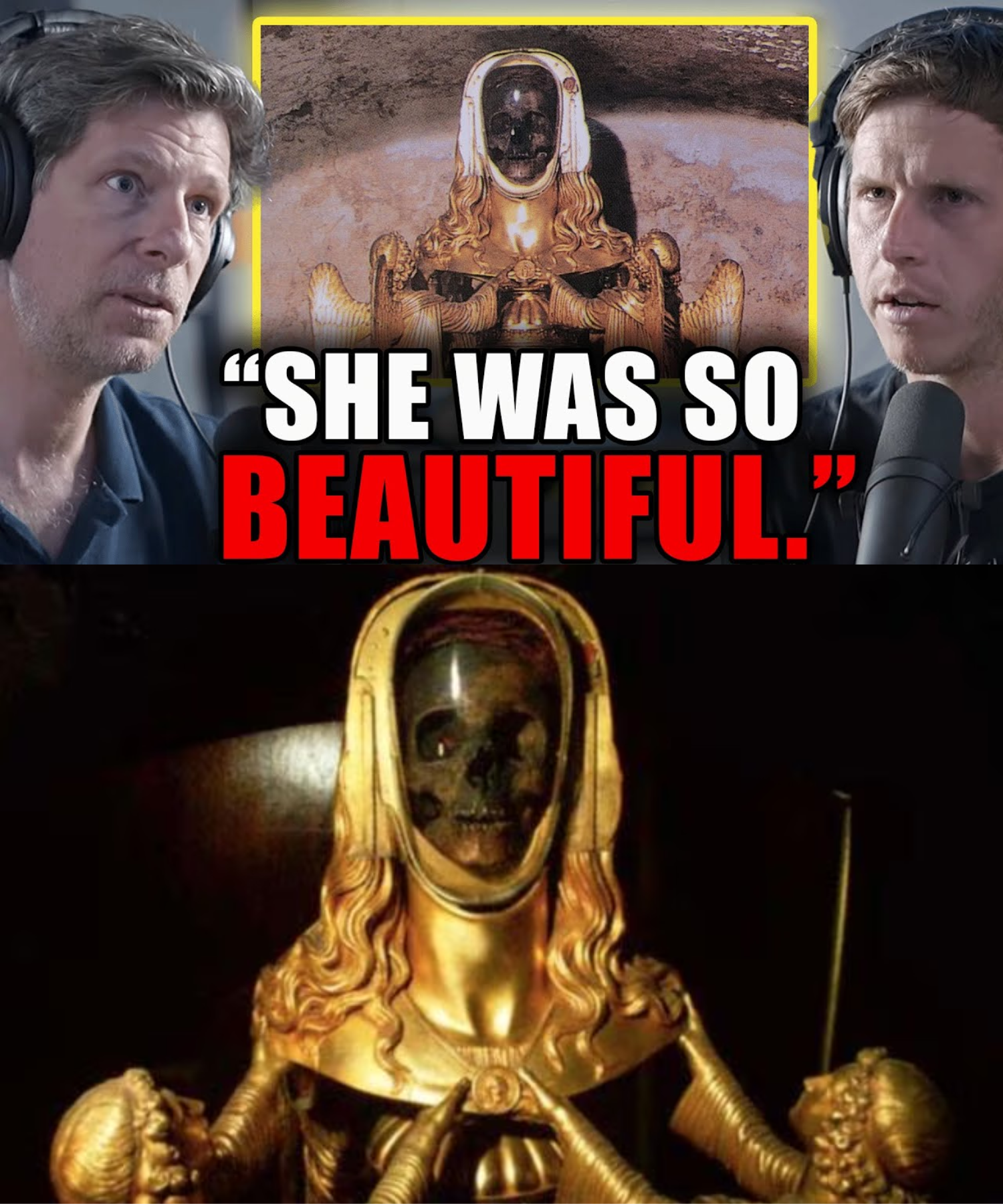
Charlier himself emphasized the importance of bringing the skull “out of anonymity.” That phrase may be the key to the entire story. Even if the relic does not belong to Mary Magdalene, it belonged to someone. A woman lived, aged, died, and became part of a sacred tradition that carried her remains across centuries. Her identity may be uncertain, but her humanity is not. The reconstruction reminds us that relics are not only objects of devotion or debate. They are the remains of people.
There is something profoundly moving about that.
In a world obsessed with certainty, this project offers a different kind of encounter. It does not hand us a clean answer. It gives us a face surrounded by questions. Was this Mary Magdalene? Was it another woman whose bones became absorbed into legend? How did the relic tradition develop? Why did generations of believers preserve, protect, and venerate these remains? What does it mean to seek truth in a place where faith and science look at the same skull and ask different questions?
The reconstruction also forces a larger reconsideration of Mary Magdalene herself. For centuries, she has been used as a symbol of sin, repentance, devotion, femininity, mystery, and spiritual transformation. Yet the Gospels present her as one of the most faithful followers of Jesus, someone present at moments when many others were absent. Her reputation was reshaped by later interpretation, and the woman behind the tradition became buried beneath layers of sermon, art, and speculation.
A forensic face cannot correct all of that history.
But it can interrupt it.
It can make us pause before repeating old assumptions. It can remind us that Mary Magdalene was not created by painters or preachers. She came from a real place, lived in a real body, and moved through a world of political occupation, religious tension, grief, loyalty, and danger. Whether or not the Saint-Maximin skull belonged to her, the reconstruction challenges the viewer to imagine her not as a decorative saint, but as a woman of the ancient Mediterranean world.
That may be why the image spread so widely.
People were not only curious about what she might have looked like. They were hungry for a more human Mary Magdalene. Not the scandalous figure of later legend. Not the polished saint of stained glass. Not the fantasy of novels and conspiracy theories. A woman with strong features, dark hair, age in her face, and a gaze that seems to resist simplification.
Of course, the next step would require tests that have not fully settled the question. Carbon dating could help establish whether the skull comes from the right historical period. DNA analysis might offer clues about sex, ancestry, and geographic origin. More advanced study could compare the remains with other relics linked to the same tradition. But religious, ethical, and conservation concerns make such work complicated. Sacred remains cannot be treated as ordinary laboratory samples without negotiation and respect.
That tension is unlikely to disappear.
Science wants access. Faith wants reverence. History wants evidence. The public wants wonder. The skull sits at the center of all those desires, silent and unreachable behind glass.
And perhaps that is fitting.
Mary Magdalene has always existed in a space between presence and absence. She is present in the Gospel story at crucial moments, but absent from many later structures of authority. She is remembered everywhere, yet misunderstood everywhere. She is named, painted, preached, questioned, claimed, and reimagined. Now, even in forensic reconstruction, she remains both revealed and hidden.
The face is there.
The certainty is not.
That is what makes Philippe Charlier’s work so compelling. It does not end the mystery of Mary Magdalene. It deepens it in a more responsible way. It replaces vague imagination with anatomical possibility. It replaces a stereotype with a human face. It invites people to look again, but also to think carefully before claiming too much.
In the end, the reconstruction may not show us exactly what Mary Magdalene looked like.
But it shows us something almost as powerful: what happens when modern science reaches toward one of history’s most sacred mysteries and touches, not a legend, but a person.
A woman once lived behind that skull.
A woman had eyes, cheekbones, hair, breath, and a name known to someone.
Whether that name was Mary Magdalene remains uncertain.
But for a brief moment, through bone, light, measurement, and imagination disciplined by science, the past looked back.
And that was enough to change the way many people saw her forever.