Christians and Muslims Saw Her Together: Our Lady Returned to Egypt 3 Times
Christians and Muslims Saw Her Together: Our Lady Returned to Egypt 3 Times
The first time she appeared, the workers thought someone was about to fall from the church roof. Then the light moved, the figure stood above the dome, and the streets of Egypt began to fill with people who came not to argue—but to look upward.
For decades, Egypt has carried one of the most unusual Marian stories in modern religious history: reports that the Virgin Mary appeared not once, but multiple times above Coptic churches, visible not only to Christians, but also to Muslims, skeptics, workers, families, police officers, and ordinary passersby. These events did not unfold in hidden chapels or private visions seen by one person alone. They were described as public, luminous, and communal—apparitions above rooftops, domes, and church towers, witnessed by crowds standing together in the streets.
That is what makes the Egyptian apparitions so powerful.
They were not only religious events. They were public moments in a divided world.
In a time when faith is often used to separate people, the stories of Our Lady in Egypt describe something different: Christians and Muslims standing shoulder to shoulder, watching the same light, whispering the same question, and wondering whether heaven had chosen Egypt again.
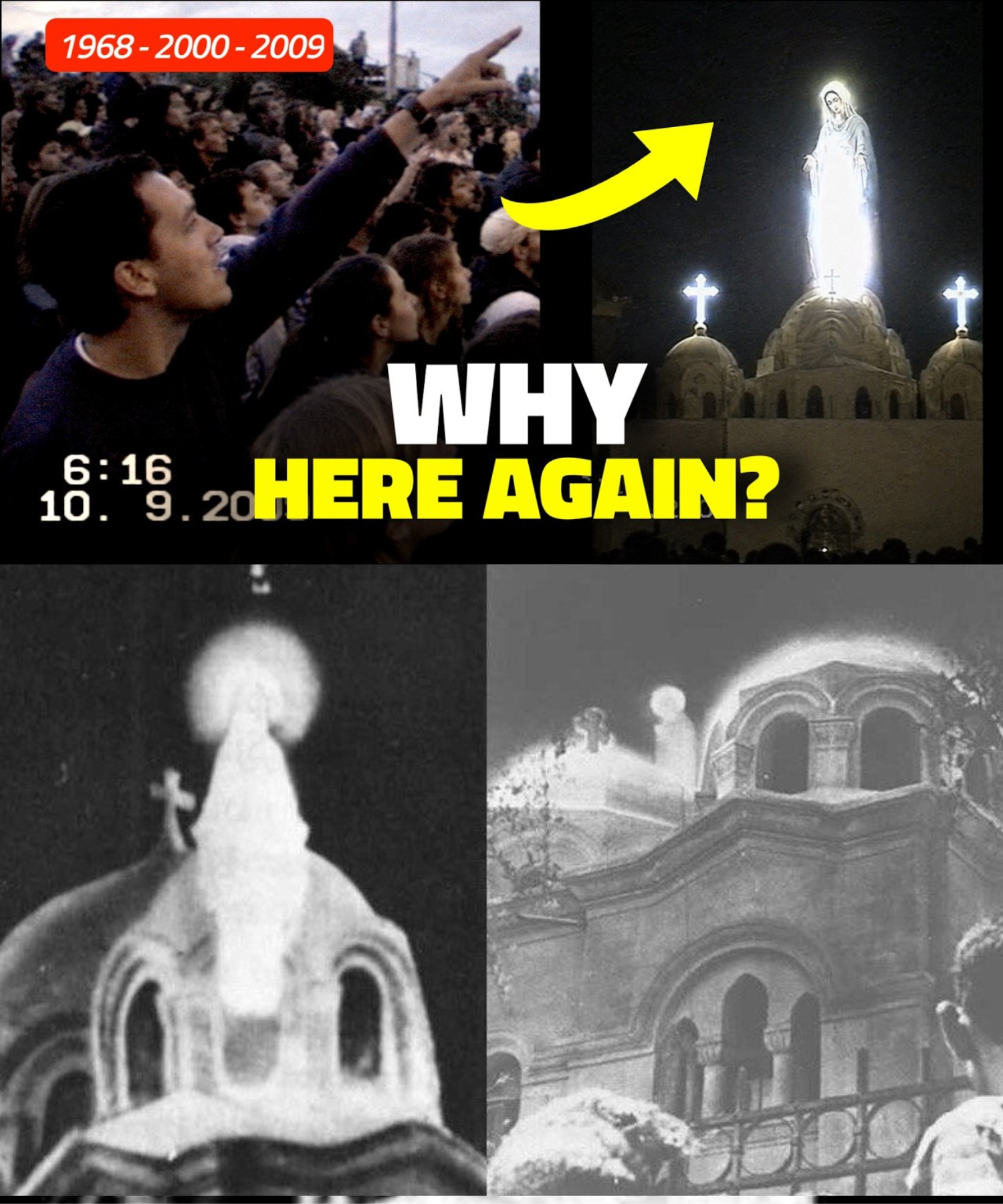
The first and most famous event began in Zeitoun, a district of Cairo, in April 1968. Egypt was still carrying the wounds of war, political tension, and national grief. The country had endured humiliation after the 1967 conflict, and ordinary people were living under a heavy atmosphere of uncertainty. Then, above the Coptic Orthodox Church of Saint Mary in Zeitoun, witnesses began reporting a bright female figure moving over the domes.
At first, many thought it was an accident. Some believed a nun or young woman had climbed onto the roof and might fall. Workers nearby reportedly shouted warnings. But then the figure was seen clearly above the church, shining with an intense white light. She did not fall. She did not speak. She moved calmly above the domes, sometimes accompanied by lights or dove-like forms, as crowds gathered below.
The news spread with impossible speed.
Night after night, people came to Zeitoun. Christians came with hymns. Muslims came with curiosity and reverence. The sick came hoping for healing. Families brought children. Police tried to control the crowds. Journalists arrived. Skeptics came expecting fraud and left unsure what they had seen. Some nights, the crowds became enormous, filling the surrounding streets until the church was surrounded by a sea of faces staring upward.
What made Zeitoun different from many private apparition claims was its public nature. The reported figure appeared above a church in a crowded urban district. People from different backgrounds claimed to see the same phenomenon. It was not limited to one visionary. It was not hidden behind monastery walls. It happened in the open air, in a city full of witnesses.
The Virgin of Zeitoun was often described as silent.
That silence became part of the mystery.
She did not deliver a long message. She did not announce punishment. She did not give a list of prophecies. She appeared in light above a church dedicated to her, and her silence seemed to speak in a language deeper than words. To many Copts, she was a sign of comfort. To many Muslims, Mary was already honored as Maryam, the mother of Jesus, one of the most revered women in Islamic tradition. That shared reverence allowed the apparition to cross a boundary that few religious events can cross.
For Christians, she was the Theotokos, the Mother of God.
For Muslims, she was the pure Mary, chosen above women.
And in Zeitoun, both communities looked up.
That is why the event remains unforgettable. In a region often described through conflict, the apparition created a rare image of shared awe. People did not agree on every doctrine. They did not need to. The figure above the church drew them into the same posture: waiting, watching, praying, wondering.
The second major Egyptian apparition story emerged years later in Shoubra, a crowded district of Cairo. In 1986, reports began that the Virgin Mary was appearing above the Church of Saint Demiana in Papadouplo, a poor and densely packed neighborhood where narrow streets made large gatherings difficult. Yet once the reports spread, people came anyway.
Shoubra did not have the same global fame as Zeitoun, but for those who witnessed it, the effect was deeply personal. The reported apparition appeared in a modest place, above a small church surrounded by ordinary homes and working families. Lights were seen over the domes. Some witnesses spoke of Mary appearing in full form, surrounded by radiance. Others described unusual flashes, glowing shapes, and signs that seemed to transform the cramped urban night into something sacred.
Again, the crowds were not only Christian.
Again, the apparition was public.
Again, the place mattered.
If Zeitoun had become a national sign, Shoubra felt like a visitation to the poor and overlooked. The streets were narrow. The church was small. The neighborhood was not glamorous. And yet, according to those who believed, heaven had chosen precisely that kind of place. Not a palace. Not a political center. Not a cathedral built to impress the world. A humble church in a crowded district where ordinary people lived pressed against difficulty.
That pattern is important.
Many Marian apparition traditions share this strange reversal: the sacred appears not where power expects it, but where suffering waits. Mary appears to children, villagers, laborers, the poor, the sick, and the ignored. In Egypt, the reported apparitions followed that same spiritual logic. They came above churches embedded in the daily struggle of ordinary life.
In Shoubra, as in Zeitoun, the central mystery was not only what people saw, but what the sight did to them. People prayed in the streets. They sang hymns through the night. Some wept. Some came because neighbors told them something impossible was happening. Some came to disprove it. But the atmosphere around the church became one of expectation.
The third major return came in Assiut, Upper Egypt, in 2000.
This time, the reports centered around St. Mark’s Church. Witnesses described bright lights, glowing forms, and dove-like shapes appearing above or around the church in the late-night hours. The timing was striking. The world was entering a new millennium. People everywhere were speaking about change, fear, technology, war, prophecy, and the unknown future. Then, in southern Egypt, crowds once again began gathering outside a church to watch the night sky.
Assiut drew intense attention because the reports seemed to echo Zeitoun: lights, crowds, public sightings, and a Marian presence seen by many. Some said they saw Mary with outstretched hands. Others saw brilliant lights and large white doves. Newspapers covered the phenomenon. Believers traveled to the site. Skeptics asked whether the lights could be explained naturally or technically. But the crowds came because the question itself had become irresistible.
Why Egypt?
Why again?
Why Mary?
For Christians, Egypt is not just another country in biblical memory. It is the land of refuge. According to Christian tradition, the Holy Family fled into Egypt to escape Herod’s violence. That means Egypt is not only connected to ancient Israel, pharaohs, Moses, and the Exodus. It is also connected to Mary carrying the child Jesus through danger, exile, and survival.
In that sense, every Egyptian Marian apparition carries symbolic weight.
Mary returning to Egypt is not random.
It is a mother returning to a land that once sheltered her Son.
That idea is one reason these stories have such emotional force. Egypt becomes not only a backdrop, but a participant in salvation history. The land that received the Holy Family becomes, in the eyes of believers, a land Mary has not forgotten. Her appearances above Egyptian churches are understood not simply as miracles, but as acts of remembrance.
She came back to the land of refuge.
She came back in light.
And she came back where Christians and Muslims could see her together.
The interfaith dimension cannot be overstated. Mary holds a unique place between Christianity and Islam. Christians honor her as the mother of Jesus Christ, central to the mystery of the Incarnation. Muslims honor Maryam as a pure and chosen woman, and the Qur’an gives her a place of extraordinary dignity. There are deep theological differences between the faiths, especially regarding Jesus. But Mary remains one of the rare figures who can be approached with reverence by both communities.
That is why the Egyptian apparitions touched something larger than one denomination.
When Christians and Muslims stood together beneath the reported lights, the scene itself became a message. It did not erase disagreement. It did not solve history. But for a moment, people who might otherwise speak past one another were facing the same mystery. They shared wonder before they shared explanation.
In a world addicted to argument, wonder can be a form of mercy.
Skeptics have raised serious questions about all three events. Were the lights caused by reflections, electrical effects, atmospheric phenomena, birds, projections, mass suggestion, or religious expectation? Were the crowds seeing the same thing, or interpreting ambiguous lights through faith? Could local conditions near the churches have created illusions? These questions deserve to be asked. Faith should not fear honest inquiry, and history should not be built on exaggeration.
But skepticism does not fully explain why the stories endured.
Zeitoun, Shoubra, and Assiut remain powerful because the witnesses did not describe only strange lights. They described presence. They described peace. They described crowds transformed by what they believed they saw. They described people praying together in streets where fear and division might otherwise have ruled. That human impact is part of the historical reality, regardless of how one interprets the phenomenon.
The apparitions also came at moments of social tension. Egypt’s Coptic Christians have often lived with pressure, vulnerability, and concern for their future. For many Copts, the appearance of Mary was received as consolation: a sign that they were seen, protected, and not abandoned. For Muslims who witnessed or respected the events, Mary’s appearance could be understood through reverence for Maryam and the mysterious mercy of God. For outsiders, the events offered a rare glimpse of popular faith that did not fit neatly into political categories.
The reports also challenge modern assumptions about miracles.
Many people imagine miracles as private, emotional, and impossible to discuss seriously. But the Egyptian apparition stories were public, urban, crowded, and documented through testimony, photographs, church investigations, and press attention. That does not automatically prove the supernatural claim. But it does mean the events cannot be dismissed as one person’s imagination. Something happened socially, spiritually, and historically around those churches. The crowds were real. The devotion was real. The questions were real.
And for believers, the message was clear even without spoken words.
Mary came in light.
She came above churches.
She came without weapons, without speeches, without politics.
She came as a mother.
That maternal symbolism may be the key to why the apparitions moved so many people. In times of national anxiety, religious tension, or personal suffering, the image of a mother standing above the city speaks directly to human need. A mother watches. A mother intercedes. A mother gathers frightened children. A mother does not always need to explain; sometimes her presence is the explanation.
Zeitoun gave Egypt a silent mother of light after national trauma.
Shoubra brought that light into a poor and crowded neighborhood.
Assiut renewed the sign at the dawn of a new millennium.
Three times, the pattern returned.
Three times, the crowds looked up.
Three times, Mary’s image became a bridge between fear and hope.
Whether one believes the apparitions were supernatural, misunderstood natural phenomena, or something history has not yet fully explained, their legacy remains extraordinary. Few modern religious events have drawn such broad public fascination across Christian and Muslim communities. Few have created such a powerful image of shared watching. Few have placed Mary so dramatically in the streets of a modern nation.
The world is still hungry for signs, but not all signs are about prediction. Some are about remembrance. Some are about healing. Some are about bringing people together long enough to realize they are standing under the same sky.
The Egyptian apparitions endure because they offer that kind of sign.
They remind Christians that Mary is not distant from suffering.
They remind Muslims of Maryam’s honored purity and spiritual importance.
They remind skeptics that human beings will always search for meaning when light appears in darkness.
And they remind the world that Egypt, land of prophets, pharaohs, exodus, refuge, and prayer, still carries stories powerful enough to make millions look upward.
Perhaps that is why these events continue to fascinate after so many years. The greatest mystery is not only whether Mary appeared, but why so many people—Christians and Muslims alike—felt that, for a moment, heaven had drawn near.
In Zeitoun, in Shoubra, and in Assiut, the night sky became a question.
And Egypt has never stopped answering it with prayer.