A Hidden Detail in Nefertiti Bust Has Been Revealed — And It’s Shocking
A Hidden Detail in Nefertiti Bust Has Been Revealed — And It’s Shocking
For more than a century, the world thought it knew Nefertiti’s face.
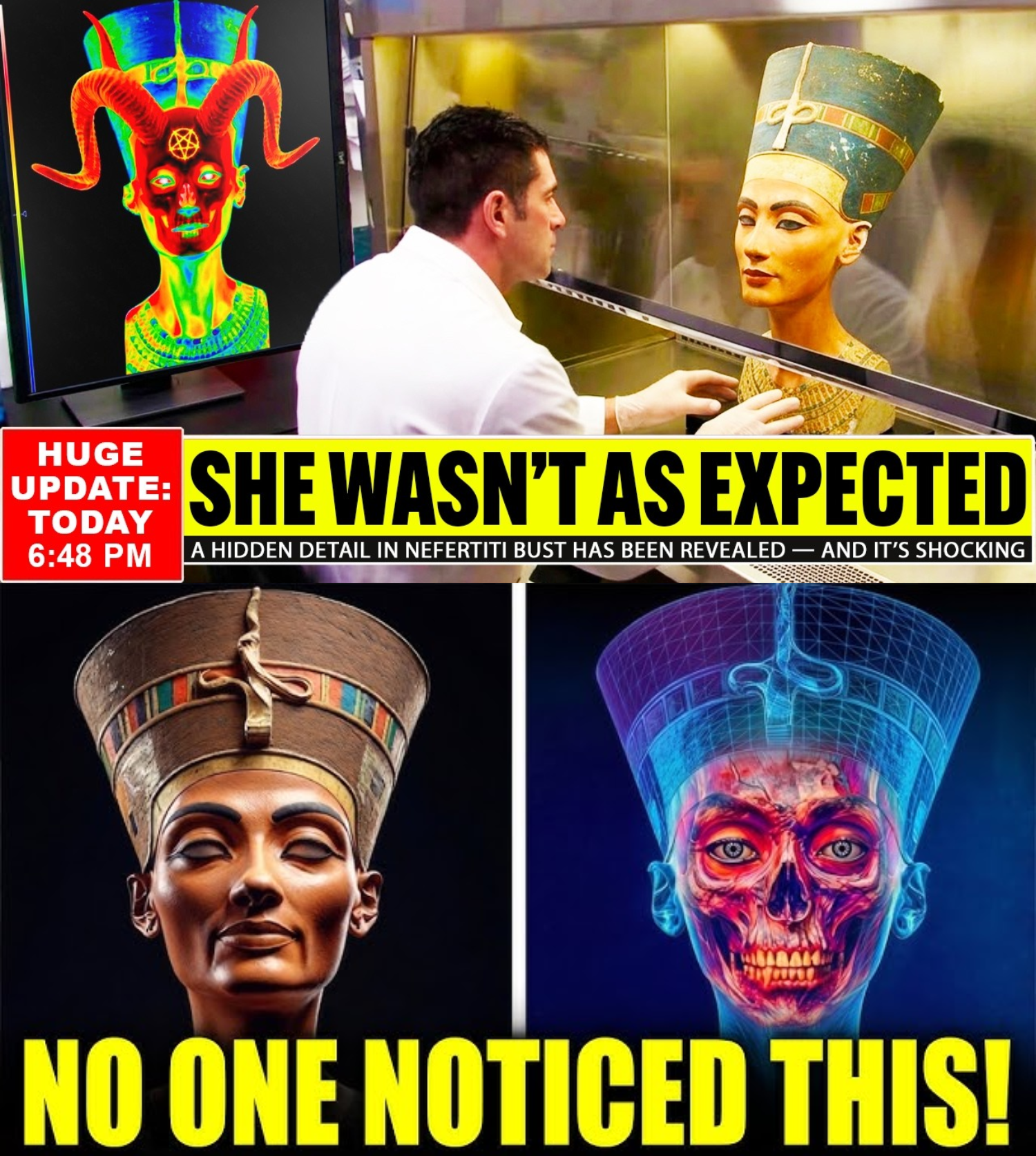
The famous bust, with its long neck, sharp cheekbones, elegant crown, and calm, unreadable expression, has become one of the most recognizable images ever created from ancient Egypt. Millions have looked at it and seen perfection. Beauty. Power. Mystery. But hidden beneath that flawless painted surface was another face — a quieter, more human face — and when modern scans revealed it, the discovery changed the way experts looked at one of archaeology’s greatest treasures.
The secret was not found in a tomb. It was not hidden inside a golden chamber or buried beneath desert sand. It was concealed in plain sight, inside the sculpture itself. The face the public knows — the smooth, balanced, almost supernatural image of Queen Nefertiti — was only the outer layer. Beneath the painted stucco was a carved limestone core, shaped with care before the final surface was applied. And that inner face was not identical to the famous one.
That is the shocking detail.
The Nefertiti bust has two faces.
One is the face the world worships: polished, idealized, serene, and almost impossibly perfect. The other is the face hidden underneath: still elegant, still beautifully made, but subtly different. It has details the outer surface softened or removed. Small creases near the mouth. Slight changes around the eyelids. Less prominent cheekbones. A tiny bump on the ridge of the nose. These are not dramatic flaws, but they matter deeply. They suggest that the ancient artist may have begun with a more individualized portrait, then covered it with a refined surface shaped by royal beauty standards.
In other words, the Nefertiti we know may not be the Nefertiti the sculptor first carved.
That possibility has stunned people because the bust is not just an artifact. It is an icon. Since its discovery in 1912 at Amarna, the ancient city built by Pharaoh Akhenaten, the bust has defined the modern image of Nefertiti. It has appeared in books, museums, documentaries, posters, jewelry, fashion, and political debates about cultural heritage. It is not merely a portrait of a queen. It is a global symbol of feminine beauty and ancient power.
But symbols can become prisons.
For generations, Nefertiti’s face has been treated almost like a perfect mask. Her image is so famous that people forget it was made by human hands, in a real workshop, for a specific purpose, during one of the most dramatic religious and political experiments in ancient Egyptian history. The hidden inner face reminds us that before Nefertiti became an icon, she was a subject of artistic decisions. Someone studied her. Someone shaped her. Someone adjusted her features. Someone decided what the world should see.
The bust was found in the workshop of the sculptor Thutmose at Tell el-Amarna, the short-lived capital city of Akhenaten. This was not an ordinary period in Egyptian history. Akhenaten had attempted a radical religious shift, elevating the sun disk Aten above Egypt’s traditional gods. Art changed with the religion. Royal images became more elongated, expressive, intimate, and unusual. Bodies were stretched. Faces were stylized. The royal family was shown in scenes of affection and worship that looked different from the rigid traditions of earlier Egyptian art.
Nefertiti stood at the center of that world.
She was not simply the wife of a pharaoh. She was represented with remarkable authority. In some images, she appears participating in rituals, wearing crowns, smiting enemies, and standing beside Akhenaten in ways that suggest unusual prominence. Her name, often translated as “the beautiful one has come,” seems almost prophetic now, because beauty became the thing by which the modern world remembered her most.
Yet the hidden face inside the bust suggests that beauty was constructed, layer by layer.
Modern CT scanning allowed researchers to see beneath the surface without damaging the fragile object. That detail is important because the bust is too precious, and too delicate, for invasive investigation. Scientists could not simply scrape away the stucco or cut into the sculpture. Instead, advanced imaging revealed what the eye cannot see: the structure beneath the paint, the layers of material, the hidden cracks, the air pockets, and the carved limestone core.
What they found was extraordinary.
The outer face, the one visitors see behind glass in Berlin, is made with a very thin stucco layer over the limestone. In many areas, that layer is only a few millimeters thick. But even such a thin layer was enough to transform the final impression. The hidden limestone face had been carefully carved, not roughly blocked out. It was not a crude support for decoration. It was a real face, shaped by a skilled artist. Then the stucco surface refined it.
That raises a fascinating question.
Was the artist correcting the sculpture, or idealizing the queen?
The answer may be both.
The inner face appears more individualized. The outer face appears more controlled. The small bump on the nose was smoothed. The creases around the mouth and cheeks were softened. The eyelids were adjusted. The final result became more harmonious, more distant, more royal. It became the face of a queen who was not merely a woman, but an image of power.
This is where the discovery becomes bigger than one sculpture. Ancient Egyptian royal art was never just portraiture in the modern sense. It was not simply about showing what someone looked like on a normal day. It was about order, divinity, authority, and permanence. A royal image had to do more than resemble a person. It had to communicate what that person represented. The face of a queen could be shaped to carry political and religious meaning.
The hidden face may therefore show us the tension between reality and ideal.
That tension still exists today. Public figures are photographed, edited, styled, lit, filtered, and presented in carefully managed ways. Their official images are rarely accidental. Ancient Egypt did not have digital filters, but it had artists, pigments, plaster, stone, and rules. Nefertiti’s bust may be one of the oldest and most beautiful examples of image-making as power.
The shocking part is not that the bust was refined. The shocking part is that we can now see the refinement.
For more than 3,000 years, the sculptor’s process was sealed beneath the surface. The outer Nefertiti looked effortless. She seemed to have emerged from history fully formed, untouched by uncertainty. But the scan reveals decisions. It reveals revision. It reveals the hand of the artist not as a magician, but as a craftsman making choices. The perfect queen was built over a more human one.
That hidden humanity is what makes the discovery so haunting.
People often describe the Nefertiti bust as beautiful, but beauty alone does not explain its power. Plenty of ancient objects are beautiful. This bust feels alive because it balances distance and presence. Nefertiti’s expression is calm, but not empty. Her lips seem almost ready to speak. Her eyes, especially the completed right eye, draw the viewer into a face that feels both idealized and specific. She is not smiling, but she is not cold. She seems aware.
And then there is the missing left eye.
For decades, that missing inlay has added another layer of mystery to the bust. The right eye contains a dark pupil and iris beneath polished rock crystal, creating a lifelike effect. The left eye socket is empty. Some have wondered whether the eye was lost. Others have suggested it was never inserted. The official museum discussion notes that the issue remains debated, though early investigators came to believe the left eye may never have existed. Whatever the explanation, the missing eye makes the bust even more unforgettable. It gives Nefertiti a strange asymmetry, a sense of incompletion inside perfection.
That incompletion now feels connected to the hidden face.
The bust is perfect, but not whole. Finished, yet mysterious. Idealized, yet layered over something more personal. It is both a masterpiece and a question.
The physical condition of the sculpture adds more drama. CT scans showed not only artistic secrets, but also vulnerabilities. There are layers of stucco, air pockets, fissures, and fragile areas in the crown and shoulders. The bust may look strong behind its glass case, but internally it is delicate. This matters because the object sits at the center of an ongoing cultural debate between Egypt and Germany over where it belongs and whether it should be returned. Supporters of keeping it in Berlin often point to its fragility as one reason it cannot travel.
That argument makes the hidden details even more important. The same scans that revealed the inner face also showed why moving the bust could be risky. The sculpture is not just stone. It is a layered object with vulnerable materials, ancient repairs, fragile paint, and structural weaknesses. Every vibration, every shift, every journey could matter.
So the bust remains in Berlin, admired by visitors and contested by history.
Egypt has long argued that Nefertiti should return home. For many Egyptians, the bust represents more than an artwork. It is a symbol of cultural identity, colonial-era removal, and the unequal history of archaeology. For German institutions, it is one of the central treasures of the Berlin collection, acquired under the rules of its time and preserved for more than a century. The argument is not only legal. It is emotional. It is political. It is about who gets to tell the story of the ancient world.
And now, the hidden face gives that argument another dimension.
Because the bust does not only belong to museums and governments. It belongs to the human imagination. It forces people to ask what we are really looking at when we look at ancient beauty. Are we seeing a queen? An ideal? A political image? A religious icon? A sculptor’s model? A cultural treasure? A stolen object? A fragile survivor? The answer is yes to almost all of it.
That is why Nefertiti remains so powerful.
She refuses to become simple.
The hidden detail revealed by scanning does not destroy her beauty. It deepens it. The outer face is still magnificent. The symmetry, color, proportion, and expression remain breathtaking. But now we know there is another layer beneath it. A version with slightly more texture. A version with details the final surface chose to quiet. A version that suggests the ancient artist may have stood between two goals: representing a real woman and creating an eternal queen.
That is what changed everything.
Before the scans, people could believe the bust was a single, seamless act of genius. After the scans, it becomes a conversation across layers. Limestone speaks beneath stucco. The original carving whispers beneath the painted ideal. The hidden face reminds us that even ancient masterpieces were not born perfect in one instant. They were made. Adjusted. Reconsidered. Completed according to the values of their time.
In a strange way, that makes the bust more modern.
We understand edited faces. We understand public images. We understand the gap between private reality and public presentation. The Nefertiti bust shows that this gap is ancient. Long before cameras, rulers knew the power of a controlled image. Long before social media, artists shaped faces for public memory. Long before modern celebrity, a queen’s appearance could become part of political mythology.
Yet the inner face resists that mythology.
It brings Nefertiti back toward the human.
We still do not know exactly what she looked like in life. No scan can give that certainty. The bust itself may have been a model, an official image, or a devotional object rather than a direct portrait. The hidden face is not a photograph beneath a sculpture. It is still art. But it gives us evidence of process, and process is intimate. It shows us where the artist’s chisel stopped before the final surface began.
That is the part that stays with people.
Not just that there was a hidden face, but that it was carefully made.
The sculptor did not carve a meaningless block and then cover it. He shaped a face with attention, then refined it further. That means the inner Nefertiti mattered. She was part of the artwork’s life, even if no ancient viewer was meant to see her. For thousands of years, she waited in darkness beneath the famous queen.
Then modern technology found her.
There is something almost poetic about that. An artifact from a civilization obsessed with eternity, seen through a machine from a world its makers could never have imagined. X-rays and computers entering a 3,000-year-old silence. Science revealing the invisible without touching the sacred surface. The past does not open easily, but sometimes it allows a glimpse.
And this glimpse is unforgettable.
The hidden face of Nefertiti tells us that beauty can be a surface, but history is always layered. It tells us that perfection may hide revision. It tells us that ancient artists were not merely copying rules; they were making choices. It tells us that the queen’s image, like her legacy, was shaped by power, politics, devotion, and desire.
Most of all, it tells us that even the most famous face in ancient Egypt was not fully known.
For more than a century, visitors stood before the bust and thought they were seeing Nefertiti. Now we know they were seeing the final answer, not the whole question. Beneath the serene surface was another version of her, carved in stone, quieter and more vulnerable, carrying details the finished queen did not show.
That is why the revelation feels shocking.
The hidden face does not make Nefertiti less beautiful.
It makes her more real.
And after 3,300 years, that may be the most powerful discovery of all.