A Hidden Code in Da Vinci’s Last Supper Was Finally Cracked by AI!
A Hidden Code in Da Vinci’s Last Supper Was Finally Cracked by AI!
For more than five centuries, people stared at Leonardo da Vinci’s The Last Supper and believed they were looking at a painting. But according to a new AI-assisted analysis, they may have been looking at a code.
The claim has reignited one of the oldest and most irresistible questions in art history: did Leonardo hide a secret message inside the most famous dinner scene ever painted? For generations, scholars have examined every face, every hand, every shadow, every plate, every loaf of bread, and every architectural line in the mural. Some saw theology. Some saw mathematics. Some saw music. Some saw conspiracy. But now, with artificial intelligence capable of scanning patterns the human eye might miss, the mystery has returned with new force.
At first glance, The Last Supper seems familiar. Jesus sits at the center of the table, calm in the moment after announcing that one of his disciples will betray him. Around him, the apostles explode into shock, denial, fear, anger, and confusion. The entire mural is built around reaction. It is not a quiet meal. It is the instant truth enters the room and tears the room apart.
That is what makes the painting so powerful. Leonardo did not simply paint a religious scene. He painted the anatomy of betrayal.
But AI researchers and digital art analysts claim the painting contains another level beneath the emotional drama. Not a simple hidden word. Not a childish cipher. Not a secret treasure map. Something more subtle: a layered system of geometry, gesture, rhythm, and symbolic placement that may reveal Leonardo was encoding meaning into the painting far beyond what viewers could immediately understand.
The first clue lies in the structure.
Leonardo organized the apostles into groups of three. Four clusters. Twelve men. One central Christ. This arrangement is obvious once noticed, but AI analysis reportedly highlighted how exact the spacing and emotional balance are. The apostles are not randomly distributed. Their bodies form waves of response, moving outward from Jesus like ripples from a stone dropped into water. The shock begins at the center and travels through the room.
To a casual viewer, this is composition. To an AI pattern system, it becomes architecture.
The mural is not merely showing chaos. It is controlling chaos.
Every hand matters. Every head angle matters. Every empty space matters. Jesus forms a stable triangle at the center, while the disciples create fractured movement around him. The contrast is dramatic: divine stillness surrounded by human disorder. If there is a code, this may be the first part of it. The painting tells the viewer where truth is located: at the center, unmoved, while fear and accusation spin around it.
Then comes the second layer: the hands.
Few details in The Last Supper have attracted more attention than the hands of the apostles. They point, reach, recoil, accuse, question, and clutch. In many paintings, hands are secondary. In Leonardo’s mural, they speak almost as loudly as faces. AI-assisted mapping reportedly traced the lines created by these hands and found that they do not merely express emotion; they form directional pathways guiding the viewer across the table.
Some hands point toward Jesus. Others point away. Some seem to interrupt another figure’s movement. Some create invisible diagonals that connect bread, wine, faces, and symbols of sacrifice. The result is a kind of visual language. The hands do not only ask, “Is it I?” They also reveal the spiritual condition of each man.
Peter’s energy is tense and physical. John appears withdrawn or sorrowful. Judas is shadowed, compressed, clutching, separated not by distance but by inward collapse. Thomas raises one finger upward, a gesture that many have linked to questioning, revelation, or divine witness. Philip seems to plead with his whole body. The room becomes a map of human reaction to judgment.
AI does not “understand” faith, betrayal, or guilt the way humans do. But it can detect repetition, alignment, angles, and pattern density. And when applied to The Last Supper, it appears to reinforce what many art historians have long sensed: Leonardo was not painting gestures casually. He was arranging them like a system.
The third layer is the most controversial: music.
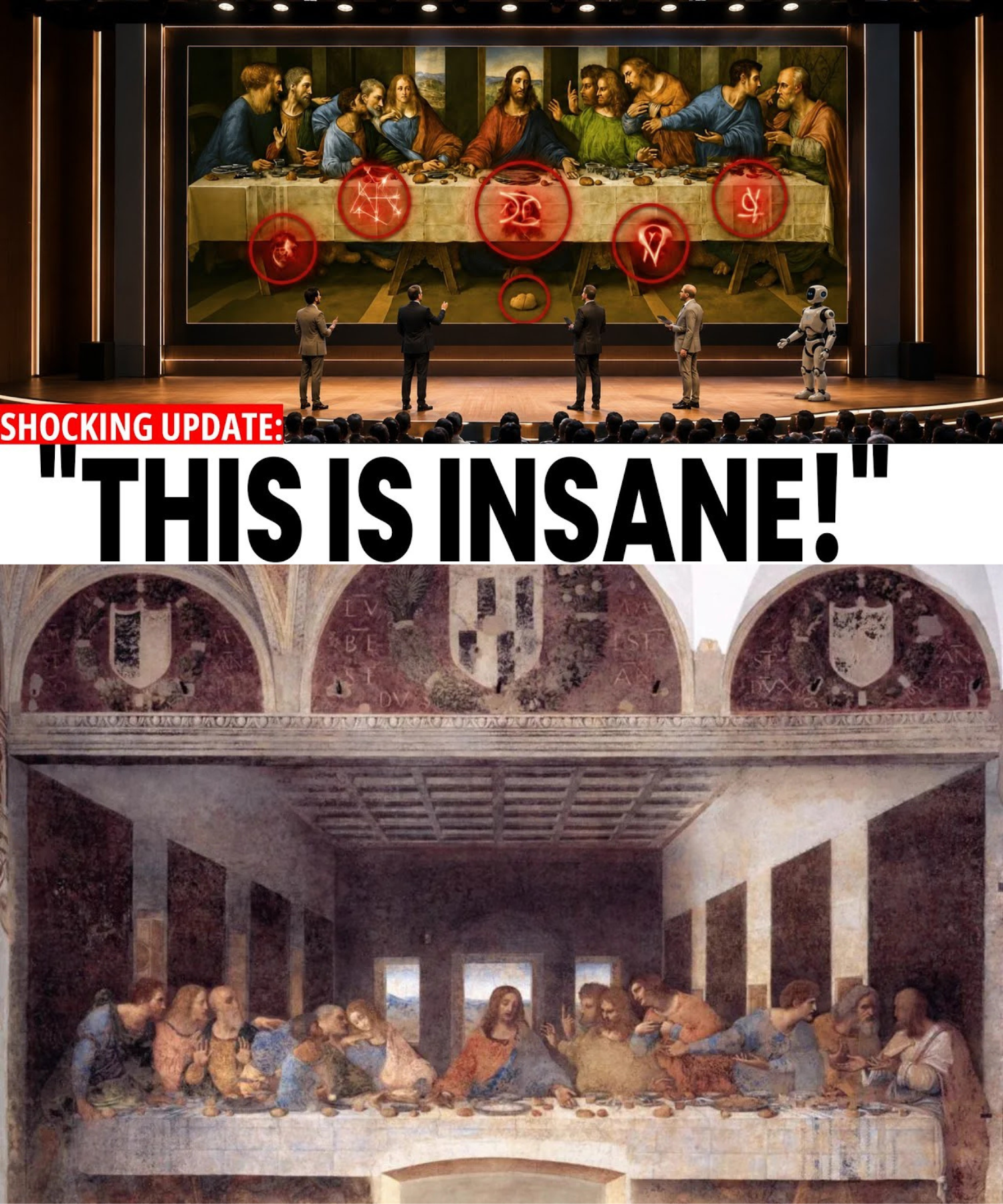
Years before the new AI discussion, researchers and musicians proposed that the positions of the bread loaves and hands might correspond to musical notes if mapped onto a staff. Played in one direction, the notes may seem strange. Played in another, especially right to left—the direction Leonardo often used in his mirror writing—they have been interpreted as a solemn, hymn-like melody.
AI has reportedly taken this old theory further by analyzing spatial relationships across the table and testing whether the repeated objects align more consistently with musical spacing than random placement would suggest. The conclusion, according to those promoting the theory, is not that Leonardo wrote a full hidden symphony. It is that he may have embedded rhythmic order inside the visual scene.
That possibility is extraordinary because Leonardo was not merely a painter. He studied anatomy, optics, mechanics, engineering, geometry, water, flight, proportion, and sound. To him, art and science were not enemies. They were different doors into the same reality. If he believed the universe was structured by proportion, harmony, and divine order, then hiding music inside a painting would not be a gimmick. It would be perfectly consistent with his mind.
The painting would become something more than visual art.
It would become silent music.
A requiem without sound.
A hymn that only appears when the viewer learns how to read the table.
But this is where caution matters. AI can detect patterns, but it can also over-detect them. Human beings are already skilled at seeing meaning in coincidence. Machines can amplify that tendency. Given enough points, lines, shadows, hands, loaves, plates, and folds, a program may find alignments that Leonardo never intended. The danger is not that AI sees nothing. The danger is that AI sees too much.
That is why the claim of a “cracked code” must be treated carefully. The AI may not have revealed a hidden message in the simple sense. It may have revealed a new way to examine Leonardo’s compositional intelligence. That is still fascinating, but it is different from saying the painting contains a secret doctrine or forbidden truth.
The most responsible interpretation is this: AI may be helping modern viewers see how deeply structured The Last Supper really is.
And that alone is enough to change the way we look at it.
One of the most compelling AI observations reportedly concerns the vanishing point. Leonardo’s perspective lines converge at the head of Christ, pulling the entire room toward him. This is already known, but when digitally mapped, the effect becomes almost overwhelming. The architecture, the ceiling, the walls, the table, and the emotional flow all move toward one center.
In theological terms, the meaning is clear: Christ is the point where all lines meet.
In artistic terms, it is genius.
In code terms, it is the key.
If the painting contains a hidden system, the system does not begin with a secret word. It begins with focus. Everything in the room leads to Jesus, even the disorder. Betrayal, doubt, fear, loyalty, denial, and love all converge around him. Leonardo’s “code,” if we can call it that, may not be about hiding something from the Church or revealing some scandalous alternate history. It may be about embedding a spiritual truth into the very geometry of the image.
The secret is not outside the painting.
The secret is how the painting works on the viewer.
This is where sensational theories often go wrong. They treat Leonardo like a novelist leaving clues for a treasure hunt. They imagine secret bloodlines, forbidden identities, hidden organizations, or explosive theological reversals. But Leonardo’s mind was more subtle than that. His mystery may not have been a conspiracy. It may have been harmony.
The AI analysis suggests that The Last Supper is full of layered relationships: groups of three, symbolic gestures, geometric triangles, repeated hand positions, musical possibilities, emotional symmetry, and directional lines. These elements do not necessarily reveal a hidden heresy. They reveal a painter thinking like an engineer, a musician, a theologian, and a psychologist at the same time.
That is more impressive than a conspiracy.
It also explains why the painting has survived in human imagination despite its damaged physical condition. The mural has suffered from Leonardo’s experimental technique, environmental exposure, restoration struggles, war, and time. Much of the original surface has been altered or lost. And yet the image still dominates. Even wounded, it speaks.
Perhaps that is because the true power of The Last Supper was never only in pigment. It was in structure.
The painting is built like a machine for attention.
You look first at Christ. Then your eye moves outward to the apostles. Then back to Christ. Then to Judas. Then to the bread. Then to the hands. Then to the architecture. Then back again. The mural keeps pulling you into the moment. It makes you participate in the question no disciple wants to ask: Who is capable of betrayal?
The answer, disturbingly, is everyone.
That may be the hidden message AI has helped expose.
Not a secret name. Not a buried sentence. Not a forbidden identity. A moral pattern.
Every apostle reacts differently, but every apostle is shaken. The betrayal is not only Judas’s crime. It reveals the vulnerability of the entire human circle. Fear spreads. Suspicion spreads. Self-defense spreads. Jesus remains still because he knows what the others do not: the darkness entering the room is already part of the road to sacrifice.
If Leonardo encoded anything, perhaps he encoded the difference between divine knowledge and human panic.
AI can map the gestures, but the human heart recognizes the scene.
This is why the new analysis has captured public imagination. People do not simply want technology to explain old art. They want technology to reveal that the past still has secrets. They want to believe that masterpieces are not exhausted, that even the most studied image in the world can still surprise us. And in this case, they may be right.
The AI did not need to prove a conspiracy to make the discovery meaningful. It only needed to show that Leonardo’s painting contains more intentional order than modern viewers may have realized.
The most beautiful possibility is that Leonardo created a work that could be read at multiple levels. The ordinary believer sees Jesus and the apostles. The artist sees perspective and composition. The theologian sees sacrifice and betrayal. The musician may see rhythm. The mathematician sees proportion. The psychologist sees human reaction. And now AI sees patterns connecting them all.
That is the real genius.
A shallow code has one solution.
A masterpiece has many.
The danger, of course, is that online culture will flatten the discovery into a sensational claim: “AI found hidden words,” “AI proves secret bloodline,” “AI exposes forbidden truth.” Those headlines travel fast because they offer shock. But Leonardo deserves better than cheap certainty. His work invites wonder, not careless exaggeration.
The better headline is not that AI solved The Last Supper.
It is that AI has shown us how unsolved it still is.
Because every time technology improves, the painting changes again. High-resolution images let viewers inspect tiny details. Restoration history reveals layers of damage and survival. Digital mapping clarifies geometry. Pattern analysis tests old theories. AI adds another lens—not a final authority, but a new way of asking questions.
And The Last Supper continues to answer in silence.
If there is a hidden code, perhaps it is this: Leonardo built the painting so that every visible thing points toward an invisible meaning. The hands, the bread, the eyes, the groups, the empty spaces, the perspective lines, the possible musical notes—all of them serve the same mystery. A meal becomes a trial. A table becomes an altar. A room becomes a universe of human weakness gathered around divine calm.
That is why the painting still matters.
Not because it hides a secret the world was never meant to know, but because it reveals a truth the world keeps forgetting.
Betrayal does not enter with thunder.
It sits at the table.
It shares the bread.
It looks familiar.
And at the center of it all, Leonardo placed Christ—not shouting, not accusing, not fleeing, but still.
The AI may have cracked patterns in the painting. It may have revealed alignments, rhythms, and coded possibilities. But the deepest code was always there, waiting for eyes patient enough to see it.
Leonardo did not simply paint the moment Jesus announced betrayal.
He painted the moment every soul in the room was exposed.
And five hundred years later, even machines are still trying to understand what he left behind.