What AI Revealed Hidden in the Dead Sea Scrolls Shocked Scholars
What AI Revealed Hidden in the Dead Sea Scrolls Shocked Scholars
JERUSALEM — For three quarters of a century, the narrative of the Dead Sea Scrolls was safely locked in amber. It was a comforting, almost cinematic tale of modern archaeology: a Bedouin shepherd flings a stone into a limestone cliff above the Dead Sea in 1947, hears the shatter of ancient earthenware, and stumbles upon the lost library of an ascetic Jewish sect called the Essenes. For generations of biblical scholars, theologians, and history buffs, these thousands of fragile parchment fragments were treated as a monolithic time capsule—a pristine, uniform snapshot of the Hebrew Bible safely tucked away in the desert while the fires of Roman conquest consumed Jerusalem in 70 CE.
But that amber has cracked.
Over the last several years, an ambitious international research consortium quietly bypassed seventy-five years of human academic gridlock by feeding the complete, digitized multi-spectral archive of the Dead Sea Scrolls into an advanced deep learning model. Trained for months on the subtle variations of ancient Hebrew, Aramaic, Greek, and Paleo-Hebrew script, the artificial intelligence was set loose on more than 25,000 disintegrated scraps of leather and papyrus. It did not merely read the texts; it looked through them, analyzing microscopic variations in pen pressure, measuring letter spacing down to fractions of a millimeter, and mapping the chemical and structural alignment of fragments scattered across institutions on multiple continents.
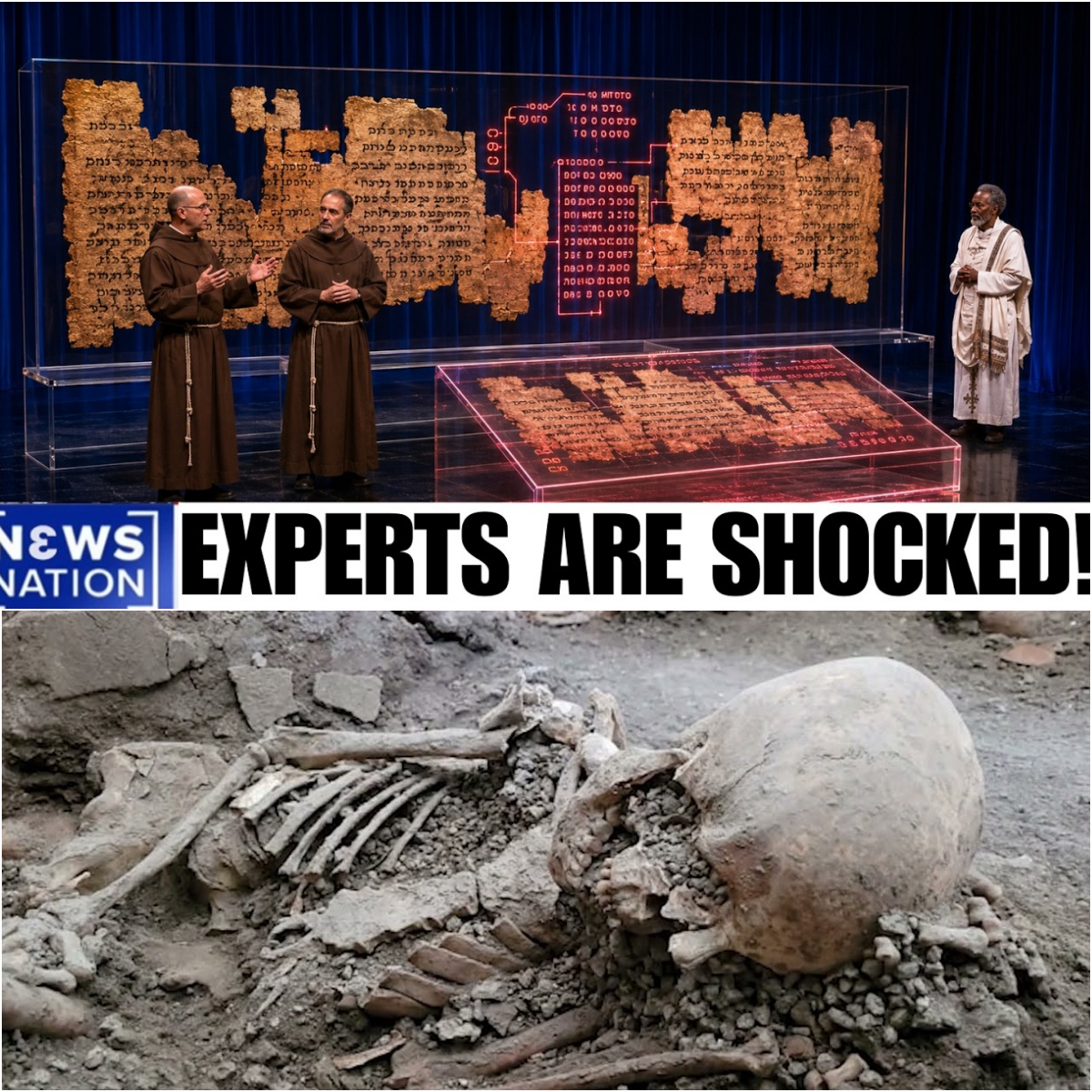
The results, which have sent shockwaves through the tight-knit community of biblical antiquities scholars, do not deliver a tidy theological payload or a sensationalized “secret code.” Instead, they dismantle the very foundation of how we thought the Bible was built.
By identifying individual scribal hands, reconstructing erased layers of text known as palimpsests, and tracking the staggering diversity of competing scriptural translations, the machine has revealed that the scrolls were never a single, curated monastic library. Instead, the AI has exposed the frantic, chaotic footprint of a civilization’s emergency rescue operation—a desperate salvage mission undertaken by deeply terrified, everyday human beings trying to outrun an empire.
The Failure of Human Eyes
To understand why a machine was required to crack a seventy-year-old cold case, one must look closely at the physical reality of the scrolls. The public often imagines the Dead Sea Scrolls as intact, rolled up skin documents, pristine as the day they were written. The reality is a tragic jigsaw puzzle from hell.
The vast majority of the find consists of approximately 25,000 fragments, many no larger than a fingernail or a postage stamp. The ink, made of lampblack and oil, has in many cases faded to the exact, mottled brown-black color of the decaying animal hide it sits upon. For decades, a scholar might spend an entire academic career—ten, fifteen, twenty years—staring through a magnifying glass at a single column of text, arguing in peer-reviewed journals over whether a microscopic, faded smudge was the Hebrew letter waw or a natural flaw in the leather.
Compounding this physiological limitation was human geography. Because the fragments were sold off piecemeal by antiquities dealers in the mid-twentieth century or divided among competing international institutions, pieces of the exact same sentence frequently ended up on opposite sides of the globe. A scrap sitting in a climate-controlled drawer in Jerusalem might hold the missing three letters of a verse currently housed in an archive in Europe or a private collection in America. No human mind, no matter how brilliant, could hold all 25,000 fragments in active memory simultaneously, cross-referencing every faded brushstroke against every other faded brushstroke across the entire global corpus.
“We were hitting an absolute wall,” says Dr. Ethan Vance, an American epigrapher who consulted on the digital reconstruction project. “The bottleneck wasn’t the data; it was us. Human eyes simply weren’t built to find patterns at this scale.”
The breakthrough came when researchers deployed multi-spectral imaging—photographing the fragments under various wavelengths of light, including infrared and ultraviolet. This process causes organic compounds in the ancient ink to pop, pulling text out of absolute invisibility. But the true catalyst was the deep learning model. By digitizing these multi-spectral scans, the AI could analyze the entire collection in a single pass, matching torn edges, tracking ink consistency, and sliding separated fragments back together across thousands of miles of geographic separation like a sentence completing itself after two millennia of silence.
The Scribe Who Shook
Nowhere is the raw, human cost of this history more visible than in the machine’s analysis of the newly revealed fragments from the Judean Desert’s infamous “Cave of Horror.” Located in the steep, unforgiving cliffs of Nahal Hever, the cave earned its gruesome moniker in the 1960s when archaeologists discovered the skeletons of some forty men, women, and children inside. These were Jewish refugees fleeing the brutal Roman suppression of the Bar Kokhba Revolt between 132 and 136 CE. The Roman army had tracked them to the cliffs, pitched camp on the flat plateau directly above the cave mouth, and simply waited. Trapped between an elite military force above and a 250-foot sheer drop below, with no internal water source, the families starved to death in the dark.
In 2021, archaeologists risked their lives rappelling down the cliff faces to conduct a definitive excavation of the site, retrieving roughly 80 new, microscopic scroll fragments preserved by the desert’s intense dryness. When the deep learning model analyzed these specific fragments—which contain Greek translations of the Book of the Twelve Minor Prophets, specifically Nahum and Zechariah—it flagged something highly anomalous in the handwriting.
In professional ancient scribal work, consistency is everything. Scribes trained for years to maintain a rhythmic, controlled, and perfectly horizontal line, masking their personal identity behind standard script forms. But as the AI mapped the pen strokes of a section from the Book of Nahum, the data metrics lurched off the charts.
The spacing between the Greek letters became unpredictable and cramped. The pressure behind the stylus fluctuated wildly from word to word, indicating a hand that was trembling or applying uneven force. The lines themselves began to sag, drifting downward away from the horizontal plane.
When researchers isolated this hand, they realized they were not looking at an untrained or clumsy copyist. Other sections of the very same scroll, written by the exact same individual, exhibited the smooth, confident, uniform strokes of a master scribe. Something fundamental had changed in the environment between the writing of the passages.
“The machine essentially charted a panic attack across two thousand years,” Dr. Vance explains. “It measured the physical manifestation of terror. You are looking at a highly skilled person sitting in the suffocating blackness of that cave, listening to the crunch of Roman caligae sandals on the rocks overhead, knowing the water skins are bone dry, knowing how this ends for their children—and they are still desperately forcing their fingers to copy the word of God.”
This handwriting of fear transforms the Dead Sea Scrolls from sterile museum artifacts into agonizingly intimate historical testaments. They were not composed in the placid, sunlit scriptoriums of a wealthy monastery; many were forged in the crucible of an existential crisis, acts of furious cultural defiance by a people who refused to let their identity be erased by the march of legions.
The Emergency Salvage of a Civilization
For decades, the dominant academic consensus—the “Qumran Sectarian Theory”—argued that the scrolls represented the isolated library of the Essenes, a marginal, apocalyptic, ultra-conservative Jewish group that had withdrawn from the corrupt politics of Jerusalem to live a communal life by the dead shores of the desert. It was a neat, clean story: an isolated group copying their specific books, hiding them in nearby caves when a singular Roman column marched past.
The AI, however, has effectively broken that narrative. By analyzing the thousands of distinct handwriting styles across the entire 25,000-fragment corpus, the model determined that the scrolls were written by hundreds of different scribes over a timeline spanning more than two centuries. The sheer variety of individual hands, scribal habits, and regional spelling variants is vastly too large for a single, isolated desert monastery to have produced.
Furthermore, the machine highlighted the profound linguistic contradictions within the caves. The collection does not just contain standard Hebrew; it is a chaotic mix of literary Hebrew, everyday Aramaic, highly sophisticated Greek, and archaic Paleo-Hebrew—a ceremonial script that had been out of common, daily use for hundreds of years.
When the machine mapped the distribution of these text types across the various caves surrounding the Dead Sea, a radically different historical picture emerged. The scrolls are not a curated library; they are a civilization’s emergency archive.
As the Roman war machine rolled through Judea in the late 60s CE, systematically burning towns and laying siege to Jerusalem, a massive, uncoordinated rescue operation apparently took place. Priests, scholars, farmers, and refugees from widely different communities across the region gathered whatever sacred writings they could physically carry and fled into the wilderness. The sophisticated Greek scrolls likely came from Hellenized Jewish families living in cosmopolitan coastal cities. The traditional Hebrew texts came from the urban center of Jerusalem. The Aramaic portions represented the rural populations of the interior.
They all converged on the jagged caves of the Judean desert at the exact same doomed historical moment, shoving their contrasting, competing versions of scripture into the dark before disappearing into history.
“It changes how we view the survival of Western scripture,” says Sarah Jenkins, a historian of the Levant specializing in the Roman period. “We used to think we were looking at a pristine stream of sectarian thought. Now we know we are looking at the scattered, desperate wreckage of an entire world. Every single jar was a choice made under extreme duress. Someone stood in a burning room, looked at a shelf of family or community scrolls, and had to decide within seconds what to leave to the fire and what to carry into the cliffs.”
The Ghostly Gaps and the Book of Esther
By identifying what was saved, the machine inevitably illuminated what was left behind. And to biblical scholars, the most glaring discovery made by the AI is an omission that has haunted the field for years, but now takes on a devastatingly human context.
The Dead Sea Scrolls contain fragments from every single book of the Hebrew Bible—except one. The Book of Esther is entirely, completely absent. Out of 25,000 pieces of parchment recovered from the desert, not a single syllable of Esther has ever been found. The Book of Chronicles fares little better, surviving only in a couple of microscopic, highly contested scraps that some algorithms still flag as statistically uncertain.
For generations, theologians constructed elaborate, intellectual defenses for this gap. They argued that the Qumran community must have rejected Esther on strict theological grounds. After all, Esther is the only book in the entire biblical canon that never once explicitly mentions the name of God. It is a secular story of palace intrigue, political maneuvering, and diaspora survival set in the Persian capital of Susa, explaining the origins of the festival of Purim—a holiday the desert ascetics did not celebrate.
But once the AI re-framed the scrolls as a frantic, wartime salvage operation rather than a coolly deliberated library, the “theological rejection” theory began to crumble under the weight of human logistics.
If you are running for your life from an invading army, you do not hold a synod or an academic committee meeting to deliberate on the finer points of non-theocentric narratives. You grab what is within arm’s reach. The absence of the Book of Esther may not be a grand theological statement at all; it may simply be a casualty of war.
Consider the irony of the omission: Esther is a story that explicitly celebrates Jewish survival against the existential threat of a hostile empire. It is a text that should have resonated deeply with people fleeing the wrath of Rome. The fact that it is missing implies a far more grounded, tragic reality: nobody could reach it in time. It was left sitting on a shelf in a burning house in Jerusalem or Jericho because hands can only carry so much when you are scrambling up a 200-foot rope ladder into a cliff face while carrying your children.
“We spent seventy-five years treating the gaps in the scrolls as intellectual judgments,” says Jenkins. “The machine reminds us that history is made of physical limitations. A book wasn’t lost because it was condemned; it was lost because the person who loved it couldn’t run fast enough.”
A Tradition in Motion
Perhaps the most unsettling revelation for modern audiences is what the machine found when it turned its focus inward, examining the text beneath the text.
For centuries, modern religious traditions have operated under the assumption that the Bible was handed down through history as a fixed, sealed, and immutable document. The standard reference point for the Hebrew Bible has long been the Masoretic Text, a meticulously standardized version finalized by Jewish scholars between the 7th and 10th centuries CE, which serves as the bedrock for every modern Jewish Bible and the vast majority of Christian Old Testaments.
The scrolls predate the Masoretic text by a millennium, and the AI’s comprehensive linguistic mapping shows that during the Second Temple period, the Bible was not a closed book. It was a living, breathing, fluid debate.
When the deep learning model compared the Hebrew fragments against later traditions, it found a dizzying array of variations. Passages appeared with entirely different word choices, altered phrases, and varying narrative emphases. In some scrolls, entire verses exist that were completely omitted from the versions we read today; in others, chapters sit in a completely different chronological sequence.
The machine also exposed this process of active modification happening in real-time on the parchment itself. The algorithm flagged thousands of instances of scribal corrections—places where a later reader had carefully scraped away an older word with a knife to write a preferred variant on top, or squeezed a note into the tiny margins between columns, explicitly noting that another community’s scroll read the passage differently.
This was not a sign of textual corruption or careless copying. To the contrary, the AI has revealed that the original condition of scripture was one of healthy, vibrant diversity. Before the political necessities of later centuries forced religious authorities to lock in a single, standardized version as the absolute “correct” text, communities fluidly engaged with multiple, parallel editions of holy writ, viewing them all as deeply authoritative.
“The machine shows us the exact moment before the concrete hardened,” Dr. Vance remarks. “We are looking at a beautiful, multi-vocal conversation that was happening across ancient Israel. The uniformity we have today isn’t how the Bible started; it’s just what happened after the state and the centuries quieted the other voices.”
The Ghost in the Leather
But the most haunting discovery made by the AI involves the palimpsests—parchment sheets where the original writing was completely scraped off so the expensive leather could be reused for a new text. To the human eye, these erased layers are totally invisible, swallowed up by the darker, heavy ink of the writing on top.
By utilizing advanced algorithmic subtraction—isolating the chemical signatures of the top layer of ink and digitally removing them from the multi-spectral scans—the deep learning model managed to look underneath the visible Bible. It resurrected the ghosts of words that had been silenced for two thousand years.
Some of these recovered under-layers contained older, variant readings of known prophetic books. But a small, stubborn percentage of the erased text matched absolutely nothing in the known corpus of ancient Mediterranean literature. They are fragments of lost histories, vanished hymns, and forgotten prayers—writings that existed nowhere else on Earth, saved from absolute non-existence only because the indentation of the scribe’s reed pen left a microscopic, structural compression deep within the fibers of the animal hide.
Somewhere beneath the words we have spent centuries reading are the words someone else decided we no longer needed to see. And for the first time, a cold, unfeeling algorithm has caught the faint, indelible trace of them.
The Machine as a Mirror
The revelation of these findings has left the academic world in a state of quiet, contemplative retreat. There are no triumphalist press conferences, no simplified headlines declaring that the Bible has been “proven” or “disproven.” The truth revealed by the machine is far too complex, far too human for the modern attention span.
The artificial intelligence did not find a conspiracy; it found a story. It is a story of an ancient people who, when confronted with the absolute annihilation of their physical world by an unstoppable military empire, did not build fortresses of stone. Instead, they built fortresses of words. They copied their songs, their laws, and their arguments onto skins, packed them into jars, and climbed into the terrifying, baking heat of the desert cliffs, driven by a singular, desperate hope: that someday, somehow, someone would find them and understand what it had cost them to survive.
That hope has finally been answered, not by a theological decree, but by a line of code. The machine has looked into the dark of the Judean caves and reflected back to us our own oldest reflection: a picture of fragile, courageous human beings writing through the tremors of fear, reaching out across twenty centuries of silence to remind us that faith, history, and human defiance have always been inextricably bound together in the dark.