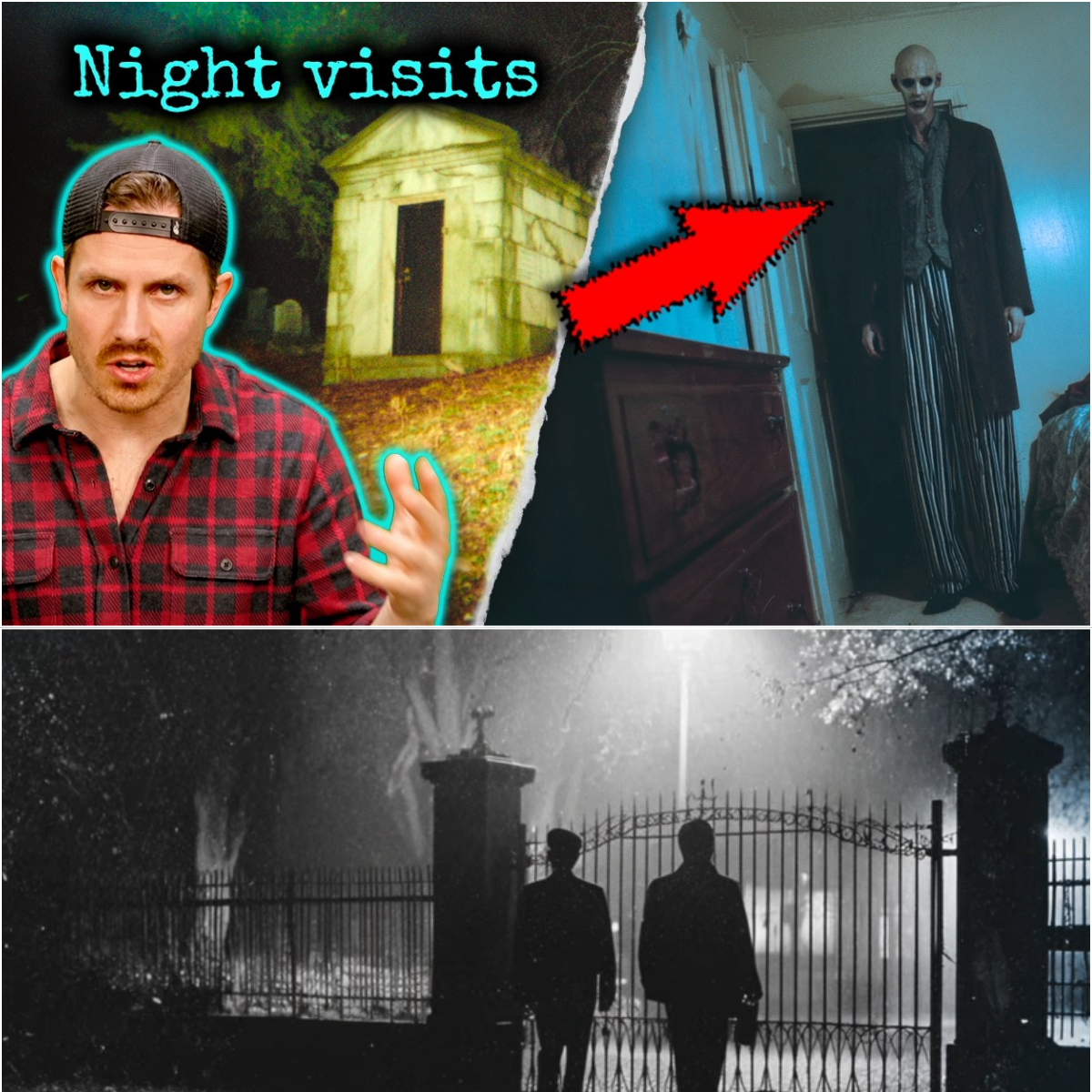
This is why you never search for the dead…
This is why you never search for the dead…
The dead man looked as though he had fallen asleep only hours earlier. Yet he had been buried for twenty years.
Two Harvard medical students stood frozen inside a dark Massachusetts mausoleum, their lantern trembling in their hands. The clothing inside the coffin had decayed into dust. The body had not. And decades later, when workers opened the same casket, the corpse had vanished entirely.
For generations, Americans have lived between two competing ideas. One says that every mystery eventually yields to science. The other insists that some events refuse to surrender their secrets. Between those two beliefs lies a territory occupied by ghost stories, unexplained encounters, strange deaths, and experiences that witnesses swear changed them forever.
The following three cases span nearly a century and several continents. They involve doctors, reporters, grieving families, medical students, and ordinary people with no obvious reason to fabricate what they saw. Some can perhaps be explained by psychology, coincidence, or faulty memory. Others remain stubbornly resistant to easy answers.
Whether these stories reveal the supernatural or simply the limits of human understanding, they continue to ask the same unsettling question:
What happens when reality behaves in ways that reason cannot comfortably explain?
The Immortal Body
Late one night in 1870, two Harvard medical students quietly climbed over the fence surrounding a cemetery in Malden, Massachusetts.
James Adams and his friend William had not come to vandalize graves or seek thrills. They had come to settle a local legend.
For years, residents had spoken about Ephraim Gray, a reclusive chemist who had died two decades earlier. During his lifetime, neighbors reportedly smelled unusual chemicals drifting from his home. Rumors spread that Gray had become obsessed with discovering an elixir that could defeat death itself.
When he died, his servant allegedly instructed that the body not be embalmed. According to the servant, Gray’s experiments had failed to preserve his life but had succeeded in preserving his body.
The claim became local folklore.
To James and William, both students of medicine, the story was impossible. Human bodies decay. Even the best preservation methods available in the nineteenth century could not prevent decomposition indefinitely.
Yet curiosity eventually overcame skepticism.
Armed with a lantern, a hammer, and a chisel, they forced open the mausoleum and located Gray’s coffin among those of his relatives. Together they lifted the casket from its shelf and opened it.
What they saw would follow James for the rest of his life.
Gray’s clothing had deteriorated. Fabric had collapsed into brown strands. But the body itself appeared untouched by time. The skin reportedly remained pale and smooth. There were no signs of decomposition. He looked less like a corpse than a sleeping man.
Terrified, the students slammed the coffin shut and fled.
For years James searched for a scientific explanation. He studied chemistry and medicine, convinced that some natural process must account for what he had witnessed. None satisfied him.
Then, thirty years later, a police officer arrived at his medical office.
The cemetery was being relocated. Workers had opened Gray’s coffin. The body was gone.
No signs suggested anyone had entered the mausoleum except James and William decades earlier. Authorities suspected the students had stolen the corpse.
Both denied it.
The mystery only deepened. If the body had truly been there in 1870 and absent in 1900, where had it gone?
The simplest explanation is that memories fail. Perhaps the students misremembered what they saw. Perhaps the body had decomposed and later been removed. Perhaps records were incomplete.
Yet for James, a trained physician who spent his life studying the human body, the experience never entirely lost its power.
In the end, he was left with two impossible facts: a body that should have decayed had not, and a body that should have remained had disappeared.
Surgery Performed by a Dead Doctor
On January 28, 1945, an Australian reporter sat inside a small church in Brazil waiting to witness an operation.
The circumstances were extraordinary.
The procedure was an appendectomy. The patient was reportedly inside a locked room. The operation would occur without nurses, assistants, or anesthesiologists. Two spiritual mediums stood outside the door. Religious music played softly in the darkened church.
Several doctors and journalists had gathered as witnesses.
The arrangement made little sense.
The physician supposedly performing the operation was Dr. Luiz Gomes, a respected surgeon. Yet according to several medical professionals present, the circumstances violated every accepted standard of surgery.
As the hours passed, witnesses sat in the heat listening to hymns and watching the mediums. Eventually a voice announced that the operation had ended.
The door was opened.
Inside, the patient reportedly lay on a table with fresh stitches. A removed appendix sat preserved in a container nearby. The surgery appeared successful.
But there was one problem.
Dr. Gomes was not in the room.
According to the organizers, he could not be in the room because he had died nineteen years earlier.
The claim sounds almost impossible to print in a modern newspaper. A dead surgeon had allegedly performed a successful operation through spiritual means.
Yet multiple witnesses insisted no living doctor entered or exited the room.
Medical examinations reportedly confirmed that the appendix had indeed been removed.
Skeptics point to numerous possibilities. The entire event may have been staged. Witnesses may have been manipulated. Another surgeon could have entered unnoticed. Documentation may have been incomplete or exaggerated over time.
Such explanations are certainly more plausible than surgery conducted by a deceased physician.
Yet the event became one of the most unusual stories in the history of psychic phenomena.
It arrived during an era when spiritualism attracted enormous public interest. Across Europe and the Americas, people sought contact with the dead through mediums, séances, and psychic healers. The devastation of two world wars had left millions grieving lost relatives.
In that environment, stories of communication with the dead found receptive audiences.
Still, the Brazilian case stands apart because it involved physical evidence. An operation had apparently occurred. The patient recovered.
What remains uncertain is who actually held the knife.
The witnesses left with radically different interpretations.
Some believed they had observed a miracle.
Others believed they had been deceived.
But nearly all agreed that they had witnessed something they could not adequately explain.
The Visitor with Blue Eyes
At five o’clock on the morning of December 5, 1957, seventy-four-year-old Frances B. awoke in her California bedroom with the feeling that someone was standing beside her bed.
She assumed it was her husband, Jean.
He had been seriously ill and often entered her room during the night. But when she opened her eyes, she saw someone else entirely.
The figure was a small man dressed in outdated clothing.
He wore polished shoes with thick heels, striped trousers, a white vest, and a black coat with tails. Most striking were his vivid blue eyes and strange smile.
Frances stared at him in confusion.
The man leaned forward.
“I’m here for Jean,” he said.
She screamed.
The figure vanished.
Moments later her husband entered the room after hearing her cries. Embarrassed by the experience, Frances gradually convinced herself that she had experienced an unusually vivid dream.
Yet within hours Jean’s health rapidly deteriorated.
He was hospitalized.
He died the following day.
For months Frances interpreted the vision as a product of grief and anxiety. Her husband had been ill. Perhaps her mind had anticipated his death.
Then, months later, her daughter Jane revealed something extraordinary.
On the morning of Jean’s death, Jane had seen the same man.
The same shoes.
The same clothing.
The same blue eyes.
The same smile.
According to Jane, the figure had spoken to her as well.
But his message had been different.
“I’m here for Jane.”
Initially both women concluded that Jane must have misheard him. After all, Jean had died shortly afterward.
But one year later, Jane herself died from previously undiagnosed cancer.
Only then did the earlier encounter acquire a terrifying new meaning.
The story eventually attracted public attention because of one peculiar detail. After hearing descriptions of the figure’s clothing, several people pointed out that his attire closely resembled that of a nineteenth-century undertaker.
Whether the similarities are meaningful remains impossible to determine.
Psychologists note that visions near death are surprisingly common. Family members often report dreams, apparitions, or strange experiences during periods of grief and stress.
Shared experiences, however, are more difficult to explain.
Did two women independently imagine the same figure?
Did one unconsciously influence the other?
Did memory change over time?
Or was something else present in those rooms?
No answer has satisfied everyone.
The Human Need for Meaning
Stories such as these occupy an uncomfortable position in modern society.
Scientists demand evidence.
Believers point to witnesses.
Skeptics seek errors.
The grieving seek meaning.
Most extraordinary experiences occur under conditions that make investigation difficult: darkness, emotional stress, illness, death, fear, and memory.
Yet these circumstances are precisely what make such experiences meaningful to those who endure them.
A medical student sees a body that should not exist.
A reporter witnesses an impossible surgery.
A widow encounters a visitor who seems to arrive before death.
The experiences themselves become inseparable from the emotions surrounding them.
Death, in particular, appears repeatedly.
The preserved corpse.
The dead surgeon.
The mysterious messenger.
Perhaps this is no coincidence.
Human beings have always struggled to understand mortality. Every civilization has produced stories about the dead returning, communicating, or refusing to disappear completely.
Modern medicine has extended life and explained countless diseases, yet it has not eliminated humanity’s oldest questions.
What happens after death?
Can the dead return?
Do people somehow sense death approaching?
These stories persist because those questions remain unanswered.
Between Belief and Doubt
There is a temptation to approach such accounts with certainty.
One group insists that every mystery has a rational explanation.
Another insists that unexplained events prove the existence of supernatural forces.
Reality may be less satisfying.
Some stories are false.
Some are misunderstood.
Some are exaggerated.
And some simply remain unresolved.
What makes these cases endure is not necessarily the evidence itself. It is the credibility of the witnesses. Doctors, reporters, family members, students—people who believed they understood the world suddenly encountered something that did not fit.
Their experiences did not necessarily turn them into believers.
Instead, they left them uncertain.
Uncertainty may be the most uncomfortable position of all.
The modern world rewards confidence and explanations. Yet these stories remind us that human experience often resists both.
A body disappears.
A surgeon operates after death.
A stranger appears before tragedy.
And years later, the people involved continue asking the same question:
What did we really witness?
Perhaps there are answers that future science will eventually provide.
Perhaps these stories reveal only the extraordinary abilities of the human mind.
Or perhaps certain experiences exist at the edge of understanding, where belief and skepticism meet and neither side fully wins.
Until then, the dead man in the coffin, the unseen surgeon, and the blue-eyed visitor continue to walk through history, refusing to disappear.
And somewhere, in another quiet room, another witness may already be seeing something they know should not be there.