They find Real Life Mermaid… Then This Happens..
They find Real Life Mermaid… Then This Happens..
For centuries, the edge of the map was where human understanding ended and monsters began.
Today, that boundary has shifted from the open horizon to the abyssal depths of our own oceans. Despite an era dominated by satellite imaging and deep-sea submersibles, the viral resurgence of “mermaid sightings”—from decayed skeletons on Florida beaches to blurry underwater encounters captured by drone operators—reveals a collective fixation on the unexplored ninety-five percent of the marine world. While these modern tales are no longer passed down through whiskey-soaked whispers in a tavern but through algorithms on social media, they serve the same ancient purpose: filling the vast, terrifying blanks of our natural map with the monsters and wonders of human imagination.
The Viral Ocean and the Five Percent Myth
The modern obsession with aquatic humanoids frequently begins with a single, highly effective rhetorical hook: the statistical reality that humanity has mapped only a tiny fraction of the global ocean floor. In an age where the terrestrial world has been completely cataloged, paved, and digitized, the deep ocean remains our planet’s last great wilderness. This scientific blind spot provides a perfect breeding ground for modern folklore. When a video surfaces showing a sleek, humanoid form darting through the heavy surf of Jamaica or bobbing near a rocky outcrop in Puerto Rico, the public’s default skepticism is often bypassed by a desperate, romantic desire for the unexplainable.
The mechanics of the modern internet have transformed how these legends spread. In the past, a sailor’s yarn required years to travel from port to port, slowly morphing through retelling. Today, a ten-second clip uploaded from a smartphone can reach millions of screens across the globe in a matter of minutes. These snippets are carefully engineered for the short-attention-span economy: a sudden splash behind a fishing boat on the Wolf River, a pale arm striking the viewport of a deep-sea research submarine, or a stiff, mummified carcass rotting on a sandbar in South Africa.
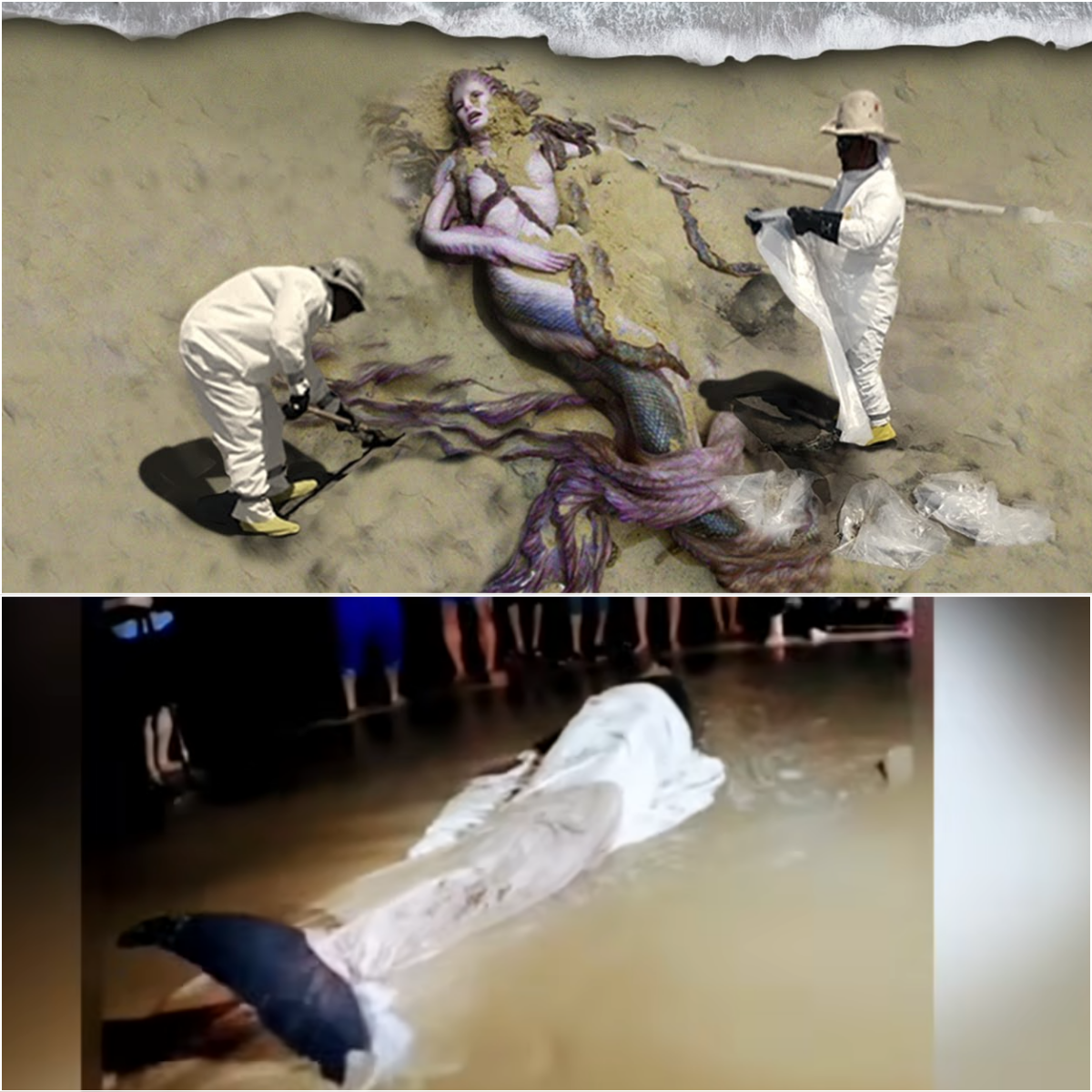
By stripping away geographical context, scale, and technical data, online creators invite viewers to step into a world where ancient myths are actively breaking through into reality. The allure of these videos does not lie in their technical perfection; rather, it thrives on their calculated ambiguity. The low resolution, the frantic shaking of the camera, and the raw, unedited panic of the onlookers all mimic the aesthetic of genuine breaking news, lending an air of documentary authenticity to what is often nothing more than clever digital manipulation or theatrical staging.
The Anatomy of the Shoreline Deception
Among the most persuasive categories of modern mermaid folklore is the discovery of physical remains on public beaches. For a generation raised on cinematic spectacles of pristine, beautiful sirens with flowing hair and shimmering scales, the reality presented in these viral videos is intentionally jarring and ghoulish.
Consider the recurring phenomenon of the “dehydrated mermaid.” Across the coastlines of Florida, Australia, and the Black Sea, a distinct sub-genre of footage involves beachgoers stumbling upon skeletal or mummified remains wedged between rocks or half-buried in the sand. These specimens invariably feature a highly specific anatomical layout: a human-like rib cage, a elongated spine, and a skull that transitions seamlessly into a rigid, scaly caudal fin. In many instances, the flesh is depicted as dried, leathery, and sun-bleached, with elongated fingers ending in sharp, claw-like nails.
The psychological impact of these gruesome displays is profound. By presenting a creature that is clearly dead, decaying, and deeply unappealing, the creators of these hoaxes tap into our instinctual association with biological reality. A pristine, Hollywood-style mermaid feels artificial; a rotting, foul-smelling carcass on a grey beach feels like an uncomfortable truth unearthed by the tide. In Great Yarmouth, England, one such discovery sparked intensive local speculation when observers noted that the remains possessed a distinct, organic odor of rot and sea-brine—a sensory detail that many argued could not be faked by a casual prankster.
However, the history of these shoreline marvels reveals a direct lineage to the sideshow hucksters of the nineteenth century. The most famous ancestor of the modern beach-carcass hoax is P.T. Barnum’s notorious Feejee Mermaid, unveiled to an astonished American public in 1842. Barnum’s specimen was not an archaeological miracle but a masterpiece of traditional East Asian taxidermy, constructed by meticulously stitching the torso and head of a young monkey to the rear half of a large salmon, dried and preserved with papier-mâché.
The modern digital equivalent uses the exact same formula, updated with silicone, advanced casting resins, and cinematic special effects techniques. In several high-profile instances, what the public celebrated as definitive proof of an unknown species was later unmasked as an elaborate movie prop left behind by a film crew, or a specialized dummy constructed by a special effects artist for a museum exhibition dedicated to cryptozoology. The enduring success of the trick relies entirely on the viewer’s unfamiliarity with marine decomposition; a bloated, decaying dolphin or a mutated deep-sea ray can easily be misinterpreted by an untrained eye as a half-human abomination when framed by a sensationalized online caption.
The Professional Performers of the Shallows
Not all mermaid encounters rely on dead props or digital fabrication. A significant portion of the most compelling, high-definition footage circulating through modern channels features living, breathing subjects executing impossible underwater maneuvers in natural bodies of water. From the crystal-clear lakes of Northern Michigan to the popular tourist resorts of Spain, these encounters often leave witnesses entirely convinced that they have looked into the eyes of another intelligent terrestrial species.
In these scenarios, the “anomaly” is entirely real, but its origin is theatrical rather than evolutionary. Over the past two decades, the global subculture of professional mermaiding has grown from a niche hobby into a highly sophisticated entertainment industry. Performers known within the community by monikers such as “Phantom” or “Mermaid Melissa” utilize custom-engineered silicone tails that can cost thousands of dollars and weigh upwards of forty pounds. These tails are not mere costumes; they are highly efficient hydrodynamic tools designed to replicate the exact undulating motion of marine mammals.
When one of these professional athletes dives into a natural river system or a secluded lake to practice their craft, they inadvertently create a perfect storm for localized mythology. To a group of children fishing from a boat or a family recording the sunset on a Mexican beach, the sight of a human torso transitioning into a massive, functioning fin that cuts through a strong current is utterly transformative. The illusion is maintained by the incredible physical conditioning of the performers, many of whom are trained in advanced freediving and breath-holding techniques, allowing them to remain submerged for minutes at a time without the aid of scuba gear or visible breathing apparatus.
The irony of the modern mermaid watch is that the very technology used to document these performers often serves to obscure their human identity. A drone camera flying high over Dana Point, California, might capture a group of sleek, elongated shapes diving in perfect unison through the surf. While the drone operator’s immediate instinct might be to announce a breakthrough discovery of a silent siren fleet, a sober analysis of the visual data almost always reveals a highly common, entirely natural explanation: a pod of dolphins playing in the wake of the tide, their hunting patterns mimicking the synchronized movements of a humanoid group from a distance.
Corporate Mythmaking and Alternative Reality
The blurring of boundaries between myth and reality reached a crisis point in the early 2010s, when corporate entertainment networks realized that the public’s hunger for ocean mysteries could be monetized through simulated documentaries. This marked a major shift in the evolution of the mermaid myth, moving it from amateur folklore into the realm of coordinated mass media manipulation.
The most notable example of this phenomenon occurred in 2012, when a prominent nature and wildlife television network broadcasted a program structured entirely as a legitimate scientific investigation. Complete with frantic, grainy footage of an alleged government cover-up, interviews with actors portraying distressed marine biologists, and a dramatic sequence where a ghoulish creature slaps its webbed hand against the window of an deep-sea submarine, the broadcast shook millions of viewers to their core. The program was presented with such straight-faced, journalistic solemnity that the National Oceanic and Atmospheric Administration was ultimately forced to issue an official public statement clarifying that no evidence of aquatic humanoids has ever been found.
This corporate experimentation with “mockumentaries” exposed a profound vulnerability in the modern information ecosystem. When networks traditionally trusted to deliver factual content regarding the natural world choose to package science fiction as investigative journalism, the baseline of public trust is severely damaged. Years after these programs were explicitly revealed to be scripted entertainment designed to boost viewership ratings, clips from the broadcasts continue to circulate on video-sharing platforms, stripped of their fictional context and presented as real, historical evidence of “Test 2008” or classified military projects involving captured sirens.
This institutionalized mythmaking has created an environment where genuine marine biology must constantly compete with sensationalized fiction. A real, historic discovery—such as the bizarre, gelatinous form of a deep-sea siphonophore or the undulating, alien grace of an oarfish—is often ignored by the wider public unless it can be framed as a monster or a mythical being. The tragic consequence of this trend is that it diminishes the true, breathtaking strangeness of the ocean’s actual inhabitants in favor of a comforting, anthropocentric fantasy.
The Ecological Siren Song
To fully understand why the mermaid myth persists with such tenacity in the twenty-first century, one must look beyond the mechanics of internet hoaxes and corporate television ratings. Every myth is a reflection of the anxieties of the age that births it, and the modern siren is no exception.
In many of the contemporary viral narratives, a recurring thematic element has emerged that sets these stories apart from the romantic fairy tales of the past: the concept of the “beached survivor.” In reports originating from Sri Lanka to the coastal areas of Indonesia, the stranded or dying mermaid is frequently described as a refugee from an eco-system in crisis. The narrative framework suggests that extreme industrial pollution, catastrophic underwater sonar testing by global navies, or rising ocean temperatures have driven these hidden sentinels of the deep out of their natural habitats and onto the hostile shores of the human world.
This variation of the legend transforms the mermaid from a dangerous, alluring temptress into a tragic emblem of environmental loss. The creature becomes a proxy for the countless marine species that are actively being driven to extinction by human activity. By imagining an intelligent, human-like cousin suffering under the weight of global pollution, humanity projects its collective environmental guilt onto the canvas of the ocean. It is far easier for the public to engage with the tragic death of a fictional water fairy than it is to confront the systemic, unglamorous devastation wrought by plastic microparticles and industrial runoff on the global fish population.
This dynamic was vividly illustrated in 2018 on a remote beach in South Sulawesi, Indonesia, when local residents crowded around a large, leathery marine creature that had washed ashore. Despite the animal’s distinctly non-human features, many insisted on labeling it a mermaid, treating the carcass with a degree of reverence and sorrow typically reserved for a human tragedy. Marine scientists eventually identified the creature as a dugong—a peaceful, strictly vegetarian marine mammal closely related to the manatee. The dugong has possessed a long, historic association with the mermaid myth due to its distinct, dual-lobed tail and the way it cradles its young near the water’s surface. The community’s desperate desire to see a mythical being in the body of a dying dugong underscores the profound emotional weight we place on the line where human life meets the wild sea.
The Unyielding Horizon
Ultimately, the enduring popularity of these modern hoaxes reveals that humanity has not yet outgrown its need for mystery. In a world where every square mile of land has been mapped by satellites and every historical fact can be verified with a few keystrokes, the deep ocean remains one of the few places where the imagination can still roam free.
The various digital apparitions that flicker across our screens—the silicone tails of dedicated performers, the taxidermy monsters of online pranksters, and the misidentified marine mammals of startled fishermen—are not merely evidence of public gullibility. They are a testament to an enduring, healthy instinct to look at the great spaces of our planet with a sense of wonder and humility. As long as ninety-five percent of the ocean floor remains shrouded in total darkness, the human mind will continue to invent stories to fill the void. We will continue to look out over the crashing surf, hoping against all rational evidence to catch a fleeting glimpse of something beautiful, terrifying, and completely unexplained rising from the waves.