The 44 Most Mysterious and Unexplained Events Ever Recorded
The 44 Most Mysterious and Unexplained Events Ever Recorded
The perimeter of the modern American home is no longer just a boundary against the outside world; it has become an unceasing laboratory for the supernatural. Decades ago, sharing a brush with the unexplained required a patient audience around a campfire or a typewritten letter sent to a fringe periodical. Today, the collective subconscious broadcasts its deepest anxieties in real time through high-definition doorbell feeds, dashcam streams, and smartphone uploads. This democratization of the anomalous has fundamentally reshaped how we parse reality. As our world grows increasingly quantified, calculated, and surveilled, a burgeoning digital folklore has taken root in the blind spots of consumer technology—proving that human imagination is remarkably adept at turning a camera artifact, a viral stunt, or a tricks of low-light compression into a window directly onto the impossible.
The Hominid in the Ice: The Legacy of the Minnesota Iceman
Long before the internet accelerated the velocity of the viral hoax, the transition from local rumor to national fascination relied on the traveling sideshow circuits of mid-century America. In late 1968, a bizarre exhibition debuted that would capture the attention of both pioneering cryptozoologists and the Federal Bureau of Investigation, establishing a baseline blueprint for the modern “frozen anomaly” myth.
The exhibit featured what was promoted as the fully intact, frozen corpse of a male hairy hominid, standing roughly 1.8 meters tall and preserved inside a massive, solid block of industrial ice. Dubbed the “Sibskoye Creature” or more famously, the Minnesota Iceman, the specimen was exhibited by a showman named Frank Hansen. To insulate the attraction with a layer of geopolitical intrigue during the height of the Cold War, Hansen provided deliberately conflicting origin narratives. He alternatively claimed the creature had been recovered by a Russian sealing vessel navigating the icy waters off the coast of Siberia, or by a Japanese whaling fleet operating in the deep Pacific, before it was clandestinely transported to the American Midwest.
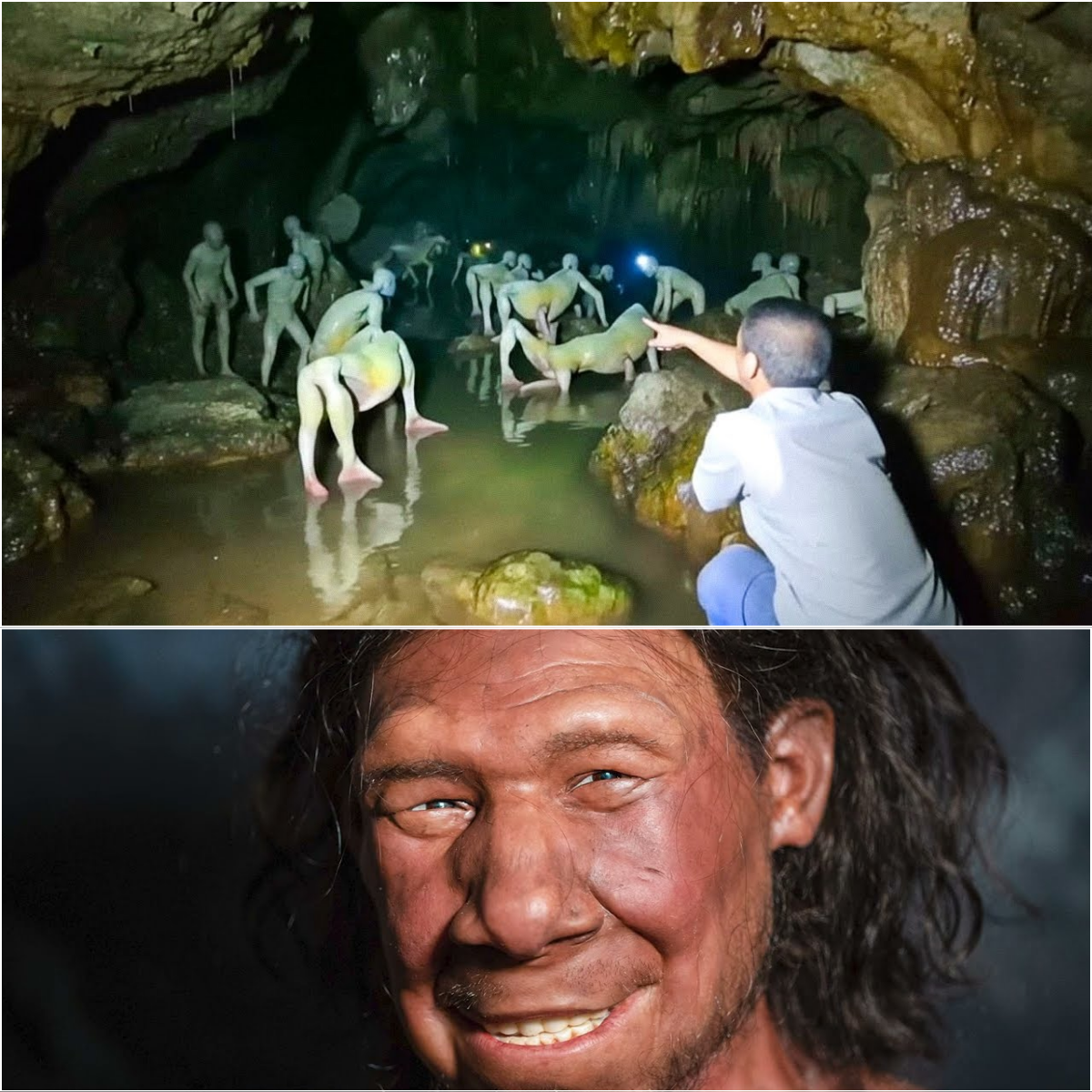
The anatomical details of the specimen were meticulously designed to provoke intense biological speculation. The hominid possessed an exceptionally broad thorax, a thick, virtually absent neck, and disproportionately massive hands and feet. Its facial architecture was flat and expansive, distinguished by a short, snubbed nose and a heavily pronounced supraorbital ridge. Most jarringly, the creature’s left ocular globe hung loosely from its socket—the apparent result of a catastrophic ballistic wound entering through the posterior skull. Other atypical evolutionary markers included a remarkably slender, tapered thumb and a thick dermal pad resting along the outer margin of the palm, features that alternative researchers argued indicated an ancestral, habitually quadrupedal locomotive pattern.
The sensation reached its zenith when prominent zoologists Ivan T. Sanderson and Bernard Heuvelmans spent days examining the ice block through its glass enclosure. Both researchers concluded that they were looking at an authentic biological specimen, famously speculating that the creature could represent a surviving relict Neanderthal or an entirely unmapped species of primitive hominid. Fearing potential legal or scientific repercussions regarding the possession of an unclassified human ancestor with a clear bullet wound, Hansen briefly withdrew the exhibit, later replacing it with an admitted latex-and-hair replica manufactured by Hollywood prop artists. Though eventually debunked as a brilliant work of sideshow showmanship, the Minnesota Iceman proved that the American public possessed a profound willingness to look into a murky, semi-translucent medium and see the physical validation of their deepest evolutionary mysteries.
The Industrial Shifter of Limpopo: Misinterpreting the Cynanthropic Figure
As the tools of mythmaking transitioned from physical sideshow exhibits to grainy, low-resolution digital files in the early twenty-first century, the geographical theater for these encounters expanded across the globe, finding a highly receptive audience on Western video-sharing networks. In 2017, a short, shaky video clip began circulating on YouTube, purporting to document a terrifying biological anomaly navigating an industrial landscape in Limpopo, South Africa.
The footage, filmed on a mobile phone near a sprawling manufacturing facility, depicted a lean, hairless, quadrupedal entity moving alongside a pack of domestic dogs. The creature’s locomotive signature was profoundly unnatural; it possessed the elongated, angular limbs of a human being, yet it navigated the dirt lot on all fours, matching the precise pacing and grouping behaviors of the canines surrounding it. Viewed through a low-resolution lens, the entity appeared to be a terrifying hybrid—a “Dogman” or an active skinwalker operating in broad daylight. The video was quickly packaged with terrifying voiceovers asserting that local factory workers had reported numerous close-range encounters with the beast, transforming the clip into a minor landmark of online cryptozoology.
The truth behind the Limpopo Dogman, however, was far more mundane and human, though no less fascinating. Local residents eventually came forward to identify the “creature” as a regional performance artist and animal behavior enthusiast named Philip Olayán. Olayán had spent months studying canine packs, mastering their precise social cues, posture shifts, and kinetic movements. To achieve a deeper level of contact and trust with the local strays, he began donning a minimal, skin-toned suit and running with the packs on all fours, mimicking their physical hierarchy so perfectly that the dogs accepted him as a member of their group.
Despite this clear explanation, a significant faction of the online community flatly rejected the human narrative, insisting that Olayán’s identity was an official cover story fabricated to suppress evidence of genetic experimentation or demonic manifestations. This refusal to accept a rational explanation highlights a core mechanic of modern internet folklore: when presented with a choice between an extraordinary human subculture and a supernatural predator, the viral economy will almost always choose the predator.
The Logic of the Mirror: Digital Spatial Illusions and Portal Lore
While some internet mysteries rely on real-world eccentricities, others leverage the unique spatial distortions inherent to simple video editing and optics. One of the most pervasive genres of modern digital folklore involves the spontaneous opening of “dimensional portals” within domestic settings. A classic example of this trend involves a highly viral clip from the mid-2010s featuring a woman executing what appeared to be a successful cross-dimensional experiment in her living room.
The video documents a simple, domestic setup: the woman places a large household mirror face-down on a wooden chair, angled directly toward a blank interior wall. However, when the camera pans to capture the reflection, the glass does not display the expected architecture of the room. Instead, the reflective surface reveals a clear, deep perspective into the interior of a massive, brightly illuminated, and completely vacant commercial department store. The woman sets the camera on a tripod, approaches the mirror, and systematically tests the anomaly. She first extends a hand into the glass, watching her limb seamlessly vanish into the reflected space, before stepping completely through the frame, her voice echoing through the vast, empty retail dimension as she calls out into the silence.
To a viewer unversed in digital post-processing, the video appears as a staggering, unedited disruption of physical law. To a video editor, however, the “portal” is a textbook example of a masked composite shot paired with forced perspective. The creator simply filmed two separate plates: one of her empty living room with a green-screen insert placed over the mirror frame, and another of a local department store during after-hours closing periods. By tracking the camera movement and masking the two shots together along the boundary of the mirror’s bezel, the illusion of an open threshold is effortlessly achieved.
The immediate viral adoption of this video as potential proof of a “glitch in the Matrix” underscores the deep-seated human fascination with hidden spaces. Ever since Lewis Carroll sent Alice through the looking glass, the mirror has functioned as a potent psychological archetype—an everyday domestic object that symbolizes the fragile, paper-thin nature of our immediate reality.
The Sentinel of the Fields: Infrared Glitches and the Skinwalker Archetype
The contemporary American rural landscape has become heavily populated by automated surveillance. Hunters, farmers, and suburban landowners routinely deploy motion-activated night-vision cameras to safeguard their perimeters. While these devices are designed to catalog wildlife or deter trespassers, their technical limitations frequently generate the very phantoms they are meant to dispel.
A prime manifestation of this phenomenon occurred in a widely shared security clip featuring a pack of farm dogs reacting to an unseen presence at the edge of a pasture. The audio captures the intense, uniform alarm of the animals: their ears are pinned back, their postures rigid, and their collective attention locked onto a dark tree line just beyond an agricultural fence. As the camera’s infrared illuminator floods the field, a pale, elongated humanoid silhouette becomes visible, crouched static amidst the brush. The creature appears completely hairless, with radically extended, spindly limbs and an arched, asymmetrical spine. It remains entirely motionless, observing the barking dogs with an unnatural, glass-like stillness before the video abruptly cuts.
Forensic Breakdown of Common Night-Vision Anomalies:
- Overexposure (Ghosting): Infrared light reflecting off close-range objects (e.g., a passing moth) creates a glowing, formless entity.
- Focal Distortion: Distant objects captured through wide-angle security lenses appear elongated, mimicking unnatural humanoid proportions.
- Compressed Frame Rates: Low-bandwidth digital recording drops frames, causing birds or animals to appear to float or teleport across a yard.
Within hours of its upload, the clip was thoroughly absorbed into the digital mythology of the American West, labeled by commentators as a definitive capturing of a “Skinwalker” or a “Crawler.” Yet, automated wildlife cameras operate under highly specific engineering constraints. In low-light environments, infrared cameras drastically lower their shutter speeds to capture maximum ambient light. If a common wild animal—such as an emaciated, hairless deer or a mangy black bear—stands in the distance, the prolonged exposure time combined with high-contrast digital sharpening can completely dissolve the animal’s recognizable features. The resulting image strips away fur, ears, and snout, leaving behind a glowing, washed-out, skeletal silhouette that the human brain, through the process of pareidolia, immediately reconstructs into a terrifying, non-human intruder.
The Autonomous Choir: The Panic of the Acoustic Forest
The terror of the unknown is not exclusively visual; some of the most unsettling modern myths are constructed entirely within the acoustic spectrum. A viral subgenre of outdoor video involves hikers or hunters capturing what is colloquially known as “the silent forest anomaly.”
In these recordings, a typical day in a dense woodland environment undergoes a sudden, atmospheric shift. The ambient sounds of nature—the chattering of birds, the buzzing of insects, and the movement of small rodents—abruptly cease, plunging the environment into an oppressive, unnatural silence. Suddenly, the silence is broken by a cascade of incomprehensible, overlapping vocalizations. The sounds do not align with any known North American fauna; they manifest as a chaotic mixture of rhythmic metallic clicks, deep, guttural wood-knocks, and distorted, human-like mimicry echoing through the canopy. In the most famous iteration of this clip, the terrified videographer loses spatial orientation as the sounds appear to emanate from every direction simultaneously, culminating in a panicked flight through the brush before the camera drops.
Acoustic analysts and wilderness experts note that the forest environment functions as a massive, natural acoustic amplifier and distortion chamber. A localized weather event, such as a thermal inversion, can trap sounds near the forest floor, allowing noises from distant highways, logging operations, or industrial sites miles away to travel vast distances and bounce off rock faces, creating a disorienting, omnidirectional echo. Furthermore, certain native avian species, such as the common raven (Corvus corax), possess an astonishing capacity for vocal mimicry, capable of perfectly reproducing the sounds of chainsaws, human speech, and mechanical machinery. When a lone hiker, primed by online horror fiction, encounters these distorted acoustic reflections in an unpopulated wilderness, the primordial survival instinct overrides rational deduction, transforming a quirk of atmospheric acoustics into an active hunting ground for a unseen monster.
The Archival Myth: The Blenjai and the Headless Peoples of Antiquity
While the majority of modern myths are born from contemporary digital media, some find their validation by retroactively linking viral internet aesthetics to the deep archives of historical literature. This synthesis of ancient text and modern cryptid lore is best exemplified by the enduring fascination with the Blenjai, or the Blemmye tribe.
According to medieval manuscripts and ancient geographical surveys, the Blemmyes were a tribe of nomadic humanoids who entirely lacked a distinct cranium, their facial features—eyes, nose, and mouth—being situated directly upon their broad chests. This bizarre anatomical configuration was documented as a historical reality by some of the most influential scholars of antiquity. The Greek historian Herodotus, writing in his Histories around 430 BC, placed this headless race within the wild, uncharted interior of eastern Libya. Centuries later, the Roman geographer Pomponius Mela and the naturalist Pliny the Elder cross-referenced these accounts, officially categorizing the Blemmyes as a real, aggressive ethnic group occupying the desert reaches of Nubia and Ethiopia.
The Evolution of the Headless Humanoid Mythos:
[Antiquity (Herodotus/Pliny)] -> Described as a physical, geographic tribe in Libya/Nubia.
[Medieval Era (Mappa Mundi)] -> Rendered on map margins to delineate the boundaries of civilization.
[Modern Internet (TikTok/Reddit)] -> Re-contextualized as a "historical cryptid" or interdimensional traveler.
Throughout the European Middle Ages, the Blemmyes transitioned from a distant geographical curiosity into a staple of mapmaking and theological philosophy. Their likenesses were meticulously illustrated in the margins of mappa mundi and Anglo-Saxon manuscripts, serving as visual metaphors for the chaotic, untamed worlds that existed beyond the perimeter of Christian civilization.
In the modern digital landscape, these historical illustrations are frequently repackaged by alternative history channels as potential evidence of an ancient, non-human species that once shared the planet with early humanity. In truth, modern anthropomorphic historians suggest that the myth of the Blemmyes likely arose from early military encounters. When ancient soldiers confronted desert nomads who utilized massive, high-shouldered shields painted with terrifying facial visages—or who wore distinct, exaggerated headgear that compressed the neck during combat—the frantic, traumatized reports of the frontline veterans were gradually distorted through centuries of transcription into a biological reality of a headless race.
The Van Miter Visitor: The Demonic Hominid of the Coal Shaft
The synthesis of industrial history and regional folklore is a uniquely American tradition, particularly within the historic mining towns of the Midwest. One of the most detailed historical accounts of a localized cryptid encounter occurred in the small community of Van Meter, Iowa, over a series of consecutive nights in the autumn of 1903.
The phenomenon initiated on the night of September 29, when a prominent local hardware merchant observed an unclassifiable silhouette navigating the rooftops of the town’s commercial district. The witness described an entity standing nearly eight feet tall, possessing massive, membranous wings similar to those of a bat, and executing an unnatural, hitching locomotive gait. Most remarkably, a intense, blinding beam of light reportedly emanated from a singular, blunt horn situated on the creature’s forehead. The town doctor, landing a defensive vantage point, fired five rounds from a high-caliber revolver into the entity at point-blank range, noting with horror that the bullets appeared to have absolutely no physical effect on the creature’s dense hide.
The encounters escalated when another resident, Peter Dunn, discovered three-toed, clawed tracks stamped into the mud near his property, taking plaster casts of the anomalous prints. The local panic reached its conclusion when a posse of armed citizens tracked the entity to an abandoned, 78-meter-deep coal and clay mine shaft situated on the perimeter of the factory district. The townspeople claimed to hear deep, asphyxiating, rhythmic mechanical noises echoing from the depths of the earth, which local workers compared to “Satan and his army preparing for battle.” Before the mine shaft was permanently sealed and reinforced with timber, multiple witnesses swore they observed two distinct winged entities emerge from the darkness, withstand a sustained volley of gunfire from the town’s armed guard, and sink silently back into the subterranean void.
The Anatomy of a Regional Mining Panic:
1. Economic Transition: The sudden abandonment of a major industrial mine shaft leaves a physical void in the community.
2. Initial Encounter: A highly respected civic leader (doctor/merchant) reports a striking, visual anomaly.
3. Physical Evidence: The fabrication or misidentification of tracks (three-toed impressions) locks in the narrative.
4. Collective Confrontation: An armed posse civilian action consolidates the local rumor into permanent town history.
The Van Meter Visitor incident perfectly encapsulates the psychological vulnerabilities of early industrial communities. At the turn of the twentieth century, towns like Van Meter were undergoing rapid, destabilizing technological shifts. Deep-earth mining routinely exposed workers to pockets of toxic, hallucinogenic gases, subterranean pocket collapses, and intense acoustic distortions. When a community’s economic livelihood is tied directly to a dark, dangerous hole dug deep into the earth, the mine shaft naturally becomes a psychological portal for the community’s collective anxieties regarding progress, industry, and the terrifying secrets that might be waiting beneath the soil.
Oscar the Prophetic Feline: Olfactory Chemistry and the Myth of Death’s Messenger
Not all modern anomalies evoke terror; some occupy a bittersweet space between biology and comforting mysticism. Such is the case of Oscar, a unassuming therapy cat who resided within the Steere House Nursing and Rehabilitation Center in Providence, Rhode Island, from 2005 until his passing in 2020.
Oscar achieved international scientific and journalistic fame due to his uncanny, statistically undeniable capacity to predict the imminent demise of terminally ill patients. Monitored closely by the facility’s medical staff, including geriatrician Dr. David Dosa, the feline exhibited a highly specific behavioral protocol: he would conduct independent daily rounds through the wards, systematically avoiding the majority of residents until he encountered a patient whose biological systems were actively failing. Oscar would then leap onto the bed, curl up beside the individual, and remain there purring contentedly. In over fifty documented instances, the patients passed away within two to four hours of the cat’s arrival, prompting nurses to utilize Oscar’s presence as a highly accurate diagnostic trigger to notify families to gather for final farewells.
While spiritualists quickly adopted Oscar as a modern-day familiar or an entity capable of seeing into the ethereal realm, animal behaviorists and biochemical researchers pursued a thoroughly materialist hypothesis. When a mammalian body enters the active, final phases of organ failure, its metabolic processes shift dramatically, releasing a highly specific cocktail of volatile organic compounds, ketones, and cellular byproducts through the breath and skin.
Cats possess an extraordinarily sophisticated olfactory system, containing up to 200 million odor-sensitive receptors—far surpassing human capabilities. Oscar had simply spent his formative kittenhood in a highly specialized environment where the scent of cellular transition was continuously paired with a warm bed and quiet human companionship. He was not predicting the supernatural arrival of death; he was merely responding to a unique, biochemical olfactory signature that signaling a comfortable place to take a nap.
The Persistent Glitch in the Human Matrix
Why does our contemporary society, saturated by data and scientific consensus, remain so profoundly eager to convert these digital anomalies, historical fabrications, and biological eccentricities into a pantheon of modern monsters? The answer is not rooted in collective ignorance, but in our evolutionary biology.
Human beings are, at their core, pattern-recognition engines. For hundreds of thousands of years, our survival depended on our ability to look into a dark, confusing thicket of brush and instantly infer the presence of a predator. If we made a false-positive error—mistaking a blowing shadow for a leopard—we survived. If we made a false-negative error—mistaking a leopard for a blowing shadow—we were eliminated from the gene pool.
Today, that ancient, hyper-vigilant survival mechanism has been transplanted into a digital landscape. When we look at a compressed TikTok video, a low-bandwidth security frame, or a strange historical text, our brains are still intensely scanning for the predator in the brush. The “glitch in the Matrix” is not a failure of our technology; it is the permanent, beautiful persistence of our humanity, reminding us that no matter how bright we light our cities or how advanced we build our algorithms, we will always find a way to populate the dark with wonders and terrors.