Man Captured A Strange Creature Falling From the Sky!
Man Captured A Strange Creature Falling From the Sky!
For as long as humans have looked upward, the sky has served as a canvas for our grandest projections—a pristine realm of gods, omens, and celestial order. Today, however, that canvas is increasingly crowded by a chaotic, algorithmic folklore of our own creation: a relentless stream of viral smartphone videos featuring six-foot humanoids with glowing red eyes, serpentine crimson dragons, and structural “glitches” like frozen birds or floating cities. These modern sky myths, capturing millions of views across digital platforms, do not merely represent a subculture of fringe belief; they reveal a hyper-connected society profoundly eager to pierce the sterile predictability of the modern mapped world, weaponizing the viral economy to transform atmospheric anomalies, industrial space debris, and digital artifacts into a new, terrifyingly intimate mythology.
The Atmospheric Canvas of Suspicion
In the classical era of anomalies, anomalous aerial events were documented with a sense of distant, historic solemnity. Cotton Mather wrote of spectral armies marching across the New England sky; nineteenth-century mariners logged the shimmering, impossible coastlines of the Fata Morgana with clinical detachment. The modern digital ledger has inverted this dynamic. Today’s celestial mystery is frantic, immediate, and intensely domestic. It unfolds not in the trackless wilderness, but directly above suburban rooftops, municipal utility towers, and the crowded concrete walkways of metropolitan schools.
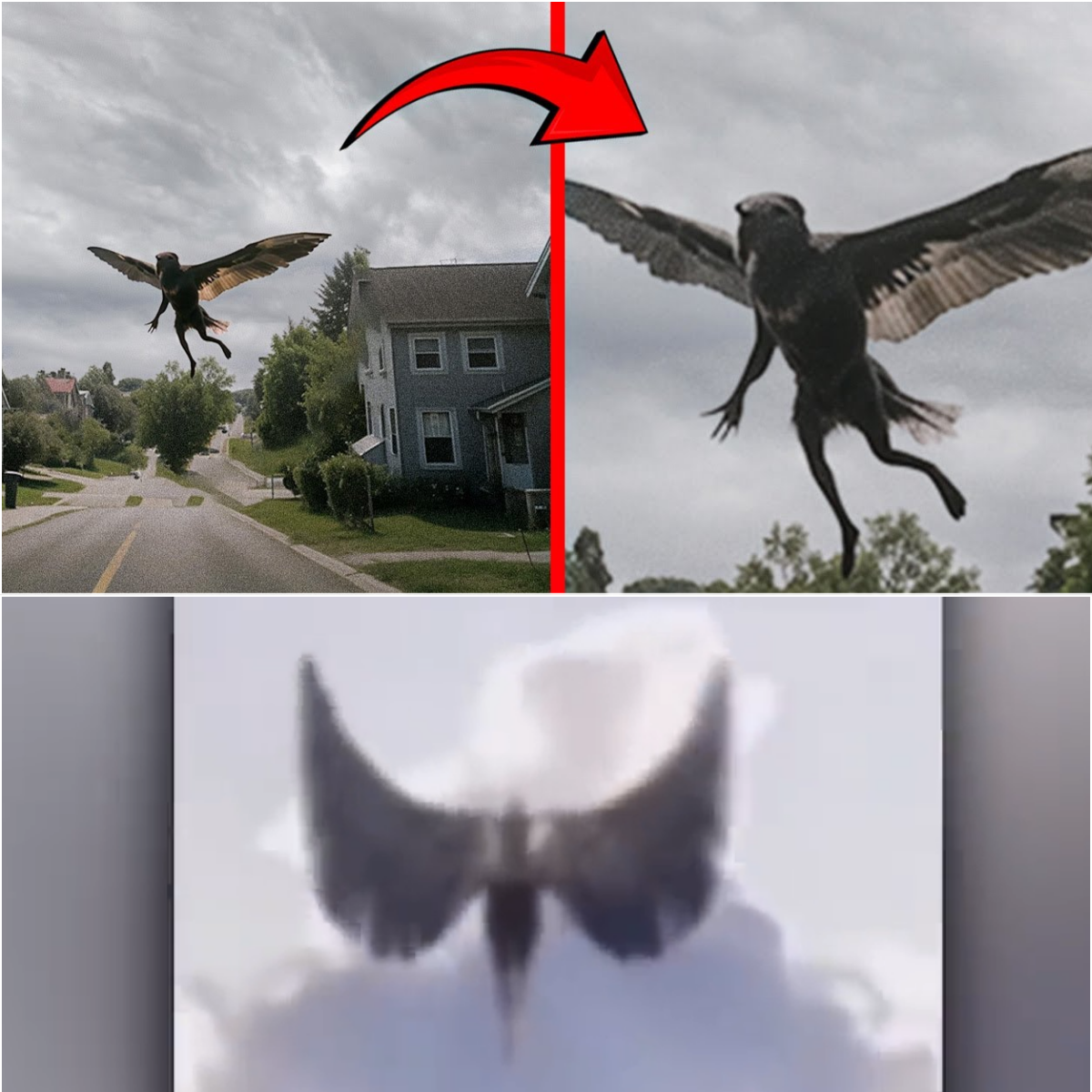
This democratization of the uncanny has fundamentally transformed the mechanics of public belief. When a video surfaces depicting a towering, six-foot humanoid figure with massive, leathery wings perched atop a telecommunications antenna in Dallas, Texas, the public reaction is instantaneous and deeply divided. Frame-by-frame analysis replaces scientific peer review. One faction of internet sleuths scrutinizes the pixels for signs of artificial motion tracking and digital compression edges, while another succumbs to a more primal psychological thrill, declaring that the creature is a modern manifestation of a classic gargoyle, an “angel of death,” or a warning of impending disaster.
What these viral occurrences exploit is a widespread cultural exhaustion with a thoroughly explained universe. In an era where satellite arrays track every weather front and commercial flight paths are mapped in real-time on consumer apps, the sudden appearance of a dark, winged entity silhouetted against an orange sunset provides a sudden, intoxicating burst of existential wonder. The network has not eradicated our desire for the miraculous or the terrifying; it has simply provided it with a more efficient distribution system, turning the vast expanse of the upper atmosphere into a localized repository for our collective anxieties.
The Bestiary of the Upper Air
As these modern accounts circulate through the digital ecosystem, they have codified a recurring cast of aerial characters—a contemporary bestiary that borrows heavily from classical demonology, cryptozoology, and science fiction. Among the most psychologically potent of these entities is the reemergence of the “Mothman” or “Jersey Devil” archetype. No longer confined to the rural backcountry of West Virginia or the dense pine barrens of New Jersey, these massive, winged humanoids are now filmed by motorists along deserted interstate highways or by urban residents watching from high-rise balconies.
The modern winged anomaly is uniquely characterized by its interaction with human infrastructure. It is seen shaking its wings on the crossbeams of electrical towers, or walking along a residential roofline on two legs like a person before unfurling its wings to vanish into the low clouds. The horror of these images stems from their proximity to the mundane. They suggest that our highly engineered environments are not as secure as we assume, and that the vertical spaces above our homes are being monitored by predatory, unclassifiable things.
Case Record: Central American Sector (Managua)
Phenomenon: High-Altitude Aggressive Hominids
Morphology: Chiropteran Wing Structure / Sub-Hominid Torso
Behavioral Pattern: Aerial Descent / Coordinated Group Agitation
This sense of territorial intrusion reaches its peak in accounts of coordinated entity encounters. In the forested trails surrounding Managua, Nicaragua, groups of tourists have documented encounters with small, brown, bat-winged creatures perched in the canopy. Unlike distant aerial anomalies, these entities are described as actively hostile, screaming and descending toward human onlookers in a manner that immediately evokes the “demonic entities” of classical folklore. By capturing these encounters on shaky, low-resolution phone cameras, creators draw on deep-seated fears of primal nature reclaiming its dominance over human intruders, turning a casual afternoon hike into an encounter with ancient, territorial guardians.
The Industrial Subversion: Rockets, Orbs, and Portals
While organic monsters satisfy our desire for a re-enchanted natural world, a separate and equally compelling category of the modern sky myth focuses on the cold, sterile vocabulary of technological transgression. The contemporary sky is no longer just home to birds and clouds; it is an industrial zone filled with orbital hardware, private satellites, and secret military testing initiatives. When these systems experience failures or re-entries, they create spectacular, alien visual phenomena that the public imagination rapidly refines into myth.
A classic example of this process is the “Skyfall Spectacle.” On a clear night, groups of amateur photographers documenting the stars capture footage of a massive, glowing cylinder moving slowly across the firmament, preceded by a brilliant, searchlight-like ball of energy that appears to actively illuminate its path. The immediate public consensus on social media almost always favors an extraterrestrial origin—a massive alien transport vessel or a structured UFO operating within Earth’s airspace.
When international aerospace experts eventually identify the object as the discarded stage of a foreign orbital rocket tumbling through the upper atmosphere, the explanation rarely dampens the viral momentum of the video. Instead, the official statement is incorporated into a broader narrative of institutional obfuscation, transforming a routine piece of space debris into a symbols of a hidden, cosmic reality.
Technical Assessment: Atmospheric Re-entry Profile
Object Classification: Non-Functional Orbital Upper Stage (Spent Fuel Mass)
Visual Anomalies: Hypergolic Venting Luminescence / Thermal Decoupling
Public Perception Matrix: Sub-Orbital Extraterrestrial Vessel / Spatial Gateway
This blur between cutting-edge technology and the supernatural is even more pronounced in encounters involving military aviators. Reports of disc-shaped crafts tracking United States Navy fighter jets over Alaska or gliding effortlessly alongside commercial airliners have migrated from the fringe pages of specialized journals directly into mainstream discourse. These accounts often feature descriptions of impossible physics: objects that change direction instantly without decelerating, activate secondary signaling devices that emit unexplained frequencies, and accelerate out of sight at thousands of miles per hour within the blink of an eye.
The psychological power of these accounts rests on the subversion of human technical dominance. When our most advanced military assets—machines designed to project total control over the skies—are depicted as completely helpless or outmaneuvered by an anonymous, hovering disc, it exposes a deep undercurrent of vulnerability in the modern consciousness.
The Surrealist Sky: From Multi-Sun Illusions to Celestial Citations
Beyond monsters and machinery, the most disorienting anomalies of the digital age are those that present the sky itself as fundamentally broken or unstable. These occurrences do not merely introduce a strange element into an ordinary scene; they distort the basic laws of physics and optics, turning the atmosphere into a giant, glitching television screen.
Consider the profound communal shock that occurred in Chengdu, China, when residents woke to find seven distinct suns arranged in a neat, horizontal line across the morning horizon. The imagery, captured from dozens of independent angles by commuters and office workers, appeared to depict a cosmic alignment straight out of apocalyptic prophecy.
While atmospheric physicists were quick to identify the phenomenon as a rare, highly complex parhelion—an optical illusion caused by the precise refraction of sunlight through ice crystals suspended in a specific layer of cloud—the local and digital reaction was overwhelmingly surrealist. Commentators spoke of a “glitch in the simulation,” a breakdown of the rendering engine of reality, or an omen of a fundamental shift in the earth’s magnetic core.
This concept of the sky as a malleable, artificial interface is further reinforced by the phenomenon of the “Giant Floating City.” Across various provinces in China and parts of the American West, videos have captured the detailed, dark silhouettes of towering modern skyscrapers rising directly out of the clouds, completely detached from the earth below. To the untrained eye, it appears as though a phantom civilization has materialized over our heads, prompting frantic debates about parallel dimensions, hidden advanced technologies, and top-secret holographic projects like Project Blue Beam.
The scientific truth—that these cities are the result of a Fata Morgana, a complex thermal inversion that bends light rays to project distant coastal infrastructure high into the humid air above—feels almost disappointingly mundane compared to the wild, multi-dimensional theories that drive the videos across the internet’s recommendation algorithms.
The Biological Inversion: Aquatic Horrors in the Air
Perhaps the most surreal development in the modern bestiary of the sky is the migration of deep-ocean archetypes into the upper atmosphere. In recent years, a distinct sub-genre of viral video has emerged depicting massive, invertebrate-like entities floating silently among the clouds, their long, fleshy tentacles waving rhythmically through the air as if swimming through a deep-sea trench.
The “Skysquid” or “Atmospheric Octopus” represents a brilliant exercise in modern visual subversion. We are evolutionary conditioned to understand that cephalopods belong in the crushing darkness of the marine abyss; seeing them transposed into the bright, open expanse of the sky triggers a profound sense of cognitive dissonance. These videos are frequently shot from moving vehicles or during crowded public events, capturing the ambient noise of onlookers screaming in confusion as a massive, dark shape with trailing appendages glides over a suburban shopping center.
While the vast majority of these encounters are eventually revealed to be highly advanced, wind-propelled artistic kites or flawlessly integrated computer-generated overlays, their viral success demonstrates a deep cultural fascination with the idea that the sky hides a secret, undiscovered ecosystem—a silent ocean of air populated by ancient, floating titans that occasionally drift low enough to be caught on a smartphone lens.
“It didn’t look like a machine,” one witness noted under a video of a dark, trailing shape over a European city. “It moved like a gown or a living shadow, waving its arms against the wind. It felt like something that had been up there for a thousand years, just watching us from behind the fog.”
This desire to find biological anomalies in the air is matched by genuine, historical anomalies that feel equally impossible. In regions across Iran and Central America, severe cyclonic storms have occasionally resulted in literal rains of live fish, showering inland towns with thousands of flopping aquatic organisms.
While meteorologists offer a clear, mechanical explanation—powerful water spouts tracking over lakes or shallow seas, vacuuming up surface wildlife and carrying it miles inland before dropping it with the rain—the physical reality of a fish falling from a cloud remains a powerful catalyst for myth. It bridges the gap between scientific fact and biblical plague, reminding the modern observer that the boundary between the earth, the sea, and the sky is far more fluid than our orderly maps suggest.
The Psychology of the Glitch
What ultimately unites the dragon-seers, the UFO enthusiasts, and the digital forensic investigators is a shared obsession with the concept of the “glitch.” In a society thoroughly saturated by digital experiences, video games, and virtual realities, we have begun to view the physical world through the lens of software architecture. If a program can freeze, stutter, or render an object incorrectly, then perhaps reality itself can experience a systemic error.
This mindset found its ultimate expression in the viral phenomenon of the “Frozen Pigeon.” Filmed on a busy city street, the video showed a common street pigeon suspended motionless in mid-air, several feet above the pavement, its wings partially spread as if caught in a permanent state of mid-flight pause. The footage showed onlookers gathering around the bird, poking at it with long rescue poles, only for the creature to remain completely fixed in space, defying gravity without any visible wires or physical support.
[System Error Log: Physical Environment]
Subject: Columbidae (Standard Urban Variant)
Status: Spatial Coherence Stutter / Motion Frame Arrest
Vector: Gravity Defiance / Null-Velocity Suspension
The video achieved international notoriety because it perfectly embodied the “simulation theory” that has captured the contemporary imagination. It was treated not as a biological mystery, but as a hardware error—a moment where the physics engine of our universe failed to process the movement of a bird, leaving its assets floating in space.
The subsequent revelation that the bird had likely become entangled in a nearly invisible, high-tensile nylon fishing line caught between two distant utility lines did little to erase the psychological impact of the image. The idea that reality can break, that the sky can freeze, or that a monster can slip through a tear in the digital rendering remains one of the most persistent and comforting subversions of the modern age.
The Sky as a Living Mirror
Ultimately, the frantic catalog of things seen in the sky is not a reflection of what is happening in the stratosphere, but what is happening on the ground. The monsters, the portals, the multiple suns, and the metallic discs are the complex, beautiful, and terrifying artifacts of a civilization that has conquered the physical world but lost its sense of the sacred. By packing the sky with demons, angels, dragons, and aliens, we are attempting to rebuild the ancient architecture of mystery that our own technologies have systematically dismantled.
Our smartphones have become the modern crucible for this transformation. They are no longer mere recording devices; they are active participants in the creation of a new global folklore. Every filter, every compression artifact, every shaky zoom, and every clever CGI overlay contributes to a collective re-enchantment of the horizon.
As we continue to navigate an uncertain future defined by technological acceleration, institutional decay, and environmental crisis, we will undoubtedly continue to look upward. And as long as we do, the sky will continue to mirror our deepest fears and our highest hopes, throwing back at us exactly the kind of monsters we need to believe that the world is still a place of wonder, terror, and untamed possibility.