Joe’s Special Forces Guest Saw a Giant in Afghanistan…and it Gets Disturbing
Joe’s Special Forces Guest Saw a Giant in Afghanistan…and it Gets Disturbing
When professional arm wrestler and former Canadian Special Forces soldier Devon Larratt sat across from Joe Rogan recently, the conversation drifted into territory usually reserved for Sunday school or late-night conspiracy forums. Larratt casually recounted seeing an eight-foot-tall warlord in a remote Afghan valley—a man so massive that Larratt’s own six-foot-five military frame only reached the man’s chest. For millions of viewers, what followed was more than just typical podcast banter; it was a spark that reignited an ancient, subterranean American fascination with the supernatural, the biblical, and the unexplained.
The Giant of Kandahar and the Podcast Pulpit
The Joe Rogan Experience has long functioned as a town square for the modern American psyche, a place where fringe theories and lived experiences collide without the filter of mainstream editorial gatekeeping. But Larratt’s appearance tapped into a specific, potent cultural current: the “Kandahar Giant.”
For years, an urban legend has circulated through military barracks and internet forums detailing a classified 2002 operation in Afghanistan. The story goes that a U.S. Army squad went missing in the rugged mountains of Kandahar. A rescue unit sent to locate them tracked their gear to a massive cave littered with discarded military equipment. There, they allegedly faced a thirteen-foot-tall, red-haired giant with six fingers on each hand and two rows of teeth, which pierced a soldier with a spear before being brought down by an intense barrage of automatic gunfire.
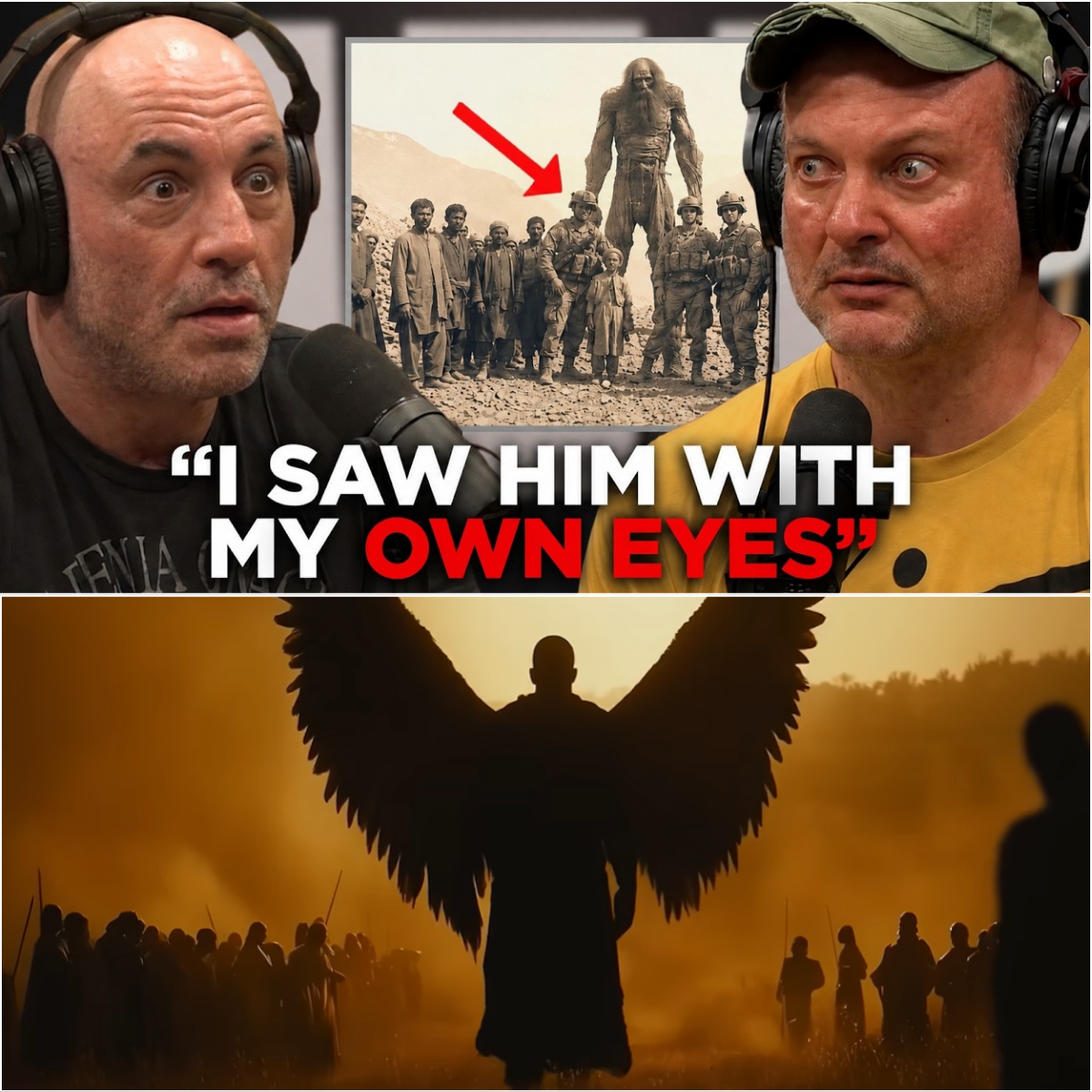
While Larratt didn’t claim to have fought that mythical beast, his eyewitness account of a real-world, eight-foot-tall Afghan leader lent a sudden, tangible weight to the folklore.
“There are anomalies,” Larratt told a visibly captivated Rogan. “There are big people out there, and people don’t know about them.”
For a growing segment of the American public, this wasn’t just a biological anomaly or a tale of extreme genetics. It was a modern confirmation of Genesis 6:4: “There were giants in the earth in those days.”
From Cryptozoology to Theology
The viral explosion of the episode highlights a profound shift in how a secularized public interacts with faith. For decades, traditional religious institutions in the West have faced declining attendance, with younger generations identifying increasingly as “spiritual but not religious.” Yet, the appetite for the transcendent hasn’t disappeared; it has merely migrated.
When content creators and commentators analyzed the Rogan transcript, they didn’t view it through the lens of evolutionary biology or wartime stress. Instead, they saw a direct line connecting the mountains of the Hindu Kush to the text of the Old Testament.
To these observers, the “Kandahar Giant” is synonymous with the Nephilim—the mysterious offspring of the “sons of God” and the “daughters of men” mentioned in scripture. The logic driving the viral commentary is straightforward: if giants are real, then the Bible is historically accurate. If the Bible is accurate, then the spiritual warfare it describes is actively unfolding around us.
This phenomenon represents a new kind of digital apologetics. Rather than using theological arguments or historical analysis to prove the validity of faith, internet commentators are using military anomalies, fringe history, and podcast transcripts to build a bridge back to the gospel.
The Return of the Demonic
If the discussion of an eight-foot warlord pushed the conversation to the edge of conventional reality, Larratt’s second anecdote pushed it entirely over the precipice. He described an incident involving a close comrade during a deployment in Erbil, Iraq—an ancient region deeply rooted in biblical geography.
According to Larratt, the soldier underwent a sudden, terrifying transformation that defied medical explanation. The man allegedly began speaking in languages he had never learned, demonstrating an intimate, supernatural knowledge of the private sins and childhood secrets of everyone in the unit. The military medical system was reportedly bypassed in favor of a chaplain, who performed an exorcism.
“The crazy thing was,” Larratt remarked, “the priest who did the exorcism said he knew the demon. He’d already done the exorcism like three or four times on different people.”
In the digital aftermath of the episode, this segment was seized upon with even greater urgency than the giant lore. Commentators framed it as a stark warning to a culture that has largely dismissed the concept of personified evil. The prevailing sentiment among Christian creators reacting to the clip was summarized by a famous literary sentiment: the devil’s greatest trick was convincing the world he didn’t exist.
By bringing accounts of demonic possession into a secular, mainstream arena like Rogan’s studio, the conversation forced listeners to confront a worldview that modern secularism has spent centuries trying to dismantle.
A Cultural Alarm Clock
The intense reaction to this single podcast episode underscores a broader cultural anxiety. We live in an era characterized by institutional distrust, rapidly shifting moral landscapes, and a pervasive sense of instability. In this environment, the ancient and the unchangeable possess a unique allure.
For the creators slicing these podcast clips into short-form videos, the message is intensely evangelical and urgent. They view these stories not as mere entertainment, but as signs of the times. Drawing parallels to Matthew 24, where Jesus warns that the days preceding his return will mirror the “days of Noah”—an era defined by both spiritual apathy and the presence of the Nephilim—they are using the podcast to sound a spiritual alarm.
The narrative shifts from a fascinating piece of military lore to a cosmic ultimatum. The commentary accompanying the viral clips routinely challenges viewers to look past the distractions of modern life, to abandon superficial religion, and to prepare for a literal, final judgment.
The Appeal of the Unfiltered Truth
Why does a story told by an arm wrestler on a podcast carry more theological weight for millions of people than a traditional sermon? The answer lies in the perceived authenticity of the source.
Larratt is not a theologian trying to convert an audience, nor is he a politician managing an image. He is a veteran sharing what he saw, admitting his own confusion, and stating plainly, “I don’t know what to tell you, Joe. There’s a lot I don’t know.”
This raw, unvarnished delivery resonates deeply with an audience that feels constantly managed, spun, and lectured to by elite institutions. When Larratt admits that these experiences scared his friend and shocked him, it feels authentic. And in the economy of the modern internet, authenticity is the ultimate currency.
When Rogan—a notorious skeptic who has spent years questioning mainstream narratives—sits in rapt attention, it gives the audience permission to wonder. It creates a space where the supernatural is no longer a punchline, but a possibility.
Conclusion: The Persistent Supernatural
Ultimately, the cultural ripples of this conversation reveal that humanity’s hunger for the supernatural cannot be permanently suppressed by technology or secularism. The more the modern world insists that existence is purely material, the more aggressively the human psyche looks for cracks in that narrative.
Whether the Kandahar Giant is a campfire story passed down by bored soldiers or a lingering remnant of an ancient biblical lineage, its power over the American imagination is undeniable. By broadcasting these stories to tens of millions of listeners, the digital landscape hasn’t just created a viral moment; it has unlocked an ancient doorway, reminding a modern audience that there may be far more things in heaven and earth than are dreamt of in their philosophy.