Ancient Discoveries Experts Can’t Explain…15 of Them
Ancient Discoveries Experts Can’t Explain…15 of Them
BOSTON — We are accustomed to thinking of the past as a puzzle with a finite number of pieces, a grand historical mosaic that can be neatly assembled if given enough time, patience, and funding. In our modern, high-tech imagination, the dirt of the earth is a storage drive waiting to be read, and the tools of contemporary archaeology—ground-penetrating radar, satellite imaging, and carbon-14 accelerator mass spectrometry—are the ultimate decryption keys. We tell ourselves that it is only a matter of time before the silent monuments of antiquity yield their secrets to the relentless march of human intellect.
Yet, scattered across the globe are anomalous discoveries that flatly reject this narrative of linear progress. These are the artifacts, ruins, and rock carvings that do not expand our understanding of history, but rather fracture it, exposing the deep boundaries of our collective ignorance. From the subterranean labyrinth of Derinkuyu to the weathered contours of the Saint-Bélec slab, certain ancient creations seem purposefully designed to resist the modern mind. They stand as silent provocations, reminding an ultra-connected, data-saturated society that our ancestors possessed motivations, technologies, and spiritual worldviews that may be entirely lost to us. When we look at these relics, we are not looking at a mirror of our own developmental path; we are staring into an intellectual abyss where the standard timeline of human civilization begins to fray.
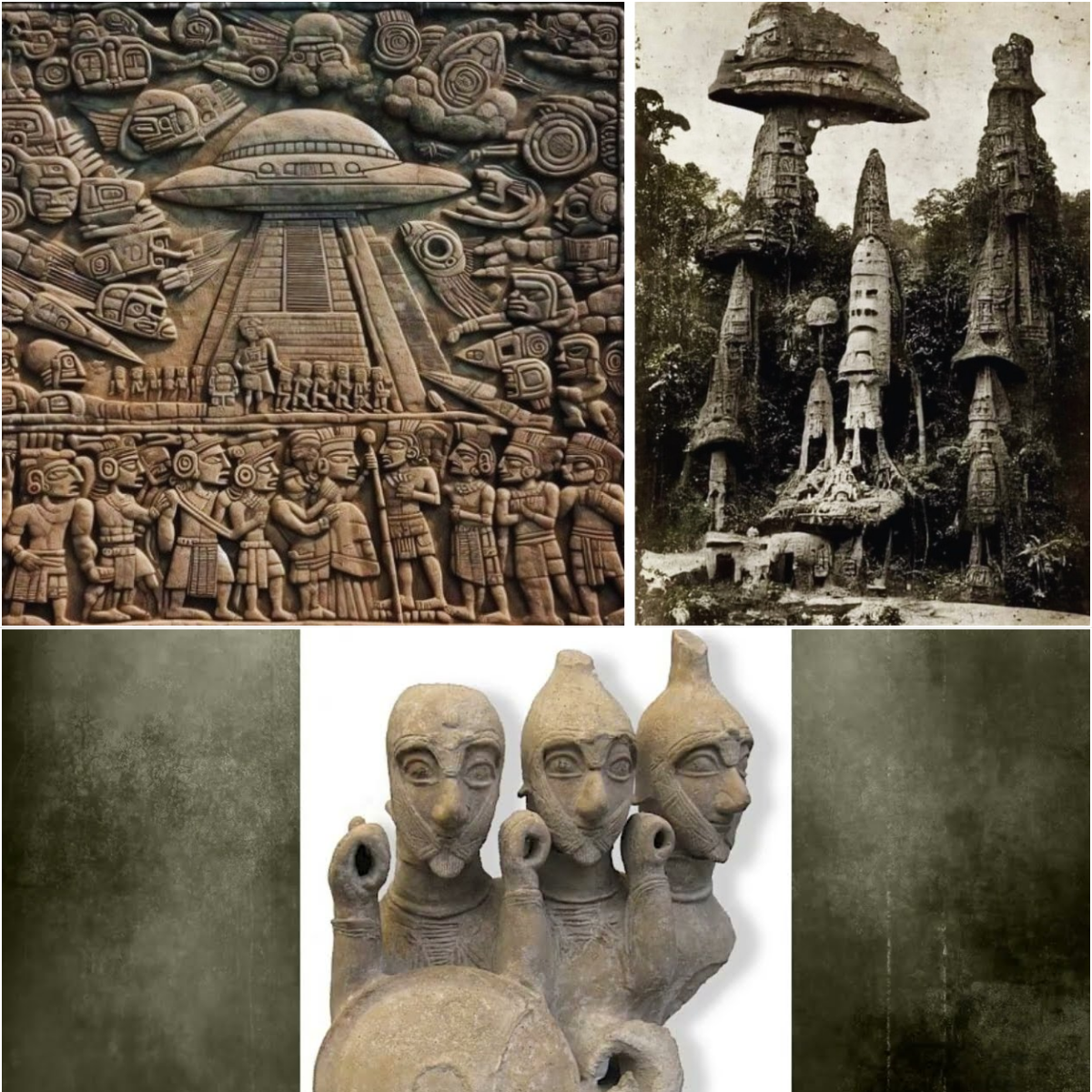
The Astronauts of Val Camonica: The Limits of Perception
High in the alpine valleys of northern Italy, where the sheer rock faces of Lombardy have been polished smooth by prehistoric glaciers, lies Val Camonica. This narrow valley holds one of the largest collections of prehistoric rock art in the world, a vast stone library containing over 300,000 individual petroglyphs carved over a span of roughly 10,000 years. For the most part, the valley tells a deeply human story: it is a visual record of an emerging European consciousness, depicted through scenes of ritualistic stag hunts, bronze-age battles, agricultural labor, and geometric symbols of tribal ownership.
But hidden among this sweeping narrative of pastoral life are a few figures that seem violently out of place. Carved into the iron-rich sandstone during the Iron Age are two humanoids that have spent the last half-century at the center of an intense cultural custody battle. The figures stand side by side, their bodies rendered in blocky, primitive strokes, but their heads are completely enclosed by large, perfect circles from which thin, radiant lines protrude. To the modern eye, conditioned by decades of science fiction and space exploration imagery, the visual deduction is instantaneous: they look exactly like two astronauts clad in pressurized suits and bubble helmets, holding strange, unidentifiable instruments.
"The human brain is an advanced pattern-recognition machine," notes a prominent European cultural anthropologist. "When it encounters an ambiguous ancient image, it automatically populates the blank space with contemporary iconography. We see an astronaut because that is the most technologically complex suit we can conceptualize."
In the mid-20th century, these carvings became foundational proof-texts for the “ancient astronaut” hypothesis, a fringe literary movement that sought to explain the rapid technological leaps of early humanity through the intervention of extraterrestrial visitors. Mainstream archaeologists have spent decades trying to reclaim the Val Camonica figures from this pop-cultural hijacking, arguing that the “helmets” are actually crude depictions of halos, ceremonial headdresses, or the glowing aura of local protective deities.
Yet, the professional frustration remains. The orthodox explanation, while rational, cannot completely erase the unsettling specificity of the image. The artists of Val Camonica left no explanatory text, no glossary of symbols. We are left with a fundamental epistemic divide: did our ancient ancestors carve what they imagined—a spiritual reality we can no longer feel—or did they carve precisely what they saw, leaving behind a literal record that our modern historical framework is simply not equipped to accept?
The Ghost of the Fourteenth Century: Giovanni Dondi’s Astrological Clock
The mystery of ancient ingenuity is not confined to the prehistoric era. Sometimes, the most frustrating anomalies emerge from periods we believe we understand intimately, such as the late Middle Ages. In 1348, a physician and astronomer named Giovanni Dondi dell’Orologio began work in Padua on a machine that would consume sixteen years of his life. He called it the Astrarium, and when it was completed, it was arguably the most complex mechanical device created by human hands since the fall of the Roman Empire.
The Astrarium was not a clock in the modern sense; it was a mechanical model of the universe as understood through the geocentric Ptolemaic system. Constructed primarily of brass and bronze, this seven-sided masterpiece featured a bewildering array of interlocking gear trains that tracked, with flawless mathematical precision, the daily and annual movements of the sun, the moon, and the five planets then visible to the naked eye. It calculated the solar equations, predicted eclipses, and automatically accounted for the shifting dates of movable Christian feasts.
What perplexes modern horologists and historians is the sheer, anomalous sophistication of Dondi’s engineering. The Astrarium utilized complex elliptical gears and intricate internal differentials centuries before these concepts were officially integrated into the lexicon of Western industrial engineering. More astonishingly, the entire multi-layered mechanism was assembled without a single screw—every gear, lever, and weight was held in place by handcrafted wedges, pins, and custom joints.
The original machine vanished into the fog of war and political upheaval sometime in the late 15th century, leaving behind only Dondi’s meticulously illustrated manuscripts. When modern engineers attempted to build functional replicas using only the tools and metallurgical techniques available in the 1300s, they were met with a humbling reality. The machine required a level of mathematical intuition and manufacturing tolerance that historians had long assumed was utterly impossible for the medieval mind. The Astrarium proves that technological progress is not a smooth, ascending line; it is a landscape of forgotten peaks, where solitary geniuses can construct machines that sit centuries ahead of their time, only to be buried by history and forgotten by the generations that follow.
El Castillo: Who Owns the Birth of Art?
Deep within the limestone heart of northern Spain, the cave of El Castillo contains a chamber known as the Gallery of Hands. Here, cast in brilliant shades of red ochre, are dozens of negative hand stencils—images created by placing a human hand flat against the rock and blowing pulverized pigment over it through a hollow reed or bone. For generations of art historians, this chamber was revered as the cradle of human artistic expression, the place where Homo sapiens first learned to externalize their internal consciousness and say, “I am here.”
That comfortable narrative collapsed in 2012, when researchers utilized advanced uranium-thorium dating techniques to analyze the thin layers of calcite that had formed over the pigment. The results were a severe blow to traditional paleoanthropology: one of the abstract red disks in the cave was determined to be at least 40,800 years old, making it the oldest known cave art in Europe.
The problem with this date is one of demographic timing. According to the current archaeological consensus, anatomically modern humans were only just beginning to migrate into northern Spain around 40,000 years ago, living in sparse, nomadic groups that left minimal cultural footprints. The established inhabitants of the region at that time were Neanderthals—a hominid species that had long been caricatured in the public and scientific imagination as lumbering, brutish, and incapable of symbolic thought or abstract language.
If the El Castillo paintings predate the arrival of Homo sapiens, then the conclusion is inescapable: Neanderthals were the world’s first artists. This possibility forces a radical re-evaluation of what it means to be human. If creativity, symbolic expression, and the impulse to leave a permanent mark on the world were not unique to our species, then the intellectual gap between us and our extinct cousins narrows to a razor’s edge. The red stencils of El Castillo are no longer just beautiful relics of the Ice Age; they are a profound genealogical riddle, asking us who we really are and what, if anything, makes Homo sapiens unique among the creatures of the earth.
The Skeletons of Mohenjo-Daro: The Silent Catastrophe
In 1922, archaeologists working in the arid plains of Pakistan’s Indus Valley unearthed Mohenjo-Daro, a sprawling bronze-age metropolis that turned our understanding of ancient urban planning upside down. Built around 2500 BC, Mohenjo-Daro was a marvel of civic engineering. Its streets were laid out in a rigid, sophisticated grid system; its houses were constructed from standardized baked bricks and featured internal plumbing; and its public sanitation system, complete with covered brick drains and public baths, was vastly superior to anything found in contemporary Egypt or Mesopotamia.
Yet, for all its architectural brilliance, Mohenjo-Daro holds a dark, unresolved secret. In the upper layers of the excavation, scattered across public avenues and inside ordinary dwellings, researchers found roughly forty human skeletons. These were not the occupants of a formal cemetery or the casualties of a organized military siege. The positions of the bones suggested an event of sudden, overwhelming terror.
"Some were found face down in the dirt, others were holding hands as if bracing for an impact," wrote an early British excavator. "They died exactly where they fell, left unburied in the streets of a city that was suddenly abandoned by its remaining population."
For a century, historians have debated what killed the people of Mohenjo-Daro. Early theories blamed an invasion by nomadic Aryan tribes, but subsequent skeletal examinations revealed no signs of trauma caused by weapons of war. Others suggested a catastrophic flood or a sudden epidemic, but these explanations fail to account for why the bodies were left to rot in the open air of a highly organized, hygienic society.
The lack of clarity has allowed alternative, hyper-radical hypotheses to take root in the public imagination. In the 1970s, popular alternative historians pointed to controversial reports of high radiation levels in the soil and the apparent vitrification—the melting of stone into glass—of certain brick structures, suggesting a prehistoric nuclear event or an atmospheric explosion akin to the Tunguska event. While mainstream science has thoroughly debunked these claims as pseudoscience born of flawed data, the academic community has yet to provide a consensus answer. The skeletons of Mohenjo-Daro remain fixed in their final, agonized postures, a silent testament to a civilization that achieved the pinnacle of ancient urbanity only to vanish into the night for reasons we still cannot name.
The Great Pyramid of Cholula: The Mountain That Wasn’t
If you were to stand in the center of the Mexican city of Puebla and look toward the horizon, your eyes would naturally rest on a massive, verdant hill rising out of the valley floor, its summit crowned by the elegant, yellow spires of the Church of Our Lady of Remedies. To the untrained eye, it is an idyllic scene of Spanish colonial triumph over a rugged Mesoamerican landscape. But beneath the grass, trees, and colonial brickwork lies the largest monument ever constructed by human hands anywhere on Earth.
This is Tlachihualtepetl—the Great Pyramid of Cholula. With a base that covers nearly forty-five acres and a total volume estimated at over 4.45 million cubic meters, it is nearly twice the size of the Great Pyramid of Giza. Yet, when Hernán Cortés and his conquistadors marched into Cholula in 1519, carrying out a brutal massacre of the local population, they completely missed it. The pyramid had been abandoned for so long that nature had totally reclaimed its stepped terraces, disguising the colossal mud-brick structure as a natural landform.
The mystery of Cholula is not just its size, but its structural evolution. Unlike the pyramids of Egypt, which were built in concentrated bursts of imperial ambition, Cholula was constructed incrementally over a period of a thousand years, beginning around the 3rd century BC. Six distinct cultures layered new pyramids directly over the work of their predecessors, creating an architectural onion that contains miles of labyrinthine internal tunnels.
Archaeologists have spent decades mapping these tunnels, but the deeper they go, the more the purpose of the monument blurs. Why did successive civilizations feel compelled to bury the sacred spaces of their ancestors under millions of tons of new earth, rather than building separate monuments? Local indigenous mythology attributes the construction to Xelhua, a mythical giant who survived a primordial flood and sought to build a tower that would storm the heavens. While science rejects the giants, it has yet to fully explain the socio-economic engine that could sustain a single, continuous construction project across a millennium of political upheaval and cultural collapse. Cholula remains an invisible mountain, a monument so vast that its true scale can only be comprehended through the instruments of modern science.
The Saint-Bélec Slab: Cartography in the Dark
In 1900, an antiquarian named Paul du Châtellier excavated a Bronze Age burial mound in western Brittany, France. Inside, forming one of the walls of a stone cist, he found a massive, broken slab of schist measuring nearly twelve feet in length. The stone was covered in a dense, chaotic network of circular cup marks, intersecting lines, and geometric hollows. Confused by the markings, du Châtellier moved the several-ton slab to his private château, where it was eventually packed into crates and forgotten in a dusty cellar for more than a century.
In 2014, researchers pulled the Saint-Bélec slab out of storage and subjected its weathered surface to high-resolution 3D digital scanning. When they analyzed the topography of the carvings, the chaos dissolved into an image of astonishing sophistication. The lines and hollows were not random decorations; they were a highly accurate, three-dimensional representation of the Odet River Valley and the surrounding hills of Brittany.
"The slab corresponds to an area of land roughly 18 miles long and 13 miles wide, achieving an 80 percent accuracy rate when overlaid with modern topographical maps," reported the French National Institute for Preventive Archaeological Research. "It is, without question, the oldest known map ever discovered in Europe, dating back to between 2150 and 1600 BC."
The discovery of the Saint-Bélec slab has completely upended our understanding of prehistoric cartography. It proves that Bronze Age Europeans possessed a sophisticated understanding of spatial relationships, scale, and geographic abstraction long before the arrival of literacy or formal geometry.
But the map leaves behind a deeper, darker mystery. Why was this invaluable administrative or sacred document—a map that likely represented the territorial boundaries of a powerful prehistoric kingdom—deliberately broken, defaced, and used as cheap building material for an ordinary grave? The breaking of the stone hints at a violent political transition, a forgotten revolution where an ancient regime was overthrown, and its most sacred symbol of geographic dominance was shattered and buried in the dirt to signify that their map of the world had come to an end.
The Monoliths of Gornaya Shoria: Nature’s Mimicry or Lost Engineering?
Deep within the remote, snow-bound wilderness of southern Siberia, the mountains of Gornaya Shoria hold a geological phenomenon that has pushed the boundaries of scientific debate to its absolute limit. Discovered by researchers who managed to penetrate the dense taiga, the site features a colossal wall of granite blocks piled on top of one another to heights exceeding one hundred feet.
The scale of these stones is staggering. Many of the individual rectangular blocks are estimated to weigh over three thousand tons—making them significantly larger than the megaliths found at Baalbek in Lebanon or the stones of Stonehenge. What makes Gornaya Shoria so disturbing to the eye is the sheer geometric precision of the formation. The blocks feature perfectly flat surfaces, razor-sharp 90-degree corners, and horizontal joints so tight that a knife blade cannot be inserted between them.
The official stance of the international geological community is unyielding: Gornaya Shoria is an entirely natural formation. Geologists argue that the wall is the result of tectonic forces, deep-crustal pressure, and a process known as orthogonal jointing—a phenomenon where certain types of granite naturally fracture along clean, vertical and horizontal planes as they cool and uplift over millions of years. The wind and frost of the Siberian winter did the rest, scouring the joints to create the illusion of a man-made wall.
Yet, for many engineers and independent researchers, this natural explanation strains credulity. The uniformity of the blocks, the appearance of what some claim to be drilled structural holes, and the way the wall appears to follow a strategic ridge line have fueled persistent theories of an unknown, pre-glacial civilization capable of moving mountains. If it is natural, Gornaya Shoria represents one of the most astonishing examples of nature mimicking human architecture on Earth. If it is artificial, it shatters every established model of human prehistory, pushing the origins of megalithic engineering back into an epoch that modern science considers an age of unformed hunter-gatherers.
The Riddle of Dighton Rock: The Stone of Many Stories
On the banks of the Taunton River in Berkley, Massachusetts, sits an eleven-ton boulder that has been driving historians, linguists, and amateur sleuths to the brink of madness for over three centuries. Known as Dighton Rock, this inclined, wedge-shaped block of sandstone is covered on one face with a dense, confusing tapestry of petroglyphs—lines, geometric shapes, schematic human figures, and what appear to be letters from an unknown alphabet.
The markings were first recorded by English colonists in 1680, and in the centuries since, Dighton Rock has become a blank canvas for the competing anxieties and romantic fantasies of American historiography. Over thirty distinct theories have been published by serious scholars, each claiming to have finally cracked the code of the stone.
The Indigenous Hypothesis: Early scholars argued that the markings were the work of local Algonquian tribes, recording a significant battle or a spiritual encounter with the river spirits.
The Nordic Claim: In the 19th century, Danish researchers declared that the inscriptions were runic, carved by Thorfinn Karlsefni in the 11th century during a forgotten Viking expedition to the New England coast.
The Portuguese Connection: In 1918, a psychology professor from Brown University published a massive study claiming the rock bore the coat of arms of Portugal and the name of Miguel Corte-Real, a Portuguese explorer who vanished in the Atlantic in 1502.
The Phoenician and Chinese Theories: Other writers have claimed to find Phoenician script, Libyan characters, and ancient Chinese ideograms within the stone’s chaotic geometry.
The tragic comedy of Dighton Rock is that every new, sophisticated analysis solves one aspect of the inscription only to render the rest of it completely nonsensical. The markings have been so severely weathered by three hundred years of tidal action and repeated attempts to cast or clean the stone that the original intent of the lines has been permanently blurred.
In 1963, the rock was removed from the river and placed inside a climate-controlled museum to protect it from further degradation. It sits there today beneath harsh gallery lights, an silent monument to human subjectivity. It is an artifact that refuses to speak, choosing instead to mirror back whatever historical obsession the observer brings to its surface.
The Landscape of the Unresolved
To study the mysteries of Val Camonica, Mohenjo-Daro, or the Saint-Bélec slab is to be cured of our modern cultural arrogance. We live in an era that equates data collection with understanding, assuming that because we can scan a stone with a laser or date a pigment with an isotope, we have captured the soul of the people who created it.
These ancient anomalies prove that the past is not a simple problem to be solved by the next software update. They are reminders that human history is a vast, shadowed forest where entire chapters of human creativity, engineering, and spiritual experience have been lost to the wind. The creators of these artifacts did not build them to satisfy our modern curiosity or fit neatly into our academic textbooks. They worked for their own gods, their own kings, and their own survival, operating within realities we can now only glimpse through a glass, darkly.
As we continue to dig, scan, and debate, these enigmatic discoveries serve a vital purpose. They preserve a sense of wonder in a world that often feels completely mapped and quantified. They remind us that the earth beneath our feet is still crowded with ghosts, and that the greatest triumphs of our ancient ancestors may be the ones that continue to elude our grasp, resting silently in the dirt, keeping their secrets for another thousand years.