What Mary COOKED for Jesus Every Day: Biblical Rec…
When Jesus was a boy, she absolutely did. She baked his bread. She made his stew.
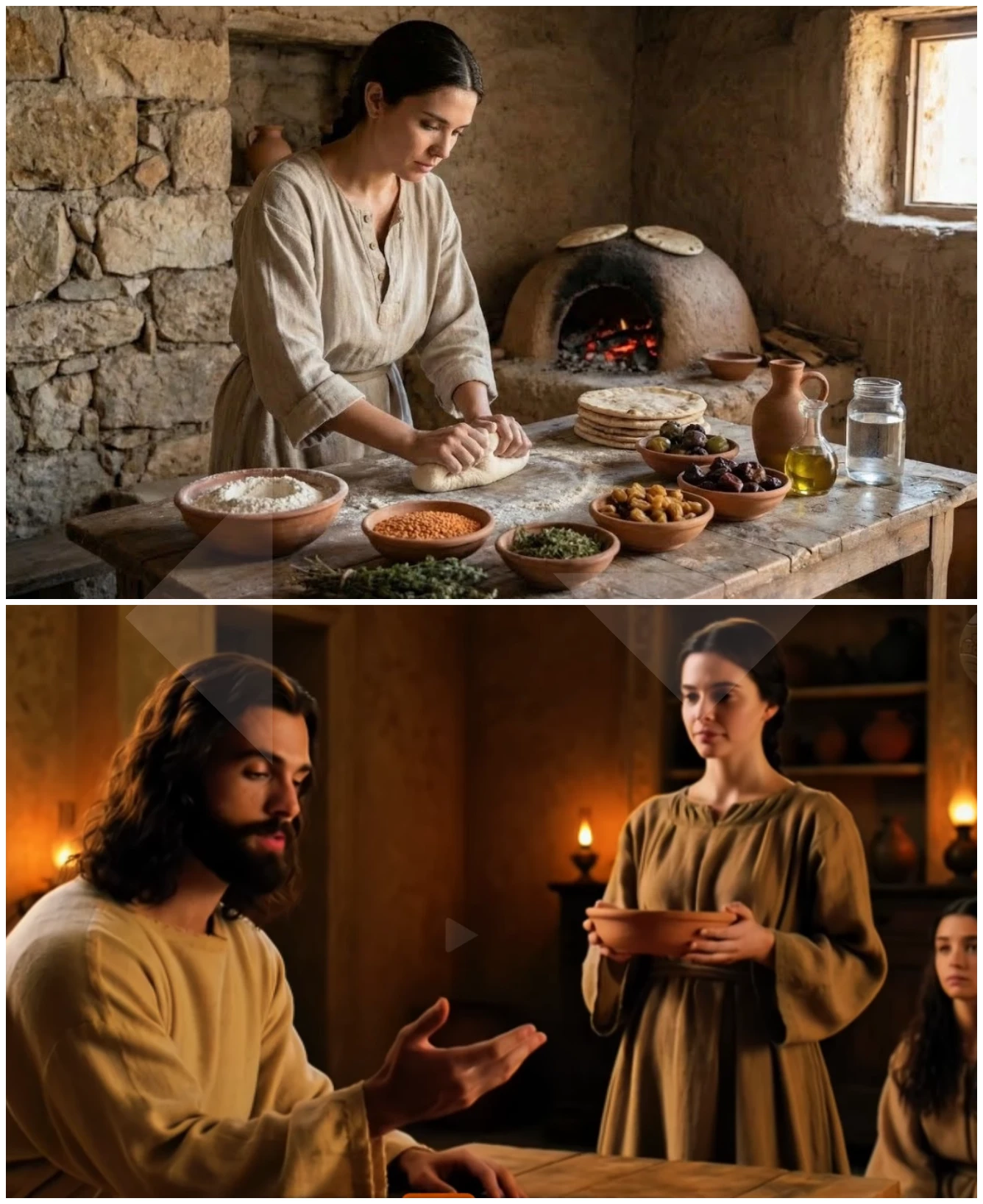
She was the one grinding grain every single morning before the sun came up. But during his ministry, those three years when Jesus was traveling, teaching, healing, the woman who actually cooked for him most often wasn’t his mother.
It was a woman named Martha. Martha of Bethany, sister of Mary and Lazarus. Luke 10 38-42 makes it very clear.
Martha opened her home. Martha served. Martha prepared the meals. Her sister Mary sat at Jesus’s feet and listened.
Martha cooked. So when I say Mary in this story, I really mean Martha. She’s the one and she deserves the credit.
Now let’s talk about what she actually made. Every single day started with bread. Not sometimes, not most days, every day.
Bread wasn’t a side dish in first century Palestine. It was the meal. The Hebrew word for bread, lehem, literally meant food.
If you said, “Let’s eat bread,” you were saying, “Let’s eat.” Period. Scholars estimate bread made up somewhere between 50 and 70% of a person’s daily calories.
Everything else, the stew, the olives, the cheese, those were accompaniments. Bread was the foundation.
And making that bread was a woman’s first task every morning. Before dawn, Martha would kneel on the stone floor of her kitchen and reach into a large clay storage jar filled with barley grain.
Barley, not wheat. Wheat was expensive, the grain of the wealthy. Barley was coarser, denser, cheaper.
It was the bread of the working class. And even though Martha’s family had money, we know this because later in John 12, her sister Mary anoints Jesus with a pound of pure nard worth an entire year’s wages.
Even wealthy households kept barley on hand. It was practical. It was filling. It was what everyone knew.
She’d scoop the grain into a stone mortar, a heavy basalt bowl worn smooth from years of daily use.
And she’d grind slowly, methodically, the pestl, cracking the hard kernels open, twisting, pressing, crushing them into a rough flour, not fine like modern flour.
Coarse, textured. You could still feel bits of husk between your fingers. This took 20, 30 minutes of steady work every morning.
No shortcuts, no machines. Once the flour was ready, she’d pour it into a wide clay bowl, push a well into the center, and tear in pieces of yesterday’s dough, the sourdough starter, the leaven.
There was no packaged yeast. You saved a lump of dough from the day before.
Let it ferment overnight and used it to make the next batch rise. Then water drawn from the village well at dawn.
Then a small pour of olive oil, thick golden green, pressed from the trees just outside the village.
She’d knead the dough with the heels of her palms, pressing forward, folding back, pressing again 5, 7, 10 minutes until it was smooth and elastic.
Then she’d cover it with a cloth and let it rise for about an hour.
While the dough rested, she’d light the taboon, a dome-shaped clay oven in the courtyard about 2 and 1/2 ft wide, lined inside with smooth, flat pebbles.
The fuel wasn’t wood. Wood was scarce. She used dried animal dung, goat, cattle mixed with straw and small twigs.
It sounds rough, but dried dung burns slowly, evenly, and produces steady, reliable heat. She’d strike a flint, catch a spark on the straw, blow gently until the flame spread, then seal the oven with a clay lid, and let it heat for 30 or 40 minutes until the stones inside were white hot.
When the dough had doubled, she’d tear it into five or six pieces, flatten each one into a rough circle about 7 or 8 in across, press dimples into the surface with her fingertips to keep it flat, and lay each round directly onto the scorching pebbles inside the oven.
The dough would sizzle on contact, two or 3 minutes per side. The bottom would take the shape of the pebbles, bumpy, cratered, golden brown.
She’d pull each flatbread out with her bare fingers, quick and practiced, and stack them under a cloth to stay warm and soft.
That was breakfast. That was lunch. That was the base of dinner. Bread. Bread. Bread.
Now, breakfast itself was light. Almost nothing. A piece of that fresh bread may be torn and dipped in olive oil.
A few olives dark, wrinkled, cured in salt brine for weeks. Maybe a fig or two pulled straight from the tree in the courtyard.
Figs were everywhere in ancient Palestine. In Matthew 21, Jesus himself walks up to a fig tree looking for a quick bite.
That’s how normal it was. You just grabbed one as you passed by. Sometimes breakfast included a handful of parched grain, roasted barley or wheat kernels, crunchy, nutty, easy to carry.
Ruth ate parched grain for her midday meal in Ruth 2:14. David’s father, Jesse, sent parched grain to his sons in the army.
It was the ancient equivalent of trail mix. Quick energy, no preparation needed. If there was cheese, it was soft, white, crumbly, made from goats milk that had been curdled with a bit of dried animal stomach.
The curds pressed into cloth and hung to drain, similar to what we’d call labna today.
Tangy, cool, spread on bread or eaten in small bites alongside the olives. And that was it.
You ate quickly, you got moving. The day was long, and the work was hard.
Midday was barely a meal at all, more of a pause. You didn’t sit down.
You didn’t cook. You ate what you had on you. Bread from the morning, maybe wrapped in a cloth and tucked into a pouch.
Some olives, dried figs or dates, a handful of almonds or pistachios if you had them.
Maybe a piece of cheese. You dipped the bread in vinegar wine. A cheap sour drink that was part refreshment, part condiment.
Ruth did exactly this in the book of Ruth. Bread dipped in vinegar at the edge of the harvest field.
For Jesus and his disciples, walking from village to village under the Galilean sun, this midday snack was probably all they had until evening.
12 men, sometimes more, moving through the countryside. They’d pluck raw grain from the fields as they walked.
Luke 6:1 tells us the disciples did exactly that, rubbing the heads of grain between their palms and eating the kernels raw.
It was legal. Deuteronomy chapter 23 allowed travelers to eat from the edges of someone’s field.
You just couldn’t harvest it. Dates were nature’s energy bar. Intensely sweet, sticky, packed with natural sugars.
Date cakes and raisin cakes were common. Pressed dried fruit, sometimes mixed with honey and almonds.
1st Samuel 25 mentions Abigail bringing 200 fig cakes and 100 raisin cakes to David and his men.
That’s not a snack. That’s field rations for an army. But the real meal, the one that mattered, came at night.
The evening meal was when the family gathered, when the work stopped, when you actually sat down, or more accurately, reclined on the floor around a low stone platform, leaning on your left side, eating with your right hand.
No chairs, no table as we know it, cushions and mats on the ground. And the centerpiece of that meal almost every single night was a one pot stew.
Martha would have started this hours before sunset. She’d scoop dried red lentils from a clay jar, small, flat, coral colored, and rinse them three times in a bowl of water, picking out tiny stones and debris.
Lentils were second only to bread in the ancient Israelite diet. This is the same stew Jacob made for Esau in Genesis 25, the famous red pottage that cost Esau his entire birthight.
That’s how good it was or how hungry he was. Probably both. In a round bottomed clay cooking pot set over a small fire, she’d heat olive oil and drop in chopped onions.
Onions were a staple, pungent, yellow, cheap, available everywhere. The pieces would sizzle and soften, turning translucent, then golden, then crushed garlic.
Three or four cloves smashed with a stone and minced. The smell would fill the entire house.
Then the spices. Cumin seeds crushed in the mortar. Warm, earthy, nutty, ground coriander, floral, slightly citrusy, maybe a pinch of black cumin or dill.
These weren’t exotic imports. They were everyday kitchen herbs. Jesus himself mentioned them in Matthew 23:23 when he criticized the Pharisees for tithing their mint, dill, and cumin while neglecting justice and mercy.
He knew these spices, he ate these spices. They were on his table every night.
The crushed spices would hit the hot oil and bloom, releasing their fragrance in a wave.
Then in went the lentils, stirred to coat them in the oil and onion mixture.
Then water enough to cover by 2 in. Chopped leaks, fresh coriander leaves. A slow simmer for 30 to 40 minutes.
The lentils would break down, lose their shape, become thick and creamy. The stew would turn from a thin broth into a dense golden brown porridge, a pinch of coarse salt, grayish, harvested from the Dead Sea, stirred in at the end.
Some nights it was chickpeas instead of lentils. Some nights fava beans. The method was the same.
The spices were the same. The bread spoon was always the same. You tore a piece of flatbread, folded it, scooped the stew from the common bowl, and ate.
No plates, no forks, no spoons. The bread was your utensil. On special nights when an important guest arrived, when there was something to celebrate, there might be fish, especially near the Sea of Galilee, where Jesus spent most of his ministry.
The most common fish was Galilean tilapia, what’s now called St. Peter’s fish. It could be eaten fresh, or it arrived salted and dried, preserved for the journey inland.
Martha or a servant would scale the fish with the edge of a flint blade, gut it with a single cut along the belly, rinse the cavity, and rub it inside and out with coarse salt and olive oil.
Fresh herbs tucked inside, dill, mint, maybe a sliver of garlic. Then it went onto a flat stone near the fire or a clay grill over the coals.
5 minutes per side. The skin would crackle and turn golden. The flesh would go from translucent to opaque white, flaking apart at the touch.
After his resurrection, Jesus himself cooked fish. John 21 describes him on the shore of the Sea of Galilee.
A charcoal fire already burning, fish laid on it, bread beside it. He called out to his disciples, “Come and have breakfast.”
That’s one of the most human moments in the entire New Testament. The risen son of God, grilling fish on the beach at dawn for his friends.
Meat was rare, very rare. The average family ate meat only on special occasions, a wedding, a religious festival, the arrival of an honored guest.
When Abraham welcomed three strangers in Genesis 18, he ran to the herd and selected a tender calf.
That was extraordinary hospitality. That was pulling out all the stops. When meat was served, it was usually lamb or goat, never pork.
Jesus was an observant Jew. He followed the dietary laws of Leviticus 11 strictly. No pork, no shellfish, no camel, no eel, no birds of prey.
All meat had to be slaughtered in a specific way. The blood completely drained before cooking.
Blood was sacred. You never consumed it. And meat and dairy were never mixed in the same dish ever.
The meat would be cut into pieces and added to a stew, slowcooked with onions, garlic, leaks, and spices until it fell apart.
Or it was roasted over an open fire on a spit. The fat would drip and sizzle into the coals.
The smell would carry through the entire village. Everyone would know someone was feasting. Wine was the daily drink, not water.
Clean water was hard to find, and what was available could make you sick. Wine was safer.
They’d mix it with water, usually two parts water to one part wine. The natural antiseptic properties of the alcohol, helped kill bacteria.
It was practical, not indulgent. But wine wasn’t available to everyone equally. The Mishna, an ancient Jewish legal text, notes that when prescribing the minimum diet for a separated wife, wine was not included because the wives of the poor do not drink wine.
So for many families, the drink was simply water or a sour vinegar wine mixture that was cheaper and more accessible.
Honey was the only sweetener. No sugar existed. Honey was drizzled over bread, mixed into date cakes, used in cooking.
The promised land itself was described as a land flowing with milk and honey. Honey was considered a gift from God.
Pure, golden, impossibly sweet in a world where sweetness was rare. Now, let me tell you about the side dishes that would have appeared on Martha’s table almost every night.
Olives. Always olives. Dark, firm, cured in brine, drizzled with olive oil, and maybe a few flakes of dried hissup or oregano.
Olives were one of the seven species, the special agricultural products of the land of Israel listed in Deuteronomy 8:8.
Wheat, barley, grapes, figs, pomegranates, olives, and dates. These seven foods were the backbone of the entire civilization.
Olive oil was life itself. Used for cooking, for lamps, for medicine, for anointing. You literally could not function without it.
The oil was extracted by crushing olives under heavy stone rollers, collecting the paste in woven baskets, and pressing it with a lever and weight system until the golden liquid ran out.
The first press, light pressure, ripe olives, produced the finest, sweetest oil. That was the oil you dipped your bread in.
That was the oil Martha drizzled over the stew. Fresh figs in season. Dried figs the rest of the year.
Fig cakes. Pressed dried figs. Dense and sweet. Dates. Sticky. Dark brown. Intensely sugary. Pomegranates.
Ruby red seeds bursting with tart juice. Grapes mostly turned into wine, but also eaten fresh or dried into raisins.
Goat cheese with fresh herbs. Mint. Dill torn and scattered over the top. A small bowl of roasted almonds or pistachios.
Maybe a dish of hummus. Ground chickpeas with olive oil and sesame paste. Cucumbers when they were in season.
Leaks, garlic cloves, onions. Simple, abundant, shared. And then there was the last meal, the one that changed everything, the Passover.
The most sacred meal in the Jewish calendar, commemorating the Exodus from Egypt. The menu was prescribed by God himself in Exodus 12.
Roast lamb, a lamb sacrificed at the temple, brought home, and shared by the family or group.
Unleavened bread, flat, made without yeast because the Israelites had no time to let their bread rise when they fled Egypt.
Bitter herbs to remember the bitterness of slavery. Four cups of wine, each with specific meaning and timing throughout the meal.
Jesus took that bread, the most common, most ordinary, most everyday food in the ancient world, broke it, and said, “This is my body given for you.”
He took the wine and said, “This is my blood of the covenant poured out for many.”
Bread and wine, the food of the poor, the food of everyone, transformed into the most sacred symbols in all of Christianity.
So that’s what they cooked for Jesus every day. Bread ground and kneaded and baked before dawn.
Lentil stew simmered with cumin and garlic. Olives and cheese and figs. Fish when it was available.
Meat when it was special. Wine mixed with water. Honey for sweetness. Everything shared from a common bowl scooped with torn bread eaten with bare hands on the floor of a borrowed room.
And the woman behind most of those meals, the one grinding the grain, lighting the oven, stirring the pot, serving the wine, cleaning the dishes, wasn’t Mary.
It was Martha, the doer, the server. The one the Bible says was distracted by all the preparations.
The one Jesus gently told to slow down, not because her work didn’t matter, but because he was sitting right there in her living room, and that moment wouldn’t come again.
Martha cooked. Mary listened. And Jesus, the son of God, the carpenter’s son from Nazareth, who grew up on barley bread and lentil stew.
He ate what was given to him with gratitude, broke bread with everyone who would sit at his table, and turned the simplest meal in the world into something eternal.
That’s the real story.