What Mary Actually Did After Jesus Died – Th…
Close your eyes. You’re standing behind a woman at the foot of a Roman cross.
The sky is dark. It’s the middle of the afternoon, but it looks like dusk.
The ground shook an hour ago. Most of the crowd is left. The soldiers are still here.
You can hear their voices, low, bored, waiting for it to end. She hasn’t moved.
Her back is to you. Small, thin shoulders, a faded head covering. Her hands hang at her sides.
She’s close enough to the cross to reach out and touch the wood. You see her head tilt up.
She’s looking at his face. You can’t see her expression. You don’t need to. Her whole body is rigid, not shaking, not collapsing, standing.
Then you hear his voice, broken, barely a whisper. And he says something to her.
And then something to the young man standing beside her. Behold your mother. Three words.
And with those three words, Mary’s life as she has known it for 50 years ends.
And a new life, one the Bible barely mentions, begins. The next time we see Mary, weeks have passed.
The cross is behind her. The burial is behind her. The resurrection, she has heard about it, maybe seen it with her own eyes, is behind her.
Now follow her up a narrow stone staircase in Jerusalem. Her hand on the rough wall for balance, her sandals scraping on the steps.
At the top, a door. She pushes through. The upper room. Not large. Stone walls, wooden ceiling beams, oil lamps already burning.
The air is warm. Too many people for the space. You see faces in the lamplight.
Peter by the far wall, John near the window, James and Andrew sitting on the floor.
And here’s what should surprise you. Standing near the back, men you recognize. Not disciples.
Her other sons. James, Joses, Judas, Simon. The same brothers who, during Jesus’ ministry, tried to drag him home because they thought he had lost his mind.
They’re here now. Something changed them. Maybe the resurrection. Maybe their mother. Maybe both. But the men who once thought Jesus was crazy are now in this room waiting alongside the people who followed him.
Mary finds a place. She sits. She prays. There are about 120 people in this room.
And she is the only one who was there from the very beginning. The angel, the manger, the flight to Egypt, the boy in the temple, the cross.
And now this. She waits. They all wait. And then, a sound. Not from the street, not from the sky, from everywhere.
A rushing like wind, but the windows don’t move. The flames on the oil lamps flicker, then something else appears above them.
Fire, but not burning. Light, but not from a lamp. Picture Mary’s face in this moment.
The last time the Holy Spirit came to her, she was alone. A teenage girl in a dark room in Nazareth.
That encounter gave her a son. This time she’s in a crowded room in Jerusalem.
And this encounter gives her something else. A church. A family bigger than the one she raised.
A purpose beyond Nazareth. Beyond motherhood. Beyond everything she has known. Follow Mary out of the upper room and into the streets of Jerusalem.
The city is louder than Nazareth ever was. 10 times the size. Roman soldiers on every corner.
Market stalls crowding the narrow stone streets. The smell of animals and incense and bread baking.
The sound of a dozen languages, Aramaic, Greek, Latin, colliding in every alley. She’s living in John’s house now.
Jesus told him to take her, and he did. Picture the house, a modest stone dwelling in the upper city.
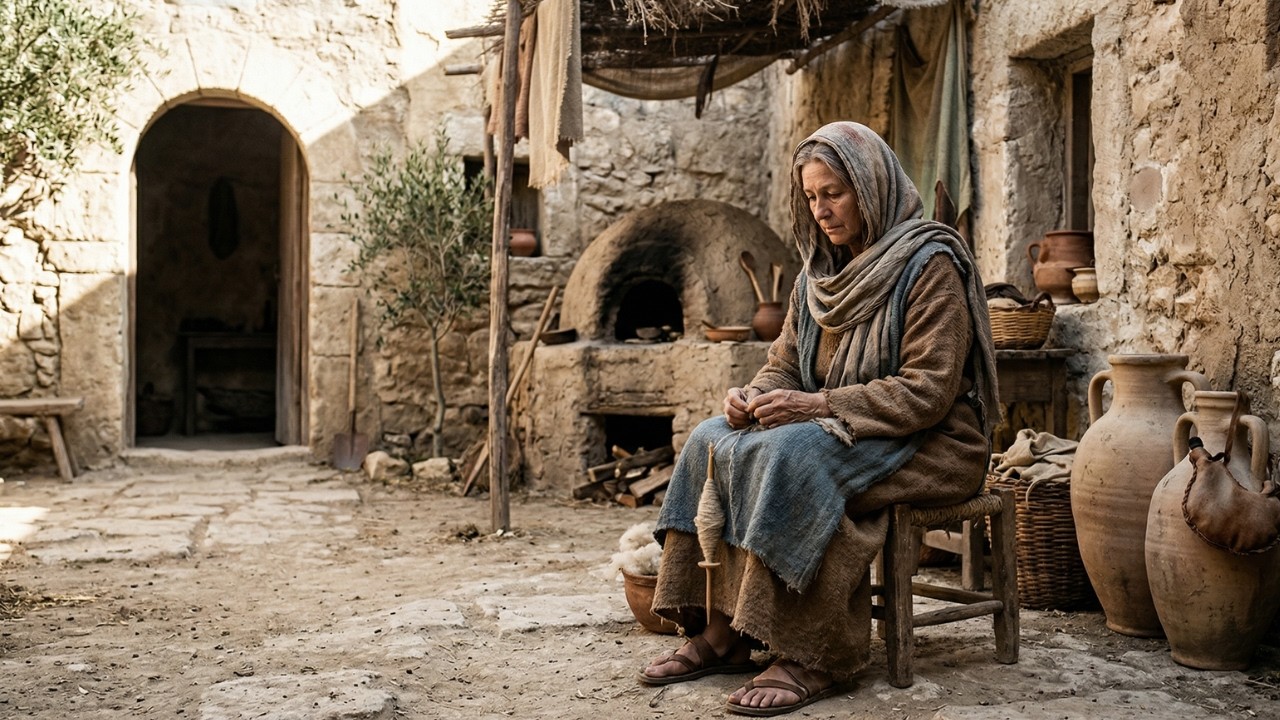
Not so different from Nazareth. Flat roof, courtyard, packed dirt floor, a cistern, a tabun oven, the same morning rhythm she’s kept her entire life.
She wakes before dawn. She grinds grain. She bakes bread. She carries water. Her hands know this work the way her lungs know breathing.
50 years of the same motions. The muscle memory of survival. But now, visitors. Every day.
People knock on the door. New believers, people who heard Peter preach at Pentecost. People who walked away from the temple and need to understand what they’ve walked toward.
And they all have the same question. What was he like? Picture Mary sitting in the courtyard, an oil lamp burning, a young believer sitting across from her.
And Mary, the woman who Luke tells us treasured all these things in her heart, finally opens that treasury.
The angel in the dark room. The journey to Bethlehem. The manger, not a wooden barn, a stone feeding trough in a cave.
The shepherds arriving in the middle of the night, breathless, talking about angels. The old man Simeon in the temple taking the baby in his arms and whispering that a sword would pierce her soul.
She had carried these stories for over 30 years. Alone. In silence. Now the church needed them.
And here’s the detail that should change how you read your Bible at Christmas. Luke, the author who wrote the most detailed account of Jesus’ birth, never met Jesus during his ministry.
He was Paul’s traveling companion. He collected his information from eyewitnesses. Who was the only eyewitness to the Annunciation?
To the birth? To the shepherds? To the boy in the temple at age 12?
One person. Mary. Every nativity scene you have ever seen. Every Christmas pageant. Every time you’ve heard, “And she wrapped him in swaddling clothes >> >> and laid him in a manger.”
That came from her. She told someone. That someone told Luke. Luke wrote it down.
Without Mary’s testimony, there is no Christmas story. But Jerusalem was not safe. Not for long.
Follow Mary through the streets again. But the mood has changed. Roman soldiers aren’t just patrolling.
They’re raiding houses. You hear shouting from a side street. A man is dragged from his home.
His crime, following the way. That’s what they called it before anyone used the word Christian.
Stephen, one of the first deacons, is stoned to death outside the city walls. You don’t see it happen, but you see Mary’s face when she hears about it.
The face of a woman who has already watched one person she loved die at the hands of authorities.
And now it’s starting again. Acts tells us a great persecution broke out. Believers scattered.
Families fled. The community that had gathered around the apostles in Jerusalem began to fracture and spread across the empire.
James, >> >> not Mary’s son, but John’s brother, was killed by Herod with a sword.
Peter was arrested. The inner circle was being hunted. And at some point, the traditions are consistent, even if the exact date is debated, John made a decision.
He had to leave. And he had to take Mary with him. Jesus had told him to care for her.
That command didn’t expire when the city became dangerous. It became more urgent. Picture Mary walking through a harbor, Caesarea, maybe, or Joppa.
The smell of salt water and tar and fish. Wooden ships rocking against the dock.
Sailors shouting in Greek. She has never been on a ship. She has never left the land of Israel.
She’s maybe in her 60s. And she’s about to cross the Mediterranean Sea. Follow her up the gangplank.
Feel the wood shift under her feet. The deck is rough. The sail catches wind.
The harbor shrinks behind her. The coastline, the only land she’s ever known, disappears over the horizon.
Days on the water. The pitch of the ship. The salt air. The stars at night.
The same stars she watched from the rooftop in Nazareth. But now they’re reflected in an ocean she’s never seen before.
And then, land. The coast of Asia Minor. Modern-day Turkey. The ship docks. She steps onto foreign ground.
And in the distance, rising above the harbor, a city unlike anything she has ever seen.
Ephesus. A Roman metropolis of 250,000 people. Marble streets, a theater carved into a hillside seating 25,000, bathhouses, libraries, fountains, and dominating the skyline, the Temple of Artemis, one of the seven wonders of the ancient world.
A pagan goddess worshipped by the entire city. Picture Mary’s eyes seeing this for the first time.
A woman from a village of 400 people, a woman who grew up in a house carved from rock, now standing in one of the largest, richest, most pagan cities in the Roman Empire.
Everything is foreign, the language, the food, the gods on every corner, the marble under her feet instead of dirt.
But John is beside her. And the same God who met her in a dark room in Nazareth is the same God standing with her on a marble street in Ephesus.
John doesn’t take her into the city. He takes her above it. Follow them up a winding path, away from the marble, away from the noise.
The road climbs through pine trees and wild olive groves. The air cools. You can hear birdsong, nightingales, hundreds of them, filling the hillside with sound.
The Turks would later call this place Bulbul Daghi, the mountain of nightingales. Near the top, a clearing.
And in that clearing, a small stone house, one main room, a sleeping chamber on the side, a fireplace, windows set high in the walls, a flat roof, a spring flowing nearby with fresh water.
Look at it. Really look at it. It’s almost identical to the house in Nazareth.
Stone walls, simple doorway, dark interior lit by oil lamps, small, modest, quiet. The woman who said yes to an angel in one stone room will spend her final years in another stone room.
Different country, different mountain, same kind of house, same God inside it. In 1881, a French priest followed the written descriptions of a German nun named Anne Catherine Emmerich, who had never left Germany, and found a small stone structure on this exact hillside matching every detail she described.
Archaeological investigation revealed that the lower foundations date to the 1st century. The structure measures roughly 7 by 7 m.
Three popes have visited, Paul VI, John Paul II, Benedict XVI. Christians and Muslims both make pilgrimage here.
Outside the house, a wall is covered with thousands of handwritten prayers tied to the stones by visitors from every country on Earth.
Was this actually Mary’s house? We cannot prove it. But the foundations are the right age in the right city, matching the right tradition.
Now, step inside with her. The room is cool. The stone holds the mountain air.
An oil lamp burns on a ledge, the same kind of lamp that burned in Nazareth, the same kind that burned in the upper room.
She sets down the bread she’s carrying. She kneels. She prays. The same prayer she has prayed every morning and every evening since she was a girl.
Hear, O Israel, the Lord our God, the Lord is one. The same words, different walls, same woman, same faithfulness.
She lived here, if the tradition is true, for years, maybe decades. Quietly. She didn’t write a gospel.
She didn’t lead a church. She didn’t preach a sermon that anyone recorded. She never held a title or an office.
The most important woman in Christian history left no writings, no autobiography, no memoir. But she left something more powerful.
She left her memory. The angel in the dark room, the manger, the shepherds, the old man’s prophecy, the boy in the temple saying, “I must be in my father’s house.”
She carried those stories across a desert, across a sea, up a mountain, and she gave them away.
Someone listened. Someone remembered. Someone told Luke. And Luke wrote them into the book that 2 billion people would read every Christmas morning, every nativity scene, every choir singing about a manger and a star.
That’s Mary’s testimony, still being told, still being heard. 2,000 years later, on a mountain of nightingales, the echoes haven’t stopped.
Step back. See the whole arc. A teenage girl in a dark room in Nazareth saying yes, grinding grain the next morning because the bread still needed to be made, a manger in Bethlehem, a flight to Egypt, a boy who wasn’t quite like other boys, 30 years of ordinary life in an ordinary village, then watching him leave, watching him preach, watching him heal, watching them turn on him, standing, not falling, at the foot of the cross, the upper room, the spirit falling, a new beginning at 50 years old, the stories finally told, the journey across the sea, a small stone house on a mountain where nightingales sing, and a quiet end, somewhere, sometime, unrecorded.
The most famous mother in history spent her final years the way she spent her first, unseen, faithful, doing the same simple things she had always done.
Different houses, different cities, different decades, the same hands grinding grain, the same voice blessing bread, the same woman trusting a God who asked everything and explained almost nothing.
From Nazareth to Ephesus, the story never changed. God chose the small life, the quiet life, the life nobody writes about, and he called it enough.