The Titanic Wreck Was Just Scanned by An AI — And It Revealed Something No One Expected
It wasn’t just another deep-sea scan — it was a digital resurrection.
When advanced AI mapped the Titanic wreck using full-scale 3D photogrammetry, experts expected clearer images.
Instead, they discovered hidden compartments, unexplained structural gaps, and newly visible artifacts — details obscured by darkness and decay.
These findings raise serious questions: Why were they never documented before? What remained buried for over a century beneath the Atlantic? This groundbreaking scan may offer new insights into how the Titanic met its fate.
Join us as we explore what the AI revealed — and why it’s reshaping our understanding of the disaster.

Titanic’s Ghost For over a century, the RMS Titanic has rested in the pitch-black depths of the North Atlantic, its shattered hull lying 12,500 feet below the surface.
Since its discovery in 1985, countless expeditions have attempted to piece together what happened on that fateful night in April 1912.
Yet for all the documentaries, sonar maps, and underwater photos, the wreck remained a ghostly outline—haunting, fragmented, and full of unanswered questions.
Visibility was poor, access was limited, and the technology just wasn’t capable of capturing the full picture.
Until now.
In 2023, a joint operation between British deep-sea mapping company Magellan and Atlantic Productions launched what would become the most ambitious underwater scanning project ever attempted.
Their goal wasn’t just to film the Titanic again—it was to digitally resurrect it.
Using submersibles, 200 hours of dive time, and more than 700,000 high-resolution images, they created a complete 3D scan of the entire wreck and surrounding debris field.
This wasn’t artistic interpretation or a speculative model.
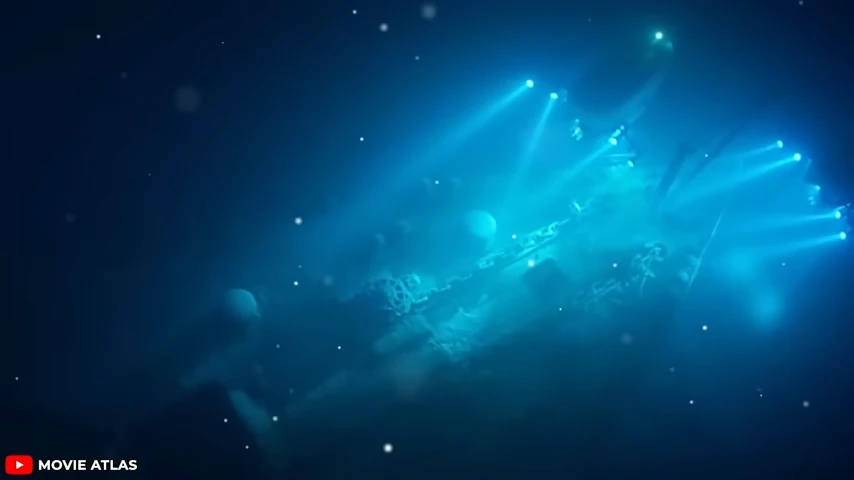
It was a millimeter-accurate, full-scale scan of the real Titanic, down to every bolt, tile, and collapsed railing.
For the first time in history, researchers could observe the ship in its entirety, as if the sea had been drained and they were walking through its remains.
The scale of the operation was mind-blowing.
Cameras had to navigate the broken halves of the ship—nearly 2,600 feet apart on the ocean floor—while mapping the massive debris field scattered in between.
In the past, these areas were studied in fragments.
Now, they were digitally reassembled with breathtaking clarity.
Not only the technology, but what it exposed is what makes it revolutionary.
All previous expeditions could only reveal what human divers could view or what sonar could vaguely detect.
AI photogrammetric reconstruction made possible the recreation of both those parts of the Titanic that could be seen and those invisible to human perception.
Impossible-angle examination was now possible for the collapsed bow section.
The destroyed stern was suddenly one’s own.
Whole rooms, staircases, and hallways began to take shape in ways that were never visible before.
Shockingly, the AI scan has also revealed previously unknown structural features that were unrecorded-inaccessible, or buried by sediments.
These sealed compartments, isolated pieces of debris located far from the ship’s main break, and hull structure anomalies are raising questions about how this ship has been torn apart.
For years, Titanic analysts maintained that the ship cracked unevenly under the stresses of the ocean, showing jagged fractures at the keel.
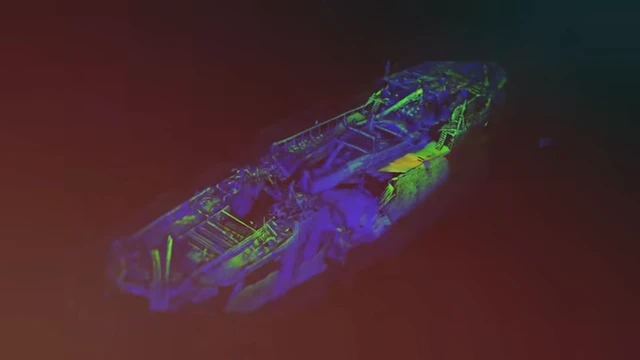
However, as the scan results indicate now, some parts resemble having failed harshly in very clean, geometric lines, perhaps raising questions about the nature of the break itself.
Whether it really broke out under pressure and flawed rivets, or whether some external influences, such as explosions, structural movements, or during the trip, participated in the breaking off? It’s not just the clarity of the wreck which is intriguing; it’s the personal touch.
The AI has captured frozen items from people’s lives: shoes, combs, unopened bottles, and dishes still stacked neatly.
In one place, the scan seems to have picked out what is possibly a perfectly preserved hat, where it lay for more than a hundred years.
These are not just artifacts.
These are clues.
Elements of real lives, real stories, now finally rendered visible.
This scan is not merely a scientific feat; it was a digital resurrection.
It allows us to view the Titanic not merely as a shipwreck, but as a living structure caught in-between tragedy.
And yet, despite all we’ve uncovered, the most stunning revelations were yet to come.
Because when AI began analyzing the scan’s data… it found something no one expected.
The AI Scan That Changed Everything When the first complete 3D scan of the Titanic was released to the public, the world saw something incredible—an ultra-clear, digital map of the wreck unlike anything before it.
But behind the scenes, something even more groundbreaking was unfolding.
The real breakthrough wasn’t just the scan itself.
It was what artificial intelligence found inside it.
Using machine learning algorithms trained on naval architecture, metallurgy, and ship design, a specialized AI program was tasked with analyzing the scan’s details—every angle, every fracture, every buried component.
The idea was to help researchers identify subtle signs of decay and predict how long the wreck might last.
What they didn’t expect was for the AI to start identifying structural inconsistencies—patterns in the break, stress points in the hull, and strange anomalies in the ship’s metalwork that didn’t match historical records.
At first, these were dismissed as scanning artifacts—errors caused by the harsh environment of the ocean floor.
But as the AI reprocessed the data, it kept flagging the same anomalies, again and again.
Most alarming were its findings in the keel area, the ship’s structural spine.
Here, the AI detected evidence of symmetrical failure points—not the chaotic ruptures expected in a ship that split from stress, but something that looked unnervingly organized.
In particular, the scan highlighted areas where the rivets—long blamed for the Titanic’s weakness—appeared to be intact.
That’s right.
In some areas thought to have failed catastrophically, the rivets were still in place, the seams unbroken.
Instead, fractures occurred in surrounding metal plates in ways that resembled shearing from inside pressure, not external impact.
That’s when a quiet but intense debate ignited among researchers: Had we misunderstood how the Titanic actually broke apart? Some experts now suggest the breakup wasn’t just the result of the iceberg impact.
The AI’s findings point toward the possibility of a secondary mechanical failure—perhaps in the engine room or boiler compartments.
The program identified unusual displacement patterns in the stern, where several bulkheads seem to have collapsed in sequence, almost like a chain reaction.
This level of detail had never been visible before.
The discovery that stunned everyone is that more debris lies tangent to the wreck than the known perimeter.
The AI pieced together fragments scattered over a mile from the main site.
They may include tiny parts of the ship never mapped, from beams to plates, and what might otherwise have been a davit of a lifeboat that was not previously documented.
If true, this might mean that lifeboats launched from areas never accounted for by witnesses, or worse, that some were never launched at all.
But perhaps the most appalling discovery was through more intense scrutiny of what were the final hours of the ship’s life.
Through feeding the AI thousands of data points, scan geometry, survivor accounts, ship schematics, and fluid dynamics, it recreated a real-time model of the breakup, simulating how the Titanic fractured and sank second by second.
The result? The AI’s version contradicted the most widely accepted version of events.
As the simulation had shown, the Titanic not only broke and sank into two pieces.
There was a compelling finding by the AI about a third structural event, probably due to an explosion or hull breach that split part of the stern into pieces before the vessel submerged completely.
The debris field will explain this and why the torn and scattered stern components look rather than crumpled, torn, and scattered, thin and crumpled.
Now reassessing everything learnt over the decades, researchers found that the AI not only sharpened but changed the entire story—the previous understanding of the wreck.
Everything thought of what occurred during the final moments of the Titanic has been put into doubt: how the ship broke, the reasons it did so, and even how some passengers conceivably died.
And this wasn’t the last surprise.
Because buried in the scan, in a section of the wreck long obscured by sediment and shadow, was a chamber that no one knew existed.
The Hidden Room When the AI scan was first released to the public, it was praised for its detail—every twist of metal, every decaying beam preserved in high resolution.
But what many didn’t realize was that the true revelation wasn’t in plain sight.
It was hidden in a part of the ship that no explorer, no diver, and no camera had ever thoroughly mapped: a collapsed section of the forward cargo area.
For over a century, that part of the wreck had been buried beneath silt, twisted iron, and near-total darkness.
Cameras couldn’t reach it.
Human divers couldn’t fit through the narrowed crevices.
It had essentially been declared inaccessible—until the AI model reconstructed a full spatial layout from subtle data points gathered by sonar and photogrammetry.
To the human eye, it was just debris.
But to the AI, it was geometry—shapes, patterns, and voids.
And one of those voids wasn’t random.
It measured precisely 14 feet across, 8 feet high, and 12 feet deep.
The proportions matched something that appeared in original Titanic schematics but had long been considered speculative: a private safe room, meant for transporting high-value cargo, including gems, documents, and government contracts.
That room—officially called the Purser’s Secure Compartment—was never recovered or mentioned in survivor accounts.
Many assumed it had been destroyed during the sinking.
But here it was, still sealed shut, its metal doors warped but surprisingly intact, buried beneath a lattice of collapsed deck plating.
More shocking still was what the AI model detected inside.
Using density measurements derived from sonar and reflected light behavior, the system built a 3D reconstruction of the chamber’s contents.
Inside were three major objects.
Two appeared to be reinforced steel lockboxes.
But the third? It defied easy classification.
The AI flagged it as an anomaly: a long, rectangular case made from an unusually high-density material.
Researchers speculated it could be a lead-lined box, commonly used at the time to transport sensitive items, sometimes for governments or banks.
Why would that be aboard the Titanic? Theories quickly emerged: perhaps it was a diplomatic pouch from the British government, or rare documents belonging to one of the elite passengers, such as J.
Morgan, who mysteriously canceled his trip at the last moment.
Could this enigmatic box be the very reason some considered the Titanic to be not just a passenger ship but one that transported dangerous cargo hardly anyone wanted to discuss? Could it be a backup of valuable financial contracts, rare manuscripts, or perhaps something politically more toxic? Immediate interest from several groups, particularly legal interests, was raised with the discovery of the chamber.
The ownership of Titanic artifacts remains very much contested, so any untouched area of the wreck could trigger a legal scuffle over who has the right to either recover it or even investigate it.
The salvage company, RMS Titanic Inc.
, publicly responded only with vague statements regarding “ongoing assessments” and “sensitive material.
” However, the public was beginning to ask mainstream historians the questions they would rather avoid: What in the world was in that sealed chamber? Why on earth was it hidden in a relatively clandestine section? And most importantly: Why on earth was it never mentioned before? This hidden chamber is no mere relic of the Titanic’s luxury; it is a secret, kept safe for over a century by some metal and the pressure of the ocean.
Legalities and ethics may delay the physical removal, but the AI scan has surely established one thing: the chamber is definitely there.
But it wasn’t alone.
Scattered throughout the wreck, the scan began highlighting other anomalies — objects buried under layers of steel and silt, some sealed, some strange, and all previously unknown.
What these items turned out to be would shake even the most seasoned Titanic researchers.
Artifacts That Rewrite the Story At first glance, the Titanic is a graveyard—an iron skeleton tangled in rust and ocean sediment.
But thanks to the 2025 AI-enhanced 3D scan, it has become something more: a time capsule.
And within that capsule lie artifacts never before seen, preserved in eerie silence for over a century.
But what’s most astonishing isn’t just that these items were recovered—it’s what they suggest about the real story of the Titanic’s final hours.
The new scan revealed several compartments of the ship that were previously either too dangerous or too collapsed to explore.
When the AI reconstructed these areas virtually, researchers noticed anomalies—unusual object shapes and densities that didn’t match expected inventories.
What followed was a series of targeted expeditions, guided by machine precision rather than guesswork.
What they found floored even the most skeptical experts.
In one of the first-class cargo holds, long thought to be destroyed, the AI identified an oddly symmetrical object encased in debris.
After robotic arms cleared away sediment and rusticles, the discovery became clear: a locked brass courier’s case, sealed and in pristine condition.
Based on its markings and construction, it was almost certainly used for diplomatic documents.
This case wasn’t listed on the Titanic’s official manifest.
The implications were immediate and uncomfortable.
If this was indeed diplomatic cargo, what country sent it? Who was it meant for? And more critically, why had it never been mentioned in over a century of documentation, inquiry, and recovery efforts? But that was only the beginning.
In the remains of the ship’s mailroom—a section assumed unsalvageable—AI scans revealed a stack of partially intact mailbags, sealed within a collapsed steel beam that had protected them from total decay.
Inside? Over 200 water-damaged letters, many of which bore official stamps and high-level business seals.
One, partially legible, appeared to reference a major transatlantic financial deal involving three shipping magnates—a deal that would have been signed in New York the week the Titanic was due to arrive.
The letter referred cryptically to a “breakthrough merger” that some historians now suspect may have altered the course of maritime trade history had it gone through.
One of the most disturbing findings turned completely upside down our knowledge of the ship’s preparations: a maintenance logbook belonging to one of the ship’s engine room mechanics was found in a toolbox behind the ruptured bulkhead.
Until recently, its pages were still partially readable with detailed reports of cracked rivets, odd hull vibrations, and concern about stress near the boiler room-all dated only a week before the maiden voyage.
All this contradicts the evidence given earlier that the Titanic had departed Southampton in “perfect working order.
” More terrifying, one almost mundane object, a child’s toy: a small wooden horse.
Found wedged between wall panels residing near the third-class quarters, the toy had initials carved into its base.
Cross-referenced with passenger lists, it matched a six-year-old boy who was previously assumed to have died in the sinking.
But there is an irony: that child’s name also appears in early survivor rosters that were later redacted.
Could the chaos have caused identity confusion, or were there survivors whose identities were suppressed based on intent? Each and every artifact pulled from the depths, thanks to AI guidance, has simply added newer wrinkles to the Titanic saga.
It was not just any doomed ship that met its fate against an iceberg.
It was a moving meeting place of politics, power, and hidden agendas.
An unwarranted suitcase.
Letters to corporate deals that faded into oblivion.
Logs listing warnings that were disregarded.
And artifacts that suggested possible cover-ups.
In the words of one historian: “We didn’t just find objects that were lost.
We found evidence-evidence that the Titanic was carrying more than passengers and dreams.
It was carrying secrets.
” If these secrets have remained hidden for 112 years, what else is still lurking in the unexamined sections of the wreck? The AI’s next target zone suggests that beneath the debris field—beneath the Titanic itself—there’s something even stranger.
A disturbance in the seabed, shaped like a tunnel, that could rewrite not just the ship’s story… but the mystery of how it sank.
The Break That Doesn’t Add Up For more than a century, one detail about the Titanic’s sinking has been etched into public consciousness: the ship struck an iceberg on its starboard side, took on water, broke in two, and sank to the bottom of the Atlantic.
But what if that break—the very image of the Titanic snapping in half—was never what it seemed? Until recently, theories about how the Titanic broke apart were based on survivor testimony, early dive footage, and structural models.
Most experts agreed that the ship broke from stress as the bow filled with water and dragged the stern upward, fracturing the vessel amidships.
But now, thanks to the most detailed 3D AI scan ever produced, that long-standing narrative is being seriously questioned.
The full wreck site, including large debris fields and even micro-fragments scattered over miles, has been digitally stitched together in a precision map never before possible.
The AI didn’t just identify where the hull tore—it reconstructed how.
And what it revealed sent shockwaves through the research community.
The break wasn’t clean.
It wasn’t even symmetrical.
It splintered in a pattern that some engineers say is inconsistent with a simple overload fracture.
Instead of failing along a predictable seam under vertical tension, the AI-generated reconstruction showed twisting, torsional stress, as if the ship had been under lateral forces before the final plunge.
This doesn’t line up with how the ship was believed to have sunk.
The official version assumes a passive failure—a ship pulled apart by gravity and water pressure.
But the AI’s simulation suggests a different force at play—one that created torque, bending the ship violently and causing an irregular break pattern.
Here’s where it gets more complicated.
The AI scan revealed a strange stress signature in the stern, showing signs of metal fatigue and pre-existing fractures, possibly sustained before or during the collision with the iceberg.
Metallurgists reviewing the data say it’s possible the Titanic’s steel, already brittle in cold temperatures, may have fractured due to unexpected pressure, not just from the iceberg, but from structural weaknesses.
Some even speculate that the ship may have suffered internal damage before it ever hit the iceberg.
This is congruent with the fiery coal theory, which says that in one coal bunker, a fire softened a bulkhead or hull area.
The new scan does not prove this theory, but it does show curious buckling patterns in the hull around Boiler Room 6, the kind that has been sustained by continued internal excess heat warping.
This evidence had not been seen on any previous trips.
And then there is the debris.
Scattered miles away from the main wreck were a cluster of large, dense objects–believed to be pieces of the double bottom hull.
But their location and distribution make no sense under the original sinking timeline.
According to the AI’s trajectory model, some of these pieces broke off before the final plunge, indicating preliminary hull failure.
In other words, parts of the ship may have detached before the ship even rose vertically out of the water.
A retired naval architect who evaluates the new findings raised an alarming question: “What if the ship was structurally compromised much before the iceberg?” Uncomfortable possibilities arise when being entertained.
Could design flaws caused perhaps by hurried construction, poor-quality steel, or ignored warnings have set the stage for catastrophe? Was the Titanic already on its way down, had the iceberg not been there? Then there is the angle of politics.
The White Star Line and its insurers had everything to lose in 1912.
An “act of God” sinking had a different flavor than sinking due to negligence.
If the ship had concrete vulnerabilities, shrouded in claims of luxury and invincibility, there had to be some control over the narrative.
The AI scan does not accuse anyone.
It does not present any conspiracy.
Instead, it shows indubitably that the fracture was not natural.
It was chaotic.
It was cruel.
It was unexpected, and that alone merits a rethink of the official story.
And it sets the stage for what researchers are now calling “the anomaly beneath the wreck”—an unexplained signal in the ocean floor just beneath the Titanic.
A buried structure that the AI flagged… and nobody can yet explain.
Theories Reignited by AI For over a century, the sinking of the Titanic has been a symbol of tragic miscalculation — a collision with an iceberg, exacerbated by hubris and poor judgment.
But the new AI-generated 3D scan is challenging that narrative in profound ways.
The level of precision revealed in the structural data has reignited several long-standing conspiracy theories that many had dismissed as fringe or speculative.
For the first time, there’s tangible physical evidence — not just speculation — suggesting something far more deliberate or concealed may have occurred aboard the Titanic during its fateful voyage.
One of the most controversial theories gaining traction again is the “ship switch” hypothesis — the idea that the Titanic was not actually the ship that sank.
According to this theory, White Star Line deliberately swapped the Titanic with her older, nearly identical sister ship, the Olympic, to cover up costly damage from a prior collision and collect insurance money.
While long dismissed due to a lack of hard evidence, the AI scans revealed subtle inconsistencies in rivet patterns and steel striation lines that don’t fully match Titanic’s documented construction.
These anomalies — picked up only because the scan captures detail down to the millimeter — don’t confirm a swap outright, but they raise new questions about the physical identity of the vessel resting at the bottom of the Atlantic.
Beyond identity theories, the scan has introduced a more troubling possibility: sabotage.
Structural analysis from the AI model uncovered patterns that some marine engineers describe as “highly irregular.
” Certain rivet lines appear to terminate unexpectedly or shift in alignment in ways that suggest intentional modification.
Combined with the clean, almost surgical nature of the ship’s break — previously assumed to be the result of metal fatigue — this has led some to theorize that structural elements were either weakened in advance or that there may have been an explosion onboard.
One analysis even posits the existence of stress points strategically compromised to accelerate failure during a collision.
What could be the underlying reason behind such sabotage? Certain researchers even go a step further and say the passenger list on board the Titanic can expose it all.
Some of the most powerful industrialists of that time, such as J.
Morgan (who canceled his journey right at the last moment), Benjamin Guggenheim, Isidor Straus, and John Jacob Astor IV, traveled on the unfortunate ship and all perished.
This will add an intense financial or political motive: removing dead figures against the establishment of the Federal Reserve or other transnational financial schemes.
These ideas have already long been spread all over conspiracy circles, but the new AI findings, especially with the proof of the asymmetric pressure patterns and sealed compartments not found on any blueprints, have made them relevant again.
Yet it is crucial to distinguish between speculation and fact.
The AI scan does not call this a conspiracy, but it points to factors in the engineering design that conventional explanations struggle to address.
The same issues managed to elude detection for well over a century, which speaks volumes about the inadequacy of imaging technologies in the past.
Now, with everything from bolts, joints, and fractures visible in high-resolution 3D, experts are reconsidering some of their once-settled assumptions.
Were there design defects? Was it something more sinister? In the end, the AI scan has left questions unanswered and has instead created more.
The watershed moment occurs when circumstantial evidence gives way to data.
It is now necessary to corroborate the evidence through other means: the ship itself—still preserved in the deep—and those manuscripts, once considered the sine qua non of Titanic research, but now conspicuously absent from the public record.
And as AI continues to parse through the millions of data points collected during the scan, we may soon learn whether Titanic was simply an unlucky ship, or something far more complex, and possibly even sinister.
The next few years of analysis could redefine not just the story of one ship, but how we understand history itself.
The Shadows Beyond the Wreck While the Titanic itself has always held center stage, the AI scan revealed that some of the most startling discoveries lay far beyond the wreck, scattered deep in the surrounding seafloor.
In areas previously thought to be nothing more than muddy ocean bottom, the scan illuminated an extended debris field marked by unusual anomalies.
Small, metallic objects, some partially buried in sediment, appeared in locations inconsistent with the previously accepted trajectory of the sinking.
Their positioning, and in some cases, their very existence, is now challenging everything we thought we knew about how The Titanic broke apart — and what it may have carried.
What makes this discovery so unusual is its distance from the main wreck site.
These objects aren’t adjacent to the hull or obvious offshoots of the ship’s breakup.
Instead, they appear in a more widely dispersed pattern, one that defies the established timeline of the ship’s final moments.
Experts are now asking: How did they get there? The prevailing theory of a linear descent following the ship’s split doesn’t align with these findings.
One possibility now being raised is that a secondary explosion — either from stored fuel or something more covert — might have cast fragments far from the expected debris trail.
Among the objects detected were several that appear sealed — intact enough that AI imaging showed sharp, undistorted outlines and, in one case, even minor reflectivity, suggesting metallic surface integrity.
Some researchers believe these could be cargo trunks or equipment cases that were either deliberately reinforced or naturally preserved by pressure and temperature.
If confirmed, these containers might house critical documents, unregistered cargo, or even classified materials that were never meant to be found.
And given how precise the AI model is, their locations have now been mapped for potential future exploration, assuming they’re not deemed too sensitive to retrieve.
Adding to the riddle is the fact that many of these artifacts exhibit geometric regularity – rectangular forms, symmetrical layouts – shapes which can hardly be formulated by random mechanical failure or disintegration.
One expert equated them to “intentional payloads”, while others are reticent, voicing the possibility that they are just relics of ship fittings or equipment that broke free during the split.
What no one is disputing is this perplexing correspondence.
If these things were aboard, why weren’t they in the manifest of the Titanic? And if they weren’t, how did they reach the bottom of the ocean right next to its wreck? The implications are disturbing.
If one is indeed forced to believe away from the ship’s distance, it would essentially call for a level of energy or disruption far beyond any such previously modeled — who knows, perhaps even supporting other theories of sabotage or internal detonation; conversely, in being declared to have been dropped much earlier during the entire voyage, it could very well suggest the desperate attempt to offload sensitive materials before all hell broke loose.
If you found this as mind-blowing as we did, hit like, comment, and subscribe for weekly deep dives into discoveries rewriting human history.
And don’t miss our next video.
Because if we’re only just unlocking Titanic’s final secrets now… who knows what ancient truths we’re about to uncover next?