Scientists Discovered the Bag of a Mesopotamian God —What’s Inside Shouldn’t Exist
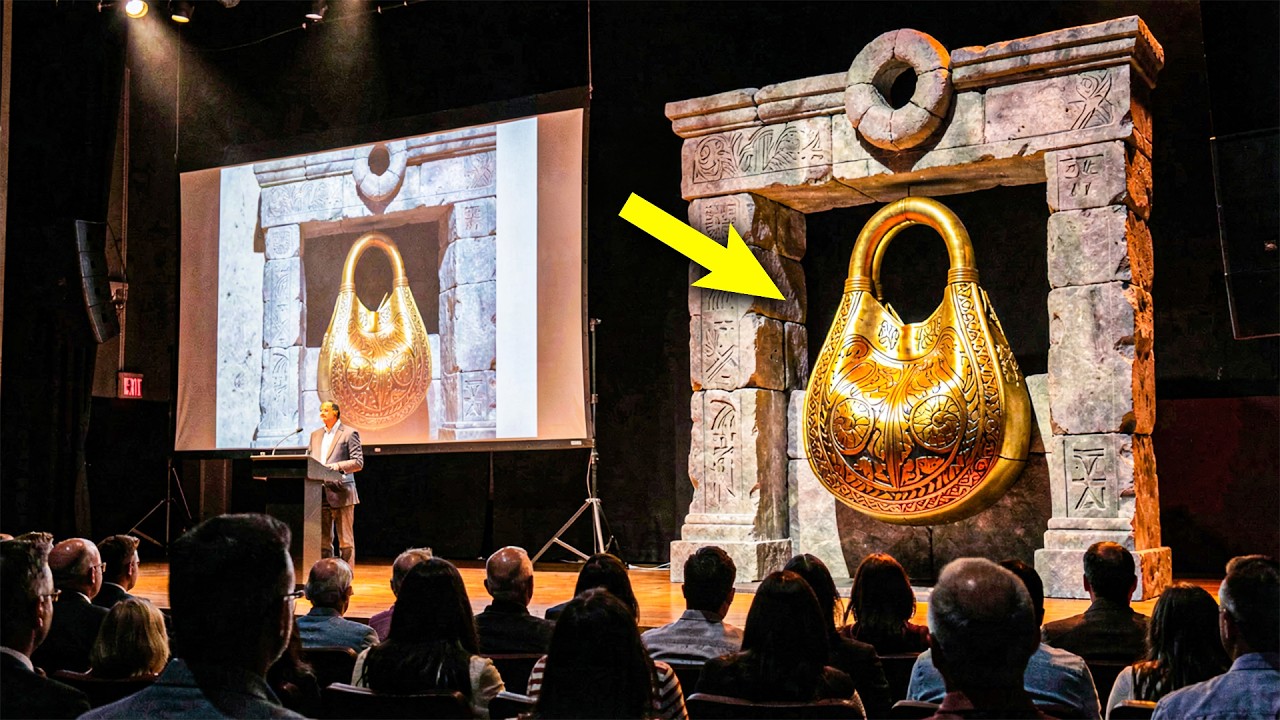
The Ancient Mesopotamian Handbag Mystery: What Was Really Inside?
For more than a century, archaeologists, historians, and mystery hunters have stared at the same strange object carved into the walls of ancient Mesopotamian palaces. It appears in the hands of winged beings, divine guardians, and sacred figures. It looks surprisingly familiar—a small handheld bag with a curved handle. Yet no one could explain why an object that resembles a modern handbag appeared in stone carvings nearly 3,000 years old.
Then researchers began connecting clues hidden in palace reliefs, ancient ritual texts, archaeological discoveries, and even chemical residue preserved for millennia.
What they found did not reveal alien technology, lost civilizations, or forgotten super-science.
The truth was far more fascinating.
Because the mysterious “handbag” was real. It had a name. It had a purpose. And it may preserve evidence of one of the oldest integrated systems of biological and chemical knowledge ever documented.
The Object That Shouldn’t Be There
Thirty kilometers south of modern Mosul, Iraq, lie the ruins of ancient Nimrud, once one of the greatest cities of the Assyrian Empire.
Nearly three thousand years ago, King Ashurnasirpal II transformed Nimrud into the capital of a rapidly expanding superpower. At the heart of the city stood the Northwest Palace, a monumental structure designed to impress visitors and intimidate enemies.
The palace walls were covered with massive carved stone panels. These reliefs depicted military victories, conquered cities, foreign tribute, and royal authority. Every image served a purpose. Every scene reinforced the power of the king.
Yet among the soldiers, prisoners, and royal attendants stood another type of figure.
These were the Apkallu—semi-divine guardians in Assyrian belief.
They appear repeatedly throughout the palace. Their bodies are human. Their wings are carefully detailed. Some have bird-like heads, while others appear fully human. They stand beside sacred trees, guard entrances, and surround important spaces.
And almost every one of them carries the same peculiar object.
A container with straight sides, a flat base, and a curved handle.
At first glance, it looks remarkably modern.
Even more striking is the consistency. The proportions rarely change. The handle maintains the same shape. The size remains almost identical from carving to carving.
This wasn’t artistic improvisation.
It was standardization.
And that standardization suggested something important: the object represented a specific thing that every viewer was expected to recognize.
A Mystery That Spread Across Continents
The puzzle became even stranger when researchers noticed similar shapes appearing in other ancient cultures.
Comparable “handbag-like” symbols have been identified at Göbekli Tepe in modern Turkey, a site thousands of years older than Assyria. Similar forms have also been noted in some Mesoamerican artwork.
To alternative researchers, this seemed like proof of a forgotten global civilization.
Ancient astronaut theorists proposed even more dramatic explanations.
Perhaps the object was a power source.
A battery.
A communications device.
An oxygen generator.
Some kind of advanced technology passed down from gods or visitors from the stars.
The problem with these theories is that they begin with the assumption that the object must be extraordinary.
Archaeology usually works the other way around.
The first question is not, “What impossible thing could this be?”
The first question is, “What ordinary thing does the evidence support?”
And when researchers looked carefully at the object itself, a much simpler answer emerged.
Its shape is remarkably practical.
A rigid container with a curved handle is one of the most efficient ways to carry liquids in one hand. Similar designs appear across countless cultures because human beings everywhere face the same physical challenges.
Gravity works the same way.
Human hands are shaped the same way.
Containers evolve toward similar solutions.
The shape itself was never the real mystery.
The real mystery was what the container held.
The Clues Hidden in Ancient Clay Tablets
The breakthrough came not from the palace walls, but from thousands of clay tablets discovered in the ruins of Nineveh.
These tablets came from the famous library of King Ashurbanipal, one of the greatest archives of the ancient world.
The collection preserved medical texts, royal correspondence, omens, rituals, and administrative records.
Among them were detailed instructions used by Assyrian ritual specialists.
These specialists were not wandering mystics or folk healers.
They were trained officials attached directly to the royal court.
Their job was to protect the king, the palace, and the kingdom from disease, misfortune, and harmful supernatural influences.
In several ritual texts, a specific object appears repeatedly.
Its name was the banduddû.
The instructions are surprisingly precise:
“Take the banduddû in your left hand. Take the mullilu in your right hand.”
The wording immediately caught scholars’ attention.
Why?
Because it perfectly matches the palace carvings.
The mysterious container is always held in the left hand.
The smaller object is always held in the right.
The tablets describe movement through rooms, around doorways, along thresholds, and throughout royal spaces.
The individual carrying these objects performs actions at specific locations.
He applies substances.
He touches surfaces.
He conducts purification rituals.
Suddenly the carvings no longer looked symbolic.
They looked procedural.
The winged guardians were depicted performing actions that corresponded directly to written ritual instructions.
Looking Closer at the Stone
Even with the textual evidence, skeptics remained cautious.
Ancient art is often symbolic.
Perhaps the carvings merely represented ideas rather than actual objects.
To test this possibility, researchers examined the reliefs using modern imaging technologies.
Multispectral photography revealed traces of pigments invisible to the naked eye.
The mysterious container had been deliberately painted.
Dark pigments outlined its edges.
Metallic compounds appeared around its rim and handle.
This mattered because pigments were expensive.
Artists did not waste valuable materials highlighting insignificant details.
The object clearly held importance.
Even more revealing were subtle carved patterns along its surface.
Under magnification, some examples showed textures resembling woven fibers or constructed materials.
The artists were not simply drawing an outline.
They were attempting to represent a physical object with structure and substance.
Three-dimensional analysis provided another clue.
Using photogrammetry, researchers measured the proportions of the container relative to the carved figures.
The estimated capacity ranged between four and six liters.
That size is practical.
Large enough to hold a meaningful amount of liquid.
Small enough to carry comfortably in one hand.
Again and again, the evidence pointed toward the same conclusion.
This was not a symbol pretending to be a container.
It was a container.
The Discovery Beneath the Palace
The most dramatic evidence emerged from beneath Nimrud itself.
In 1989, archaeologists uncovered intact royal tombs beneath the palace complex.
These burials belonged to Assyrian queens and contained extraordinary treasures.
Gold jewelry.
Crowns.
Seals.
Luxury goods.
And among these objects were metal vessels unlike ordinary household containers.
Several featured rigid bodies, broad openings, and curved handles attached on both sides.
The resemblance to the carved “handbags” was remarkable.
The proportions closely matched those reconstructed from the palace reliefs.
These vessels were not discovered in kitchens or storage areas.
They were found in elite burial contexts among high-status ceremonial objects.
That alone suggested they carried special significance.
But the real surprise came from the material preserved inside.
The Chemistry of a 3,000-Year-Old Mystery
Dark residue clung to the interiors of several vessels.
Scientists collected samples and subjected them to chemical analysis using gas chromatography and mass spectrometry.
The results transformed the investigation.
Researchers identified traces of plant-derived resins.
Organic oils.
Fatty acids.
And other botanical compounds.
At first, these findings seemed intriguing but inconclusive.
Ancient containers often held organic materials.
Contamination is always possible.
However, when researchers compared the chemical signatures with ingredients listed in Assyrian ritual texts, an extraordinary pattern emerged.
The tablets described purification mixtures containing:
Fresh water
Cedar oil
Juniper resin
Honey
Plant extracts
Wax-based ingredients
Meanwhile, laboratory analysis detected markers associated with many of those same substances.
Among the most significant discoveries was evidence of conifer-derived compounds consistent with cedar and juniper resins.
Scientists also identified fatty acid signatures associated with plant oils.
Some samples even contained traces consistent with beeswax.
Individually, these findings might be dismissed.
Together, they formed a compelling picture.
The ritual texts described mixtures.
The vessels contained residues from mixtures.
The carvings depicted containers used in those rituals.
Three independent lines of evidence were converging on the same answer.
The Secret of the Object in the Right Hand
One final mystery remained.
What was the object held in the right hand?
For decades, scholars commonly described it as a pine cone.
The shape certainly resembles one.
But closer examination suggested another possibility.
Some researchers believe the object more closely resembles the male flower cluster of the date palm.
This detail matters enormously.
Date palms were among the most important crops in ancient Mesopotamia.
Farmers learned long ago that manually transferring pollen from male trees to female trees significantly increased fruit production.
The process involved carrying pollen-bearing flower clusters and applying them directly to female blossoms.
When viewed through this agricultural lens, the palace scenes begin to look very different.
The right hand performs an action.
The object is extended toward sacred trees.
It is raised toward the king.
It appears to be applying or dispersing something.
Meanwhile, the left hand carries a container filled with a prepared mixture.
One hand supplies.
The other applies.
The imagery suddenly becomes functional rather than decorative.
The Real Purpose of the Ancient “Handbag”
By combining archaeology, chemistry, iconography, and ancient texts, researchers arrived at a surprisingly practical conclusion.
The famous Mesopotamian handbag was likely a ritual vessel used during purification ceremonies.
It carried carefully prepared mixtures containing water, oils, resins, waxes, and botanical ingredients.
The object in the right hand may have served as an applicator used to sprinkle, spread, or symbolically transfer those substances.
Together they formed part of a highly structured ritual system designed to protect spaces, promote fertility, and maintain order.
Far from being a mysterious technological artifact, the banduddû was something arguably more remarkable.
It represented applied knowledge.
Knowledge of plants.
Knowledge of agriculture.
Knowledge of preservation.
Knowledge of environmental protection.
Knowledge accumulated through generations of observation and experience.
Why This Discovery Matters
The most fascinating aspect of the story is not the container itself.
It is what the container reveals about the people who carried it.
Modern societies often imagine ancient civilizations as primitive, guided by superstition rather than systematic thinking.
The evidence from Assyria challenges that assumption.
The rituals surrounding the banduddû were not random acts.
They involved standardized procedures.
Specific ingredients.
Consistent preparation methods.
Controlled application.
Repeatable outcomes.
In modern language, we might describe this process as a blend of agriculture, chemistry, sanitation, and environmental management.
The Assyrians did not possess laboratories in the modern sense.
They lacked scientific journals and formal disciplines.
Yet they practiced observation.
They recorded procedures.
They preserved successful techniques.
They institutionalized knowledge.
In many ways, the underlying logic is familiar:
Observe.
Measure.
Prepare.
Apply.
Evaluate.
Repeat.
That is the foundation of science.
The mysterious handbag looks strangely modern not because it contains advanced technology, but because the thinking behind it feels familiar.
For the Assyrians, the container represented protection against chaos—against disease, crop failure, uncertainty, and the collapse of order.
It was a portable system for preserving stability in a fragile world.
And after three thousand years, the evidence suggests that the strange object carved into palace walls was never meant to symbolize magic.
It was something far more powerful.
It was knowledge carried by hand.