LOURDES: Humanity’s FINAL Warning — Why It’s Happening Now
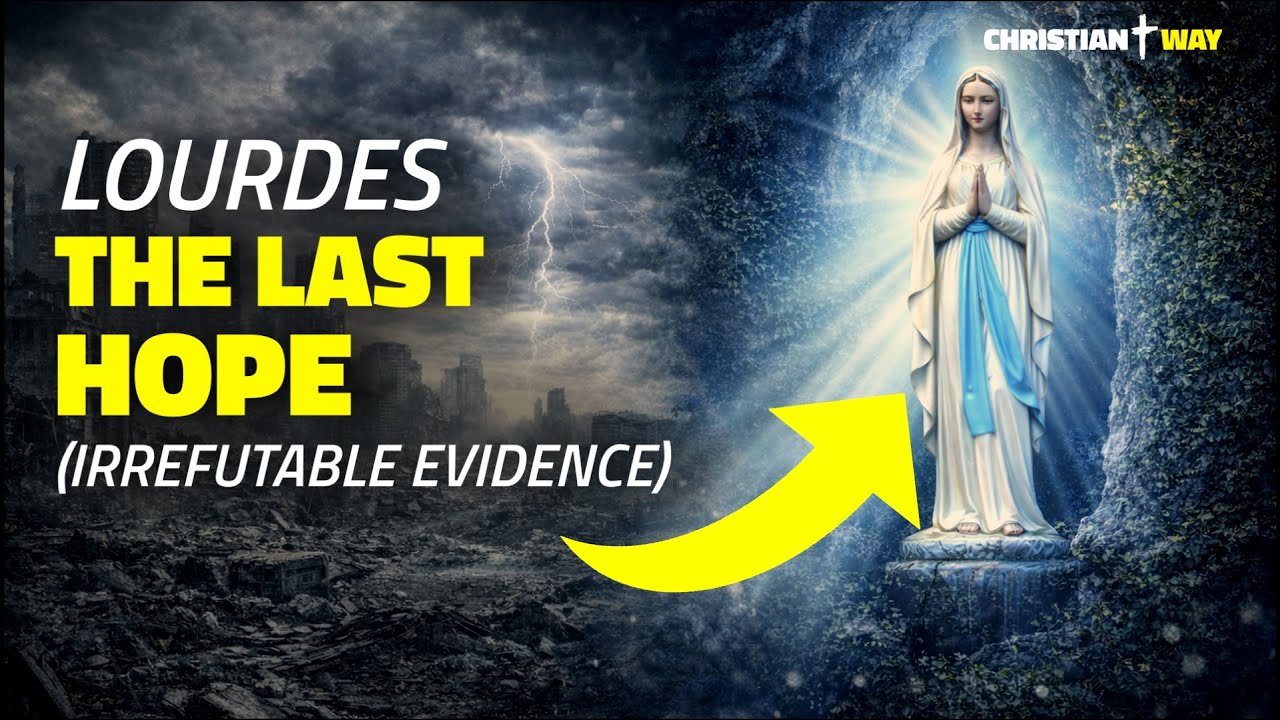
Lourdes: Humanity’s Last Resort? The Miracles, Mysteries, and Message Behind the World’s Most Famous Healing Shrine
What if one of the greatest challenges to modern skepticism is not hidden in a laboratory, a government archive, or a secret scientific project—but in a small grotto visited by millions of pilgrims every year?
For more than 165 years, the sanctuary of Lourdes has stood at the center of an extraordinary mystery. Here, countless people have arrived carrying illnesses, disabilities, grief, and hopelessness. Some returned home unchanged. Others claimed their lives were transformed forever. And a small number left behind medical cases so unusual that even experienced physicians struggled to explain them.
Whether one views Lourdes through the lens of faith or science, one fact remains undeniable: it continues to provoke questions that refuse to disappear.
Why does this place attract millions of visitors from around the world? Why do stories of healing continue to emerge generation after generation? And why did one of Christianity’s most beloved figures choose such an unlikely location to deliver a message that still resonates today?
To understand Lourdes, we must begin in a place few people would have considered holy.
A Grotto in the Mud
When people imagine sacred places, they often picture magnificent cathedrals, mountaintop monasteries, or ancient temples bathed in sunlight.
The story of Lourdes begins somewhere very different.
In 1858, the grotto of Massabielle was hardly a destination anyone would have sought out. It sat on the outskirts of the town, near a riverbank often associated with dirt, debris, and neglect. It was not a place of prestige. It was not a place of influence.
Yet according to Catholic tradition, it was here that the Virgin Mary appeared to a poor teenage girl named Bernadette Soubirous.
The choice of location has fascinated believers ever since.
Why would heaven choose such an ordinary and overlooked place?
The answer many pilgrims discover in Lourdes is simple: because humility has always been at the heart of the spiritual journey.
Throughout biblical history, God repeatedly chooses the unexpected. Shepherds instead of kings. Fishermen instead of scholars. A stable instead of a palace.
Lourdes fits perfectly into that pattern.
Its message begins with a reminder that greatness is often hidden where the world least expects to find it.
The Girl No One Expected
Bernadette Soubirous was not famous.
She was not educated.
She was not powerful.
Her family lived in severe poverty, occupying a former jail cell known as the Cachot after falling on hard times. Conditions were difficult, and the family struggled daily.
If someone had been asked in 1858 to predict who would become one of the most influential religious figures of the century, Bernadette’s name would likely never have appeared on the list.
Yet history often moves through ordinary people.
According to the accounts, Bernadette reported a series of apparitions that eventually transformed Lourdes into one of the world’s most visited pilgrimage sites.
What made her testimony remarkable was not eloquence or authority. It was consistency.
Despite skepticism, questioning, and pressure, she continued telling the same story.
Her simplicity became one of the reasons many people found her account convincing.
For believers, this was a sign that the message itself mattered more than the messenger.
The Spring That Changed Everything
One of the most important moments in the Lourdes story occurred when Bernadette was instructed to dig into the muddy ground near the grotto.
At first, nothing seemed to happen.
Then water began to emerge.
That small spring eventually became the source of the water that millions of pilgrims would later visit.
Today, visitors continue to collect and drink water from Lourdes.
What makes this remarkable is that repeated scientific analysis has consistently found the water to be ordinary.
It contains no unique chemical composition capable of explaining extraordinary healings.
This fact has fascinated both believers and skeptics.
If the water itself is ordinary, why has it become associated with so many stories of recovery and transformation?
For many pilgrims, the answer has never been about chemistry.
The water serves as a symbol—a visible sign of something deeper.
Faith, hope, surrender, prayer, and trust.
The spring reminds visitors that the most important healing may not always be physical.
The Medical Mystery of Lourdes
Perhaps the most intriguing aspect of Lourdes is the role science has played in its history.
Contrary to popular assumptions, the Catholic Church does not automatically declare every reported healing a miracle.
In fact, the process is notoriously rigorous.
The sanctuary established a medical bureau where physicians evaluate claims of extraordinary recovery. Cases are examined carefully, often over many years.
Medical records are reviewed.
Diagnoses are verified.
Long-term outcomes are monitored.
Alternative explanations are considered.
This scrutiny has become one of the defining characteristics of Lourdes.
Out of thousands of reported healings, only a very small number have received official recognition as medically inexplicable by Church authorities.
This distinction is important.
The goal is not to reject science but to investigate claims with as much rigor as possible.
As a result, Lourdes occupies a unique space where faith and medicine intersect rather than simply oppose one another.
The Case That Captured Global Attention
Among the many stories associated with Lourdes, certain cases have become particularly famous.
One frequently discussed example involves a patient suffering from severe bone disease and cancer-related destruction of skeletal structures.
According to reports, medical examinations documented conditions that appeared irreversible. Yet following a pilgrimage to Lourdes, physicians observed unexpected improvement.
Cases such as these continue to generate debate.
Supporters view them as evidence of divine intervention.
Critics argue that unusual recoveries, while rare, can occur naturally and may not always be fully understood.
The significance of these stories extends beyond the specific details of any individual case.
They force people to confront a larger question.
What happens when reality does not fit neatly into existing categories?
Lourdes has become a place where that question is asked repeatedly.
Why So Few Miracles Are Officially Recognized
One of the most misunderstood aspects of Lourdes concerns the number of officially recognized miracles.
Millions of pilgrims have visited the shrine.
Thousands have reported healings.
Yet only a small number have received formal recognition.
To some observers, this seems surprising.
Wouldn’t a place famous for miracles recognize more cases?
The answer reveals something important about the process.
The Church requires extraordinary evidence before declaring a miracle.
A condition must be serious.
The diagnosis must be well established.
The recovery must be complete.
The healing must endure over time.
And there must be no satisfactory medical explanation available.
This caution reflects an important principle: extraordinary claims require extraordinary scrutiny.
The result is a process that many physicians regard as among the most demanding investigations of alleged miraculous healings in the world.
The Body of Bernadette
Another mystery frequently associated with Lourdes concerns Bernadette herself.
Following her death in 1879, her body was exhumed during procedures connected to her canonization process.
Observers noted that her remains appeared unusually well preserved.
For believers, this became another sign associated with her holiness.
For scientists, preservation of human remains raises fascinating questions involving environmental conditions, burial circumstances, and biological processes.
Regardless of interpretation, the condition of Bernadette’s body contributed significantly to the growing fascination surrounding her life and legacy.
Even today, visitors continue to travel great distances to see the woman whose experience transformed an obscure grotto into a global pilgrimage destination.
A Place Where Science and Faith Meet
Perhaps the greatest misunderstanding about Lourdes is the assumption that it exists in opposition to science.
The reality is far more complex.
Many physicians have worked closely with the sanctuary over the decades.
Medical professionals have participated in investigations.
Scientific evidence has been collected, analyzed, debated, and reviewed.
Lourdes does not ask people to abandon reason.
Instead, it challenges them to consider whether reality may be larger than current explanations can fully describe.
This does not mean every extraordinary claim is true.
Nor does it mean every mystery automatically proves supernatural intervention.
It means the conversation remains open.
And it is precisely this openness that continues to attract people from both scientific and religious backgrounds.
Why the Message Still Matters
The enduring power of Lourdes may have less to do with miracles and more to do with its message.
At its heart, Lourdes tells a story about humility.
It reminds people that value is not determined by wealth, status, education, or influence.
The central figure of the story was not a queen, politician, scholar, or military leader.
She was a poor young girl.
The setting was not a palace.
It was a grotto.
The symbol was not gold or power.
It was water.
These details communicate a message that remains surprisingly relevant in the modern world.
In an age obsessed with visibility, achievement, and influence, Lourdes points in the opposite direction.
It suggests that transformation often begins in simplicity.
The Call to Conversion
One theme repeatedly associated with the apparitions is conversion.
This word is often misunderstood.
Many people hear it and immediately think of rules or religious obligations.
Historically, however, conversion means something deeper.
It means turning around.
Changing direction.
Reconsidering one’s path.
The message attributed to Lourdes is not primarily about fear.
It is about invitation.
An invitation to rediscover what matters most.
An invitation to move away from bitterness, selfishness, and despair.
An invitation to live with greater trust, compassion, and purpose.
Whether one accepts the supernatural claims or not, this message continues to resonate across cultures and generations.
Why Millions Continue to Come
Every year, people travel to Lourdes carrying different burdens.
Some seek physical healing.
Others seek emotional peace.
Many arrive simply searching for hope.
Not everyone experiences a dramatic recovery.
Most do not leave with a medical miracle.
Yet countless visitors describe something else.
A renewed sense of purpose.
A deeper faith.
A feeling of peace.
A restored capacity to face life’s challenges.
In this sense, Lourdes may represent something larger than a collection of miracle stories.
It represents humanity’s enduring search for meaning.
The desire to believe that suffering is not the final chapter.
The hope that healing remains possible.
The conviction that darkness does not have the last word.
Humanity’s Last Resort—or Its First?
The phrase “last resort” is often used when all other options have failed.
Yet the story of Lourdes invites a different perspective.
Perhaps faith is not meant to be humanity’s last resort.
Perhaps it is meant to be its foundation.
The millions who visit Lourdes each year are not simply searching for cures.
They are searching for answers.
They are searching for hope.
They are searching for evidence that love, compassion, and grace remain active in a world that often feels broken.
Whether one views Lourdes as a miraculous intervention, a profound psychological phenomenon, or a combination of many factors, its impact cannot be denied.
For more than a century and a half, this small grotto has continued to challenge assumptions, inspire devotion, and provoke debate.
And perhaps that is the greatest mystery of all.
In a world increasingly convinced that everything can be measured, explained, and controlled, Lourdes continues to whisper a different possibility.
That there are realities deeper than statistics.
That hope can survive even the darkest diagnosis.
And that sometimes the most powerful answers emerge not from the centers of power, but from a humble spring flowing quietly from the earth.