Jesus Said This Will Happen First When the Rapture…
Jesus Said This Will Happen First When the Rapture Is About to Start
What if the first sign that the rapture is near is not a mysterious event in the sky, but something unfolding quietly across the earth right now?
What if Jesus Himself warned that before the final moment arrives, certain unmistakable conditions would begin to appear—conditions that would signal that history is approaching its most dramatic turning point?
Throughout the centuries, believers have searched the Scriptures to understand the moment when Christ will gather His people.
The word “rapture” itself does not appear in the English Bible.
Yet the event it describes is drawn from the words of the Apostle Paul in 1 Thessalonians 4:16–17:
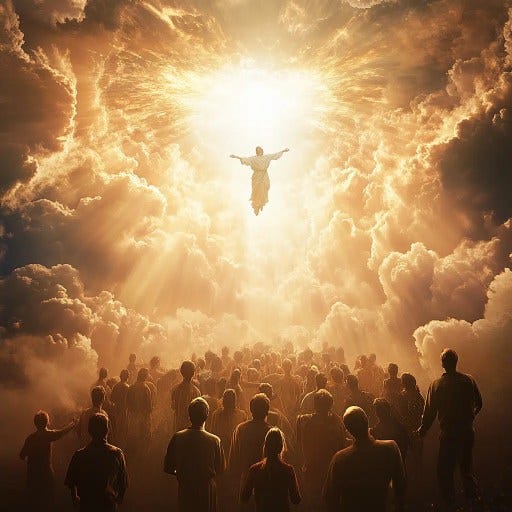
“For the Lord himself will come down from heaven, with a loud command, with the voice of the archangel and with the trumpet call of God, and the dead in Christ will rise first. After that, we who are still alive and are left will be caught up together with them in the clouds to meet the Lord in the air. And so we will be with the Lord forever.”
The Latin translation used the word rapturo—“to be caught up”—giving rise to the term believers now use.
But long before Paul described that moment, Jesus Himself spoke about the events that would unfold before the end.
In a quiet conversation with His disciples on the Mount of Olives—overlooking the golden stones of Jerusalem—they asked Him a question that echoes through time:
“Tell us,” they said, “when will this happen? And what will be the sign of your coming and of the end of the age?” (Matthew 24:3)
The answer Jesus gave was not a single sign, but a sequence.
His words did not begin with cosmic disasters or supernatural wonders.
Instead, Jesus began with something far more subtle—and far more dangerous.
“Watch out that no one deceives you,” He warned in Matthew 24:4.
This was the first signal He spoke of.
Not earthquakes.
Not wars.
But deception.
The warning may seem simple at first glance, yet it reveals something profound about the days leading toward the end.
According to Jesus, the earliest stage of the final era would not be defined by obvious judgment, but by confusion—by a world where truth becomes increasingly difficult to recognize.
In the centuries after Jesus spoke those words, historians and theologians have often reflected on this pattern.
According to early Christian writings preserved by the church fathers, many believers in the first generations already feared false teachers who twisted the message of Christ.
But Jesus indicated something far greater would unfold as the end draws near.
Deception would not remain isolated.
It would spread.
“For many will come in my name, claiming, ‘I am the Messiah,’ and will deceive many.” (Matthew 24:5 NIV)
The emphasis was not merely on false prophets, but on the sheer number of them.
The word “many” appears repeatedly in this passage, suggesting a wave of spiritual confusion sweeping across humanity.
Imagine the scene on that hillside where Jesus spoke.
The temple gleamed in the afternoon light.
Pilgrims filled the city streets below.
To the disciples, the world seemed stable—enduring—almost permanent.
Yet Jesus was describing a future where spiritual certainty itself would erode.
And this erosion would begin long before the final trumpet sounds.
Deception, Jesus implied, would prepare the world for everything that follows.
When people lose their grip on truth, they become vulnerable to fear, manipulation, and false hope.
The Apostle Paul later echoed this same warning.
Writing to Timothy, he described a time when people would no longer tolerate sound teaching:
“For the time will come when people will not put up with sound doctrine. Instead, to suit their own desires, they will gather around them a great number of teachers to say what their itching ears want to hear.” (2 Timothy 4:3 NIV)
This pattern creates a spiritual fog over the world.
Truth becomes relative.
Faith becomes diluted.
Teachings that once stood firmly rooted in Scripture begin to bend under the pressure of culture, power, and human desire.
Jesus’s warning suggests that this fog of deception is not random.
It is the opening movement of the final chapter of history.
When deception multiplies, it signals that the stage is being set for events that will shake the world.
Yet Jesus did not stop there.
After speaking of deception, He described the next conditions that would follow.
“You will hear of wars and rumors of wars,” He said in Matthew 24:6.
The phrase suggests not only conflict itself, but constant reports of conflict—a world saturated with tension.
But even here, Jesus inserted an important reminder:
“See to it that you are not alarmed. Such things must happen, but the end is still to come.”
These events are not the finish line.
They are the early tremors before the great upheaval.
History reveals that wars have always existed.
Yet the scale and reach of modern conflict has transformed the nature of human struggle.
Entire continents can be drawn into a single war.
Weapons possess the power to devastate cities in moments.
Communication spreads news of conflict instantly across the globe.
To many Bible scholars, this global awareness mirrors what Jesus described—not simply isolated wars, but a world where humanity constantly hears about them.
Rumors, threats, and tensions circulate endlessly, creating an atmosphere of instability.
Then Jesus expanded the picture further:
“Nation will rise against nation, and kingdom against kingdom.” (Matthew 24:7)
The original Greek carries a deeper meaning: ethnic group against ethnic group.
Conflict would increasingly divide humanity along cultural and tribal lines.
Alongside these conflicts, Jesus mentioned “famines and earthquakes in various places.”
These disasters, He explained, are not the final catastrophe, but “the beginning of birth pains.”
Like contractions before childbirth, they grow more frequent and more intense as the moment approaches.
This metaphor reveals something remarkable.
Birth pains do not mean death.
They signal that something new is about to be born.
In the same way, the turmoil Jesus described points toward the coming transformation of the world under the reign of God.
Yet, before any trumpet sounds—before the clouds part and believers are caught up to meet the Lord—Jesus made something unmistakably clear.
The first sign would be a spreading wave of deception, followed by a restless world trembling with conflict and upheaval.
These are the early signals—the quiet warnings—that history is moving toward the moment when heaven will intervene.
As Jesus continued speaking on the Mount of Olives, the weight of His words settled over the disciples like the slow gathering of a storm.
What He described next was not merely political turmoil or natural disaster.
It was something far more personal—something that would test the very faith of those who followed Him.
“Then you will be handed over to be persecuted and put to death,” Jesus said, “and you will be hated by all nations because of me.” (Matthew 24:9)
This statement reveals another sign that unfolds before the final moment arrives.
The world’s hostility toward those who remain faithful to Christ would intensify.
Persecution has been part of the Christian story since the earliest days of the church.
The Roman Empire once hunted believers in secret gatherings.
According to historical accounts preserved by early Christian writers such as the historian Eusebius, many endured imprisonment and death rather than deny their faith.
Yet Jesus described something broader than the suffering of the early church.
He spoke of hatred spreading among all nations.
The language suggests a global pattern—an era when loyalty to Christ becomes increasingly unpopular, misunderstood, and even dangerous.
And as pressure grows, Jesus warned that many hearts would falter:
“At that time many will turn away from the faith and will betray and hate each other.” (Matthew 24:10)
Faith that once appeared strong will collapse under fear and confusion.
The image Jesus painted is sobering.
Communities once united by belief begin to fracture.
Friendships dissolve.
Trust erodes.
In moments of crisis, some will abandon what they once claimed to believe.
Again, Jesus repeated the warning that deception would surge during this time:
“Many false prophets will appear and deceive many people.” (Matthew 24:11)
The repetition is deliberate.
When Christ emphasizes something twice, it carries great weight.
False prophets do not always appear obvious.
They often sound convincing.
They speak with confidence.
Sometimes they even use the language of Scripture.
Yet their message slowly pulls people away from the truth rather than toward it.
Then Jesus described a spiritual condition that may be one of the clearest signs of the approaching end:
“Because of the increase of wickedness, the love of most will grow cold.” (Matthew 24:12)
This statement reaches beyond outward behavior and touches the condition of the human heart.
Love—the very command Jesus declared to be the greatest—is slowly drained from society.
Compassion fades.
Mercy weakens.
People become hardened by violence, division, and endless conflict.
Yet even in this sobering description, Jesus gave a promise of hope:
“But the one who stands firm to the end will be saved.” (Matthew 24:13 NIV)
The message is clear.
Endurance matters.
Faith is not merely a momentary confession, but a lifelong commitment.
And then Jesus revealed a sign that has fascinated scholars and believers for centuries—a sign directly connected to the global spread of the gospel itself:
“And this gospel of the kingdom will be preached in the whole world as a testimony to all nations, and then the end will come.” (Matthew 24:14 NIV)
In the first century, such a statement would have sounded nearly impossible.
The known world was vast.
Communication was slow.
Entire continents remained unknown to the disciples listening that day.
Yet over the centuries, the message of Christ has traveled farther than anyone on that hillside could have imagined.
Missionaries carried the gospel across oceans and deserts.
According to modern Bible translation organizations, Scripture has now been translated into thousands of languages—reaching cultures once considered unreachable.
For many believers, this global proclamation represents one of the most remarkable fulfillments of Jesus’ words.
The message that began with a small group of followers in Jerusalem has spread across nearly every corner of the earth.
But even after describing these signs—deception, conflict, persecution, fading love, and the worldwide proclamation of the gospel—Jesus reminded His disciples of something crucial.
The exact moment of His return would remain hidden:
“But about that day or hour no one knows, not even the angels in heaven, nor the Son, but only the Father.” (Matthew 24:36 NIV)
The purpose of these signs was never to allow humanity to calculate the date.
Instead, they serve as a call to remain watchful.
Jesus compared the final days to the time of Noah.
Life continued as normal—people eating, drinking, marrying, building their lives—until the day the flood arrived suddenly.
In the same way, the moment of divine intervention will come unexpectedly to many.
And then, according to the promise recorded in 1 Thessalonians 4:16–17 NIV, the event believers call the rapture will unfold.
The Lord will descend.
The trumpet of God will sound.
The dead in Christ will rise first, and those who belong to Him will be caught up together to meet the Lord in the air.
These words were never meant to inspire fear, but readiness.
They remind believers to live with faith, vigilance, and hope.