Israel’s $30 Billion Machine That Rewired the Middle East
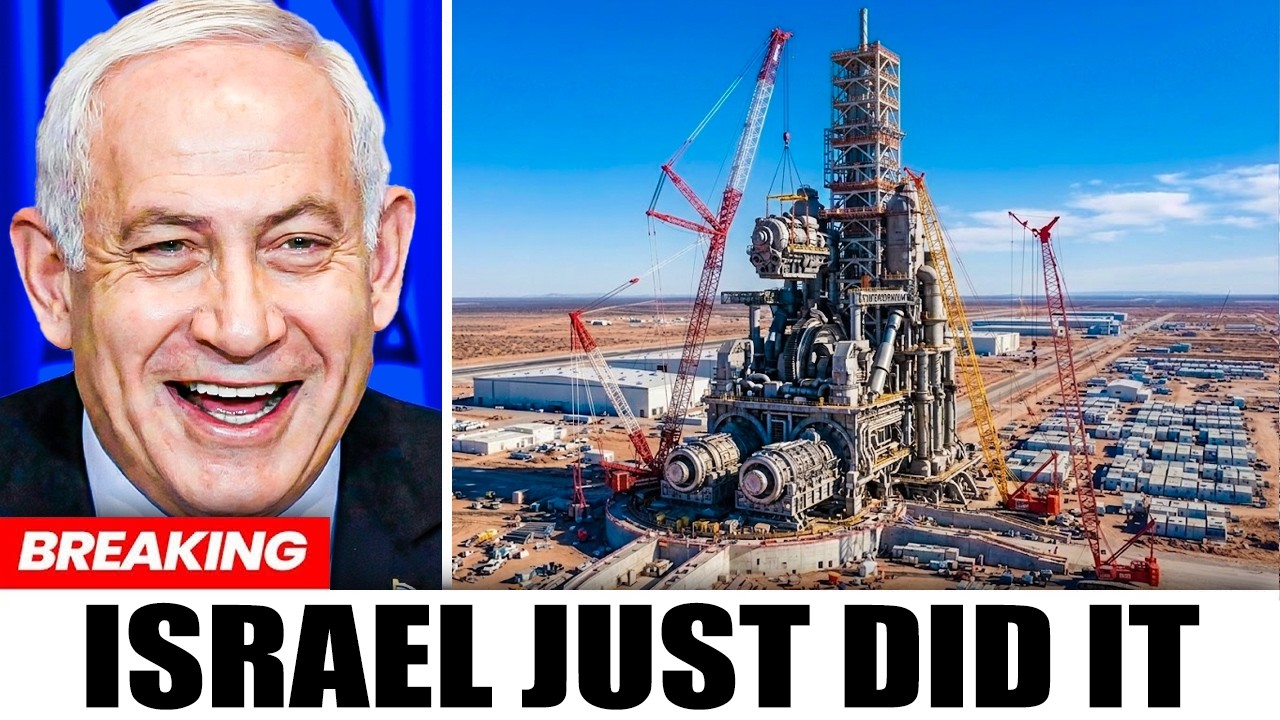
For most of its history, Israel lived with a strategic weakness that many of its neighbors never had to face.
Surrounded by some of the richest energy-producing nations on Earth, it possessed almost none of the resources that fueled the modern Middle East. Oil flowed beneath the deserts and seas of nearby countries, generating wealth, influence, and power. Israel, meanwhile, remained heavily dependent on imported energy, leaving its economy and national security vulnerable to events beyond its control.
Then everything changed.
Hidden beneath the eastern Mediterranean lay a discovery so massive that it would transform Israel’s future. What began as a risky search for offshore resources evolved into one of the most ambitious infrastructure programs in the country’s history. Engineers drilled miles beneath the seabed, assembled gigantic offshore platforms, carved tunnels through mountains, built some of the world’s most advanced desalination plants, and created projects that reshaped regional politics.
The result was far more than an energy revolution. It altered diplomatic relationships, strengthened economic independence, and helped turn a resource-poor nation into a growing regional powerhouse.
This is the story of the multi-billion-dollar projects that changed Israel forever.
The Discovery That Rewrote Israel’s Future
For decades, Israel faced a difficult reality. Despite its technological achievements and rapidly growing economy, the country lacked one of the world’s most valuable strategic assets: energy resources.
Its dependence on imported oil and gas created a constant vulnerability. In a region where political tensions and conflicts can escalate quickly, relying on foreign suppliers for energy carried significant risks. A diplomatic dispute, regional crisis, or disruption in supply routes could create immediate problems for the nation.
To solve this challenge, Israel turned its attention offshore.
Geologists began examining the Levant Basin beneath the Mediterranean Sea, an area believed to contain untapped hydrocarbon reserves. Several energy companies partnered together to conduct extensive surveys across the seabed, searching for signs of natural gas.
Then, in 2010, they found something extraordinary.
Approximately 81 miles off Israel’s coast, seismic scans revealed a geological structure unlike anything previously discovered in the region. The data suggested the presence of a massive underground reservoir.
At first, nobody knew for certain what was hidden beneath the seabed. The only way to find out was through an extremely expensive and risky drilling operation.
A single exploration well would cost more than $90 million.
If no gas was found, the investment would be lost.
The gamble paid off.
After drilling thousands of feet beneath the ocean floor, engineers struck natural gas. Further studies revealed the astonishing scale of the discovery. The newly named Leviathan Field contained roughly 22 trillion cubic feet of recoverable natural gas.
The find instantly became one of the largest offshore gas discoveries of the decade.
Suddenly, Israel possessed enough natural gas to potentially meet domestic demand for decades while also creating opportunities for exports.
But finding the gas was only the beginning.
Building a Giant Beneath the Sea
Discovering a resource and extracting it are two very different challenges.
The Leviathan Field sat nearly 5,000 feet below the ocean’s surface and stretched across a vast underwater area. Accessing it required one of the largest engineering efforts ever undertaken by Israel.
The first development phase alone cost approximately $3.6 billion.
Engineers drilled multiple production wells into the reservoir, each extending more than 16,000 feet beneath the sea. These wells were positioned strategically to maximize output while ensuring long-term sustainability.
Once the gas reached the wells, it needed a way to travel to processing facilities.
A complex network of underwater flow lines connected each well to gathering systems on the seabed. These systems acted like giant underwater intersections, collecting gas from multiple sources before directing it toward a central platform.
The centerpiece of the entire project was the Leviathan Platform.
Weighing approximately 38,000 tons, the structure resembled a floating industrial city.
Interestingly, it was not built in Israel.
Instead, massive sections were fabricated in Texas before being transported across the Atlantic Ocean. The journey required specialized ships capable of carrying enormous components thousands of miles to the Mediterranean.
Once the pieces arrived, one of the world’s largest crane vessels assembled them offshore with remarkable precision.
Working at sea is notoriously difficult. Waves, wind, and changing weather conditions can quickly turn even simple tasks into dangerous operations.
Every component had to be positioned accurately.
Any major mistake could have delayed the project for months or caused catastrophic damage.
Eventually, the giant platform emerged above the water.
Standing more than 150 feet above sea level and extending hundreds of feet below it, the facility became the operational heart of Israel’s offshore gas industry.
A Factory in the Middle of the Ocean
The Leviathan Platform is far more than a drilling site.
In many ways, it functions like a self-contained industrial city.
Workers live onboard for extended periods, often spending weeks or months away from home. Living quarters, dining facilities, operational centers, and maintenance areas allow hundreds of personnel to operate continuously around the clock.
The platform’s most important role, however, is processing natural gas.
Freshly extracted gas contains impurities and must be stabilized before transportation. Specialized equipment removes unwanted substances and prepares the gas for delivery to customers onshore.
After processing, the gas enters a network of pipelines stretching across the seabed toward Israel’s coastline.
These pipelines carry enormous volumes of energy directly into the national grid.
Today, the Leviathan Field produces billions of cubic meters of natural gas annually, helping fuel homes, industries, and power stations throughout the country.
The impact has been enormous.
Israel dramatically reduced its dependence on coal, lowering emissions while improving energy security. The availability of affordable natural gas also boosted industrial development and strengthened the country’s petrochemical sector.
Yet the project’s influence extends far beyond economics.
Turning Gas Into Diplomacy
Natural gas gave Israel something it had never possessed before: regional energy leverage.
Instead of importing energy, Israel could now export it.
This created new opportunities for diplomacy.
Historically, Israel’s relationships with many neighboring countries have been complicated by decades of political and military tensions. Energy exports offered a new foundation for cooperation.
The logic was straightforward.
Countries that depend on one another economically often have stronger incentives to maintain stable relations.
Israel signed major agreements with neighboring states, including Egypt and Jordan.
One agreement with Egypt involved tens of billions of dollars in natural gas exports. Another long-term deal helped supply a substantial portion of Jordan’s energy needs.
These arrangements created new forms of interdependence that would have seemed unlikely just a few decades earlier.
Energy became more than a commodity.
It became a diplomatic tool.
Protecting a Strategic Lifeline
With billions of dollars invested and national energy security at stake, protecting the Leviathan infrastructure became a top priority.
Offshore platforms are vulnerable targets.
Missiles, drones, sabotage operations, and regional conflicts all present potential threats.
To defend these assets, Israel deployed significant naval resources around its offshore facilities.
Warships patrol the area, while advanced defense systems provide protection against airborne threats.
Among the most important technologies is the naval version of Israel’s famous missile-defense network, designed to intercept rockets, drones, and other incoming attacks before they can reach critical infrastructure.
The goal is simple: ensure that the country’s energy lifeline remains operational under virtually any circumstances.
The Haifa Port Controversy
Energy was only one part of Israel’s infrastructure transformation.
Another major project emerged at Haifa, one of the country’s most important ports.
For centuries, Haifa has served as a crucial gateway between Europe, Asia, and the Middle East. As global trade expanded, however, existing facilities struggled to handle increasing traffic.
To address the problem, Israel launched a major port expansion.
The centerpiece was the Bay Terminal, a modern deep-water facility capable of accommodating some of the largest cargo vessels in the world.
Construction cost more than $1 billion.
What should have been a straightforward infrastructure success soon evolved into an international controversy.
Management of the new terminal was awarded to Shanghai International Port Group, a Chinese company.
The decision immediately attracted attention from the United States.
American officials expressed concerns about potential security risks because Haifa regularly hosts vessels associated with the U.S. Navy.
Critics worried that Chinese management of such a strategically important facility could potentially provide opportunities for intelligence gathering.
The debate quickly became part of the larger geopolitical competition between Washington and Beijing.
To address concerns, Israel implemented safeguards allowing authorities to take control of operations during emergencies.
Even today, the Haifa project remains an example of how infrastructure can become intertwined with global power politics.
Solving the Water Crisis
While energy security attracted headlines, another challenge threatened Israel’s future: water.
The country exists in a region where freshwater resources are limited.
Population growth increased demand, while natural supplies remained constrained.
Rather than accepting chronic shortages, Israel embraced a solution that many considered revolutionary.
Desalination.
By removing salt from seawater, desalination plants can create fresh drinking water on an industrial scale.
Israel invested billions of dollars into this technology.
Facilities such as Sorek and Ashkelon became among the most advanced desalination plants in the world.
Together, they produce hundreds of millions of cubic meters of freshwater every year.
The transformation has been remarkable.
Today, desalination supplies the majority of Israel’s domestic water needs, providing a level of water security that would have seemed impossible just a generation ago.
In a region where water scarcity often creates tension, this achievement may be every bit as important as the discovery of natural gas.
Tunneling Through Mountains
Another ambitious undertaking focused on transportation.
Connecting Tel Aviv and Jerusalem has always been challenging because of the rugged terrain separating the two cities.
Steep mountains and deep valleys made traditional rail construction difficult.
Engineers responded with a bold solution.
They drilled directly through the mountains.
Massive tunnel-boring machines carved passageways through solid rock while enormous bridges crossed difficult terrain.
The resulting A1 railway dramatically improved travel between Israel’s economic and political centers.
One of its most impressive features is the Yitzhak Navon Railway Station in Jerusalem.
Located approximately 260 feet underground, it ranks among the deepest railway stations in the world.
But transportation is only part of its purpose.
The station was designed with security in mind and can function as a protected shelter during emergencies, capable of housing thousands of people.
It represents a unique blend of transportation infrastructure and civil defense planning.
The Unfinished Dream
Not every mega project succeeds.
One of Israel’s most ambitious proposals involved the rapidly shrinking Dead Sea.
Water levels have been falling for decades, creating environmental problems throughout the region.
To address the crisis, planners proposed the Red Sea–Dead Sea Conveyance Project.
The idea was bold.
Water from the Red Sea would be transported northward, desalinated for human use, and then the remaining brine would be directed into the Dead Sea to help replenish it.
On paper, the project appeared capable of solving multiple problems simultaneously.
However, scientific studies raised serious concerns.
Researchers warned that mixing water from the two seas could trigger unexpected chemical reactions and potentially damage fragile ecosystems.
Faced with these uncertainties, the project was ultimately shelved.
The shrinking Dead Sea remains one of the region’s most significant environmental challenges.
A Nation Reinvented Through Infrastructure
The story of Israel’s transformation is not merely about natural gas, ports, railways, or desalination plants.
It is about how infrastructure can reshape a country’s future.
The Leviathan Field provided energy independence. Desalination plants secured water supplies. High-speed rail strengthened connectivity. Modern ports expanded trade. Together, these projects addressed some of the most fundamental vulnerabilities facing the nation.
They also demonstrate a larger lesson.
Countries are not transformed only by politics or military power. Sometimes they are transformed by engineers, geologists, construction workers, and planners willing to tackle problems that once seemed impossible.
For Israel, billions of dollars in mega projects have done more than build infrastructure.
They have helped redefine the country’s place in the Middle East and secured resources that may shape its future for decades to come.