China Reintroduced Extinct Wild Horses Into the Desert — 5 Years Later Everything Changed
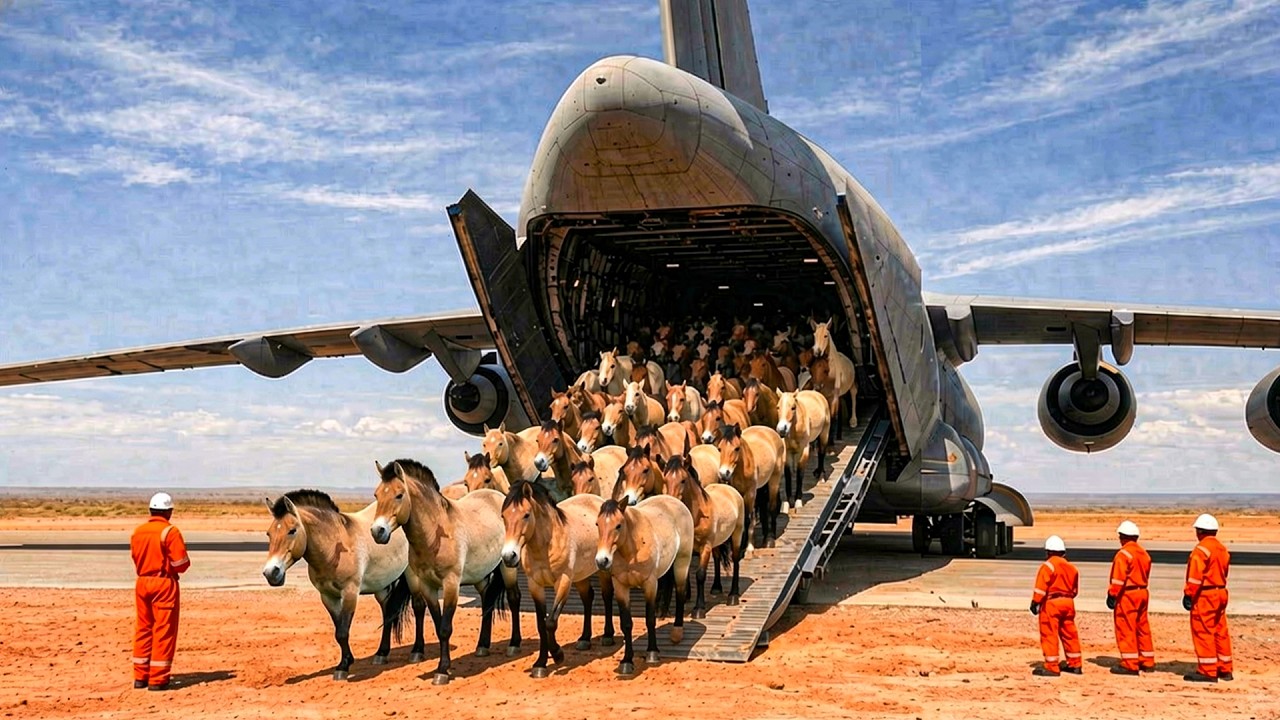
The Horse That Came Back From Extinction: How China Returned a Lost Species to the Desert—and Changed an Entire Ecosystem
For decades, the wild horse was gone.
Not rare. Not endangered. Gone.
Scientists searched the deserts and grasslands where it once roamed, but there was nothing left to find. The last true wild horse on Earth had vanished from nature, and many believed it would never return. Yet today, herds of these animals are once again running across some of the harshest landscapes in Asia. Against all odds, they are not only surviving—they may be helping bring an entire ecosystem back to life.
This is the remarkable story of how a species declared extinct in the wild made one of the greatest wildlife comebacks in modern history.
The Forgotten Horse
Long before highways crossed the Asian steppe and before modern cities spread across the region, vast herds of wild horses roamed the grasslands stretching from Mongolia into northern China and Central Asia.
These were not the horses people rode into battle or used on farms. They were something different.
Known as Przewalski’s horse, they were shorter, stockier, and tougher than domestic horses. Their legs were powerful, their bodies compact, and their upright mane stood straight like a brush rather than falling over the neck. Everything about them reflected thousands of years of adaptation to life in a harsh and unpredictable environment.
For generations, scientists considered them the last truly wild horse species on Earth.
Unlike mustangs in North America, which descended from domestic horses brought by humans, Przewalski’s horses evolved independently. They belonged to the landscape itself.
And for thousands of years, they thrived.
Then the modern world arrived.
Hunting pressure increased dramatically. Firearms made it easier than ever to kill wild animals. At the same time, expanding agriculture and livestock grazing transformed the grasslands that these horses depended on.
Cattle, sheep, and goats competed for the same vegetation. Human settlements expanded deeper into previously wild areas. Water sources became more crowded. Grazing lands shrank.
The decline happened slowly enough that few people noticed at first.
Then it accelerated.
By the mid-20th century, sightings became increasingly rare. Small groups disappeared. Herds fragmented. The remaining horses retreated into remote corners of the Gobi Desert and surrounding regions.
Finally, in 1969, the species disappeared from the wild entirely.
Scientists searched desperately for survivors.
They found none.
Przewalski’s horse was officially declared extinct in nature.
For most species, that would have been the end of the story.
But fate had other plans.
Survival by Accident
The reason Przewalski’s horses still exist today is not because of a carefully designed conservation strategy.
It happened largely by accident.
Decades before the species vanished from the wild, a small number of horses had been captured and transported to zoos across Europe and Asia. At the time, they were simply considered unusual animals worthy of display.
No one knew they represented humanity’s last insurance policy against extinction.
When scientists realized the species had vanished from nature, they turned their attention to zoos around the world.
The results were shocking.
Only about 200 horses remained alive in captivity.
Even more alarming, every one of them descended from just 13 founder animals.
That created an enormous problem.
When a species is reduced to such a tiny population, it experiences what scientists call a genetic bottleneck. Genetic diversity collapses. Harmful traits become more common. Disease resistance can weaken. Fertility can decline.
Many experts feared the species was doomed regardless of conservation efforts.
Even if the horses survived behind fences, they might never recover enough genetic strength to thrive independently.
Yet conservationists refused to give up.
Zoos across multiple countries began cooperating in an unprecedented effort to save the species.
In 1959, Prague Zoo established the first international studbook for Przewalski’s horses, carefully tracking the ancestry of every living individual.
Breeding was no longer random.
Every pairing was planned.
Scientists studied family trees, monitored genetic diversity, and coordinated internationally to maximize the health of future generations.
Every foal mattered.
Every birth represented another chance for survival.
Year after year, the population slowly increased.
The species had escaped extinction.
But another question remained.
Could it ever be wild again?
A Radical Idea
While conservationists worked to rebuild the population, another crisis was unfolding in northwestern China.
The region’s grasslands were changing.
What had once been productive steppe ecosystems were increasingly threatened by desertification. Wind erosion stripped away soil. Vegetation became sparse. Drought conditions intensified.
Large areas of grassland slowly transformed into barren landscapes.
Scientists noticed a troubling pattern.
When large herbivores disappeared, ecosystems often became less resilient.
Without grazing animals, plant communities changed. Seed dispersal declined. Nutrient cycles weakened. Ecological processes that had operated for thousands of years began to break down.
That observation led to a controversial question.
What if restoring lost animals could help restore damaged landscapes?
At first, the idea sounded backwards.
How could introducing large grazing animals into a struggling ecosystem possibly improve it?
Wouldn’t they simply consume even more vegetation?
Research suggested otherwise.
Ecologists increasingly recognized that large herbivores often function as ecosystem engineers. Their movement, grazing, and natural behavior can shape landscapes in ways that promote biodiversity and ecological health.
The absence of these animals might actually be part of the problem.
And if that was true, then bringing them back might be part of the solution.
China decided to find out.
Preparing for the Impossible
The decision to return Przewalski’s horses to the wild was ambitious.
Some thought it was reckless.
After all, these horses had spent generations in captivity. Many had never experienced a truly wild environment.
They knew fences.
They knew feeding schedules.
They knew human care.
The desert knew none of those things.
Before any release could happen, scientists spent years preparing.
The first step was choosing the right animals.
Not every horse qualified.
Researchers evaluated age, health, behavior, and genetic value. The selected horses needed to be physically strong, adaptable, and capable of contributing to future populations.
Then came behavioral training.
The horses were moved into large semi-wild enclosures covering vast areas of land. Human interaction was minimized. Supplemental feeding became less predictable.
The goal was simple but difficult.
Help the animals rediscover instincts they had not needed for generations.
They needed to learn how to locate food, find water, travel as a herd, and survive with minimal human assistance.
Meanwhile, scientists searched for the perfect release location.
Eventually they chose Kalamaili Nature Reserve in Xinjiang.
Spanning thousands of square miles of desert and steppe, it closely resembled the historical habitat where Przewalski’s horses once lived.
Even then, skepticism remained.
Critics argued that the ecosystem had changed too much.
Others believed the horses would quickly die from starvation, disease, predators, or extreme weather.
Many doubted captive-bred animals could ever function as wild animals again.
Yet after years of preparation, there was only one way to discover the truth.
The gates would have to open.
The First Steps into Freedom
In 2001, the moment finally arrived.
The first group of horses stood at the edge of their enclosure facing a landscape none of them had ever experienced.
The world beyond was vast.
Silent.
Unpredictable.
For a few moments, they hesitated.
Then one horse stepped forward.
Another followed.
Soon the entire group disappeared into the open landscape.
For conservationists, it was both exhilarating and terrifying.
Everything depended on what happened next.
The challenges appeared immediately.
Some horses wandered away from the herd and struggled.
Others had difficulty locating resources.
The first winter tested every animal.
Researchers monitored the population carefully, documenting successes and failures alike.
There were setbacks.
There were losses.
But there were also signs of hope.
The horses began identifying suitable plants.
They discovered natural water sources.
They formed stable social groups.
Most importantly, they survived.
Year after year, the population adapted.
The greatest milestone came when foals were born in the wild.
These young horses had never known fences, feeding schedules, or captivity.
They belonged entirely to the landscape.
The species was becoming wild again.
How Horses Heal a Desert
The success of the reintroduction wasn’t measured only by the horses themselves.
Scientists were equally interested in how the ecosystem responded.
What they discovered was remarkable.
The horses were influencing the landscape in multiple ways.
The first mechanism was grazing.
Although grazing often sounds destructive, moderate grazing can actually increase plant diversity. By preventing a few dominant species from taking over, grazing creates opportunities for many other plants to grow.
This diversity supports insects, birds, and small mammals throughout the ecosystem.
The horses also became seed dispersers.
As they traveled across the landscape, seeds passed through their digestive systems and were deposited in new locations.
Some plants actually germinate more effectively after passing through an animal’s gut.
In effect, the horses were helping plant new vegetation across the desert.
Their hooves contributed as well.
As they moved, they disturbed compacted soil, creating small depressions that trapped moisture and allowed seeds to establish themselves more easily.
These tiny disturbances created opportunities for new growth.
The animals also improved nutrient cycling.
By consuming vegetation and returning nutrients through waste, they helped fertilize the soil naturally.
Healthier soils supported healthier plants.
Healthier plants supported more wildlife.
The benefits multiplied throughout the ecosystem.
Over time, vegetation surveys revealed measurable improvements in areas heavily used by the horses.
Plant diversity increased.
Wildlife activity expanded.
The land became more productive.
What initially looked like a simple reintroduction was evolving into something much larger.
The horses were helping restore ecological processes that had been missing for decades.
The Return of an Ecosystem
Perhaps the most important lesson from this project is that ecosystems are more than collections of plants.
Modern conservation often focuses heavily on vegetation restoration. Trees are planted. Grasslands are seeded. Landscapes are managed.
Those efforts matter.
But ecosystems depend on relationships.
Animals move nutrients.
They disperse seeds.
They shape vegetation.
They create habitats for other species.
Without those interactions, restoration can remain incomplete.
Przewalski’s horses demonstrate this principle perfectly.
They are not merely inhabitants of the ecosystem.
They are active participants in its functioning.
Their daily behavior influences everything around them.
Over time, these influences accumulate.
A healthier grassland supports more insects.
More insects support more birds.
More vegetation improves soil stability.
Better soil retains more water.
The system gradually becomes more resilient.
Life builds upon life.
A Global Inspiration
China’s success has inspired similar efforts elsewhere.
Reintroduction programs have expanded across Mongolia and Kazakhstan, where conservationists hope to restore larger portions of the species’ historical range.
One of the most surprising examples emerged in an unexpected location: the Chernobyl Exclusion Zone.
After the 1986 nuclear disaster, humans largely abandoned the region. Wildlife gradually returned.
Przewalski’s horses introduced there established breeding populations and adapted successfully to the landscape.
Their presence demonstrated once again how resilient nature can be when given the opportunity.
Today, approximately 2,000 Przewalski’s horses live in wild and semi-wild populations across Central Asia and beyond.
For a species once extinct in nature, the recovery is extraordinary.
More Than a Conservation Story
The return of Przewalski’s horse is not simply a story about saving a species.
It is a story about restoring connections.
When the horses disappeared, the ecosystem lost more than an animal. It lost behaviors, interactions, and processes that had evolved over thousands of years.
When the horses returned, those processes began returning too.
The transformation did not happen overnight.
It took decades of planning, international cooperation, scientific research, and patience.
Yet the results reveal something profound.
Nature is often more resilient than we imagine.
Given the right conditions, damaged systems can recover.
Lost species can return.
Landscapes can heal.
Five years after the first 27 horses stepped into Kalamaili Reserve, many skeptics had their answer.
The horses had not merely survived.
They had become catalysts for ecological recovery.
Today, their descendants continue to roam the deserts and grasslands of Central Asia, carrying with them a lesson that extends far beyond conservation.
Sometimes saving a species means saving an ecosystem.
And sometimes the key to restoring the future is bringing back something we thought was lost forever.