What Mel Gibson Found in the Ethiopian Bible Reveals Shocking Truth About Jesus!
The Hidden Books Mel Gibson Is Using for His Resurrection Film: Enoch, the Ascension of Isaiah, and the Suppressed Story of Jesus
Mel Gibson’s upcoming film about the resurrection has drawn attention not just for its subject matter, but for the ancient sources he appears to be drawing from. While most people are familiar with the standard 66-book Protestant Bible (or the 73-book Catholic version), Gibson has reportedly been exploring older, more expansive Christian traditions — particularly those preserved in the Ethiopian Orthodox Church, which recognizes 81 books as scripture.
These additional texts, long excluded from Western Bibles, describe a more layered spiritual reality, including a structured descent of Jesus through unseen realms and a detailed explanation of how evil entered the world. For Gibson, these writings seem to fill in what he believes is missing from the familiar gospel accounts.
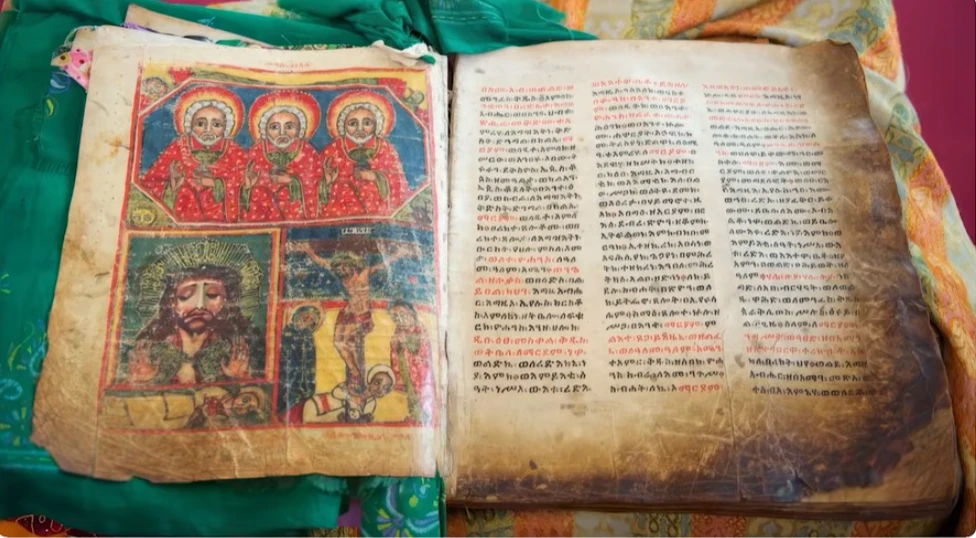
The Ethiopian Bible and Its 81 Books
The Ethiopian Orthodox Tewahedo Church has preserved one of the oldest and largest Christian canons in existence. While most Christian traditions settled on 66 or 73 books, Ethiopia maintained 81, including texts such as:
1 Enoch
Jubilees
The Ascension of Isaiah
The Shepherd of Hermas
Ethiopian versions of the Maccabees
These books were never removed in Ethiopia because the region’s geography — deserts, mountains, and difficult trade routes — largely protected it from the political and religious pressures that shaped the Western canon. While church councils in Rome and elsewhere debated and eventually excluded certain writings, those decisions never reached Ethiopia in the same way.
Monks in Ethiopia went to extraordinary lengths to protect these texts, sometimes memorizing entire books or hiding manuscripts in remote cliffside caves.
1 Enoch: The Origins of Evil and the “Son of Man”
One of the most significant excluded books is 1 Enoch. Written centuries before Christ (with fragments found among the Dead Sea Scrolls), it offers a very different explanation for how evil entered the world.
Instead of a single serpent tempting Eve, Enoch describes a group of heavenly beings called the Watchers who deliberately left their assigned place in heaven. Led by figures such as Samjaza and Azazel, they came to earth, took human wives, and taught humanity forbidden knowledge — including how to make weapons, work with metals, and manipulate appearance.
Their offspring, known as the Nephilim, are described as destructive giants who filled the earth with violence. According to Enoch, the Flood was not just a general punishment for wickedness, but a targeted response to remove the Nephilim.
The book also contains one of the earliest detailed descriptions of a figure called the Son of Man — a pre-existent being seated on a throne with authority to judge the nations. Many scholars note that when Jesus repeatedly referred to himself as the “Son of Man” in the Gospels, he was likely drawing on language already familiar from texts like Enoch.
The Ascension of Isaiah: The Hidden Descent
Another key text is the Ascension of Isaiah. This early Christian writing describes the prophet Isaiah being taken up through seven distinct levels of heaven. It then describes a figure (referred to as “the Beloved”) descending through these same levels.
Crucially, as he descended, he took on the appearance of the beings in each realm so that he passed through undetected. The text suggests that the lower heavens were under the influence of adversarial spiritual forces, and that the Beloved moved through them in disguise.
After his death and resurrection, the same figure ascends again — but this time fully revealed, with every being recognizing him.
This portrayal adds a dramatic, almost hidden dimension to the story of Jesus’ entry into the world — one that goes far beyond what is described in the four canonical Gospels.
Why These Books Were Excluded
The process of forming the New Testament canon was not purely spiritual. It was also political. In the 2nd century, a man named Marcion created one of the first official lists of Christian writings — but he rejected the entire Old Testament and promoted a sharp divide between the God of the Old Testament and the God revealed by Jesus.
This forced early church leaders to respond by defining which books were acceptable. Later, in the 4th century, Emperor Constantine called the Council of Nicaea, and bishops like Athanasius began formalizing the 27-book New Testament we know today.
Texts that were seen as too mystical, too apocalyptic, or that challenged emerging church authority were gradually pushed out. In some cases, copies were destroyed. Ethiopia, being geographically isolated, was largely unaffected by these decisions and continued preserving the wider collection.
Mel Gibson and the Resurrection Story
Mel Gibson has publicly stated that the resurrection story is much bigger than what is shown in the Gospels. He has spoken about “layers” and unseen parts of the narrative that were never fully told on screen. The texts preserved in Ethiopia — particularly 1 Enoch and the Ascension of Isaiah — closely match the kind of expanded, cosmic story Gibson has described wanting to tell.
By drawing from these sources, Gibson appears to be exploring a version of Jesus that existed before the world began, who descended through hidden spiritual structures, and whose mission operated on multiple levels — not just the earthly one.
A Bigger Story
The discovery of the Dead Sea Scrolls in 1947 confirmed that books like 1 Enoch existed long before the time of Jesus and were read in the same region where early Christianity emerged. This makes it harder to dismiss these texts as later inventions.
For many, the question is no longer simply “Are these books true?” but rather: Why were they removed, and what was lost when they were?
Mel Gibson’s project has the potential to bring parts of this larger story to a global audience for the first time in centuries. Whether one agrees with every detail in these ancient texts or not, they offer a more expansive, and in some ways more dramatic, vision of the spiritual battle surrounding the life, death, and resurrection of Jesus than what most people have been taught.
The version of the story that survived in Ethiopia may not replace the Gospels — but it may help explain what the Gospels only hinted at.