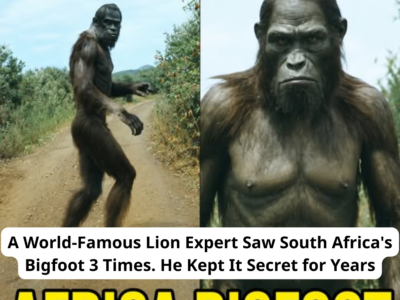
A World-Famous Lion Expert Saw South Africa’s Bigfoot 3 Times. He Kept It Secret for Years
The Knysna Forest serves as a masterclass in the fallibility of human arrogance. We operate under the delusion that our technology—our satellites, our thermal imaging, our constant aerial surveillance—has stripped the planet of its secrets, leaving no dark corners for the unknown to exist. Yet, the Knysna elephants, once officially declared a “dying ghost” of a population by the very experts tasked with their protection, were hiding in plain sight all along. That they were discovered not by a sensor, but by a man walking 22,000 kilometers on foot, is a scathing indictment of the modern, desk-bound scientific consensus.
If a multi-ton animal—an elephant—can vanish into the Afro-temperate canopy for decades, why are we so smugly certain that something smaller, faster, and more elusive cannot? The Otang is not a creature of supernatural lore; it is a creature of tactical survival. Gareth Patterson, a man whose life is built upon the dangerous, intimate trust of apex predators, reports a being that mirrors the behavioral patterns of the forest itself. He describes something that doesn’t hunt in the open or pose for cameras, but rather observes with a caution that implies intelligence.
The most profound element of this narrative is not the sighting itself, but the silence that followed. We live in an era of performative discovery, where every minor anomaly is immediately monetized into a brand, a podcast, or a social media spectacle. Patterson’s choice to bury the truth for years is a quiet, brutal act of discipline. He understood that the currency of his work was his credibility, and he knew exactly how quickly the establishment would weaponize the label of “cryptid hunter” to discredit his vital, ongoing defense of the Knysna elephants. He prioritized the real, endangered, and living over the sensational and the unprovable.
This exposes the deep hypocrisy of our discourse. We demand “proof” from witnesses who are often terrified, marginalized, or simply trying to make sense of a reality that has broken their understanding of the world. Yet, when a highly trained observer—a man who has faced down lions—presents a sighting with restraint and nuance, we default to the comfort of the “hoax” narrative. We do this because accepting the possibility of the Otang requires us to abandon the safety of our own certainty. It forces us to admit that we are not the masters of these environments, but merely temporary, noisy guests who are consistently outmaneuvered by the things that have truly mastered the shadows. We want the world to be categorized, predictable, and fully mapped, and we will ruthlessly mock anyone who suggests that the map is incomplete.