The Sumerian Tablet Listing 5 Species That Existed Before Humans — And How Each One Ended
The Sumerian Tablet Listing 5 Species That Existed Before Humans — And How Each One Ended
Part 1
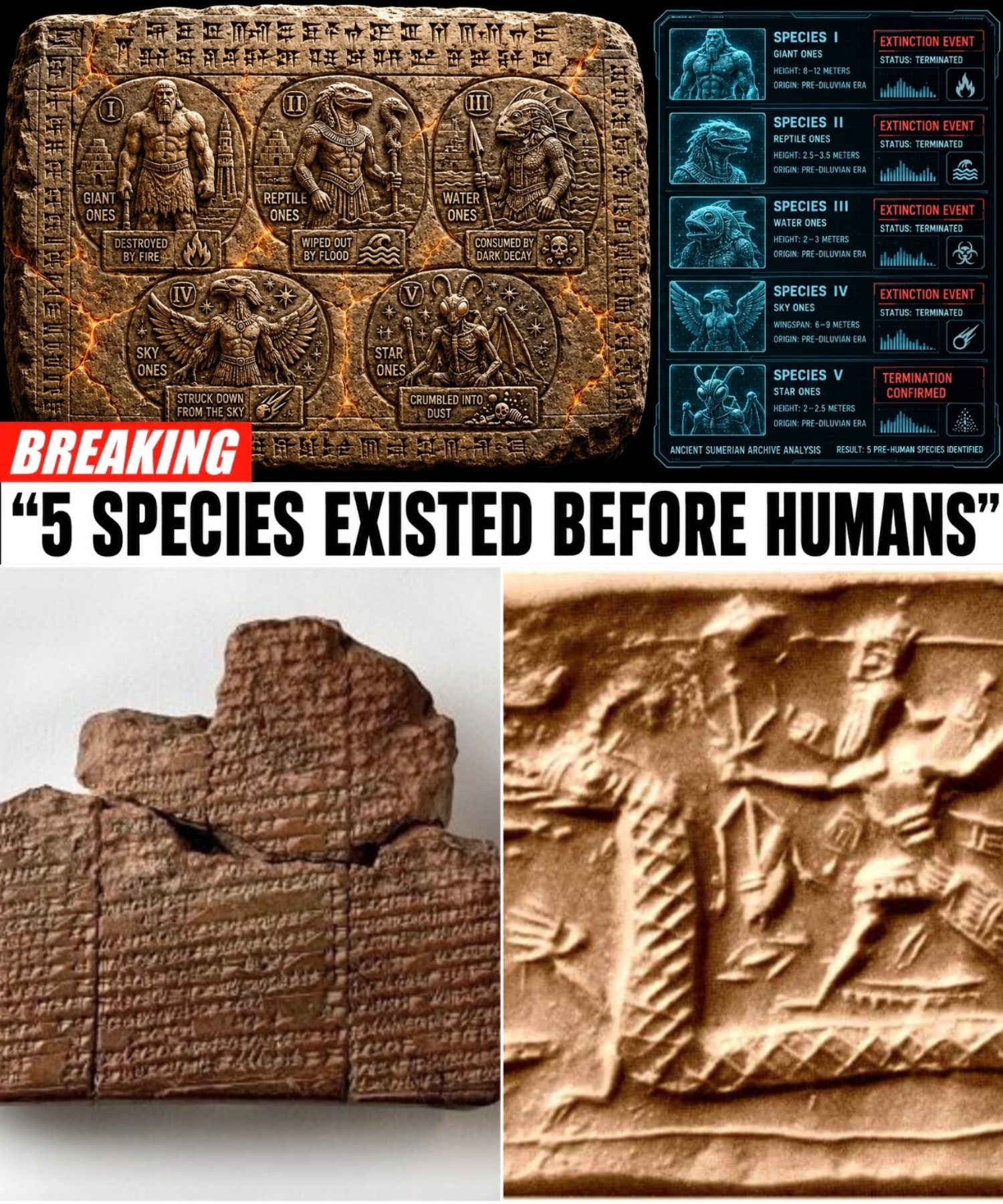
The tablet arrived in New York City inside a cedar-lined crate with no return address, no customs record, and no explanation except for one typed sentence taped beneath the lid: Do not translate this unless you are ready to know what lived here before us. Dr. Elena Mercer read the sentence twice under the cold fluorescent lights of the private archaeology lab beneath the American Museum of Natural History, then stared at the object resting on the foam padding. It was a clay tablet, dark reddish brown, cracked at the edges, and covered with markings that looked Sumerian at first glance. But the strangest thing about it was not the language. It was the map carved across its back: North America, long before borders, long before cities, with five symbols burned into five regions—New York, Ohio, the Mojave Desert, the Pacific Coast near Los Angeles, and the high plains stretching toward Montana.
Elena had spent twenty years studying ancient writing systems, and she had never seen anything like this. She called her colleague Marcus Hale in Cleveland, Ohio, a geologist with an obsession for buried impact layers. She called Dr. Priya Anand in Los Angeles, a biologist who specialized in extinct species. She called Samuel Ortiz in Brooklyn, a documentary journalist whose work had already exposed three forged antiquities and two academic scandals. By midnight, the four of them were connected over an encrypted video call, the tablet rotating slowly under Elena’s scanner. At first they thought it was a fake, a dramatic hoax built to generate viral panic. But the clay composition contained mineral traces from ancient river deposits, the script followed grammatical rules that even professional forgers often missed, and the map showed Ice Age coastlines with a precision no casual faker would know.
The translation began with a warning. The tablet did not describe kings, trade, war, or offerings to temples. It described “those who held the earth before the clay-born people.” Elena stopped reading aloud when she reached that phrase. Marcus laughed nervously from Ohio and said, “Clay-born people. That’s us, isn’t it?” Nobody answered. The next lines listed five names, each paired with a region and a final sentence describing its end. The first species was called the Deep Listeners, said to have lived beneath the rivers and lakes. The second was called the Glass-Boned Ones, beings of the desert who walked under the stars and left no graves. The third was called the Tall Keepers, rulers of forests and mountain passes. The fourth was called the Bright-Mouthed Swimmers, intelligent ocean dwellers who spoke through light. The fifth was called the Ash Children, a final species born after fire fell from the sky.
In Manhattan, thunder rolled over Central Park though the forecast had promised clear weather. The lights in the lab flickered once, then steadied. Samuel leaned over Elena’s shoulder and whispered, “This is exactly the kind of thing people click on and then dismiss. But if this is real, it’s not a story about ancient Sumer anymore. It’s about America.” Elena looked again at the five carved symbols. One rested exactly where New York now stood. One sat over Ohio. One marked the desert outside Los Angeles. One lay beneath the Pacific shelf. One burned over the northern plains. She realized the tablet was not saying these species lived somewhere far away in myth. It was saying they had lived here, before America had a name, before humans inherited the continent.
By dawn, the team made a decision. They would not publish the translation yet. They would test the tablet against the land itself. If the first symbol pointed to New York’s ancient waterways, then somewhere beneath the Hudson or buried under old glacial sediment there might be evidence of the Deep Listeners. Elena contacted a city infrastructure office under the excuse of studying Ice Age deposits. Samuel arranged cameras. Marcus flew in from Ohio before noon. Priya booked a flight from Los Angeles and warned them not to touch any biological remains without her. “If this tablet is telling the truth,” she said, “we may not be dealing with extinct animals. We may be dealing with extinct civilizations that were never human.”
That evening, the first excavation began under an abandoned maintenance tunnel near the Hudson River. The air smelled of wet stone, rusted iron, and old mud. Workers drilled carefully through a sealed layer beneath the city, and water seeped through the cracks in thin black lines. Elena held the tablet’s translation in one hand and a flashlight in the other. The first entry read: The Deep Listeners lived where water carried memory. They heard the movement of stone, the grief of beasts, and the coming of ice. They ended when the rivers changed their song. A worker suddenly shouted from below. The drill had opened into a chamber. It was not part of any subway map, sewer plan, or colonial foundation.
Inside the chamber, carved into a wall of dark stone, were five shallow depressions shaped like ears.
Part 2
The chamber beneath New York was small, but it felt older than the city above it, older than the river, older than the idea that humans could build anything permanent. The walls were smooth in a way that disturbed Marcus. Natural stone did not polish itself into curved panels. Human hands had not made these lines either, at least not with any known tool. Samuel filmed while Elena studied the carvings. The ear-shaped depressions were arranged in a spiral, and when Marcus pressed his palm near one, the chamber seemed to hum. It was faint, barely audible, but the sound traveled through their bones more than their ears. Everyone stopped moving. Above them, New York traffic roared, horns blared, trains ran, millions of lives continued. Beneath it all, the stone answered with a low note like a sleeping animal.
Priya arrived from Los Angeles the next morning and immediately found traces inside the chamber’s sediment: fragments of calcium structures, thin and curved, unlike shells, unlike bones, unlike anything in the museum collections she had studied. Under magnification, the fragments showed growth rings arranged in sound-wave patterns. “These weren’t ears,” Priya said. “They were organs. Or architecture built from organs. I don’t know which possibility is worse.” Elena returned to the tablet and translated the first full passage. The Deep Listeners had not seen the world the way humans did. They lived in underground waterways and sensed vibration through mineral plates along their bodies. They mapped rivers by sound. They knew storms before clouds formed. They knew earthquakes days before mountains moved. They built chambers where water carried messages across hundreds of miles.
Marcus wanted proof beyond the chamber, so the team traveled west to Ohio, where the second marked region overlapped with ancient lakebeds and river systems. Near Cleveland, in a restricted quarry outside the city, he had once found an unusual acoustic layer in limestone—stone that rang when struck. At the time he thought it was a geological oddity. Now, standing under gray Ohio skies with Elena, Priya, and Samuel beside him, he struck the rock again. The sound carried through the quarry, then returned as a layered echo. Samuel’s microphone caught patterns that resembled pulses, almost like a response. The tablet’s first species suddenly felt less like myth. The Deep Listeners had not vanished from New York alone. They had lived along a hidden network reaching into Ohio.
In Cleveland, the team accessed old flood-control tunnels beneath the Cuyahoga River. There they found another chamber, larger than the one in New York, with walls patterned in spirals and grooves. At the center lay a stone basin filled with dry mineral dust. Priya collected a sample, and under portable light the dust shimmered silver-blue. The tablet explained that the Deep Listeners ended when glaciers melted and rivers changed course too quickly for their sound-networks to survive. Their bodies depended on stable underground water pressure. When the land convulsed after the Ice Age, the chambers collapsed, their communication broke, and the species entered silence. The final line of the entry was not cruel. It was mournful: They did not die screaming. They died unheard.
That sentence changed Elena. For the first time, she understood the tablet was not a monster catalog. It was an obituary. Each species had possessed intelligence, culture, memory, and a way of belonging to the world. And each had ended when the world shifted beyond their ability to adapt. The Deep Listeners were not enemies of humans. They were predecessors, witnesses to a continent still forming. Their extinction was not punishment, only consequence. The rivers changed their song, and a species built entirely around listening could no longer find its way.
The second entry on the tablet took them to the American Southwest. Priya led the team back to Los Angeles, then east into the Mojave Desert. The symbol there was shaped like a rib cage filled with stars. The tablet named the second species the Glass-Boned Ones. They were described as tall, translucent, and nearly weightless, adapted to dry plains under colder skies. They stored sunlight through crystalline bone structures and moved by night, using starlight to navigate. They did not build cities underground or underwater. They built towers of mineral glass on ridgelines where the desert met the sky.
At first Samuel thought this sounded impossible. Then they reached a remote basin two hours outside Los Angeles where strange glass fragments had been found for decades and dismissed as lightning-formed fulgurite. But fulgurite twisted randomly. These fragments curved with deliberate symmetry. Some were hollow. Some held tiny channels. Some, when held to the sun, refracted light into repeating geometric patterns. Priya stood in the heat, holding one fragment with gloved hands, her face pale. “This isn’t just melted sand,” she said. “It grew. Like bone. Like crystal. Like something biological turned itself into architecture.”
That night, under a sky crowded with stars, Elena translated the ending of the Glass-Boned Ones. They had survived by storing light, but a long season of ash darkened the sky after an ancient catastrophe. Months without sunlight starved them from within. Their towers cracked. Their bones dimmed. Their children were born opaque and brittle. They climbed the ridges to wait for the stars, but the sky remained hidden. The final sentence read: They ended not in battle, but in a darkness their bodies could not forgive.
Part 3
Los Angeles seemed too bright when they returned from the desert. Freeways flashed in the afternoon sun, glass towers reflected the sky, and tourists moved along Hollywood Boulevard unaware that two hours away, evidence of a forgotten species lay scattered in the sand. Samuel edited footage in his hotel room while Elena, Marcus, and Priya argued over whether to tell anyone. The tablet had already named two species and shown them two kinds of proof. If they went public now, they would ignite hysteria, ridicule, government interest, religious speculation, and possibly the destruction of every site. If they stayed silent, they carried knowledge too large for four people. Elena slept badly that night and dreamed of river chambers humming beneath Manhattan and glass skeletons walking under ash-dark stars.
The third species brought them north, toward the forests and mountains of the Pacific states, then back east toward the Appalachians. The tablet marked several regions, but the strongest symbol appeared over upstate New York and the wooded ridges of Ohio. The species was called the Tall Keepers. Unlike the Deep Listeners and Glass-Boned Ones, the Tall Keepers sounded almost human in the translation. They walked upright. They used tools. They guarded passes, forests, and migration routes. They stood taller than any modern human, but the tablet described them not as brutes or giants, but as “keepers of boundaries.” Elena found that phrase unsettling. Boundaries between what? Between territories, species, worlds?
Marcus arranged access to a private collection in rural Ohio, where a family had preserved unusual bones found in a cave in the 1890s. The bones had never been formally studied because the local university dismissed them as misidentified bear remains. Priya examined them in a converted barn while rain struck the roof. The femur was too long for a bear, too dense for a modern human, and marked by muscle attachments suggesting enormous strength. The skull fragment had a high cranial vault, not primitive, not monstrous, but different. Priya measured it twice, then stepped back. “If this is real,” she said, “we’re looking at another hominin line. Not a myth. Not a monster. A cousin.”
The cave where the bones had been found lay beneath a wooded hill outside Athens, Ohio. Inside, Samuel filmed ochre markings on stone walls: tall figures standing beside deer, wolves, and smaller human shapes. The figures held staffs. Some appeared to point toward mountain passes. Others stood between humans and large animals. Elena translated the corresponding tablet passage by lantern light. The Tall Keepers had emerged during an age when great beasts still crossed the continent. They guided migrations, guarded water sources, and maintained agreements between rival groups. They did not rule through conquest. They ruled by memory, remembering paths, seasons, dangers, and promises.
Their end was the saddest so far because it involved humans. The tablet said the Tall Keepers survived the cold, the floods, and the fires, but not the arrival of “the multiplying ones.” Elena knew what that meant before she finished the line. Humans spread quickly, hunted widely, and feared what they did not understand. The Tall Keepers retreated into mountains and forests. Some made peace. Some interbred. Some fought. Disease took many. Hunger took more. But the final blow came when humans began cutting forests and blocking the old migration routes. The Keepers’ purpose dissolved. A species built around guardianship could not survive when no one honored the boundaries anymore.
In New York, the evidence surfaced in a different form. A construction project north of the city uncovered a line of standing stones buried beneath glacial soil. Each stone bore handprints far larger than human hands. Between them were smaller prints, human-sized, placed carefully as if in respect. The site had been sealed for thousands of years. Samuel stood there at sunset, camera lowered, unable to speak. Elena imagined an ancient meeting: humans and Tall Keepers standing together, maybe afraid, maybe hopeful, maybe making promises that humans later forgot.
The fourth species led them to the Pacific. Priya had expected this one to interest her most, and she was right. The tablet called them the Bright-Mouthed Swimmers. They lived along coastlines now drowned by rising seas. They communicated through flashes of color, pulses of light, and patterned sound. They were not dolphins, not whales, not fish, not anything modern taxonomy could hold comfortably. The tablet described them as “those who carried speech in their skin.” Their symbol sat beneath the continental shelf west of Los Angeles.
A marine institute in California had recently detected strange light patterns near an underwater canyon. Priya had dismissed the data as bioluminescent squid. Now she was not sure. The team boarded a research vessel out of San Pedro. At night, miles off the coast, they lowered cameras into black water. At first the screen showed only drifting particles. Then something flashed in the distance: blue, green, white, arranged in repeating sequences. Priya leaned toward the monitor, breath held. The pattern repeated three times. Marcus whispered, “Is it alive?” Priya answered, “Or something alive made it.”
Deep below, the camera found walls of an underwater cave coated in mineral growths. Across those walls shimmered old pigments, preserved in low oxygen water: spirals, wave marks, and figures with luminous mouths. The Bright-Mouthed Swimmers had once built reef-cities along the ancient Pacific coast before sea levels rose. When humans were still scattered and struggling inland, these beings lived in warm coastal waters, maintaining gardens of shell, coral, and kelp. They understood currents. They warned one another of storms. They watched the moon and tides with mathematical precision.
Their ending came when the oceans changed too quickly. Warming waters disrupted their food systems. Sea levels drowned their shallow nurseries. New predators entered their territories. And then, according to the tablet, “the sky-stone struck the far ice,” sending waves that shattered their reef-cities. The survivors fled into deeper water, where their light-language weakened in darkness. Some adapted. Most did not. The final sentence read: They carried songs into the deep, and the deep did not answer.
Part 4
By the time the team returned to Los Angeles, the tablet no longer felt like an artifact. It felt like a witness. Elena had begun speaking to it in her mind, asking why these five species were listed, why their endings were preserved, and why the map pointed to America with such impossible accuracy. She knew the rational explanation: perhaps the map had been added later, perhaps the tablet was a composite object, perhaps some unknown modern hand had merged ancient writing with American geography. But every site had answered the tablet. New York had held the Deep Listeners. Ohio had held the Tall Keepers. The Mojave had kept the Glass-Boned Ones. The Pacific had preserved echoes of the Bright-Mouthed Swimmers. Four names. Four endings. Four wounds in the continent.
The fifth species was the one Elena feared. Its symbol was a black sun with lines falling from it like rain. The tablet called them the Ash Children. Unlike the others, they did not predate catastrophe. They were born from it. The text said they appeared after fire fell from the sky and ash covered the land. They were small, clever, fast-breeding, and able to eat almost anything. They learned by imitation. They moved into abandoned places left by the others. They inherited broken chambers, empty towers, silent forests, drowned coasts. Marcus read over Elena’s shoulder and said, “That sounds like us.” Elena shook her head. “No. The tablet says they existed before humans. But maybe humans came after them. Or from them.”
The marked region lay in the northern plains, across Montana and the Dakotas, but the trail began in Ohio with a layer of black sediment Marcus had studied for years. Younger Dryas boundary material—microspherules, charcoal, platinum anomalies. Evidence of ancient fire. The tablet described a time when “the air burned, the beasts fell, and the old species weakened.” In the aftermath, the Ash Children emerged from caves and sheltered valleys. They were not strong like the Tall Keepers, not luminous like the Swimmers, not attuned like the Listeners, not radiant like the Glass-Boned Ones. They survived because they could endure loss.
Priya examined bone fragments from a Montana dig site while the others waited in a university lab in Columbus. The bones were small, humanoid, and old—older than expected. Their DNA, if recoverable, might answer everything. For two days, the lab worked under strict contamination controls. When the first partial sequences appeared, Priya went silent. Marcus asked what was wrong. Priya turned the screen toward them. The genetic profile did not match modern humans, but it shared certain regions—immune adaptations, metabolic flexibility, neural development markers. Not ancestor exactly. Not stranger exactly. A side branch close enough to disturb every clean diagram of human origins.
The tablet’s account of the Ash Children was complicated. They scavenged the ruins of earlier species. They learned river-sense from Deep Listener chambers, star-measure from Glass-Boned towers, route-keeping from Tall Keeper stones, and tide-reading from Bright-Mouthed ruins. But unlike those species, they did not preserve knowledge with reverence. They used whatever helped them survive. They were adaptable, ambitious, and restless. They spread fast. They entered every abandoned place. They turned fragments into tools and tools into dominance.
Elena disliked them at first. The tablet made them sound opportunistic, almost parasitic. But as she translated further, her judgment softened. The Ash Children were born into a broken world. They had no stable river-song, no clear sky, no protected forest, no shallow reef-city. They inherited aftermath. If they took, it was because the world had taught them scarcity. If they spread, it was because staying still meant death. Their ending, according to the tablet, was not immediate extinction. It was transformation. They ended when they forgot they were not the first. Elena read that line several times. “That isn’t death,” Samuel said. “That’s amnesia.”
In New York, the team finally gathered in Elena’s lab again with evidence from all five sites. The city outside glittered like a human triumph, towers rising into clouds, trains crossing rivers, bridges stitching islands together. Yet beneath it lay a chamber built for listening by a species nobody remembered. Elena placed the tablet at the center of the table. The five endings formed a pattern: silence, darkness, forgetting, drowning, transformation. Each species ended when the gift that sustained it became useless or corrupted. The Deep Listeners depended on stable waters. The Glass-Boned Ones depended on light. The Tall Keepers depended on honored boundaries. The Bright-Mouthed Swimmers depended on living coasts. The Ash Children depended on memory—and lost it.
Samuel asked the question nobody wanted to say. “Are we the sixth species? Or are we what the Ash Children became?” Priya looked at the DNA results. Marcus looked at the map. Elena looked at the tablet. None of them answered.
Part 5
The first leak came from someone in Los Angeles. A blurry screenshot from the underwater cave appeared online beside the words: Ancient non-human city found off California coast. Within hours, the internet turned the research into spectacle. Some called it proof of aliens. Others called it proof of giants, demons, lost Atlantis, government cover-ups, forbidden Bible history, or prehistoric America. News vans surrounded Elena’s building in New York. Reporters camped outside Marcus’s office in Ohio. Priya received threats and invitations from podcasts in the same hour. Samuel’s unreleased footage was hacked, edited badly, and uploaded with dramatic music.
Elena knew they had lost control. So she decided to tell the truth, or as much of it as they could support. They held a press conference at a university auditorium in New York. Behind them stood images of the tablet, the Hudson chamber, the Ohio cave markings, the Mojave glass fragments, the Pacific light-cave, and the Montana DNA sequences. Elena began carefully. “We are not claiming certainty about every interpretation. We are not claiming aliens, gods, or monsters. We are saying that an ancient tablet appears to preserve a tradition about five intelligent species or cultures that existed before modern humanity became dominant. We have found American sites that correspond to portions of that text. The implications are enormous, and they require humility.”
The room erupted with questions. A reporter from Los Angeles asked whether the Bright-Mouthed Swimmers were still alive. Priya answered honestly: “We don’t know. We recorded unexplained light patterns, but we cannot say they came from surviving members of that species.” A journalist from Ohio asked whether the Tall Keepers were giants. Marcus said, “That word carries too much baggage. We found remains suggesting a large-bodied hominin or human-adjacent population. More testing is required.” A New York anchor asked whether the Ash Children were ancestors of humans. Elena hesitated. “The tablet may preserve a memory of a population that contributed to later humans, or it may be symbolic. But the warning attached to them matters either way.”
That warning spread faster than the evidence. They ended when they forgot they were not the first. People argued about it everywhere. In churches, pastors used it as a sermon about pride. In universities, professors debated its implications for anthropology. In environmental groups, activists connected it to extinction and climate collapse. In coffee shops, subway cars, Ohio diners, and Los Angeles studios, ordinary Americans repeated the sentence without knowing why it unsettled them. It felt aimed not at the past but at the present.
A week later, the government stepped in. Federal agencies sealed the New York chamber, restricted access to the Ohio cave, and placed the Montana remains under protective custody. The stated reason was preservation. The unofficial reason was panic control. Samuel believed they were hiding something. Elena was less sure. She had seen what careless attention could do. Already tourists were trespassing in the Mojave, stealing glass fragments as souvenirs. Someone spray-painted ASH CHILDREN LIVE on a museum wall in Cleveland. A group tried to dive illegally near the Pacific cave and nearly died in rough water.
The team retreated to a rented farmhouse in rural Ohio to review everything away from cameras. At night, wind moved through cornfields, and coyotes called from distant woods. The quiet helped. Marcus spread maps across the kitchen table. Priya sorted lab notes. Samuel transcribed interviews. Elena returned to the tablet’s final section, a passage they had avoided because it was damaged and difficult. It did not list a sixth species by name, but it described “the inheritors who walk above bones and call the earth empty.” The words felt like an accusation. The passage said the inheritors would build cities over chambers, roads over graves, towers over warnings. They would mistake survival for ownership. They would call themselves first because memory was inconvenient.
Elena read the passage aloud. Nobody interrupted. The farmhouse seemed to shrink around them. The tablet was no longer just about extinct beings. It was about moral succession. Every species had inherited something and failed to preserve it fully. The Deep Listeners inherited water. The Glass-Boned Ones inherited light. The Tall Keepers inherited boundaries. The Bright-Mouthed Swimmers inherited song. The Ash Children inherited ruins. Humans inherited everything—and remembered almost nothing.
Part 6
The next discovery came from New York, where workers maintaining a deep utility tunnel beneath the East River reported strange vibrations after heavy rain. Elena was still in Ohio when the call came. The federal preservation team had reopened part of the Hudson chamber because water levels were rising unexpectedly. A new wall had cracked open, revealing a narrow passage leading deeper under Manhattan. Elena, Marcus, Priya, and Samuel were summoned under strict confidentiality. They flew in before dawn and entered the tunnel while the city above was still waking.
The passage was flooded ankle-deep and lined with the same polished stone as the first chamber. But this section contained carvings not of ears, but of all five species together. Deep Listeners below rivers. Glass-Boned Ones under stars. Tall Keepers beside forests. Bright-Mouthed Swimmers in waves. Ash Children standing among falling black rain. At the far end of the passage was a sixth figure: small compared with the Keepers, solid compared with the Glass-Boned Ones, blind to the underground vibrations, voiceless in the water-language, carrying fire in one hand and a broken memory in the other.
Priya touched the carved figure lightly with gloved fingers. “Human,” she said. Elena corrected her. “Maybe not exactly. Maybe what the tablet thought humans would become.” Beneath the figure was an inscription in the same hybrid script as the tablet. Elena translated slowly: The last inheritor must choose whether to remember or repeat. Marcus closed his eyes. Samuel stopped filming for once. The message was simple enough for anyone to understand and heavy enough to crush the room.
The passage continued into a chamber that had not been opened in thousands of years. Inside, they found objects arranged in five circles. In the first circle lay mineral plates like those from the Deep Listeners. In the second, desert glass bones. In the third, a giant handprint pressed into clay. In the fourth, shells etched with wave-light symbols. In the fifth, blackened tools from the Ash Children. At the center was an empty circle. A place reserved for the inheritor.
Elena understood then that the tablet was not merely a record. It was part of a system of remembrance. Maybe the Sumerians inherited the story from older peoples. Maybe travelers carried fragments across oceans. Maybe similar warnings arose independently because civilizations keep failing in similar ways. The mechanism mattered less than the message. The chamber beneath New York had been built to gather the memory of vanished intelligences and leave space for the next one to add its own testimony.
The question became what humans would place in the empty circle. A phone? A weapon? A book? A plastic bottle? A Bible? A flag? A map? Marcus suggested soil from Ohio. Priya suggested a vial of ocean water. Samuel suggested a camera drive, proof that humans had at least tried to witness honestly. Elena said nothing. She looked at the five circles and thought about endings. Every species ended when it lost relationship with the thing that sustained it. Humans were losing relationships everywhere—with water, light, boundaries, oceans, memory. Maybe the tablet had reached them not because they were special, but because they were next.
The federal agents wanted the chamber sealed immediately. Elena refused. For the first time in her career, she shouted at government officials. “You can’t bury a warning and call that preservation.” Samuel livestreamed the confrontation before anyone stopped him. Within minutes, millions were watching. The footage cut out, but not before the inscription was visible: The last inheritor must choose whether to remember or repeat. That phrase became bigger than the leak, bigger than the tablet, bigger than the species list. It appeared on protest signs in New York, murals in Cleveland, projection screens in Los Angeles, and handmade banners outside schools in Ohio.
Public pressure forced a compromise. The sites would remain protected, but the data would be released. The chamber would be digitally scanned. The tablet would be made available for peer review. The DNA findings would be independently tested. The underwater site would be monitored, not exploited. It was imperfect, bureaucratic, and slow—but it was better than silence.
Part 7
Months passed, and America changed in small but visible ways. In New York, schoolchildren visited virtual reconstructions of the Deep Listener chamber and learned that cities stand on older worlds. In Ohio, hiking trails near the Tall Keeper cave were redesigned with protected zones and educational signs about ancient migration routes and ecological boundaries. In Los Angeles, marine conservation groups used the Bright-Mouthed Swimmer evidence to argue for stricter protection of underwater habitats. In the Mojave, authorities finally stopped collectors from stealing glass fragments. In Montana, the Ash Children remains became the center of fierce but careful scientific debate about ancestry, adaptation, and memory.
Elena became famous in a way she hated. She was invited onto news programs, podcasts, university panels, and congressional hearings. People wanted certainty, but she kept offering humility. “We have evidence,” she would say. “We have interpretations. We have mysteries. The danger is pretending mystery means permission to invent anything we want. The other danger is pretending uncertainty means nothing matters.” Marcus became an advocate for geological memory, arguing that landscapes preserve warnings if humans learn how to read them. Priya became one of the country’s leading voices for nonhuman intelligence, insisting that extinction should be treated as the loss of worlds, not specimens. Samuel released a documentary called Not the First, and for once, the title was enough.
The tablet’s five species entered American imagination. Artists painted the Deep Listeners beneath subway maps. Musicians composed pieces based on river vibrations. Architects designed memorials inspired by Glass-Boned towers. Environmental lawyers cited the Tall Keepers in essays about land stewardship. Marine biologists used the Bright-Mouthed Swimmers as a symbol for protecting communication networks among ocean life. The Ash Children became controversial. Some people saw them as warning. Others saw them as hope. They had survived catastrophe and carried fragments forward. Their flaw was forgetting. Their gift was adaptation. Humans recognized themselves in both.
Not everyone welcomed the discovery. Some religious leaders denounced it as deception. Some scientists dismissed the tablet as overinterpreted. Some politicians called the entire project a distraction from “real American concerns.” But the discoveries refused to disappear because they were rooted in places people could visit, measure, test, and feel. The America of shopping malls and interstates now had another layer beneath it: river listeners, desert light-bones, forest guardians, ocean speakers, ash survivors. The country became stranger, older, and more morally demanding.
The climax came one year after the crate first arrived in New York. Elena returned to the Manhattan chamber with representatives from New York, Ohio, Los Angeles, Montana, and Florida. Scientists came, but so did teachers, tribal historians, clergy, students, artists, and environmental workers. They carried a small object for the empty circle: a transparent case containing five things—Hudson River water, Ohio soil, Mojave glass, Pacific shell, and a page printed with the full public translation of the tablet. On the page, beneath the five endings, they had added a human vow: We remember we were not first. We choose not to end by forgetting.
Elena placed the case in the empty circle. Nothing dramatic happened at first. No earthquake. No beam of light. No ancient machine awakening beneath New York. Only silence. Then water moved somewhere deep in the stone. The chamber gave a low hum, softer than before, like a note played in recognition. Samuel’s camera captured Elena’s face as she began to cry. Marcus put a hand on the wall. Priya whispered, “It heard us.” Elena did not know whether that was scientifically true. But for once, she did not correct anyone.
Part 8
Years later, people still argued about the tablet. They argued about whether it was truly Sumerian, whether its map had been added later, whether the five species were biological species, lost cultures, symbolic archetypes, or something between all three. They argued on television, in classrooms, in churches, in laboratories, in comment sections, and around dinner tables from New York apartments to Ohio farms to Los Angeles neighborhoods. But the arguments changed over time. They became less about proving ownership of the truth and more about living under the weight of possibility. What if humans were not the first intelligence to shape the continent? What if extinction was not ancient history but a recurring moral pattern? What if memory itself was a survival trait?
Elena eventually published a book, but she refused to title it after gods, aliens, or forbidden history. She called it The Five Endings. In the final chapter, she wrote that the tablet’s greatest shock was not that other species may have existed before humans. The greatest shock was how understandable their endings were. The Deep Listeners ended because their environment changed faster than their senses could adapt. The Glass-Boned Ones ended because the sky they depended on disappeared. The Tall Keepers ended because agreements with the land were broken. The Bright-Mouthed Swimmers ended because their living coasts were shattered. The Ash Children ended because survival without memory became another form of death. None of those endings required monsters. They required only imbalance, disruption, arrogance, and forgetting.
In New York, the original chamber became a protected research memorial. Visitors entered in small groups and stood before the five circles. Some came for science. Some came for spirituality. Some came because they had seen videos online and wanted to feel the hum for themselves. In Ohio, the Tall Keeper cave remained closed to casual tourism, but its digital reconstruction became part of school curricula. In Los Angeles, the Pacific site inspired a new marine sanctuary. In the Mojave, the glass basin became a place where scientists studied ancient climate catastrophe and artists gathered at night to watch stars. In Montana, the Ash Children remains were treated with a seriousness that combined science and mourning.
Samuel’s documentary ended with footage of modern America: commuters crossing bridges over hidden rivers, farmers walking Ohio fields, children in Los Angeles looking into tide pools, desert hikers standing beneath clear stars, researchers kneeling over bones with gloved hands. Over those images, Elena’s voice read the tablet’s final passage: The earth does not belong to the last who arrive. It belongs to all who remember what was lost before them. The line became famous, quoted badly and beautifully, printed on shirts and carved into memorial walls. But even when commercialized, it carried some of its power. People felt accused by it. People felt invited by it.
The five species did not return. The Deep Listeners remained silent beneath the rivers. The Glass-Boned Ones did not walk again under the stars. The Tall Keepers did not step from forests to reclaim old paths. The Bright-Mouthed Swimmers did not rise glowing from the Pacific. The Ash Children did not explain whether humans were descendants, cousins, or merely inheritors of their ruins. But their stories changed the living. Americans began to see the ground differently. A highway was no longer only asphalt; it might cross an ancient migration path. A river was no longer only water; it might carry memories older than language. A beach was no longer only recreation; it might cover drowned speech. A desert was no longer empty; it might be full of broken light.
At the tenth anniversary of the discovery, Elena stood again in the New York chamber, older now, her hair streaked with gray. A group of students from Cleveland, Los Angeles, and Brooklyn stood around her. One asked whether she believed the tablet had been sent intentionally, whether someone wanted modern Americans to find it. Elena looked at the five circles, then at the human vow resting in the center. “I don’t know,” she said. “But I know this: warnings only matter if they arrive before the ending. That means we still have time.”
Above them, New York moved in its endless rush. Cars crossed bridges. Lights flickered in office towers. People argued, loved, lied, forgave, built, destroyed, remembered, forgot. The city sounded impossibly alive. Beneath it, in the old chamber, the stone held its quiet. Elena placed her palm near one of the carved listening marks. For a moment, she imagined the Deep Listeners hearing the city, the Glass-Boned Ones seeing its light, the Tall Keepers judging its broken boundaries, the Bright-Mouthed Swimmers watching its rivers pour into the sea, the Ash Children recognizing its restless hunger. Then she imagined all of them waiting to see whether humans would become another ending or something new.
The tablet had listed five species that existed before humans and how each one ended. But its true purpose was not to trap America in fear of the past. It was to force a choice in the present. To remember water. To protect light. To honor boundaries. To listen to the oceans. To survive without losing memory. To admit that being last does not mean being greatest. And to understand, finally, that history is not a ladder with humans at the top. It is a field of ruins, warnings, gifts, and unfinished vows.
The final line of the tablet remained the one Elena carried with her longest: The last inheritor must choose whether to remember or repeat.
And America, standing above all those buried worlds, had not yet finished choosing.