How the U.S. Pumps Billion Tons of Seawater From Mexico Through Giant Pipelines Into Dry Arizona
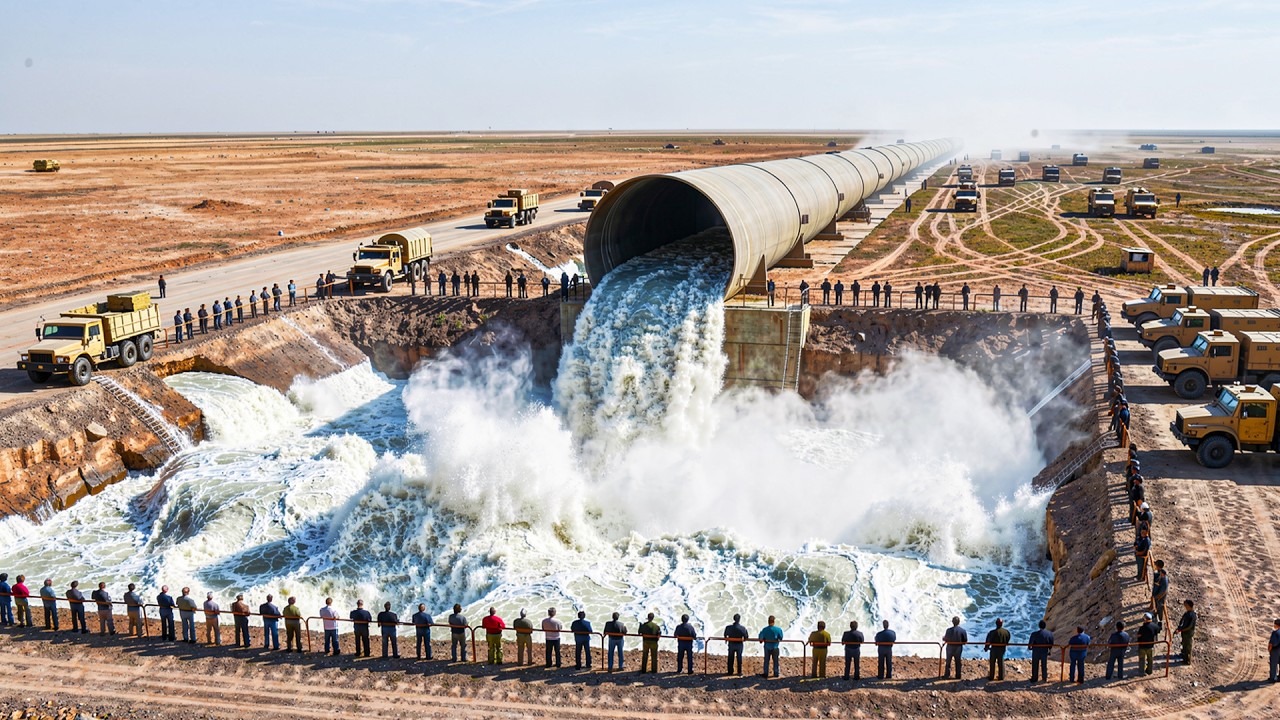
Arizona’s Water Crisis: The Controversial Plan to Import an Ocean Through Mexico
For more than a century, Arizona conquered the desert.
Massive dams stopped rivers. Canals carried water across hundreds of miles of barren land. Entire cities rose where nature never intended them to exist. Phoenix became one of the fastest-growing metropolitan areas in America. Farms flourished in landscapes that should have been too dry to support them. For decades, it looked like engineering had defeated geography.
Now that victory is beginning to unravel.
Beneath Arizona’s expanding suburbs, groundwater levels are falling. The Colorado River is shrinking. Reservoirs that once seemed limitless are approaching dangerous lows. State officials have already taken the extraordinary step of restricting new development in parts of the state because they can no longer guarantee enough water for future growth.
And that has pushed Arizona toward an idea so ambitious, so expensive, and so controversial that it sounds almost impossible.
Build one of the largest desalination systems in the world on the coast of Mexico. Turn seawater into fresh water. Then pump it hundreds of miles across an international border and thousands of feet uphill into Arizona.
Supporters call it a necessary lifeline.
Critics call it an environmental disaster waiting to happen.
For communities in northern Mexico, it raises an even more uncomfortable question:
Why should they sacrifice their coastline, their fisheries, and their future so that Arizona can continue growing?
The answer lies at the center of one of the most important water battles unfolding in North America today.
The Desert Is Running Out of Water
Arizona’s water problems did not appear overnight.
For decades, the state relied on three primary sources of water: groundwater stored beneath the desert, surface water from local rivers, and imports from the Colorado River system. Together, they created the illusion of abundance.
But every part of that system is now under pressure.
Groundwater aquifers that took thousands of years to fill are being drained faster than nature can replenish them. In many areas, wells must be drilled deeper and deeper just to reach water. Some communities have already watched long-standing wells fail entirely.
At the same time, the Colorado River is experiencing one of the most severe periods of decline in recorded history.
Scientists studying ancient tree rings discovered that the American Southwest is currently enduring a megadrought unlike anything seen in more than 1,200 years. Rising temperatures accelerate evaporation. Mountain snowpacks that once fed the river are shrinking. Reservoirs lose enormous amounts of water to heat before it can ever reach consumers.
The result is a river system that simply cannot provide what it once did.
For Arizona, that reality has serious consequences.
The Central Arizona Project, often called CAP, was designed to protect the state from exactly this kind of crisis. Stretching hundreds of miles across the desert, the canal system carries Colorado River water to cities, industries, and farms throughout central and southern Arizona.
For years it represented security.
Today it represents uncertainty.
Federal water cuts have already reduced Arizona’s access to Colorado River supplies. Officials openly acknowledge that additional reductions may be necessary if reservoir levels continue to fall.
What was once considered a permanent solution is now becoming increasingly unreliable.
The Hidden Cost of Green Fields
The contradiction becomes obvious the moment you drive through Arizona.
Much of the landscape appears harsh, dry, and unforgiving. Dusty plains stretch toward distant mountains. Rain is scarce. Temperatures regularly climb into dangerous territory.
Then, suddenly, bright green fields appear.
Massive farms produce cotton, alfalfa, Sudan grass, and other crops that require extraordinary amounts of water.
The contrast is startling.
These crops survive only because vast quantities of water are diverted into areas that naturally receive very little rainfall.
Agriculture consumes more water in Arizona than all cities combined. Estimates suggest that farming accounts for more than 70 percent of total water use across the state.
Meanwhile, Arizona’s population continues to grow.
Since 2000, millions of new residents have arrived. New housing developments spread farther into the desert each year. Data centers, semiconductor manufacturing facilities, and industrial projects require additional water supplies.
These demands do not replace agricultural consumption.
They are added on top of it.
The pressure continues to build.
In 2023, Arizona regulators made a historic decision. Officials halted approval of certain new housing developments in parts of the Phoenix area because they could not demonstrate a guaranteed 100-year groundwater supply.
It was a warning unlike any the state had issued before.
The message was clear:
Arizona’s traditional water sources can no longer support unlimited growth.
The Search for a New Lifeline
As conditions worsened, attention shifted south.
Across the border, on the coast of Mexico near Puerto Peñasco, lies a stretch of shoreline overlooking the Gulf of California.
At first glance, it appears unremarkable.
Yet engineers, planners, and private companies have spent years examining the area because it offers something Arizona desperately needs: access to the ocean.
Unlike rivers or reservoirs, the ocean contains an effectively unlimited supply of water.
The challenge is removing the salt.
That process is known as desalination.
Modern desalination plants force seawater through specialized membranes under extremely high pressure. The membranes separate salt and other impurities from the water, producing clean freshwater suitable for drinking, agriculture, and industry.
Countries such as Israel, Saudi Arabia, and the United Arab Emirates have used desalination to overcome water shortages for decades.
Arizona’s planners believe a similar solution could work for the American Southwest.
One proposal envisions a massive desalination facility near Puerto Peñasco capable of producing hundreds of billions of gallons of freshwater annually.
The numbers are staggering.
At full capacity, the plant could theoretically supply water to millions of households.
But producing the water is only the beginning.
The Engineering Challenge Nobody Can Ignore
Getting water from the Mexican coast to Arizona may be one of the most difficult infrastructure projects ever attempted in the region.
Water naturally flows downhill.
Phoenix sits roughly 2,000 feet above sea level.
That means every gallon would need to be pumped uphill across nearly 200 miles of desert.
The system would require enormous pipelines, powerful pumping stations, maintenance corridors, electrical infrastructure, and continuous energy supplies.
Engineers have proposed massive solar installations to help power the operation.
Even then, the costs would be enormous.
Unlike traditional water projects that rely on gravity for much of their movement, this system would require constant energy simply to keep water flowing.
The price of building it could reach billions of dollars.
The cost of operating it would continue indefinitely.
Yet supporters argue that Arizona has reached a point where expensive water is better than no water at all.
Why Mexico Is Concerned
The controversy begins where the pipeline begins.
Many residents of Puerto Peñasco already experience periodic water shortages.
Families store water in tanks. Neighborhoods deal with interruptions in service. During peak tourist seasons, demand often strains local supplies even further.
Against that backdrop, the idea of exporting enormous quantities of freshwater to the United States feels deeply unfair to many people.
The concern extends beyond economics.
Desalination creates a byproduct known as brine.
Brine is highly concentrated saltwater left behind after freshwater is removed. It is significantly saltier than normal seawater and must be disposed of somewhere.
Most proposals involve returning it to the ocean.
Environmental groups worry that large-scale discharge could alter local marine ecosystems, particularly in the northern Gulf of California, where water circulation is relatively limited.
Scientists fear that increased salinity could affect plankton populations that form the foundation of the marine food chain.
If those organisms are disrupted, the consequences could ripple outward through fish populations, fisheries, seabirds, and marine mammals.
For local fishing communities, those risks are impossible to ignore.
Their livelihoods depend directly on the health of the ecosystem.
The Vaquita Problem
Perhaps no species symbolizes the environmental concerns more than the vaquita.
The vaquita is the world’s rarest marine mammal and exists only in a small portion of the northern Gulf of California.
Fewer than a dozen are believed to remain alive.
Any major environmental disturbance in the region attracts intense scrutiny because the species is already dangerously close to extinction.
Conservation organizations worry that even relatively small changes to habitat conditions could create additional stress for an animal that has almost no margin for survival.
Whether desalination would significantly impact the vaquita remains a subject of debate.
But the possibility alone has made the project highly controversial.
A Pipeline Through Protected Land
Environmental concerns do not end at the coastline.
To reach Arizona, the pipeline would cross sensitive desert ecosystems and protected landscapes.
Some proposed routes pass near or through areas containing rare wildlife, fragile habitats, and culturally significant Indigenous lands.
Among the strongest critics are members of the Tohono O’odham Nation, whose ancestral territory spans portions of the U.S.-Mexico border region.
For many tribal members, the land is more than geography.
It is history, culture, identity, and spirituality.
Construction on the scale required for a major international pipeline could permanently alter landscapes that have remained largely unchanged for generations.
Opponents argue that once such damage occurs, it cannot simply be reversed.
The Politics Behind the Project
Water has always been political in the American Southwest.
But this proposal introduces an entirely new level of complexity.
Unlike a dam or reservoir located within one state, this project would depend on international cooperation for decades.
That means negotiations involving water rights, environmental protections, trade relationships, energy agreements, and diplomatic priorities.
Mexico and the United States already share water resources under existing treaties.
Any new arrangement would likely become part of a broader conversation involving economics, infrastructure, and cross-border relations.
Supporters view this cooperation as practical and necessary.
Critics worry it could create long-term dependence on infrastructure located in another country.
If political priorities change in the future, water security could become entangled with international disputes.
For a resource as essential as water, that prospect makes many policymakers nervous.
The Future of the Southwest
The proposed desalination project is ultimately about something larger than Arizona.
It represents a fundamental question facing much of the American Southwest.
What happens when growth collides with environmental reality?
For decades, the region expanded under the assumption that engineering could solve almost any water problem. Dams, reservoirs, canals, and groundwater pumping allowed cities and farms to thrive in places where natural water supplies were limited.
Now many of those solutions are reaching their limits.
Climate change, population growth, and declining river flows are forcing governments to consider options that once seemed unthinkable.
Desalination is one of those options.
It offers the possibility of a new water source independent of rainfall and river levels.
But it also comes with enormous financial, environmental, and political costs.
Whether the Puerto Peñasco project is ultimately built remains uncertain.
Permits, environmental reviews, funding challenges, legal battles, and international negotiations could delay it for years.
Yet one fact is becoming increasingly difficult to ignore.
Arizona’s search for water is no longer a question of convenience.
It has become a question of survival.
And as the Colorado River continues to shrink, the fight over who controls the next major source of water in the Southwest may determine the future of entire communities on both sides of the border.