Why Did Paul Offer Animal Sacrifices AFTER Jesus?
Why Did Paul Offer Animal Sacrifices AFTER Jesus?
Part 1
The question appeared in New York City at 2:08 in the morning, projected across the front wall of St. Anselm’s Biblical Research Library while rain ran down the stone like tears. The library stood near Columbia University, surrounded by old churches, coffee shops, locked gates, and apartment windows glowing with the insomnia of students who believed history was safest when trapped in books. But that night, history stepped out of the books and wrote one sentence across the building in pale white light: Why did Paul offer animal sacrifices after Jesus?
By sunrise, the photo was everywhere. Christian social media erupted. Skeptics called it proof that Christianity had contradicted itself from the beginning. Some Jewish commentators said Christians had misunderstood Paul for centuries. Some pastors warned believers not to let critics weaponize Acts 21. Some Catholic and Orthodox scholars reminded everyone that the Temple still stood in Paul’s time. Evangelical channels argued about law, grace, and whether Paul had compromised. Atheist accounts posted, “If Jesus ended sacrifice, why was Paul paying for sacrifices?” and watched the comment sections burn.
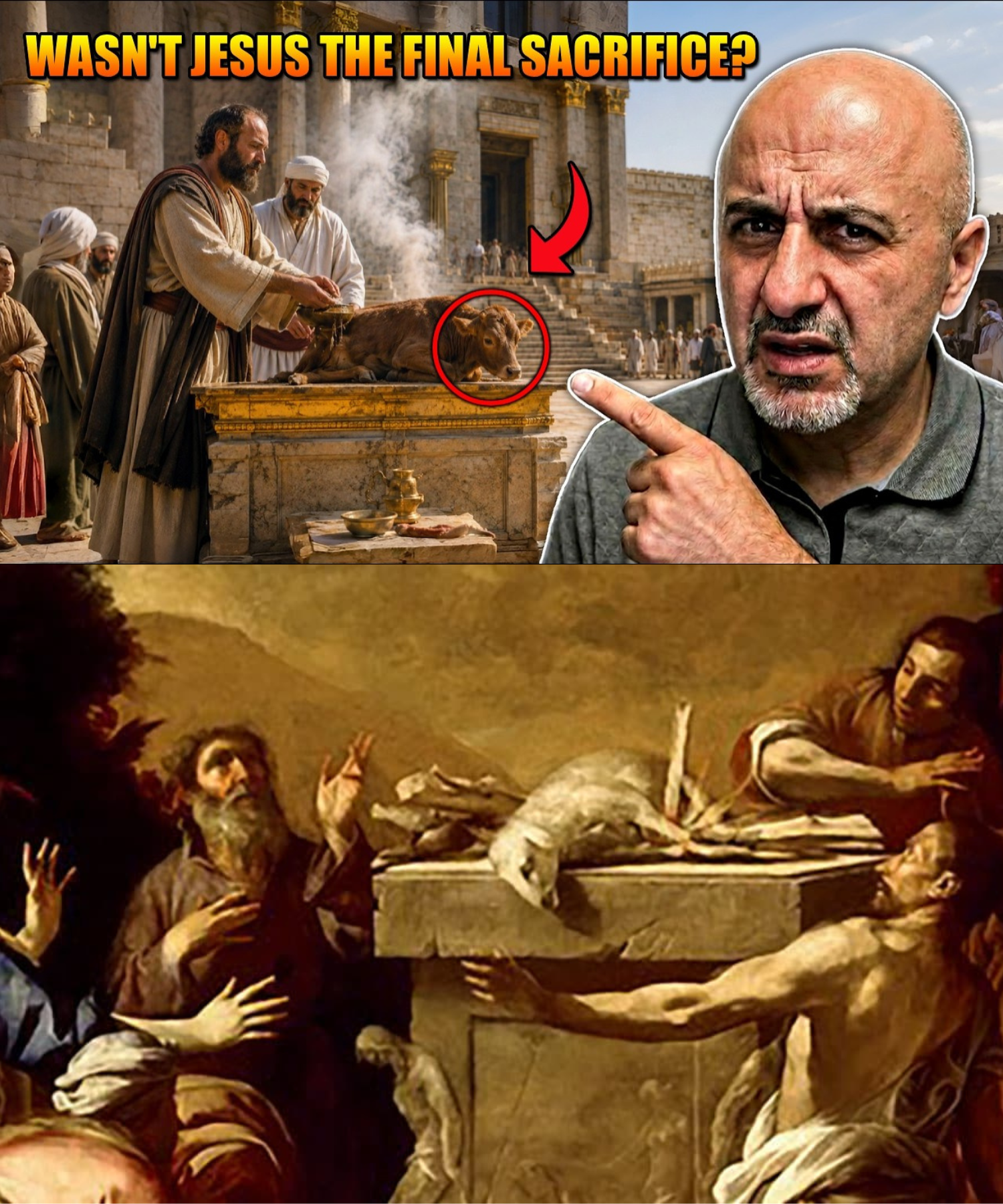
Dr. Miriam Cole saw the image before breakfast and already knew the country was about to turn one complicated biblical passage into a battlefield. She was a New York historian of early Christianity, one of those scholars who could explain Second Temple Judaism, Greek verbs, Roman law, and church history clearly enough for ordinary people, but who still went quiet when Scripture stopped being a topic and became a wound. She opened Acts 21 on her desk and read the familiar lines again: Paul arriving in Jerusalem, James and the elders warning him that thousands of Jewish believers were zealous for the law, rumors spreading that he taught Jews to abandon Moses, and the plan for Paul to join four men under a vow, purify himself, and pay their expenses so everyone would know he lived in observance of the law.
Then came the line that made modern readers stop breathing: offerings would be made for each of them.
Animal sacrifices.
After Jesus.
Miriam closed her Bible and whispered, “This is not a contradiction. It is a doorway into a world most Americans no longer understand.”
In Ohio, Father Caleb Ward watched the same argument unfold in a church basement outside Cleveland while volunteers sorted canned soup for the Mercy Ridge food pantry. A teenage volunteer named Marcus stared at his phone and said, “So did Paul not believe Jesus’ sacrifice was enough?”
Ruth Bell, the seventy-eight-year-old woman who ran the pantry with the authority of a prophet and the patience of a tired school bus driver, looked up from a box of rice.
“Or maybe,” she said, “people on the internet don’t know the difference between sacrifice for salvation and sacrifice as part of a vow.”
Marcus blinked. “You know about that?”
Ruth shrugged. “I went to Sunday school before Christians started learning theology from thumbnails.”
In Los Angeles, Naomi Reyes, a documentary filmmaker known for exposing religious clickbait, received three pitch decks before noon. One wanted a film called Paul’s Secret Sacrifice. Another wanted Did Paul Reject the Cross? The worst one read: The Animal Blood Scandal Christianity Buried. Naomi deleted them and called Miriam.
“They’re going to make Paul look like a fraud,” Naomi said.
“They’re going to make the first-century Temple look like a Protestant church lobby,” Miriam replied.
“So what’s the truth?”
Miriam looked down at Acts 21.
“The truth is that Paul did not offer animal sacrifices because Jesus was insufficient. He entered a Jewish purification and vow context in a Temple that still stood, among Jewish believers still living inside Israel’s covenant practices. He did it to show he was not teaching Jewish Christians to despise Moses. The scandal is not that Paul denied Christ. The scandal is that modern readers have forgotten how Jewish the earliest Church was.”
Naomi paused.
“That’s the film.”
That night, the sentence appeared again, this time on the glass doors of a church in Queens:
Do not ask why Paul stood in the Temple until you ask why you removed him from his people.
Part 2
The first public forum was held in New York, and it was packed before the doors opened. Miriam stood at the front of a church hall filled with pastors, students, skeptics, rabbis, Catholic priests, Protestant ministers, journalists, and angry men who had already decided the answer before sitting down. Naomi filmed from the back. She had learned that religious arguments often revealed more in the audience than onstage.
Miriam began with the passage. She read slowly from Acts 21, refusing to skip the uncomfortable parts. Paul comes to Jerusalem. James receives him. The elders rejoice over what God has done among the Gentiles. Then they raise the crisis: Jewish believers have heard Paul teaches Jews among the nations to forsake Moses. To prove otherwise, Paul joins men under a vow and pays their expenses. He purifies himself. The Temple offering is expected.
Miriam closed the Bible.
“Paul did not walk into the Temple because he thought the cross failed,” she said. “He walked into the Temple because the earliest Christian movement was not yet a separate Gentile religion called Christianity in the modern American sense. It was a Jewish messianic movement centered on Jesus, spreading to Gentiles, still negotiating how Jews and Gentiles lived together before the Temple’s destruction.”
A young man stood. “But Hebrews says Christ’s sacrifice is once for all.”
“Yes,” Miriam said. “And Hebrews reflects deeply on the finality of Christ’s priestly sacrifice. But Acts 21 shows us a historical moment before the Temple fell, when Jewish followers of Jesus still participated in Temple life. You cannot flatten the entire New Testament into one timeline with no development, no pastoral tension, no transition, and no Jewish context.”
A skeptical journalist raised his hand. “So did Paul believe animal blood could forgive sins after Jesus?”
“No,” Miriam answered. “Paul’s letters are clear that justification is in Christ, not in works of law, not in sacrifices, not in ethnicity, not in ritual status. The issue in Acts 21 is not Paul seeking salvation by animal blood. It is Paul participating in a purification and vow practice to show solidarity with Jewish believers and to silence a false accusation.”
Rabbi Rachel Stein, invited as a Jewish scholar of Second Temple practice, leaned toward her microphone. “Christians often forget that sacrifice in the ancient Temple was not one flat category. There were offerings for purification, thanksgiving, vows, dedication, calendar festivals, and atonement. To say ‘animal sacrifice’ and assume every instance means ‘trying to replace Jesus’ is historically careless.”
The room grew quieter.
Naomi filmed Marcus watching from the Ohio livestream, his arms folded, face changed by concentration. Ruth sat beside him eating crackers from her purse.
Miriam continued. “Paul could say Gentiles do not need circumcision and still live as a Jew among Jews. He could preach Christ as the fulfillment of God’s promise and still honor his people’s customs. He could oppose forcing Torah observance on Gentiles and still refuse to become an enemy of Jewish life. That tension is not hypocrisy. It is the messy birth of a Church learning how Jew and Gentile become one in Christ without erasing the story of Israel.”
A pastor from Brooklyn whispered, “We made Paul too American.”
Miriam heard him and nodded.
“Yes,” she said. “We made him an individual arguing abstract theology online. But Paul was a Jew, an apostle, a missionary, a bridge, a man carrying Gentile churches in one hand and love for his people in the other.”
That line became the beginning of Naomi’s documentary.
Part 3
Ohio made the question personal because Mercy Ridge knew what it meant to be misread by outsiders. The town had been called poor, backward, angry, addicted, forgotten, resilient, red-state, working-class, religious, hopeless, and “real America,” depending on which reporter needed which story that week. Ruth hated all of those labels equally. “People love explaining a town they don’t have to love,” she said.
So when Father Caleb announced a Bible study on Paul’s Temple offering, the room filled with people who were not there for academic curiosity. They wanted to know whether obedience could look wrong to people who did not understand the situation. They wanted to know whether compromise was always cowardice. They wanted to know whether Paul had bent too far to please others. They wanted to know whether keeping peace ever required entering a place where people would later accuse you anyway.
Father Caleb stood before them with Acts 21 open.
“Paul went to Jerusalem knowing danger was waiting,” he said. “He did not offer sacrifices to earn salvation. He participated in a public act meant to show that he was not teaching Jewish believers to hate their own identity. But even that act did not save him from arrest. Sometimes doing the right thing does not stop people from misunderstanding you.”
Marcus looked up sharply.
His father had died years earlier after addiction and factory layoffs hollowed him out. People in town still remembered him as an addict before they remembered him as a man. Marcus knew what it meant for one label to swallow a whole life.
“So Paul tried to prove the rumor was false,” Marcus said, “and people still attacked him?”
“Yes,” Caleb said.
“That’s depressing.”
Ruth answered from the back. “That’s Scripture being honest.”
Naomi filmed the Ohio study for Part Three of her documentary. She wanted viewers to feel the gap between online debate and lived complexity. In New York, the question was theological. In Ohio, it became human. Paul was not only a doctrinal problem; he was a man walking into a community conflict where both sides could misunderstand him.
Caleb explained the vow. “The men in Acts 21 were likely completing a vow, perhaps something similar to a Nazirite vow or purification-related obligation. Such vows required offerings at the Temple. Paul paying their expenses was not random. It was a public sign of support and solidarity.”
A woman named Denise raised her hand. “So he paid for sacrifices but did not believe the sacrifices saved them?”
“Correct,” Caleb said.
She frowned. “That feels strange.”
“It should,” Caleb replied. “Because we live after the Temple’s destruction, after centuries of Christian separation from Jewish practice, after theological debates Paul himself did not experience the way we do. We are looking backward through layers of history.”
Ruth leaned forward. “Say it easier.”
Caleb smiled. “Paul lived in a world where the Temple still stood. We don’t.”
“There it is.”
After the study, Marcus asked Naomi why the internet made it sound like a scandal if the answer was so explainable.
Naomi said, “Because scandal is easier to sell than context.”
Marcus looked toward the pantry shelves.
“Context should get better marketing.”
Naomi laughed.
Then Ruth said, “No. Context should get better Christians.”
That became Part Three’s final line.
Part 4
Los Angeles turned the question into a weapon exactly as Naomi expected. Vale Media released a special called Paul’s Animal Sacrifice After Jesus — The Verse Churches Fear. The trailer showed flames, blood, a CGI Temple, Paul looking guilty, and the words DID PAUL CONTRADICT THE CROSS? Naomi watched it in her Burbank editing room with Jonah Price, her editor, and paused on a scene where animated blood ran across a Bible page.
“That’s disgusting,” Jonah said.
“It’s effective,” Naomi answered. “That’s worse.”
The special reduced everything to a trap. If Jesus was the final sacrifice, why was Paul involved in sacrifices? If Paul preached grace, why did he act law-observant? If the Temple system ended in Christ, why enter the Temple at all? Every question had a real answer, but the program asked them the way a prosecutor asks questions when he does not want the witness to explain.
Naomi called Adrian Vale, the producer.
“You made Acts 21 look like a cover-up.”
“We asked the obvious question.”
“You cut out the historical answer.”
“Answers reduce tension.”
“Truth reduces manipulation.”
He sighed. “Naomi, people don’t click on ‘Paul navigates Jewish-Gentile tensions in a pre-70 Temple context.’”
“Then teach them to.”
“That’s not media.”
“No. That’s discipleship.”
Her own film was now titled Paul in the Temple. It opened not with blood, but with Jerusalem streets reconstructed simply, then cut to modern America: New York classrooms, Ohio food pantry, Los Angeles editing room, a Queens synagogue, a Catholic church, a Baptist Bible study, and a Messianic Jewish congregation in Chicago. Naomi wanted to show that the question was not only about an ancient ritual. It was about the Church’s memory of its Jewish roots.
In Los Angeles, she interviewed Pastor Daniel Cross, leader of a large evangelical church. He admitted that he had preached Paul for twenty years as if Paul were mostly an anti-religion American individualist. “I made him allergic to tradition,” Daniel said. “Then I read Acts again and realized Paul kept going to synagogues, kept caring about Jerusalem, kept identifying as Israelite, kept carrying offerings, kept navigating his people’s customs. He was freer than I preached, but also more rooted.”
Miriam responded on camera, “Paul’s freedom in Christ did not make him culturally weightless.”
That line became central.
Naomi also interviewed Rabbi Rachel again. “For Jewish viewers,” Rachel said, “Christian confusion about Acts 21 often sounds like surprise that Jewish followers of Jesus remained Jewish. That surprise reveals how much later Christian history has trained people to imagine Jewish practice as the opposite of faith rather than the soil from which the earliest faith in Jesus grew.”
In Chicago, Naomi filmed a Messianic Jewish teacher named Aaron Levi who said, “Paul did not think honoring Jewish custom meant denying Messiah. He opposed making Gentiles become Jews to be saved. That is not the same as teaching Jews to become Gentiles.”
The sentence traveled widely.
Vale Media ignored it.
Their second episode accused scholars of “explaining away the plain text.”
Ruth watched it in Ohio and said, “The plain text is plain only if you ignore half the chapter.”
Part 5
New York brought the hardest question: did Paul compromise? Miriam did not avoid it. At the second forum, she projected Acts 21 beside Galatians 2, 1 Corinthians 9, Romans 14, and Philippians 3. The room was full again, but quieter this time. People had moved beyond the cheap question and into the difficult one. Paul had refused to circumcise Titus under pressure. Paul had rebuked Peter for separating from Gentiles. Paul had written fiercely against requiring Gentiles to keep the law. And yet Paul also circumcised Timothy because of Jewish communities they would encounter. Paul became “as a Jew” to win Jews. Paul participated in Temple purification.
Was that wisdom?
Was it inconsistency?
Was it pastoral flexibility?
Was it dangerous accommodation?
Miriam answered carefully. “Paul was not a slogan. He was an apostle making real decisions in real communities under real pressure. His principle was not ‘rituals are always bad’ or ‘customs never matter.’ His principle was that nothing but Christ can be the basis of belonging to God’s people. Once that is clear, Paul can flex culturally for love. But when a practice is used to deny the sufficiency of Christ or exclude Gentile believers, he resists fiercely.”
A student asked, “So Acts 21 was okay because it was not about salvation?”
“That is one major way Christians have understood it,” Miriam said. “Paul could participate in a Jewish vow practice as a matter of identity, peace, and witness, not as a way of earning justification.”
Another student asked, “But why did it fail? He still got arrested.”
Miriam nodded. “Faithfulness is not measured only by immediate success.”
That line struck Naomi deeply. She cut it beside footage of Paul’s later arrest from a simple reenactment: no dramatic blood, no villain music, just shouting, confusion, soldiers, and a man caught between communities. Paul’s attempt at peace did not prevent violence. But it revealed his willingness to suffer misunderstanding for the sake of the gospel.
In Ohio, Marcus asked whether trying to please everyone had trapped Paul.
Father Caleb answered, “Paul was not trying to please everyone. He was trying to avoid unnecessary offense while refusing to compromise the gospel.”
“That sounds impossible.”
“It often is.”
Ruth added, “Welcome to being useful.”
Part Five of Naomi’s film became the moral center: the difference between compromise and costly love. Compromise abandons truth to avoid pain. Costly love carries truth into painful places. Paul did not deny Christ by entering the Temple. He entered the Temple as a follower of Christ still bound in love to his people, still hoping rumors could be healed, still willing to pay expenses for men under vow, still trusting that the God who fulfilled sacrifice in Jesus had not made Jewish believers enemies of their own history.
The film showed modern parallels carefully. A Native Christian honoring tribal customs without worshiping old gods. A Jewish believer in Jesus attending family Passover without treating the meal as salvific. A Catholic visiting an evangelical church and praying honestly. A Protestant attending a Catholic funeral and standing respectfully. A Christian refusing to mock practices they do not personally keep. A pastor apologizing for teaching grace as contempt for tradition.
Naomi’s voiceover said, “Paul’s act in the Temple does not ask Christians to return to animal sacrifice. It asks whether they can tell the difference between the finished work of Christ and the cultural practices of a people God did not erase.”
That was the sentence that made people share the film.
Part 6
Los Angeles premiered the film before it was finished because the argument had become too loud to wait. Naomi released a one-hour cut online called Paul in the Temple: Why Acts 21 Is Not a Scandal. It did not have the polish she wanted, but it had the truth she needed. It opened with the viral question, then moved through New York scholarship, Ohio pastoral struggle, Jewish context, Temple history, vow offerings, Paul’s letters, and modern misreadings. It gave viewers enough history to stop panicking and enough theology to start thinking.
The response was immediate and divided.
Some viewers thanked her for explaining something they had avoided for years. Others accused her of defending animal sacrifice. Some said Paul had clearly compromised. Some said James had pressured him wrongly. Some said Acts was descriptive, not prescriptive. Some said the entire event showed why the Temple had to fall. Some Jewish viewers appreciated the care. Some Christians still struggled with the emotional weight of animal offerings after Jesus.
Naomi expected all of that.
What she did not expect was the letter from a slaughterhouse worker in Texas.
He wrote, “I know your film is about Paul, but I cannot stop thinking about sacrifice. I grew up hearing Jesus was the Lamb of God, but I work every day where animals die for people’s appetites, not worship. Maybe modern Christians are shocked by Temple sacrifice because we hide our blood better.”
Naomi sent the letter to Miriam.
Miriam sat with it for a long time.
The final version of the film added a short chapter called Modern Blood. It did not compare ancient sacrifice simplistically to industrial meat. It simply asked why modern people were often horrified by ritual blood while remaining comfortable with hidden blood that served convenience. The Temple was public, symbolic, regulated, theological. Modern consumption often hid death behind packaging. The point was not to shame viewers into one dietary conclusion. It was to expose the selective nature of modern disgust.
Ruth watched the new chapter and said, “Well, that’ll make everyone mad.”
“Should I cut it?” Naomi asked.
“No. I said mad, not wrong.”
The theological conclusion remained clear. Christians do not return to animal sacrifice because Christ’s sacrifice is definitive. The Eucharist, for Catholics and Orthodox, is not a new killing but participation in the once-for-all sacrifice of Christ made present sacramentally. Protestants speak differently but also affirm that Christ’s offering is complete. Paul’s Temple participation did not reopen the sacrificial system as a Christian requirement. It happened in a particular historical moment before the Temple’s destruction, within Paul’s mission to hold together truth, Jewish identity, and Gentile inclusion.
In New York, Miriam summarized it in one sentence at the final forum.
“Paul did not go to the Temple because the cross was unfinished; he went because the Church was unfinished in understanding how the cross gathered Jew and Gentile into one body.”
That line became the film’s final thesis.
In Ohio, Marcus repeated it badly but sincerely: “So Jesus finished salvation, but people were still figuring out the family table.”
Ruth said, “Good enough.”
Part 7
The finished documentary premiered in three places at once: New York, Ohio, and Los Angeles. In New York, scholars watched for nuance. In Los Angeles, filmmakers watched for controversy. In Ohio, Ruth watched for whether ordinary people could understand it without pretending to be professors. Naomi cared most about Ohio.
The film opened with the glowing question on the church doors: Why did Paul offer animal sacrifices after Jesus? Then the answer unfolded slowly. Paul’s arrival in Jerusalem. The rumors. James and the elders. Jewish believers zealous for the law. The vow. The purification. The expenses. The offerings. The riot. The arrest. Then the wider context: Paul’s Jewishness, Gentile inclusion, the living Temple, sacrifice categories, the finality of Christ, and the danger of reading ancient texts as if they happened in modern American denominational categories.
At the New York screening, Rabbi Rachel spoke afterward. “I do not share Paul’s claims about Jesus,” she said, “but I appreciate when Christians remember Paul did not stop being Jewish in order to become important to Christians.”
At the Ohio screening, Peter, a recovering addict who had struggled with the idea of rituals, said, “I think I get it. The ritual didn’t save Paul. But refusing the ritual would have said something false to people he loved.”
Father Caleb smiled. “Yes.”
Marcus added, “And doing it still didn’t make everyone happy.”
Ruth replied, “Welcome to love.”
In Los Angeles, a young pastor asked Naomi if the film meant Christians should adopt Jewish rituals. Miriam, joining by livestream, answered carefully. “Not carelessly. Not as costume. Not as proof of being more authentic. Christians should honor the Jewish roots of their faith, reject contempt for Jewish practice, and learn history humbly. But appropriation is not repentance. Paul was not playing at Jewishness. He was Jewish.”
That answer mattered.
The film’s final scene returned to Mercy Ridge. Marcus stood in the pantry, stacking bread after the screening. Naomi asked him what he thought the answer was now.
He shrugged. “Paul offered because he was trying to tell the truth in a language his people could see.”
Naomi asked, “And what was the truth?”
“That Jesus was enough,” Marcus said. “But enough doesn’t mean you stop loving where you came from.”
Ruth, off camera, said, “Now that is actually good.”
The credits rolled over a simple line:
Christ fulfilled the sacrifice. Paul honored the people. The modern Church must learn to do both: proclaim fulfillment without contempt.
The response surprised Naomi. The film did not go viral in the explosive way the scandal videos had. It moved more slowly. Bible studies used it. Seminaries assigned it. Pastors quoted it. Jewish-Christian dialogue groups discussed it. Even skeptics acknowledged that the issue was more historically complex than the viral claim suggested.
Vale Media released one final response video.
No one cared much.
Context had finally grown legs.
Part 8
Years later, the question still returned online: Why did Paul offer animal sacrifices after Jesus? It remained powerful because it touched something real. Christians do believe Jesus is the final sacrifice. Paul did participate in a Temple-related purification and vow context in Acts 21. The tension is not imaginary. It deserves careful reading. But the cheap scandal faded wherever people learned to read Paul inside his world rather than drag him into ours.
New York kept teaching the passage. Miriam’s lecture became a book called Paul Before the Altar. Its argument was simple but demanding: Acts 21 is not an embarrassment to hide, but a window into the earliest Church’s painful transition. The Jewish Messiah had come. Gentiles were entering. The Temple still stood. Jewish believers still honored ancestral customs. Paul refused to make Torah observance necessary for Gentile salvation, but he also refused to teach Jews to despise their covenant history. In that tension, he entered the Temple.
Ohio kept making the lesson practical. Father Caleb used the story whenever church people mocked traditions they did not understand. Ruth used it whenever someone confused freedom with arrogance. Marcus, eventually becoming a youth teacher, told teenagers, “Paul didn’t do rituals because he thought Jesus was weak. He did them because love sometimes speaks someone else’s language.”
Los Angeles kept the media warning. Naomi’s film became a case study in how viral religion turns complexity into accusation. She taught younger filmmakers that the most dangerous religious videos are not always the ones that invent facts, but the ones that isolate a true fact from the world that makes it intelligible. Paul offering sacrifices after Jesus was a true problem. It became false only when stripped of Temple, vow, Jewish identity, pastoral strategy, and the once-for-all meaning of Christ.
The most moving response came from Chicago, where Aaron Levi’s Messianic Jewish congregation screened the film alongside a local Black Baptist church. Afterward, an elderly Baptist woman said, “I think I was taught that grace meant God threw away all the old Jewish things. I see now that grace fulfilled promises, not people’s contempt.”
Aaron cried when he heard it.
On the tenth anniversary of the glowing question in Queens, St. Michael’s held a night of Scripture and prayer. They read Acts 21, Galatians 2, Romans 9 through 11, Hebrews 10, and Ephesians 2. They prayed for Jewish-Christian healing, for humility, for freedom from contempt, for the ability to distinguish fulfillment from erasure. Father Gabriel preached briefly.
“Paul did not offer because Jesus failed,” he said. “Paul offered because history had not yet reached the point where the Temple fell, and because love required him to stand among his people without surrendering the gospel. The animal blood did not save him. Christ did. But Paul was willing to be misunderstood in order to bear witness that the Messiah of Israel had not come to make Israel a stranger.”
After the service, Marcus, Ruth, Miriam, Caleb, Naomi, Rabbi Rachel, Pastor Daniel, and dozens of others gathered downstairs for food because Ruth insisted theology without food was suspicious. On the wall, someone had written the sentence that ended Naomi’s film:
Christ fulfilled the sacrifice. Paul honored the people.
A little girl asked Ruth what it meant.
Ruth thought for a moment.
“It means,” she said, “God keeps His promises better than we understand them.”
The child accepted that and reached for bread.
Outside, New York rain tapped against the church windows. Somewhere in Ohio, pantry shelves waited to be filled. Somewhere in Los Angeles, another editor chose whether to cut context for drama. And in the pages of Acts, Paul still walked toward the Temple, carrying a gospel big enough to include Gentiles and a love deep enough not to despise his own people.
The question had not disappeared.
It had become better.
Not “Did Paul deny Jesus?”
But “Can Christians proclaim Jesus as the fulfillment of sacrifice without turning fulfillment into contempt?”
That is the question every generation still has to answer.









