A Fisherman Pulled a “Living Fossil” From the Deep — It Shouldn’t Have Been at the Surface
A Fisherman Pulled a “Living Fossil” From the Deep — It Shouldn’t Have Been at the Surface
Part 1
The fish came up off the coast of New York just before sunrise, when the Atlantic was the color of gunmetal and the deck of the Saint Marisol smelled of diesel, salt, bait, and old coffee. Captain Jonah Mercer had been fishing those waters for thirty-two years, out past Montauk where the shelf dropped and the sea began acting less like water and more like weather with teeth. He had pulled up sharks, monkfish, eels, half-rotted netting, a bicycle wheel, a World War II shell casing, and once a sealed plastic cooler full of cash that he wisely turned over to the Coast Guard. But he had never pulled up anything that made every man on his crew step backward.
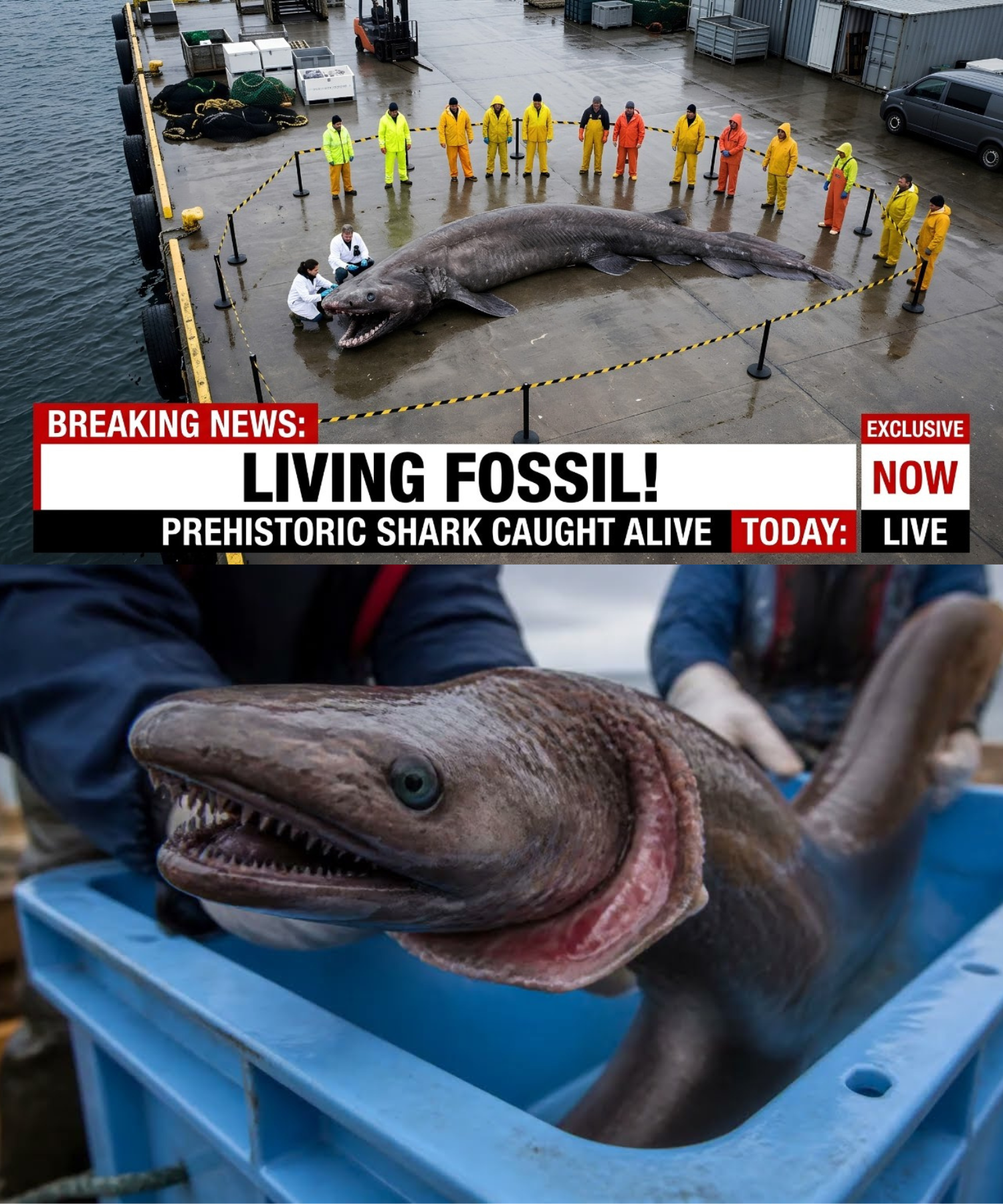
At first, Jonah thought it was dead. It lay tangled in the net among cod, mud, and black seaweed, heavy as a sack of wet cement, its body armored in thick blue-gray scales that looked less like fish skin and more like stone plates. Its fins were wrong. They did not fan like ordinary fins. They jutted from the body on fleshy stalks, jointed almost like limbs. Its tail was broad and strange, divided in a way Jonah had only seen in pictures of prehistoric fish. Along its sides ran pale silver lines that pulsed faintly in the half-light, glowing and fading like breath under glass.
Then it opened its mouth.
One deckhand shouted and fell against a crate. The fish’s jaws spread wider than seemed possible, revealing small ivory teeth and a dark throat that moved slowly, deliberately, as if the creature had surfaced from a time before panic existed. Its eyes were black and wet, not empty like a normal fish dragged from depth, but focused. Looking. Jonah had spent his life refusing superstition because the ocean already had enough real ways to kill a man. But when that thing turned its head and stared at him, he felt, with a certainty deeper than thought, that the sea had just handed him something it never meant to give back.
“Captain,” the youngest deckhand whispered, “what the hell is that?”
Jonah did not answer because he knew the answer would sound insane. The fish looked like a coelacanth, one of those ancient “living fossils” he had seen in documentaries, the kind of creature scientists spoke of with reverence because it seemed to have walked out of deep time. But those fish belonged far away, in other oceans, other depths, other stories. They did not thrash in American nets off New York before breakfast. They did not come up alive from waters too shallow and too cold. And they certainly did not carry a fresh wound behind the gill that glowed blue every time the animal breathed.
Jonah ordered the crew to fill the bait tank with seawater and keep the animal alive. Nobody argued. They worked with fear and tenderness, lifting the creature with wet canvas, avoiding its jaws, sliding it into the tank as its heavy tail struck the deck once with a sound like a hammer on wood. The fish settled slowly, its strange lobe fins moving as if it were crawling through invisible mud. When the first sunlight broke over the horizon, the silver lines along its body brightened, forming a pattern Jonah could almost read.
He took one photograph.
That photograph was in New York by 8:00 a.m., in the inbox of Dr. Mara Ellison at the American Museum of Natural History. Mara was a marine paleobiologist, the kind of scientist who loved creatures that embarrassed extinction. She had spent years studying deep-sea fish, fossil lineages, and the way public imagination clings to anything called “prehistoric.” At first, she assumed the image was fake. Then she saw the fin structure. The scale pattern. The tail. The wound. She enlarged the photo until the pixels broke apart and still felt her heart climbing into her throat.
She called Jonah Mercer immediately.
“Captain,” she said, “where is the animal?”
“In my tank.”
“Alive?”
“For now.”
“Do not bring it to market. Do not let anyone touch it. Do not post anything else. I am sending people to you.”
“What is it?”
Mara looked at the photo again. She wanted to say she did not know. That would have been safer. But science begins with saying what the evidence allows, even when it terrifies you.
“It may be a living fossil,” she said. “And it should not be anywhere near the surface.”
By noon, reporters in New York had already heard rumors of a “prehistoric fish” on a Montauk boat. By evening, the story had reached Ohio, where Dr. Caleb Ward at Ohio State saw the images and noticed something Mara had missed: the glowing marks on the creature’s body resembled fossil impressions found in Devonian rock from ancient inland seas. By midnight, Naomi Reyes in Los Angeles, a documentary filmmaker working on deep-ocean mysteries, received the footage and froze on the frame where the fish looked straight into Jonah’s camera.
She whispered to herself, “That thing didn’t rise by accident.”
And far below the Atlantic, something opened in the dark.
Part 2
The fish survived the first night because Jonah Mercer refused to let curiosity kill it. He kept the tank shaded, cold, and constantly refreshed with seawater while Mara’s emergency team drove out from New York under police escort. By then, news vans were already parked near the dock, and men with cameras were shouting questions over the marina fence. Jonah ignored them. He sat beside the tank with one hand resting on the rim, watching the creature breathe. Every few minutes, the blue wound near its gill pulsed, and the fish shifted its jointed fins against the tank floor like an animal trying to remember a deeper place.
Mara arrived with a veterinarian, two marine technicians, and a portable oxygen system. She had expected urgency. She had not expected grief. The moment she saw the fish, not in a photo but living before her, she felt the enormous sadness of deep time compressed into one wounded body. It was not a monster. It was not a miracle for human amusement. It was an animal in distress.
The first measurements made no sense. The fish’s body was adapted for depth: pressure-resistant tissues, slow metabolism, specialized eyes, heavy scales. At surface pressure, it should have been dead or dying rapidly. Yet it was alive, not thriving but holding on with an eerie stubbornness. The blue wound was stranger. It was not a bite, not a cut from the net, not a parasite. It looked like tissue burned by cold light. When Mara’s veterinarian touched a probe near it, the equipment failed.
Caleb Ward arrived from Ohio the next morning, carrying fossil casts and a stack of field notes. He was not a marine biologist, but he knew ancient fish better than almost anyone alive. He had spent years studying fossils from the old seas that once covered what is now the American Midwest, back when Ohio was not farmland and highways but warm water full of armored fish, reef systems, and predators that looked like nightmares designed by geology. When he saw the living creature in the tank, he did not speak for a long time.
Mara watched him. “Say it.”
“I don’t want to.”
“Say it anyway.”
Caleb swallowed. “It resembles a lineage we thought vanished from this part of the world hundreds of millions of years ago.”
“That’s impossible.”
“Yes,” he said. “That is why I didn’t want to say it.”
Naomi Reyes arrived from Los Angeles later that day, but she kept her camera down. She had filmed enough scientists to know when awe had become fear. The public wanted a headline: living fossil caught by fisherman. But the people standing around the tank were not celebrating. They were looking at the animal as if it were a messenger that had arrived bleeding.
The first lab results deepened the mystery. Genetic sampling, taken carefully from a loosened scale, showed the creature was related to ancient lobe-finned fish but not identical to known coelacanth populations. It was American, in the strangest possible sense. Its lineage had been isolated long enough to diverge, hidden somewhere in deep Atlantic systems no one had mapped properly. But isolation alone did not explain how it reached the surface alive.
Then Jonah showed them the sonar recording.
His boat’s old depth sounder had glitched minutes before the net came up. He had ignored it at the time, thinking it was just another cheap electronic tantrum. But the recording showed a vertical column rising from deep water beneath the boat, not solid, not thermal, not a school of fish. A cold upwelling, perhaps. A pressure event. A plume from the abyss. It rose from the continental slope like a chimney of darkness, carrying deep water upward too fast, too cleanly, almost like the ocean had exhaled.
Caleb studied the data. “If that plume came from deep enough, it could have carried the fish upward.”
Mara frowned. “And not killed it?”
“No. It should have killed it.”
Naomi finally lifted her camera. “So what does that mean?”
Caleb looked at the glowing wound on the fish.
“It means the event that brought it up may have changed the rules around it.”
At that exact moment, the fish opened its mouth and released a low sound into the tank. Not a gasp. Not a croak. A vibration. The water trembled. Every phone in the room buzzed and died.
On the surface of the tank, ripples formed a circle.
Then three points appeared inside it.
New York. Ohio. Los Angeles.
No one moved.
Part 3
The public story broke before they could stop it. Someone at the marina sold a blurry clip to a New York tabloid, and by sunrise, the internet had named the animal everything from “Atlantic dinosaur fish” to “the Montauk fossil beast.” Crowds came to the dock. Influencers arrived with microphones. A man from a cable channel asked Jonah to reenact the catch. A religious livestreamer declared the fish a sign from Revelation. A crypto company posted a meme of the creature wearing sunglasses. Mara watched the circus from inside the sealed marine facility and felt something inside her harden.
“We need to move it,” she said.
“Where?” Jonah asked.
“Somewhere people can’t love it to death.”
The animal was transferred at night to a secure research aquarium in New York under Coast Guard supervision. Naomi filmed only the covered tank, refusing to give the public a clear image until the science team was ready. That decision cost her a distributor and gained her Mara’s trust. Caleb returned to Ohio with samples and the strange ripple pattern burned into his thoughts. Why would a deep-sea fish produce a pattern that matched three American locations? Was it coincidence? A reflection of equipment? Human projection? Or had they seen what fear wanted them to see?
In Columbus, Caleb compared the creature’s scale structure to fossil specimens from Ohio’s Devonian formations. The match was not exact, but it was close enough to unsettle him. The glowing lines on the living fish corresponded to sensory canals—ancient pressure-detection systems used by fish to read movement in water. But in this creature, the canals contained microscopic mineral crystals that reacted to electromagnetic fields. That could explain why phones failed near it. It could not explain the map-like ripple.
Then Caleb found an old fossil slab collected in southern Ohio in 1912. It showed a lobe-finned fish impression surrounded by unusual circular marks. For decades, scientists dismissed the marks as sediment distortion. Under new imaging, the marks resembled the same three-point pattern. Caleb stared at the fossil until the lab lights felt too bright.
He called Mara.
“This pattern may be biological.”
“How can a map be biological?”
“I didn’t say map. I said pattern. Three-point orientation. Maybe magnetic. Maybe migratory. Maybe some deep sensory behavior we don’t understand.”
“Why would it align with cities?”
“Maybe it doesn’t. Maybe our interpretation does. New York, Ohio, and Los Angeles are our overlay.”
Naomi, listening from Los Angeles, added, “Or maybe the creature is reacting to things beneath those places, and the cities came later.”
No one liked that.
The next clue came from the fish itself. In the New York aquarium, the animal refused normal food but reacted strongly when exposed to low-frequency sounds recorded from the sonar plume. When Mara played the deep pulse through underwater speakers, the fish moved toward the sound and pressed its head against the tank wall. The wound brightened. Its body lines pulsed in sequence. The monitors picked up a returning vibration.
Mara converted the vibration into audio.
It sounded like water moving through a stone hallway.
Then something underneath it clicked seven times.
Naomi went pale. “That is not an animal sound.”
Mara looked exhausted. “We do not know what this animal is capable of.”
Jonah Mercer, who had refused to leave since the catch, stood in the corner listening. “Maybe it’s not talking.”
They turned to him.
He looked at the fish, then at the speakers. “Maybe it’s answering something.”
That night, NOAA detected another plume.
This one rose off the coast of California, near a deep canyon west of Los Angeles.
By morning, dead deep-sea fish began washing ashore in Malibu.
Among them was a scale the size of a silver dollar, blue-gray and ancient.
Part 4
Los Angeles turned the discovery into spectacle before the scientists even arrived. Malibu beaches filled with reporters, drones, influencers, police, marine biologists, and people who seemed personally offended that the ocean had produced something disturbing without warning them first. The dead fish on the sand were strange but explainable: deep-water species pushed upward by a sudden cold plume, dying from pressure shock and exposure. But the scale was not explainable. It matched the Montauk creature’s armor almost perfectly.
Naomi met Mara and Caleb at a temporary marine command center near Santa Monica. The California plume had emerged from an underwater canyon tied to an old fault system. Instruments showed rapid upward movement of deep water, electromagnetic disturbance, and acoustic pulses similar to the one recorded by Jonah’s boat. If the New York plume had carried one living fossil to the surface, the Los Angeles plume suggested a wider event. Something beneath America’s coastal waters was opening channels from the deep.
Caleb hated the word opening.
“It implies intention,” he said.
Mara replied, “So does door, and I’m trying not to use that.”
The team sent a drone into the California canyon. Naomi watched the feed with her camera off. At 2,000 feet, the water darkened. At 4,000, the drone lights revealed clouds of suspended sediment. At 6,000, the canyon walls narrowed. Then the drone found the source of the plume: a vertical fissure in the seafloor emitting cold, mineral-rich water that shimmered under the lights. Around the fissure were marks in the rock. Not carvings. Not exactly. More like erosion patterns shaped by repeated flow. They resembled branching fins, circles, and the same three-point orientation.
Then something moved beyond the fissure.
A large shape, striped with pale light, passed through the darkness and vanished.
Mara gripped the console. “Was that another one?”
Maya Chen, the robotics engineer assisting the drone mission, rewound the footage. Frame by frame, the shape emerged: jointed fins, heavy body, broad tail, glowing sensory lines. Larger than the Montauk animal. Much larger. It did not look wounded. It looked adapted to the fissure, moving through cold water with slow authority.
Naomi whispered, “There’s a population.”
Caleb shook his head. “There may be an ecosystem.”
The California drone also captured something stranger: a sound coming from the fissure, a rhythmic pulse that resembled the one emitted by the fish in New York. When played through speakers, it caused the Montauk creature—now nicknamed Mercy by Jonah, though Mara refused to use names in official notes—to become agitated in its tank three thousand miles away. It swam in tight circles, mouth opening and closing, body lights flashing in sequence.
Mara watched from New York through the live tank feed. “It hears the canyon.”
Caleb answered from Los Angeles, “It shouldn’t. Not across the continent.”
“Maybe it’s not hearing through water.”
No one replied.
The Ohio connection emerged that evening. Sensors in Caleb’s Columbus lab detected a faint electromagnetic pulse from the fossil slab with the three-point pattern, triggered when the California sound played through his computer speakers. The fossil, stone for hundreds of millions of years, produced a measurable response.
Caleb stepped away from the equipment, visibly shaken.
“What are these things?” Naomi asked.
He looked at the live footage of the canyon fissure.
“Not fossils,” he said. “Not just fossils. They may be survivors of a sensory world we never knew existed.”
Then the Montauk fish stopped swimming.
It faced the tank glass, opened its wide ancient mouth, and released another vibration.
This time, Mara saw the water ripple into words.
Not English. Not letters.
But the meaning arrived in her mind with terrible clarity:
The deep is rising because the surface is sinking.
Part 5
Mara did not tell anyone about the words for twelve hours. She told herself it had been stress, sleep deprivation, suggestion, the brain forcing meaning onto pattern. Scientists are trained to distrust private revelation, and rightly so. But the phrase would not leave her. The deep is rising because the surface is sinking. It sounded ecological, geological, moral, impossible. She hated it because it felt true in too many ways.
The world above the deep was indeed sinking, though not always physically. Oceans warming. Currents shifting. Fisheries collapsing. Plastic descending into trenches. Noise pollution filling water with human violence. Deep-sea mining proposals slicing maps into profit zones. Cities expanding, consuming, forgetting. The surface world had treated the deep as empty because emptiness is easier to exploit than mystery. Now something ancient had reached the surface wounded.
Caleb returned to Ohio to investigate the fossil slab response. He found that several specimens from ancient inland sea deposits reacted faintly to the same low-frequency sounds. Not all. Only those containing certain mineral traces. The fossils were not alive, of course, but their preserved structures amplified the sound like old instruments. Ohio’s ancient seabed had become a memory chamber. When deep pulses played, the fossils answered with vibrations of their own.
He called Mara. “The pattern is older than the Atlantic population.”
“What does that mean?”
“It means this lineage, or something related to its sensory system, once existed across the ancient seas that covered America. The deep survivors may still use signals that fossil structures can resonate with.”
“Like a biological radio?”
“Please never say that publicly.”
Naomi said it publicly three days later, but only in the documentary narration after Caleb reluctantly approved a better phrase: “a preserved sensory architecture.”
The public story became enormous. Living fossil off New York. Deep population near Los Angeles. Fossils in Ohio responding to sound. Every part was real enough and strange enough that conspiracy grew around it like mold. Some claimed the fish were ancient guardians. Others claimed government bioweapons. Some said the deep was punishing America. Some wanted to capture the animals for study. A biotech company offered to fund genome sequencing in exchange for rights. Mara told them to go to hell on a recorded call, which improved her public image considerably.
Then Mercy began to fail.
The Montauk fish had survived longer than anyone expected, but surface captivity was killing it slowly. Its wound brightened less. Its movements slowed. It stopped responding to food. Jonah sat beside the tank for hours, guilt heavy on his face. “I pulled it up,” he said.
Mara answered, “The plume pulled it up.”
“I kept it.”
“You kept it alive.”
“For what? So everyone could stare?”
That question cut deeper than he intended.
The team decided to return Mercy to the deep near the original New York plume, if the plume could be found again. It was risky. The fish might die. It might be unable to descend. It might be rejected by its environment. But keeping it at the surface was a slower death dressed as research.
Before release, Caleb flew in from Ohio with a small stone from the fossil slab—not to put in the water, but to test resonance during the descent. Naomi came from Los Angeles with no film crew, only one camera. Jonah insisted on being aboard. Mara allowed it.
At dawn, they carried Mercy in a specially designed pressure tank onto the Saint Marisol. The fish moved weakly, its ancient eyes open.
Jonah placed one hand against the tank.
“I’m sorry,” he whispered.
The fish’s body lines pulsed once.
The sonar found the plume at 6:42 a.m.
It rose from the deep like a black road.
Part 6
Mercy descended inside the pressure tank attached to a remotely operated platform. The plan was careful: lower the animal gradually, monitor vitals, release near the plume once pressure and temperature matched its likely habitat. Mara watched every reading as if numbers could become prayer if stared at hard enough. Jonah stood behind her, silent. Caleb monitored the fossil resonance. Naomi filmed the monitors but not Mara’s face.
At 1,800 feet, Mercy stirred.
At 3,000, the wound brightened.
At 5,500, its fins began moving with more strength.
At 7,000, the plume appeared on camera, a column of shimmering cold water rising from darkness. Around it, shapes moved. Not one. Many. Large bodies drifting at the edge of the lights, glowing faintly along sensory lines. The deep population had come.
Mara covered her mouth.
The release mechanism opened.
For a moment, Mercy did not move. Then one of the larger creatures approached the tank. It pressed its head gently against the opening. Mercy slipped out, awkward at first, then with increasing strength. The larger fish turned, and Mercy followed into the plume. The others circled slowly, their glowing lines pulsing in patterns that made the camera image flicker.
Caleb’s fossil stone vibrated on the console.
The audio system filled with low tones. Not voices. Not language in the human sense. But pattern, call, recognition, return.
Jonah wept openly.
Naomi kept filming through tears.
Then the deep creatures turned toward the drone camera. For several seconds, the screen showed a dozen ancient faces looking upward from a world humanity had never known existed. Not monsters. Not relics. A surviving nation of deep time.
The largest creature opened its mouth.
The sound that came through the speakers was low, almost below hearing. The control room lights dimmed. On the sonar, the plume widened.
Mara felt meaning again, not as words this time, but as warning: the channels were unstable. The deep was not invading the surface. It was being forced upward. Pressure changes, warming currents, seismic shifts, human noise, and chemical disturbances were altering old boundaries. The living fossils were not messengers by choice. They were refugees from a depth becoming less safe.
The surface was sinking.
The deep was rising.
When the drone returned, Mercy was gone.
Alive, as far as they could tell.
That should have been the happy ending. It was not. Within two weeks, more deep plumes appeared: one off the Carolinas, one near the Gulf, one in the Pacific Northwest. Most carried only cold water and dead deep-sea organisms. But one Gulf plume brought up a living juvenile of another ancient lineage, a blind armored fish thought known only from fossils. It survived three hours. The footage broke hearts across the country.
The crisis was larger than one species. Ancient ecosystems were being disturbed.
Mara testified before Congress. Caleb brought fossil resonance data. Naomi screened footage of Mercy’s return. Jonah Mercer spoke last, wearing his fishing jacket in a room full of suits. “I used to think the deep was where things went when the surface was done with them,” he said. “Now I think it’s where things live because we haven’t ruined it yet. Maybe we should stop being proud of how far down we can reach.”
That sentence did what charts could not.
For one day, America listened.
Part 7
The Deep Refuge Act was born from fear, grief, science, and the image of Mercy vanishing into the plume beside its own kind. It was not perfect legislation. Nothing touched by politics is. But it restricted deep-sea mining in vulnerable zones, expanded acoustic protections, funded abyssal ecosystem mapping, and created emergency response protocols for deep organisms forced to the surface. New York media called it “the living fossil law.” Ohio newspapers emphasized Caleb’s fossil evidence. Los Angeles outlets focused on Naomi’s footage. The Gulf states argued over economic impact. Industry lobbyists fought quietly and hard.
Mara did not trust victory. She had seen too many public awakenings fade after the headline cycle. But something had shifted. Schoolchildren learned that living fossils are not museum curiosities but living animals. Fishermen received training on what to do if deep species surfaced. Museums redesigned exhibits to show extinction not as old tragedy but ongoing responsibility. Caleb’s Ohio fossil lab became famous, though he hated tours. Naomi’s documentary, The Deep Is Rising, won awards and made audiences leave theaters in silence.
The documentary’s most haunting scene was not Mercy’s capture or even the return. It was the footage of the larger deep creatures looking into the camera before turning away. Naomi held the shot for almost thirty seconds, no music, no narration. Just faces from deep time, illuminated briefly by human technology, then swallowed by darkness. Viewers said it felt like being judged.
Mara disagreed. “They were not judging us,” she said in interviews. “They were surviving us.”
The phrase became a slogan, then a warning.
Jonah Mercer kept fishing, but differently. He changed gear to reduce deep bycatch. He helped train crews. He became a reluctant public speaker at marine conservation events, always starting with, “I am not a hero. I caught what should have stayed free.” People respected him because he refused to make himself central.
Caleb’s fossil resonance research led to new discoveries about ancient sensory systems, mineral preservation, and how extinct structures could inform living biology. He insisted on caution. “Fossils do not speak,” he said. “But sometimes they preserve enough shape that the living world can make them vibrate again.” It was a beautiful sentence for a man who disliked beauty in scientific writing.
The biggest mystery remained unsolved: how many deep populations existed? The Atlantic creatures were given a provisional classification, though the public kept calling them American coelacanths. Scientists hated the name. It stuck anyway. Genetic evidence showed they were not true coelacanths but a related surviving lineage, ancient and distinct. Their habitat remained mostly hidden along deep fissure networks. Protecting them meant protecting places humans barely understood.
Years later, another camera captured Mercy one final time. A scar near the gill confirmed the identification. She was larger, healthier, moving beside two juveniles. Mara watched the footage in New York with Caleb, Naomi, and Jonah. No one spoke until the clip ended.
“She made it,” Jonah whispered.
Mara nodded. “She made it.”
Then she added, because science must always return to responsibility, “Now we have to make sure they do.”
Part 8
The living fossil became a legend, but not the kind America first wanted. At first, people wanted the creature to be a monster, a miracle, a resurrection, proof that the world still had secrets big enough to humble the internet. It was all of those things in pieces, but none of them fully. Mercy was an animal. Ancient, wounded, displaced, magnificent, vulnerable. Her appearance at the surface did not prove the deep wanted to reveal itself. It proved the deep was being disturbed badly enough that even its oldest survivors could be thrown upward into human hands.
In New York, the American Museum opened an exhibit called Surface of the Deep. The centerpiece was not a tank—Mara refused any captive display—but a life-sized projection of Mercy based on scans, swimming slowly through darkness. Around her were fossils from Ohio, sonar maps from the Atlantic, footage from Los Angeles canyon drones, and testimonies from fishermen, scientists, and students. The final wall read: A living fossil is not a message from the past. It is a life in the present.
In Ohio, Caleb’s lab became a bridge between ancient seas and modern oceans. Students who had never seen the coast learned that their state had once been sea floor, that fossils under farmland were not dead decorations but evidence of worlds that rose, flourished, vanished, and sometimes left relatives in the dark. Ohio children wrote letters to Mercy, which Caleb found ridiculous until he read one: I’m glad you got to go home. Sorry we made your home sick. He kept that one.
In Los Angeles, Naomi continued making films about things humans almost ruined by looking too hard. She refused to reveal exact locations of deep populations. She fought producers who wanted sequels with more drama. She said the real drama was restraint. Hollywood disliked restraint until restraint won awards, then pretended it had invented it.
Jonah Mercer retired eventually. On his final day at sea, he took the Saint Marisol near the place where he had pulled Mercy up years before. The ocean was calm. He cut the engine and drifted. No plume appeared. No ancient fish rose. No glowing lines moved beneath the hull. Only water, sky, gulls, and the endless breathing of the Atlantic.
Mara came with him. So did Naomi and Caleb. They stood quietly on deck.
“Do you miss it?” Caleb asked Jonah.
“The catch?”
“The moment.”
Jonah looked out over the water. “No. I wish it never happened. And I’m grateful it did. I don’t know what that makes me.”
“Human,” Mara said.
At sunset, they lowered a small metal tag into the water—not attached to any animal, not marking territory, just a memorial weight engraved with one sentence: What rises from the deep is not ours to own.
It sank quickly, disappearing into blue darkness.
Far below, perhaps, Mercy’s descendants moved through cold fissures older than cities, reading pressure, mineral, current, and vibration with bodies shaped by time beyond human imagination. They did not know New York, Ohio, or Los Angeles. They did not know laws, documentaries, hearings, or museum exhibits. They knew depth. They knew return. They knew how to live where light never asked to be admired.
America had pulled a living fossil from the deep and nearly turned it into a spectacle.
But for once, not completely.
For once, the country learned—imperfectly, late, and with too much noise—that wonder is not ownership, discovery is not permission, and survival is not guaranteed simply because something has survived for ages.
The fish should not have been at the surface.
That was the horror.
It made it back to the deep.
That was the mercy.
And what America did afterward would decide whether mercy became memory or warning.